SimonD
-
Posts
1941 -
Joined
-
Last visited
-
Days Won
10
Everything posted by SimonD
-
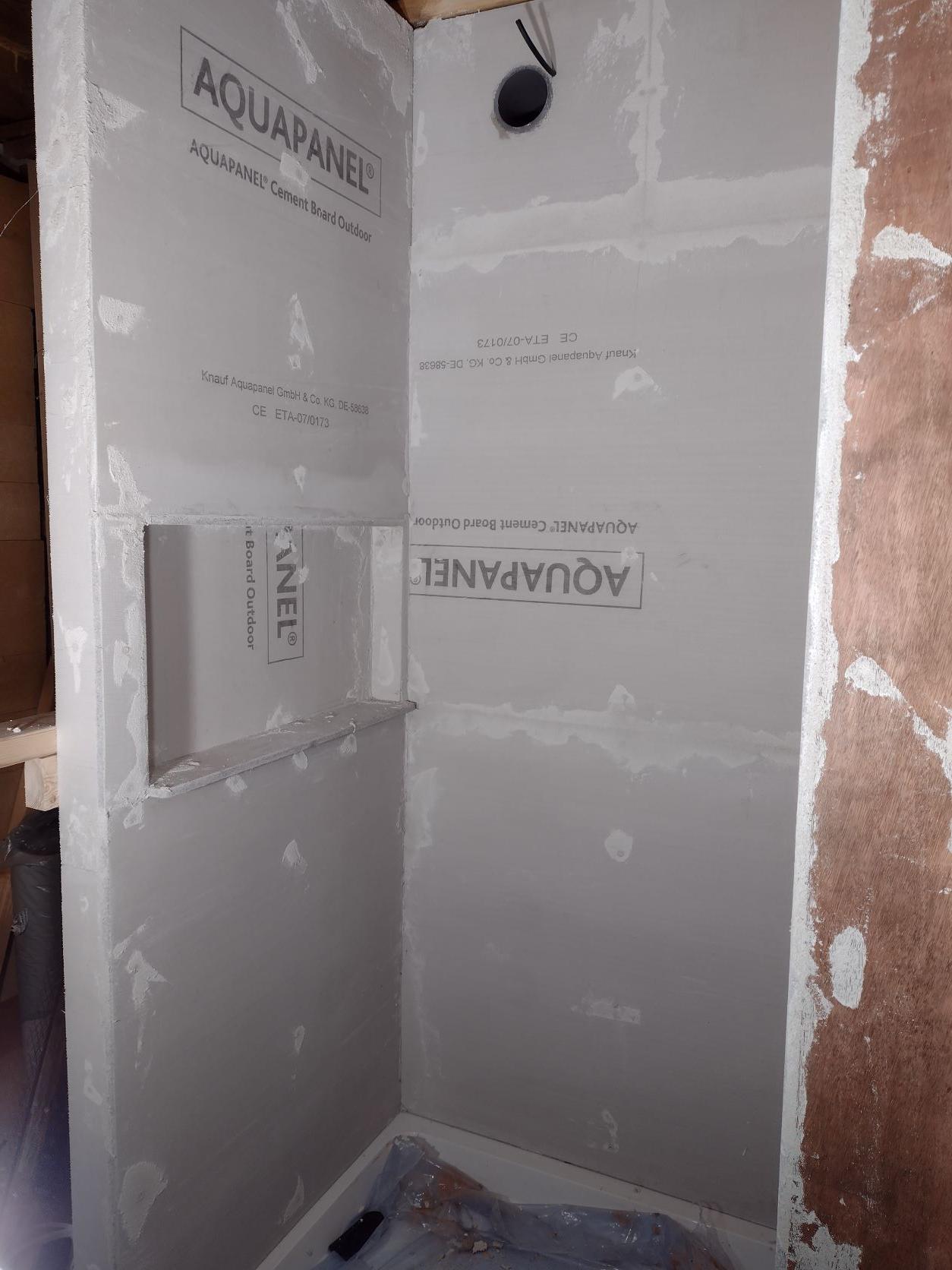
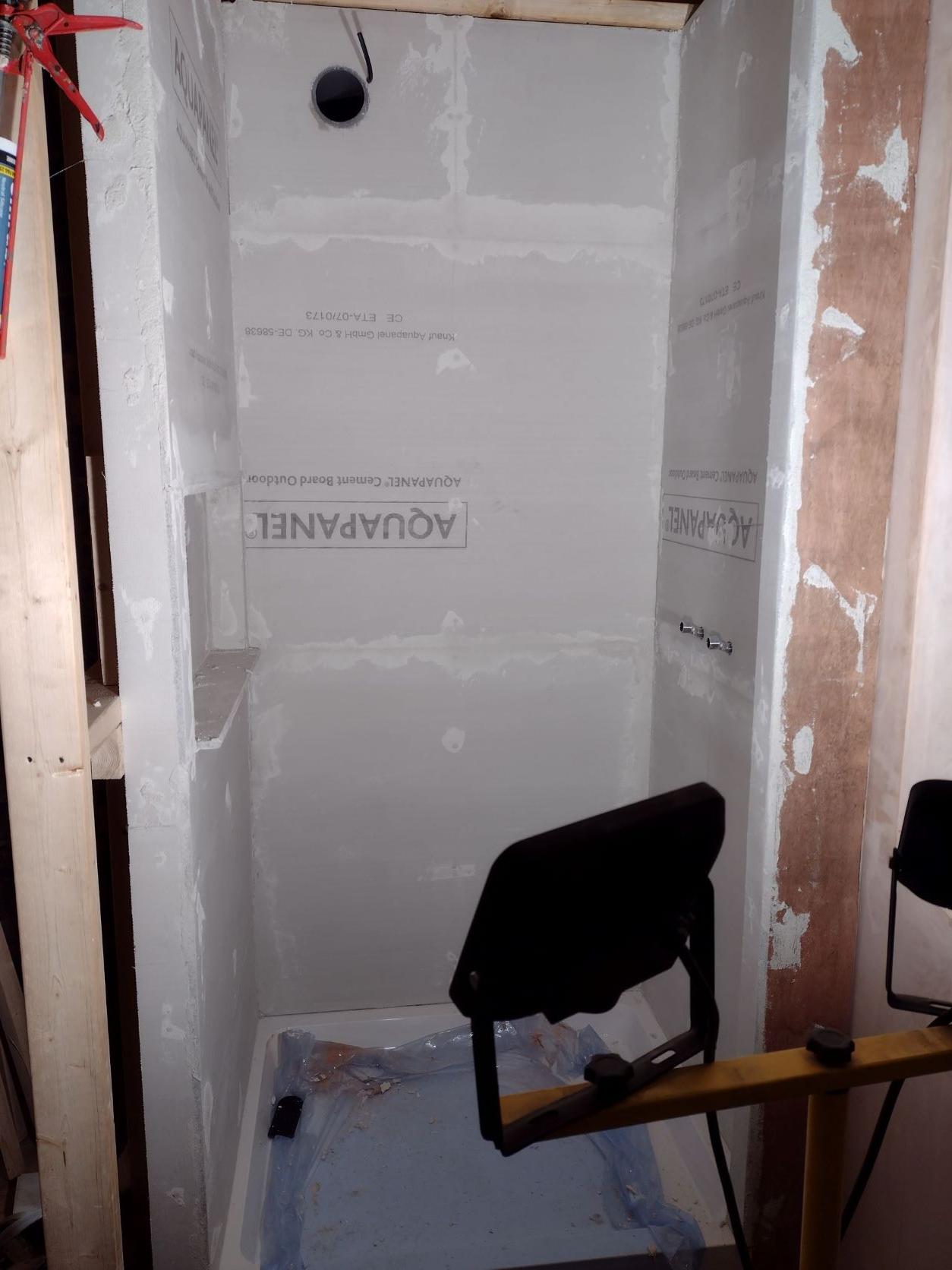
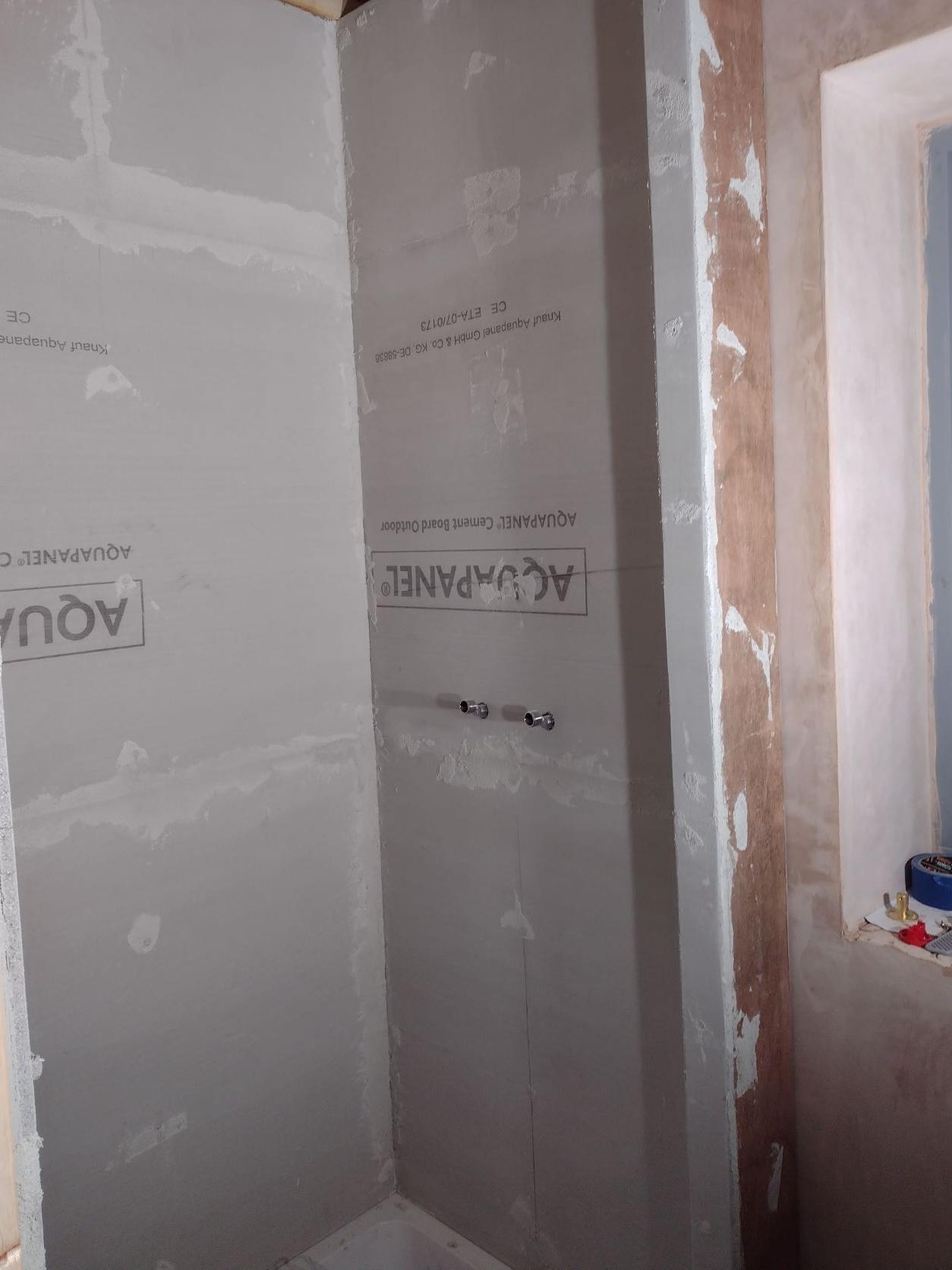
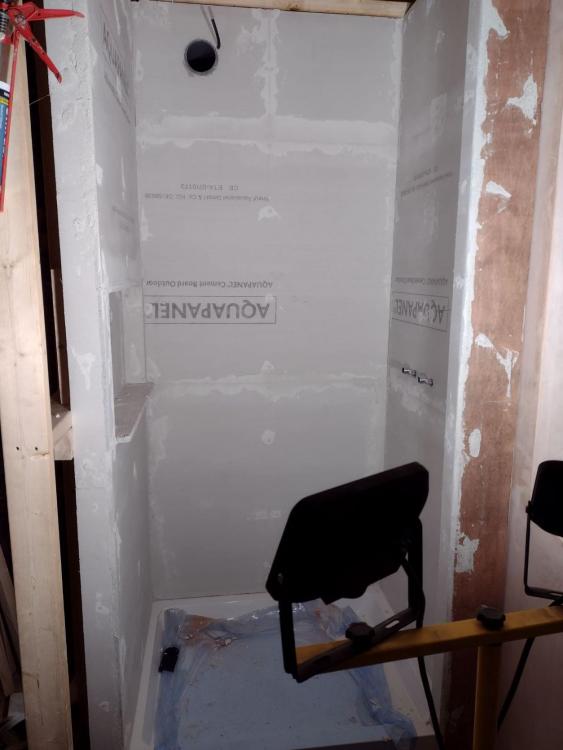
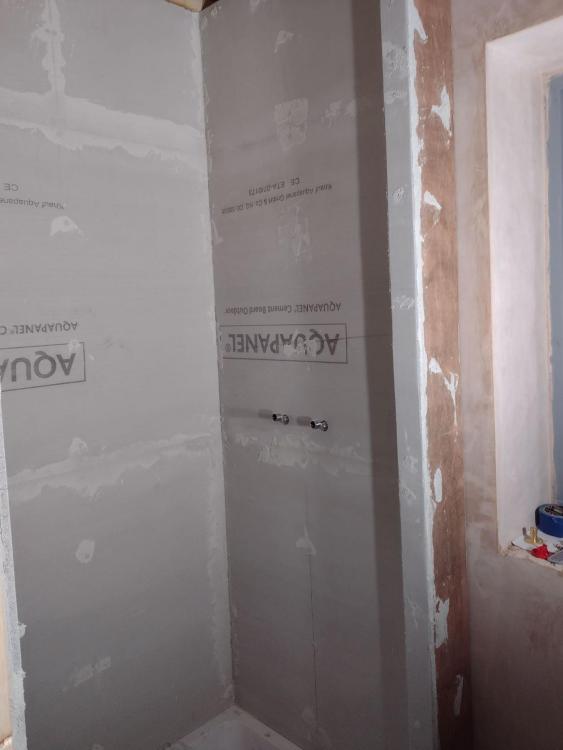
I've just started with microcementing a shower now. Decided to use an ensuite for the experiment so if it goes wrong, nobody's really going to notice Here are photos of 1st stage - boarded with Aquapanel Outdoor as the base because I had 3 panels knocking around, but you can use plaster and skim, plasterboard, and even plywood as the base. At this point I've just filled the countersunk screw wholes, joints and gaps with the microcement base coat. Nothing out of the ordinary just recording the steps for anyone interested. Tomorrow will be sanding it all down and then hopefully applying basecoat and mesh.
-
Problems with Baumit.com thin coat render system - part 3.
SimonD replied to ProDave's topic in Plastering & Rendering
I don't blame you. I'd have thrown all my toys out of the pram with them by now. It's simply not on. -
I couldn't agree more. That's where the value comes from in terms of an architect. Ours certainly had his failings but he also made a lot of comments about what to specify and what not to specify that have born out to be absolutely spot on. Many of these comments were also based on his experience that once a customer actually sees the space, then they want and need the flexibility to change the designs and if you've detailed everything too tightly, it'll cost ya. What I do think needs to be detailed very well are the structural scheme and the building envelope.
-
I think this counts for quite a lot of building physics, much of which is still being investigated and not fully understood - just look at research into hygrothermal performance of building envelopes, for example. Basically, you just have to proceed on the basis of best current knowledge but be careful to separate the wheat from the chaff with good quality research and studies because as I've found, there's still a lot of myth and misunderstanding out there which is assumed to be evidence based truth. I was in your very situation 5 years ago where I thought I understood much more than I did, only to have found recently many of my assumptions were based on a lack of knowledge and understanding. I now tend to go straight to the research and horse's mouth so to speak as it often takes years for this info to filter out into the world, let alone be accepted and used. What specifically have you found out that's troubled you?
-
Don't count your chickens yet - you know the old maxim that if you don't ask you don't get ? If you have such considerable equity and your history is impeccable, discussions with the underwriter, even through what appear to be intransigent lenders can pay off sometimes. I know, because I've negotiated mortgage lending for myself from a lender who wouldn't normally touch self-build with a barge-pole. Are you also dismissing the idea of exploring an equitable charge? I suspect the problem you might always come back to is point 2 of your OP as any mortgage based lending will need to pass those tests - ridiculous as many of them might be! I quite like @Ferdinand suggestion of getting PP in the garden ? (I'll run away now too!)
- 31 replies
-
- 2
-

-
- equity release
- second charge
- (and 2 more)
-
I don't fully understand the legal ins and outs of it and it was a few years ago, but as a general overview it was first about approaching the restrictive lender to obtain a consensual agreement on the basis that there was significant equity in the property and also a bit of leaning on the argument that the restrictive clause may be unfair and unenforceable in any case. However, this situation may very well have changed due to current accepted practise and case law, which might be why equitable charges have grown in use. Sorry I can't be more helpful on this point.
- 31 replies
-
- 1
-
-
- equity release
- second charge
- (and 2 more)
-
Have you taken legal advice on this? I know someone who was able to put a 2nd charge on a property regardless of the first charge having a clause in the agreement not to allow this. I think there is also now something called an equitable charge which doesn't provide the 2nd charge with the ability to force a sale of the property.
- 31 replies
-
- 1
-
-
- equity release
- second charge
- (and 2 more)
-
Thankfully Protek do cover caravan contents as part of their self-build policy. The additional premium is actually not too much money in relation to the whole policy cost. As for seperate garage contents, I've also found it a difficult process. I used to have it included within a normal house building and contents policy through a more specialist broker as many standard policies don't cover separate garage contents particularly well. However, that doesn't cover us any more due to the house not existing as it did so policy lapsed.
-
Our architect did everything with paper and pencil, but these were young'uns brought up on newfangled tech called CAD.
-
It's good you found some people to help you. I ended up having to learn all about it myself and modify the designs myself to take this kind of thing into consideration. I've come across so many examples now of registered architects not being up to speed on technical detailing required beyong building regs for energy efficiency, which is one area where I remain highly critical of my architect and several others I've met. One architect with whom I discussed efficient wall buildup systems said to me that the industry moved so quickly with these things, they simply don't have the available time to keep up with it - shocking.
-
That's definitely the common wisdom of this and a rule I used to follow. However, surprising as it might seem, I've broken almost all of these rules with our current temporary site electrics. Different ring mains, 2 breakers and many, sometimes multiple extension leads. Surprisingly my TP-link mains extenders work amazingly across my whole site, and seamlessly too. I have no idea how it's all worked so well. The only rule I haven't been able to break is the surge protector.
-
How to keep Exposed Frame Dry In Winter
SimonD replied to bob the builder 2's topic in General Structural Issues
I was in a similar situation just before the first COVID lockdown. I boarded and covered the roof with temporary membrane and then wrapped the timber frame in tarpaulins as I had months to wait for some materials. However my frame got very wet before I got a roof cover on and that's just expected. The effort you go to will depend on the work schedule and the tf wall buildup - i.e. is it a standard wall with sheathing on the outside or reversed with sheathing on the inside. -
What's the highest temperature rated paint available?
SimonD replied to Oxbow16's topic in Stoves, Fires & Fireplaces
That's not a paint, it's a lubricant. I'd hazard a guess it's used on the calipers and maybe between the disk and hub on disk installation (to prevent the disk from rusting to the hub). -
What's the highest temperature rated paint available?
SimonD replied to Oxbow16's topic in Stoves, Fires & Fireplaces
Nope, you definitely don't want paint anywhere near your brake disks ? Brake caliper paint only goes to 300-500 C. I don't quite understand why you'd want to paint internal parts of a stove but you can get lots of types of stove paint. Not sure how well they work, mind you. Have you measured the actual temperature? -
Yes, pretty much, but there are also other benefits. Having an architect talk to suppliers and manufacturers means you get an answer. E.g we have an unusual 1st floor design with 2 sections of curved roof. We could get quotations to decide on the structure - e.g. steel frame/glulam frame/hybrid steel frame plus glulam - via architect whereas these companies simply wouldn't talk to us as self-builders. This may be the same with an AT, I don't know but there does seem to be a difference with companies when dealing with an architecture practice.
-
I think there is some confusion here about what glues are what. The D4 category is simply a durability category for interior areas exposed to frequent wetting, or external use. What you need is a polyurethane glue that expands within the joints of the boards as well as at the joist board connection. The D4 everbuild glue linked to doesn't do that. @nod suggested the Caberfix. You can also use the Soudal 30min or 5min PU wood glue, which also gently expands. example PU wood glues: https://www.ironmongerydirect.co.uk/product/soudal-trade-30min-d4-pu-wood-adhesive-290ml-clear-737362?vat=1&shoppingxp=true&msclkid=591dab1002551015fd7acaade429e924&utm_source=bing&utm_medium=cpc&utm_campaign=Shopping > Top Products&utm_term=4580909046907901&utm_content=Top Products https://www.toolstation.com/30-minute-polyurethane-wood-glue/p52489
-
We initially employed an Architectural Technologist who presented a number of design suggestions, none of them worked for us as they were very unimaginative. None of the ideas would provide us with the functional family space that also gave us a design that inspired us as a place we wanted to be in and spend the money developing. Because we were starting off with a bungalow, all the AT did was set in his mind we needed a loft extension. We live in an area where the planners are very particular because of its world heritage status and Georgian architecture and this AT was just too worried about the planners. We sacked the AT after a very frustrating 6 months of messing around with ideas only to meet with an architect who within a week sent a scanned sketch of his proposed design that would transform the house in exactly the way we wanted, giving us a full two storey house with loads of space. Then we discussed the planners and he listed all the design elements he would add to the planning application that would distract the planners enough to ask for changes to the application that wouldn't impact our designs very much, if at all. And because he understood the nature of the local architecture, he was able to talk with the planners to explain how our design incorporated influences from the historical nature of the city in such a way as to complement existing architecture. Our application did go to planning committee but he presented at that committee and the application flew through. From a design perspective, our architect got it spot on and he suggested ways in which we could use the landscape to enhance the house. We are on a fairly steep slope and he designed the house upside down so that we have a bridge going from the living area straight to the level of back garden, for example. The design also fully takes advantage of the views we have over the valley, which the AT never even considered. So the architect considered the context of the design. One very interesting thing I noticed recently was that the asymmetrical design of the house means that the windows follow the shape of the landscapoe they're looking out on - which makes the space much better to be in. Design wise, I wouldn't hesitate to use an architect again. From a technical detailing perspective, however, he was incredibly frustrating, but if you use an architectural practice, you should be able to get someone onto the detailing.
-
It must be difficult being a contractor in these situations as you're at the front end. What helps even less is that official figures seem to be contradictory. ONS Construction Output figures suggest annual price inflation up to September of just 5.5% for all construction work, 7.8% if you just look at new build. Then there are figures that show forecast contractor tender and price inflation of just 2.7% for the next year! Somebody clearly hasn't left their office in a while. Clearly something is going to come out in the wash as some point soon, probably about 3 months before the government finds out about it.
-
+ 1 @ToughButterCup's suggestion. If there is one thing I've learned about architects over the last few years is that they do tend to learn an eye for design. What I mean by that is proportions and relations between elements of a building which often subtle are nevertheless important in the end result. Many, although not all, will also have a good sense of how space functions and thus how to take that into consideration in the design too. I grew to despise my architect, and thus the rest of the field, at one point in the project, but I now have to say that many of the things he drew into our plans, as well as his suggestions have come to pass as absolutely spot on - I merely didn't understand, or couldn't see/imagine what he was on about at the time. One specific example is that I had another architect visit to look at our build who remarked that the building hasn't closed in as we've completed the fabric. She said most buildings feel much smaller once you close it up, but our doesn't somehow. Similarly, as we've added all our partition walls, the space actually feels much bigger that when it was open so we've got an additional sense of space. All the room proportions work perfectly for what they need to do - this is entirely of our architects design. Also, don't close down your decisions right now in terms of fit out. E.g. luxury vinyl tiles are not necessarily cheap from high end suppliers like Harvey Maria - and with flooring, cheap usually means cheap - but you might find that as you move through the build and see the construction in reality, you'll want to deviate from those decisions. A decent architect may be able to guide you better at the outset.
-
I think as @epsilonGreedy and @Gus Potter have said, don't count your chickens yet. I'm building on clay and we decided not to go for complete new build but use a large proportion of the existing bungalow for several reasons - time will tell whether this was a mistake financially. The biggest pain has been dealing with existing structure that isn't square, true or plumb, so I've been doing a lot of swearing. Our bungalow was built in the late 1920s and the existing foundations are in some cases as little as 150mm deep and about 450mm wide in some parts they are as deep as 1m. We've added a complete story plus infill extension and the total weight of the new build is less than that of the original roof that held concrete tiles. Structural engineer dealt with some point loads using pad foundations where necessary. I suggest you first look at designing what you want and then consider which way is best to achive that, extending existing or knock down and rebuild.
-
Also requires free air ventilation within the room and some of them have a maximum daily duty cycle due to products of combustion and catalytic converter. If you must go down the gas fire route, then possibly consider a balanced flue freestanding fire, which you can get.
-
Problems with Baumit.com thin coat render system - part 3.
SimonD replied to ProDave's topic in Plastering & Rendering
I have to say I concur with you, @saveasteading and @Gordo that it's most likely external moisture ingress and that microcracks may be playing a role. If your render is going through thermal shock while damp then it's got to be possible that the freeze-thaw expansion and contraction causes microcracks which let in more moisture over time. Having looked at the technical manual from my wood fibre manufacture, Schneider, I also suspect that movement in the timber frame plays a role here. Schneider wood states that their silicon resin plaster, similar to Baumit's sillikonTop, only has ETICS approval when the boards are fitted onto a masonry substrate. The alternative top coat is a mineral final render which appears to be fine on timber frame. They also recommend the application of a final levelling coat of silicon paint for extra weather protection on top of the silicon resin, or as the final coat on the mineral render final coat. This is quite different to the buildup used by Pavatex/Baumit and the now defunct NBT which is on your wall. It may be that, as already suggested, trying a final layer of protective silicon paint might help, but obviously damage has already been done. -
I would build a shelf unit that hangs on french cleats fixed to the metal studs using Tek screws. French cleats are brilliant for hanging cabinets and shelves on stud walls.
-
Problems with Baumit.com thin coat render system - part 3.
SimonD replied to ProDave's topic in Plastering & Rendering
Lime Green has now developed a pure lime render for Woodfibre. One of Weber's products is also suitable for Woodfibre but with the caveat that Weber uses local aggregate so mixes do vary slightly depending on region. I suspect your best long term solution may be to look at adding a rainscreen so battening, cavity, render board, render. Your problems are very similar to those experienced in Norway, Finland and west coast of Sweden with premature ETICS failures. -
I think that may very well be the case if your last open heat emitter can't radiate sufficient heat and your boiler can't modulate down far enough. Anscillary to this discussion I think a major problem lies in how we combine heating and hot water. For example, looking at gas boilers for my current build (we've run out of budget for Air to Water HP right now), if I'm to size output for reasonably fast DHW recharge, then the boiler struggles to modulate down its CH output low enough for normal house heat demand. For example, I have a calculated load of 5.8kW calculated at the standard -3/21 with half the house at -3/18. A Baxi 18 or 24kW system boiler can only modulate down to 4.9kW at 50/30 or 4.5 at 80/60. It's better with an Ideal Vogue as I could go 15kW boiler modulating down to 3.0kW. But for some of the year, it's likely going to be cycling more often than I'd like. At the moment, I'm sorely tempted to look at separating the CH and DHW systems in some way. E.g. a gas water heater and air-to-air heatpump, but that may have to wait a few years until budget allows.