SimonD
-
Posts
1943 -
Joined
-
Last visited
-
Days Won
10
Everything posted by SimonD
-
Good question. It retrofit circles airtightness is claimed to be the first low cost biggest bang for buck improvement followed by insulation. On new build, BRE suggests airtightness accounts for about 10% heat loss. I've seen other figures suggesting 15-20%. Energy Saving trust puts a figure of 30% losses down to thermal bridging. However, countries like Sweden put airthightness at the top of the list in terms of importance for energy efficiency - it's first design for airtightness then insulate. I don't think the overall heat loss is 'just' down to the heat capacity of the air but how that movement of air impacts thermal loss of all elements - we know how much eliminating convective currents within insulation layers improves energy efficiency for example. Like with everything, it's got to be a balance of what is done to what extent and for what cost?
-
Hmmm, would be interesting to have a larger sample size of average normal family consumption rates. I've just noted our first 'normal' month on all electric using induction hobs, excluding DHW and minimal EV (daily average 0.57kWh) due to holidays and we've used a daily average of 12.29kWh for 31 days. Tumble dryer has only used 0.52kWh/day average. We do cook and bake a lot but I'm wondering if this is high for a family of 4. Must get some individual energy monitors on the circuits to see where exactly it's going.
-
What is considered to be short cycling
SimonD replied to Johnnyt's topic in Boilers & Hot Water Tanks
I reckon you need to check the configuration of the system. Has it been installed for priority domestic hot water? If you're going to run lower flow temps on the ufh you'd be much better of with this setup. PDHW means that the boiler runs at two difference flow temperatures - a high temperature for your uvc to get to temperature quickly and a lower, variable temp, ideally modulating/weather compensating for the heating system. Also look at the balancing of the system - what's the flow and return temperature across your heating system? Unfortunately not a lot of installers understand this this stuff let alone set the system up properly to do this ☹️ Without the separate temps, you rely on the same flow temp to heat both your uvc and heating system which can lead to this kind of problem. -
Where is the kWh price heading in 2022?
SimonD replied to epsilonGreedy's topic in General Self Build & DIY Discussion
The problem is that there are no transparent figures and the /kWh prices vary by region. OFGEM doesn't even provide these figures referring people to their regional supplier. Everyone quoting their figures on here only applies to their region so it's not like comparing like for like. -
I think that at about £110 per month it's close to the going rate, but insurance rates do seem to be going up recently. The Protek one at least is an all risks policy with pretty comprehensive cover, including material theft, owned tools and plant, plus the rate for adding hired in plant is very good. Mine even covered the caravan if it got squashed. I'd call them.
-
No, the wood fibre insulation board referred to by ecomerchant is a different product compared to the between rafter wood fibre bats. In this case, blown cellulose is by far the better option. The high decrement delay woodfibre boards are those that are usually installed above the rafters and form a sarking so you end up with a hybrid warm roof - very good for reducing repeated cold bridges too.
-
How to decide between ASHP or Gas boiler for New Build
SimonD replied to Meabh's topic in Air Source Heat Pumps (ASHP)
I can't speak of the technical programming of the heat pumps themselves, but I think there's a big difference between what should be done and what is done in the market. To design a heating system using a heatpump or a gas boiler is exactly the same process if you want a properly designed heating system. As follows: calculate heat loss calculate hot water demand calculate total heat demand size heat emitters based on design temperature drop of the system and flow/return temperatures select your heat emitters based on heat factor and pipework emissions (this also varies depending on radiator connections) calculate system flow rate including pressure drop and flow velocity size pipework and pump accordingly (with heatpumps this might include the buffer) The differences between your fossil fuel boiler and heatpump is largely the flow/return temps and temperature drop across the system (which can be managed using a buffer in heatpumps) and thus flow velocity and rate. Using this method it's a fairly simple process to future proof the heating system for upgrade to heatpump in the future. The problem as I see it is that most installers doing gas/oil, don't bother to do these calculations, using rules of thumb instead which can be totally random. But with these systems you can get away with it because you just chuck in a big engine. Not so with a heatpump. I reckon if we rejigged all the existing fossil fuel systems we'd manage to save well in excess of 15% of gas, if not a lot more and have decently heated houses. Talk in the industry appears to be edging towards hybrid heatpumps using small heatpumps added to existing fossil fuel boiler or new hybrid boilers as a transitional phase. -
Renting a garage for off-site storage?
SimonD replied to puntloos's topic in Project & Site Management
Also beware any warranty or quality problems. Suppliers won't give you support for any problems if there's too long since you bought it and you could be out of warranty by the time you install the stuff. I bought loads of stuff just before Brexit. Yes, I saved myself a fortune compared to today's prices with some items, but on the other hand I've now spent a couple of years working round stuff and it's actually got in the way of getting things done and finished. It's a difficult balance. -
Oh dear, bang goes the sustainability claims on that one then!
-
Yes, it does rather look like that. I wondered whether it was a disguised whole population jailhouse or a massive extension of foreigner compounds. One of the image mockups in particular looked like they'd taken a scene from Bladerunner and plonked a load of trees on the balconies and bridges. I also like how imaginative the architects must have been when making sure the project "will contain residential, retail and leisure areas as well as schools and parks." You'd hope so wouldn't you.
-
ASHP, Just an outdoor fridge ?
SimonD replied to Post and beam's topic in Air Source Heat Pumps (ASHP)
Well, to matters even more clear to the unitiated, the guy running the heatpump training moved on to explain that a heatpump pump makes heat 'run up hill' compared to the normal process of heat rolling down a hill from hot to cold. That's definitely the reverse cycle, but I can't help but imagine a scenario explaining to a customer that it's a refrigerator that chases heat up the hill using what's in effect a powerful water gun. I wonder how many customers would sign you up then 😁 -
ASHP, Just an outdoor fridge ?
SimonD replied to Post and beam's topic in Air Source Heat Pumps (ASHP)
Funnily I've just been watching this series on heatpump design on the Institute of Refrigeration website: https://ior.org.uk/heat-pump-design-course The guy running the training says in the introduction. AND NO..a heat pump is NOT a reversed refrigerator. • IT IS a refrigerator. I suppose that clarifies things except a lot of people might think it's going to make their house cold...... -
How well do you know the installer? I guess you've already had discussions about the extent of works? My concern is that there are a few areas open to interpretation that could allow shortcuts to be taken. For example, 'prepare walls reading for tiling (special plasterboard...) and 'prepare floor for tiling (boards etc.). I once had an installer lay plywood as the bathroom subfloor on top of exiting floorboard saying it was a great job only to find that once he'd gone, the floor flexed as he hadn't bothered to screw done the plywood at the required 100mm centres as specificied by the floor product manufacturer and the plywood should have been thicker. He also bent the plywood over a dip in the floor instead of filling it. Within 6 months we had to get it all re-done. I would re-look at the specification of works to make sure there is no room for interpretation, providing specs. of the subfloor and even the type of plasterboard you require as the substrate for tiles, bearing in mind you might need to take into consideration the weight/m2 of the tiles on the boards. Is plasterboard the best option or could a fresh plaster and skim suffice instead? I would personally be inclined to specify the overall wall and floor areas for tiling - e.g. is it just the sink splashback, half wallheight around sink/bath, full wall height somewhere else? Also, don't give your installer the cart blanche freedom to buy materials for re-imbursement, define a controlled process of request, approval and purchase that gives proper oversight and works for all of you.
-
Oh dear! Sorry to hear that. As a product and material, I've come to really like it. Time will tell as to longevity.
-
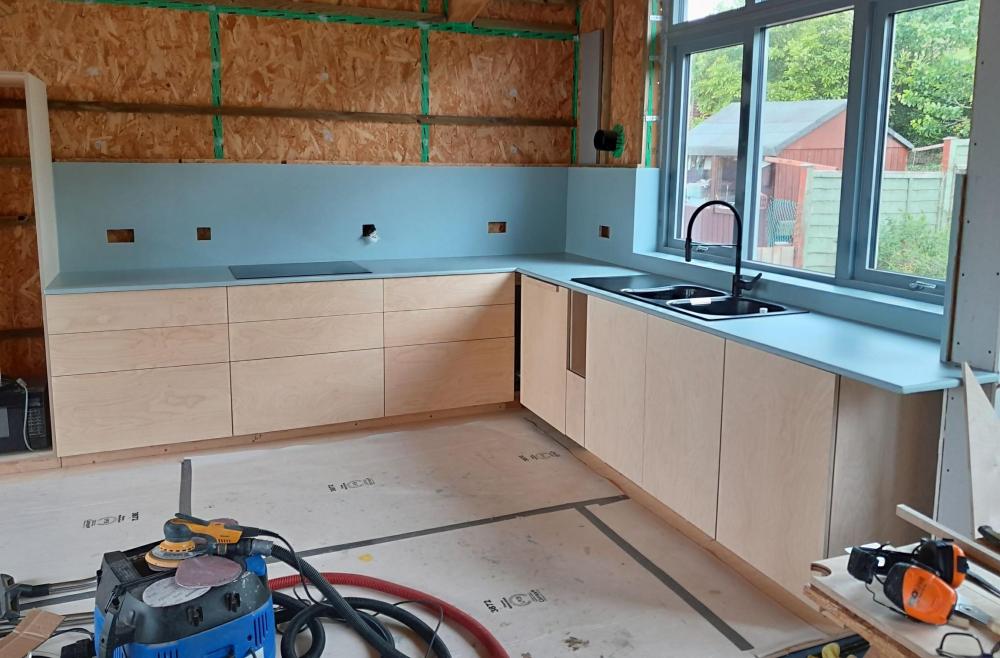
So far I'm happy, but do bear in mind that I did the installation entirely myself. I've now done one shower and the kitchen worktop/splashback. For the actual microcement I paid a couple of different prices as the system varies according to toughness and area of application. At current prices the system for shower/wetroom cost £29.50/m2 for 10m2 kit and the system for the kitchen worktop was £41/m2 again for a 10m2 kit (plus shipping which as it's heavy works out at about £65). The shower has had regular use for about 6 months now and is as it was when installed - as you'd hope! 🙂 Kitchen worktop has seen regular use for nearly 3 months. Neither long term test yet. The only slight annoyance I've got is that the worktop kit says it's completely resistent to stains from just about anything. It seems to do this but when cooking with turmeric, if it sits on the worktop for a period of time I have to scrub it off the surface rather than just wipe it off like with everything else. Once scrubbed, there's no sign of it so it doesn't actually stain. I do wonder whether I applied the final coats of sealant slightly too thin because there is a fine texture on the surface which I think the turmerice gets into. When I get the chance, I have enough left over to apply another thicker final coat of the sealer. Nothing else touches it so far. Service I have to say was very good. When I started laying the microcement for the kitchen the base coat came out very blue, and so did the first of the top coats. I contact the supplier with some photos and within a day they'd shipped out a replacement topcoat kit with a corrected pigment. I've uploaded a photo of the worktop with integral splashback and window sill - still looks blue in the photo but it's actually a silver grey that takes on a slightly blue tone under certain light conditions and the bare wood in the house also makes it look more blue that it really it. Apologies I can't help more with installers but I bought my stuff from Relentless Microcement and bought the professional kits rather than diy kits. If you want to tackle the job yourself they do provide comprehensive instructions and training videos. Otherwise perhaps get in touch with them to see if they have a network of known installers, possibly worth a try? I think the cost of microcement installation is because it needs several layers with time in between each coat which means lots of curing time and return journeys for the installer. I've found that if you follow the proper curing times it ends up taking about 6 days in elapsed time with daily applications that take anything from only 1/2 hour to 3 hours only.
-
Moving from self-build insurance to standard house insurance
SimonD replied to jamieled's topic in Self Build Insurance
I recently moved from self-build insurance to a specialist home insurance policy. The sb insurance had become overkill in terms of both extent of cover and premiums, so the home insurance was a better option. I used Towergate as I've used them over the years for numerous policies. I simply explained what was left to be done, how long it's likely to take. No problem at all. There are just some clear exclusions to cover when using contractors and subbies who must hold their own insurances. They were mostly concerned that the structure was complete and watertight and this phase had been signed off by BC. Personally, I'd just explain where you are to the insurer and see what they come back with - always better to be upfront rather than risk voiding an insurance policy, and also check the requirements made by any lender. -
Or as per the above linked paper: 3.4. Critical storage volume The critical storage volume to satisfy 100% solar fraction using different thermal energy storage technologies can be estimated based on the energy densities given by literature (Hadorn, 2008), which estimated the storage volumes required for a storage capacity of 1850 kWh with 25% heat loss were 1 m3, 10 m3, 20 m3 and 34 m3 respectively for chemical reaction storage, sorption storage, phase change material storage and water sensible heat storage. Take the moderate overall heat loss coefficient at 150 W/K as an example, the critical storage volume using sorption storage is 31.5–44.3 m3 in all studied cities. Critical values of using other storage technologies can be proportionally calculated according to the data provided by literature (Hadorn, 2008), for example, if using water as the storage material, this storage volume should be in the range of 107.1–150.62 m3. Nevertheless, in reality, the energy density of SSTES system depends on the system structure and scale, some experimentally tested energy densities of SSTES prototype and corresponding critical storage volume are shown in Fig. 5. Download : Download high-res image (175KB) Download : Download full-size image Fig. 5. (a) Energy densities of SSTES prototypes, the number besides the dot symbol is the prototype system scale in unit of kWh; (b) corresponding critical storage volumes. β = 45°, γ = 0°, = 150 W/K. Storage technology: 1. Hot water in pebble-bed storage (Hahne, 2000); 2. Na2HPO4·12H2O supercooling latent heat storage (Hirano and Saitoh, 2007); 3. Closed SrBr2-water sorption (Mauran et al., 2008); 4. Open SrBr2-water sorption (Michel et al., 2014); 5. Closed LiBr-water sorption (Zhang et al., 2014); 6–8: Closed LiCl-water sorption (Zhao et al., 2016, Bales, 2008); 9: Open MgCl2-water sorption (Zondag et al., 2013); 10: Open vermiculite-CaCl2-water sorption (Aydin et al., 2016); 11–14: Closed zeolite-water sorption (Bales, 2008, Finck et al., 2014, Hauer, 2002); 15–17: Open zeolite-water sorption (Bales, 2008, Weber et al., 2016); 18–19: Closed silica gel-water sorption (Bales, 2008); 20–21: Closed NaOH-water sorption (Bales, 2008). Current results are based on the situation of 100% solar fraction for domestic heating with 21 °C room temperature all through a year, which might not be practical; however, these results can be used as baselines or fundamental database, then the SSTES system performance with lower solar fraction or shorter space heating period can be reasonably estimated.
-
The fact that there are few UK examples is not a testament as to viability but to lack of trial and experimentation, but certainly not non-existent. There are several ways to skin a cat not all using PV. Cost is seen as one of the major problems. UK Energy Research Centre looking a typically larger installations highlights cost as per below but also as always with any UK based implementation, that of poor quality housing stock https://d2e1qxpsswcpgz.cloudfront.net/uploads/2020/03/the-future-role-of-thermal-energy-storage-in-the-uk-energy-system.pdf : Large inter-seasonal stores are only sized for a maximum of a few hundred buildings for reasons of cost and financial return. A strong relationship exists between store size and cost, ranging from about £390/m3 for small tank-based systems (volume around 300m3 ), to about £25/m 3 for large pit-based systems (volume around 75,000m3 ). This paper looks at viability for the domestic sector with smaller stores which I mentioned earlier: https://reader.elsevier.com/reader/sd/pii/S0038092X18300227?token=5BD4A1BEF09BBCA25643BC6D4E463AF9F4E62D5E237FA1297528B54D444AC895E251123C4D173A481F64C939A73E7ADF&originRegion=eu-west-1&originCreation=20220711123502 I'm sure you'll relish in the numbers 😉😁
-
I have a copy of Solar Houses for a Cold Climate from the 1970s/early 80s that demonstrates it is possible. Many of the cases studies are in worse climates that the UK - but there are significant climate differences related to annual insolation that play a factor for the UK. Here's a link to archive.org where you can read it after registration: https://archive.org/details/solarhousesforco0000carr/mode/2up With a large enough solar array, it is certainly possible. I once had a reference about a house built in the UK that has a roof designed as a large solar collector - can't find it now. I also came across a recent paper through google scholar on a study looking at total roof area required to do this in the UK and it wasn't silly amounts - again can't find the link right now due to switch over of laptops a little while ago.
-
Your architect sounds amazing and has some very interesting ideas here. Insufflation basically means to blow into something so it is a fan assisted system, possibly a positive pressure system. The drawing of air from ducts under the building could provide you with a very effective natural and low cost summer cooling system - I'm regreting not installing this ducting under my house to feed cool summer air. I assume she's designed some type of vent at the top of the building to create a stack effect to exhaust hot air from this system. I actually have a book published around the mid 1800s that details similar designs. How well the pre-heat system under the the solar panels would be, I'm not so sure. The additional note about the natural insulations is that while you do have the 'scientific' calculations to go by which include decrement delay and moisture transport, the quality of the feel of the indoor environment is so much better with a well designed and installed natural insulation system than one using synthetic materials. IMHO....
-
As has already been mentioned there's no specific qualification needed and plenty of people on here have done it. Split or air-to-air would require f-gas and then you'd need an electrician. Beyond that, you may want to check the manufacturer's warranty requirements if that's a relevant consideration for you. The other side however is that you do need some good knowledge about heating system design and as I've recently found, it's sometimes even more difficult to access that knowledge than it is finding a good installer in the first place.
-
Okay, so just to stoke up a bit of emotion here, I think on the face of it, it is poor. They don't appear to have thought about or questioned your brief, just plonked an additional kitchen diner on the end of the house. I think the bedroom layout is a bit ropey too. I'd reckon you need to step back a bit from your brief and ask yourself how you are going to use the space and what you need from it - from a functional perspective. Do you have a family? Is your family young or old? Are you planning for this house to be a family home or are you wanting it for older age and/or for a couple who wants to have space for guests? Some of these questions are likely going to feed into the design and how it works. For example, if you have a young family, the existing layout could work really well because you are going to want to have a seperate space to get rid of the kids and the kids stuff (possibly into the front lounge) when you want some piece, tranquility and tidyness when you want to chill out. Same thing with the utility - yound family with children means a great demand on washing an laundry etc. so a generous room is a great thing. But at the same time I think that the open plan dream can turn into hell on earth with a busy family because of noise and disturbance too - just think someone cleaning up the kitchen and making a load of noise while the other is watching something on tv. Did your architect actually visit the site and sit down with you to understand you as a client? This could yield alternative and more efficient designs that might work better. The whole thing needs a tad more thought IMHO, then consider designs and subsequent likely budget. For 150k, don't even think about knocking down to rebuild.
-
Is it time to move to a fixed price tariff
SimonD replied to JohnMo's topic in General Self Build & DIY Discussion
MSE has a regularly updated section on when it's worth fixing or not: https://www.moneysavingexpert.com/utilities/-are-there-any-cheap--fixed-energy-deals-currently-worth-it--/ -
Starting a 40 year old generator, not ran for 20 years.
SimonD replied to ProDave's topic in Boffin's Corner
Where does this still connected pipe go to on the engine or does it simply vent to atmosphere? When you took apart the tap originally was there any sign it could be a vacuum or pressure mechanism? -
Starting a 40 year old generator, not ran for 20 years.
SimonD replied to ProDave's topic in Boffin's Corner
Yes photos please. These Honday gennies are almost always fixable...when they need fixing. I've got an old one I bought nearly 20 years ago that was second hand even then. Still starts every time.