SimonD
-
Posts
2215 -
Joined
-
Last visited
-
Days Won
13
Everything posted by SimonD
-
How to measure the remaining HW in an unvented cylinder
SimonD replied to Adsibob's topic in Boilers & Hot Water Tanks
Yes, that's certainly an option. I have to admit that I initially incorrectly assumed the huge Grundfos circulator was in part for a large rad circuit. -
How to measure the remaining HW in an unvented cylinder
SimonD replied to Adsibob's topic in Boilers & Hot Water Tanks
Given 2 major things: 1, you typical lifestyle and usage of the system, and 2, the solar gain in certain rooms, I will go against the grain here. So briefly, I'd go down the route of 4 pipe priority hot water with weather compensation BUT retain/or install new room based zoning controls to deal with intermittent use and solar gain. The weather compensation deals with heat distribution through the temperature of the system and the zones by controlling flow. To deal with potential low system volume due to closed zones, the buffer would counterbalance this and reduce short-cycling risks. Now this would mean a compromise when it comes to the towels rads temperature, but they could easily be kept warm for good comfort. There is a trend to opt for UFH as the default but I think there are situations where a low thermal inertia system is more appropriate due to occupancy patterns, system use, and building characteristics and I think this is such a situation, but the UFH is alreadsy installed. It's just to do the requirement for zoning and if you have lots of zonesand youuse then, it's better to have a buffer in there. -
How to measure the remaining HW in an unvented cylinder
SimonD replied to Adsibob's topic in Boilers & Hot Water Tanks
You'd certainly hope so. Here's a link about controls and ErP from the Worcester website: https://www.worcester-bosch.co.uk/professional/support/troubleshooting/faqs/erp-faqs/how-do-controls-affect-erp -
How to measure the remaining HW in an unvented cylinder
SimonD replied to Adsibob's topic in Boilers & Hot Water Tanks
No, I'm saying that every other manufacturer of controls publishes their ErP certification class so as a system designer and installer I can certify the installation properly - with Tado I can't and couldn't without this data and frankly their report supporting efficiency savings they publish on their website is worthless. -
How to measure the remaining HW in an unvented cylinder
SimonD replied to Adsibob's topic in Boilers & Hot Water Tanks
Froma slightly nerdy perspective, I have yet to find an Erp certificate for the Tado controllers. Erp of controllers is important because their functionality determines the overall energy efficiency of the boiler over 89% - therefore if you're installing a brand new system and need to provide 94% efficiency you haven't got the info, you can't actually provide that guarantee whereas with other controllers I've got the certificate to back up the install. -
How to measure the remaining HW in an unvented cylinder
SimonD replied to Adsibob's topic in Boilers & Hot Water Tanks
@Adsibob can you describe the zone setup you have in more detail please? I'm particularly interested in the UFH setup and zoning, where this is and how you manage the spaces with UFH, but also the radiator circuits. I haven't kept up with your retrofit but generally speaking, I'm guessing you have brick walls with added insulation (where? IWI, EWI cavity?), upgraded floor insulation and roof insulation. What I'd like to understand is the level of heat loss in relation to the thermal mass of the building. (Yes, I've used dreaded thermal mass, and in terms of figures, thermal mass = Building element volume x Volumetric Heat Capacity). Also, which rooms experience significant solar gain and how are those rooms generally used? Your stove will also play a role here as you don't want that interfering too much with heating through the rest of the house, as you've mentioned. What I'm getting at here is that I don't always think that whole house weather compensation is the right answer for everyone and every house. With well planned zoning, you can get good results. The problem is the control of this, especially with a mixture of UFH and radiators because they'll behave so differently, particularly where you've got thick coverings. But in terms of controls, I do think that using load compensating combined with weather compensating controls can be used to good effect for improved efficiencies in a zoned situation. In this instance we need to figure out the best way to approach this, and as you've mentioned, whether it it is more efficient than the existing Tado arrangement without modulation. In terms of the difference between load compensation and weather compensation, it is just a different approach to ensuring the heat input to the house matches its heat loss. With weather compensation, it uses outdoor temp (and sometimes other inputs) matched to a curve a closely matched to corresponding heat loss of the house.With load compensation, it does this by measuring actual reference room temperature to target temperature and the better load compensating controls will learn how the room responds to heat input/loss over to time to control heat output of the boiler. As I've been thinking about your system and earlier comments about the low loss header, I wonder whether your installer confused the use of low loss header versus a buffer. Their functions can be the same but from a control perspective, they are different. If you're running a system with lots of zoning, then you use a buffer, not a low loss header and the low loss header can't replace it, because its function is different. So my thoughts are drawn to thinking about whether a buffer can be installed in place of the LLH together with a 4 pipe system for DHW and then turn down your flow temperature on the the boiler. Then, only if necessary look at replacing the tado which I'm guessing has lots of smart TRVs installed through your house too? Just a strawman though at the mo. -
Now he's not going to sleep for a week 😁
-
How to measure the remaining HW in an unvented cylinder
SimonD replied to Adsibob's topic in Boilers & Hot Water Tanks
After saying all of that, I've spoken to technical support and found out the Worcester diverter kit I need for the above job actually converts the boiler to a 4 pipe system. -
How to measure the remaining HW in an unvented cylinder
SimonD replied to Adsibob's topic in Boilers & Hot Water Tanks
Yes, to become an installer all you need is a Gas Safe certificate, or if employed ACS qualification. None of this training covers efficiency in systems and only recently has low temperature system design and wiring controls been included, but at a basic level for sizing boilers only. It's on the installer to train themselves as few of the bigger companies invest the money. But then there is the issue of the marketplace. If I quote for a boiler to be properly sized, set up and controlled, it will cost more than the installer who chucks it in over a few hours and runs off to the next job, all booked online through one of those fixed price cheapo websites that are cropping up everywhere. I was contacted by one of them offering me a fixed rate of £900 for install of boiler and the installation of 9 radiators all while I have to provide vanof minimum age, equipment, insurance etc. - yeah, right! But then you also get those that charge a fortune to install a complex system that doesn't work at all, just like this one I've got to go and sort out. You can't see it in the photo but the installer has put in 3 pumps on one flow pipe from the LLH all teed off a 22mm pipe. Heating is on constantly but relay only and no timers for anything, plus none of the rads work as they should while both boilers merrily cycle away. Oh, and it's all in a garage with no pipe lagging anywhere - the garage is toasty! And @Adsibob thinks he's got problems..😉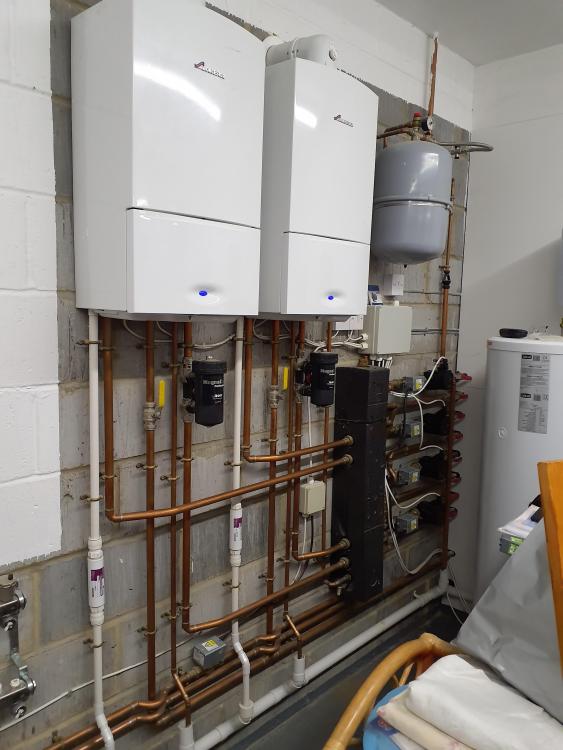
-
How to measure the remaining HW in an unvented cylinder
SimonD replied to Adsibob's topic in Boilers & Hot Water Tanks
A two pipe boiler can of course be set up to do this and you can still gain the benefits from PDHW. The problem with 2 pipe is that many boilers don't provide the functionality to output two difference temperatures as it's all based on CH flow temp. I just installed a Vokera for a customer which seem to be flying off the shelf because the company isn't affected by the CHMM and this boiler had single wire switched live only, not even modulation capability, but the customer just wanted a cheap boiler. Those that do have separate temperature capability, like many Worcester's need an additional diverter valve assembly to be installed into the boiler -not a great issue but most installers just don't bother - and then you need specific manufacturer controls. Likewise with Ideal, there is a switched live you can use for PDHW but Ideal will say that this can only be used if weather comp has been connected, although I do use it for PDHW installs and it does actually work. The Ideal Halo Heat & System controller is set up for priority hot water as is the Honeywell Evohome control that uses opentherm to increase flow temps. This, I think highlights the problem - it becomes quite messy unless the boiler manufacturer specifically supports and promotes the solution. The difference with the Viessmann 4 pipe system is that you do away with the need to install separate diverter valves and pump (except for a cut-out 2 port valve to the cylinder on some unvented cylinders). You can also use the boiler expansion vessel & prv for the unvented cylinder. Controls also get wired directly into the boiler such as the cylinder temp sensor so you can in many cases get away without having to use a wiring centre at all. It all works in an integrated way and less time to install. Control wise, you can simly use weather compensation or if load compensation if preferred, you can use Viessmann Vicare which, because the system boilers have wifi installed, you connect straight to the boiler. But if I want to, I can still use any other controller I want and still have the means to get priority hot water, even if the controller itself doesn't support it. -
You need to use the manufacturer's flue for the relevant boiler. There's no getting around this. The flues nowadays are mostly 100mm with 125mm options in some cases where necessary. It is no major issue to install a vertical flue through a pitched roof so you'll either need to decide on the boiler now, or just get the roof done and then fit flue later when more appropriate.
-
How to measure the remaining HW in an unvented cylinder
SimonD replied to Adsibob's topic in Boilers & Hot Water Tanks
No daft question, but yes, it pretty much is. The internal pump does both duties using an internal diverter that you'd see on a combi. I reckon it's the same hydraulic unit as used on a combi minus the plate heat exchanger and uprated pipe size for the DHW flow and return. The normal intake of fresh water becomes the return from the cylinder. All using the system water. -
How to measure the remaining HW in an unvented cylinder
SimonD replied to Adsibob's topic in Boilers & Hot Water Tanks
So just to go back to my original conclusion that you're in the Tado sphere and may as well just stay there without changing anything and you specifically asked me to suggest a different controller for your hot water. I'm not trying to steer you down that road due to the upheaval required to do so. My statements were more to explain that your system is not doing what you think it is doing, nor probably what you meant for your system to do when you employed your installer. You thought you had priority hot water and you thought your boiler/controls combo would modulate the boiler that you'd chosen for its ability to modulate and the installation you have does not appear to do either of those. You currently have a fairly traditional system which is either a Y or S plan depending on which motorised valve you have installed, with the additional of a low loss header. This means that the flow temperature of the boiler going into your heating system has to run at a minimum temperature required to heat your DHW to sufficient set temperature and it will do so at all times regardless of the heat demand of the house. So if your hot water is set to 50C the flow needs to be at least about 8C higher, ideally more. At present, your boiler will only modulate in order to keep the flow temperature at that fixed temp. You can obviously get your system running as efficiently as you can by balancing it to mostly be in condensing mode. It's difficult to find reliable data to provide specific figures on the savings, but what we do know is that with either load compensation or weather compensation based modulation provides savings in the region of about 10-16%. With the use of PDHW it's going to be a bit more because you can benefit from the efficiency advantages of lower flow temp & the boiler condensing at lower temps for space heating. But then this also depends on usage patterns and correct system setup. If you are going to undertake further work, then to get the best out of the system you should also install modulating controls, that are either load compensating, weather compensating, or both. I'd probably also ditch the low loss header at the same time. I'm also wondering whether you have some comeback on your installer depending on the nature of the contract and what this specified, bearing in mind that doing all the above mentioned stuff is not really a complex high cost design process. -
How to measure the remaining HW in an unvented cylinder
SimonD replied to Adsibob's topic in Boilers & Hot Water Tanks
Yes, it's a 2 pipe install. For PDHW the two pipes between the outer flow and returns and gas pipe would be used to supply the DHW. So it is possible to modify your existing installation, but not without some work. I can't quite make out all the pipework in your photos, but you'd need to run pipes from these boiler connections straight to your hot water cylinder and this can bypass your low loss header pipework completely. You'd then modify the existing pipework that currently goes through the motorised valves to your water cylinder and just cap it off. Wiring wise, you could still use your existing cylinder stat, but wire in a Viessmann cylinder demand terminal box which converts the 230v call from the cylinder to low voltage to go into your boiler to run the 4 pipe PDHW. That way you can still control the schedule from your Tado app. Otherwise, you could rewire to hot water control using the low voltage DHW cylinder temperature sensor. That should, in theory, work... -
Heat loss over time (Vented Cylinder)
SimonD replied to marshian's topic in Boilers & Hot Water Tanks
-
How to measure the remaining HW in an unvented cylinder
SimonD replied to Adsibob's topic in Boilers & Hot Water Tanks
Do you know if your boiler has been installed with the 4 pipe system or 2 pipe system? Take a pic of boiler and pipework below maybe? -
How to measure the remaining HW in an unvented cylinder
SimonD replied to Adsibob's topic in Boilers & Hot Water Tanks
It is totally relevant because it reduces the load on the boiler as well as bringing operating (flow) temperatures down to improve running efficiency. It's also likely to extend running times of the boiler. -
How to measure the remaining HW in an unvented cylinder
SimonD replied to Adsibob's topic in Boilers & Hot Water Tanks
I'm as completely sure about this as I can be, this is an excerpt from a complaint I made to Tado about receiving incorrect guidance from their technical team before buying the controller from Tado for a customer - all of which worked out to be somewhat embarassing for me, but no apology from Tado: The situation is different for the combi option and there are rumours there's a european version that does support modulation, but I've been unable to source one and feels like a waste of time trying any further.... That's a interesting point. Tado have already come up for criticism for removing modulation from the controls they sell in the UK without telling anybody, particularly the combi version. But also, if you read more into the paper they use to sell the efficiency gains, you'll find that it does not appear to be based upon the modulation of the boiler. Here's a bit that I find quite laughable: The bold highlights are mine, but to me it seems fairly obvious that if you're not at home needing heating and the heating is turned off, you're going to save energy! Link to the report for full reading: https://www.ibp.fraunhofer.de/content/dam/ibp/ibp-neu/en/documents/ibp-report/579.pdf You might also note that Viessmann Direct don't appear to sell Tado, but only Viessmann controls... As you're already in the Tado ecosystem, there's no point trying to swap out anything for just part of the system. Live with what you've got and only when it's time to switch the whole thing do you reconsider what you have as a whole. -
How to measure the remaining HW in an unvented cylinder
SimonD replied to Adsibob's topic in Boilers & Hot Water Tanks
Most people don't. When I quote for installs, I take time to try to explain to customers what it takes to install and configure a new system that is as energy efficient as possible. Often they're surprised because none of the other companies quoting even mention anything like this. Just like the heat pump market though, the boiler companies and controller companies don't make things easy. It takes a long time to understanding what's on offer for which make of boiler and how to configure it to work properly and then you get the big names like Tado and Hive, for example, marketing their controllers that apparently produce massive savings but neither do any modulation control in the UK, just relay. -
How to measure the remaining HW in an unvented cylinder
SimonD replied to Adsibob's topic in Boilers & Hot Water Tanks
Are you aware that this product does not do load compensation with the boiler, i.e. manage flow temperatures to get full benefit of your modulating boiler? It only does relay switching for both hot water and central heating? I'm a bit of a critic of Tado given that in the UK and also from their professional installer's shop that ships from Germany, you can't get a controller that does digital control and modulation for system/heat only boilers (S & Y plan), only for the combi. And if you want modulation via Opentherm E-bus or Km-bus for a combi you pay a hefty premium, £200 versus about £89. I now always spec other controllers because of this. For single zones, as a contoller, the Honeywell T6R-HW is far better because Opentherm is supplied as standard, as is the process of setup compared to the Tado (IMHO). If you want full efficiencies from your boiler and heating setup, I'd recommend you change your controllers. Your heating engineer really should have told you this given the importance you put on modulation. -
How to measure the remaining HW in an unvented cylinder
SimonD replied to Adsibob's topic in Boilers & Hot Water Tanks
With your tado, where did you get it? And when you bought it did you ensure that it was definitely a version with digital control possible of the boiler? -
How to measure the remaining HW in an unvented cylinder
SimonD replied to Adsibob's topic in Boilers & Hot Water Tanks
Generally speaking with 25kW you'll get to see about 9-11l/min with an instantaneous temperature lift of 30-35 degrees C, sometimes you can be lucky to see a bit more. -
How to measure the remaining HW in an unvented cylinder
SimonD replied to Adsibob's topic in Boilers & Hot Water Tanks
No, it should actually improve the efficiencies and reduce wear and tear on the boiler. One of the reasons for this is that if you're heating up your cylinder for a longer period of time from empty, the flow rate throught the cylinder and boiler is high enough for the return temperature to go above 54C. Therefore, there is likely to be a long period of time where the boiler is not condensing. It's also more likely you'll see higher return temps causing boiler cycling. If you run PDHW and allow the boiler to top up the cylinder frequently, the time period where the return is above 54 is reduced, therefore efficiencies are improved. This is partly the case because with modern cylinders manufacturer's don't tend to advise that flow is balance using a gate valve so you have full boiler/pump flow rates without much restriction. You can further improve your efficiencies by reducing cylinder temp and thus required related dhw flow temp to get the cylinder to required temperature IYSWIM. -
How to measure the remaining HW in an unvented cylinder
SimonD replied to Adsibob's topic in Boilers & Hot Water Tanks
This is where I'd like to know the set up of the system, the controls being used and how it's wired up because on some systems, like the Evohome system I have installed, I have full control of this so I can set a differential, pump over-run time, minimum run time etc., and why using something like the Viessmann cylinder stat wired directly to the boiler on a 4 pipe system is designed to make this approach as efficient as it should be. Hence why I'm confused about how the PDHW has been approached in this installation, but also why the system isn't being used as it is suggested it's been installed. @Adsibob? -
How to measure the remaining HW in an unvented cylinder
SimonD replied to Adsibob's topic in Boilers & Hot Water Tanks
But Mixergy won't solve this problem because it learns your regular patterns of use and therefore you'll still need to manually top it up following unusual hot water usage.