


SimonD
-
Posts
2215 -
Joined
-
Last visited
-
Days Won
13
Everything posted by SimonD
-
Decent merchant to buy metal brackets in bulk - UK
SimonD replied to JohnBishop's topic in Garages & Workshops
I use either: https://www.tcfixings.co.uk/home or https://www.metrofixings.co.uk/ I've always been able to source the metalwork/brackets and other fixings as specificied by structural engineers from both these companies and Metro are efficient if they don't have stock and need ordering. HTH.- 1 reply
-
- 1
-

-
Of course, my memory is flawed and behind the times. It was from DRC that the fuel for the Hiroshima and Nagasaki bombs was sourced. Knew it was of some historical significance...
-
Very sensible as a transitional technology option. The reality on the ground is that here in the UK we have an intractable problem with heating and hot water which is not easily resolved by fabric alone, nor is it a binary choice of fossil fuel/heatpump. 80% of boilers (about 1.2 million per yer) installed are combis and across the country we have about 23 million homes with gas boilers installed, 80% of which are combis. So not only would we need to be installing nearly a million heat pumps per year to get rid of just our gas boilers by 2050, we'd also have to be resolving satisfactory hot water provision in many households where a hot water cylinder and/or necessary buffer isn't an option, including many newbuilds as they haven't been designed with sufficient spare room, unless they lose a spare room. To do this we would also have to change the whole economic model of energy across the UK as it is currently skewed in favour of gas v electric and we have to invest significantly in infrastructure, especially if impractical evangelists suggest direct electric heating for hot water - I was just having a conversation with an electrician yesterday about the installation realities of electric boilers and combis which is an entirely different story....which unfortunately doesn't involve a plug and 13amp socket. Now working in the industry, I've been astonished by the lask of joined up thinking across the whole spectrum from policy makers, to the instrustry, to the evangelists......
-
Doesn't most of it come from the DRC?
-
Wow, now that's going to be a reliable source these days.....
-
I provided a link above on the delay. What actually happened with the government was that the policy was going to come into effect 2025, then they watered it down to merely a consultation, and now the consultation has been kicked down the road 🙄
-
It seems customers are waking up to it. Hopefully pressure will mount on the developers https://www.theguardian.com/money/2023/oct/16/housebuilders-just-want-the-cheapest-thing-possible-how-futureproof-are-new-build-homes But with this lot in government, the can will probably be kicked down the road indefinitely if they can: https://www.theguardian.com/society/2023/oct/05/delayed-consultation-on-net-zero-construction-a-blow-to-uk-homeowners
-
Yup, been there too with the Mira shower tray - totally rubbish finish around the waster area. I resolved it by getting out my orbital sander and smoothed it off properly. Will not buy another as having used some Mcalpine traps, I'm not convinced the Mira ones are that good either.
-
Yeah, you need an adapter. My Marcrist actually came with the adapter even though it's sold as needing one to be bought to use the machine.
-
The acoustic performance of the wall doesn't depend on the sound insulation - most on the market are pretty identical to each other in terms of both the frequency and absorption because the materials are so similar - what you need to do is go to the insulation manufacturer to get the performance of a specific build up design.
-
Of course. Their developer buddies will now be sending out dinner invitations that show the politicians their cheque books, reminding them how much money they've 'donated' to the party over the years while teasing them about more...
-
What Boiler to prevent short cycling?
SimonD replied to windsor-tg's topic in Central Heating (Radiators)
When you install a new boiler, you need to add new controllers because the overall efficiency of the boiler is calculated using a combination of boiler/controller.The controller could be programmer & thermostat and/or weather compensation.These need to be modulating and not on/off (e.g. relay) to achieve the best energy efficencies. There are still loads of installers putting in new on/off controls. And even if they're sold as smart controls,like the Hive, they don't necessarily provide boiler modulation. Balancing is adjusting the lockshield valves to get all rads warming up and just as importantly making sure you have the right temperature differential across the system. The close coupled tees may be installed in the airing cupboard off the primary pipework, but it depends on the overall pipework layout. There are many ways to provide hydraulic separation and close coupled tees do the same thing but obviously sometimes the other options may be more suitable - without seeing your system it's difficult to say exactly. I think you should let him have a look and maybe report back on the findings. -
It's a Mira shower. I can't remember the model but it looks similar to the Atom on the website. Pressure is a smidgen over 3bar dynamic.
-
What Boiler to prevent short cycling?
SimonD replied to windsor-tg's topic in Central Heating (Radiators)
Thanks @John Carroll interesting observations. @windsor-tg This is how my thinking is developing, although remember it's just conjector right now and hopefully not totally wide of the mark . As @John Carrollsuggests, the results when running on no1 point towards a restriction somewhere as does the bypass getting hot as this is designed to bypass when there's too much restriction in the heating circuit. What I'm thinking is that it's the size of your circulator that is causing the main problem. This is because not only does it deal with up to 8m head, it also has a high flow rate - so about 2.25m3/h in 1 and 3.25m3/h in 3. Your radiator heating circuit is about 24kW without including the towel rails, so lets say 30kW for arguments sake in total. To transfer this amount of heat around your heating system at 70C with a target temperature differential of 20C (so your return at 50C) requires a flow rate of about 1.3m3/h so whilst your pump is more than capable of providing this, it is oversized for your needs and causing a problem within the boiler. The Vaillant 438, which I believe is the model you have has the attached pressure loss curve. As you'll see from this curve, at 1.3m3/h (or 1300l/hour as per the Vaillant chart) you have a pressure loss of only 2.5m head. However, if you take 2.25m3/h and 3.35m3/h you get 2250l/hour and 3350l/hour respectively. These figures bring the pressure loss across the boiler to above 4m head and off the chart. I suspect that when you're in no1 on your pump, the total system so close to the 6m head that you get the high differential temperatures and when it's in no 3 it's enough to cope with the boiler pressure loss plus the rest of the system - but just. This would also be why you're seeing the bypass heating up as there's probably a lot of fluid going through there due to the high resistance within the system. I suspect that the reason it's so obvious when you're only running your ufh is that because the ufh manifold blends flow & returns, this is increasing back pressure too much within the whole system. In terms of heating circulator, something like the Grundfos Alpha 25-80 would have possibly been better because it has a high head capacity but much lower flow rates - perfect in the region of 1-1.5m3/h Circulator sizing is an important part of system design but appears to be commonly overlooked. Unfortunately, the only way you can test this is probably by installing a lower flow rate circulator pump and then see if it works any better. Overall I don't think the solution to your heating system will be cheap as it probably needs balancing as well as a few components. If you do decide to go for a new boiler, get a system boiler as that has the pump built in which will be variable output, get modulating controls, and probably ask the installer to connect the ufh to the primary heating circuit using close coupled tees.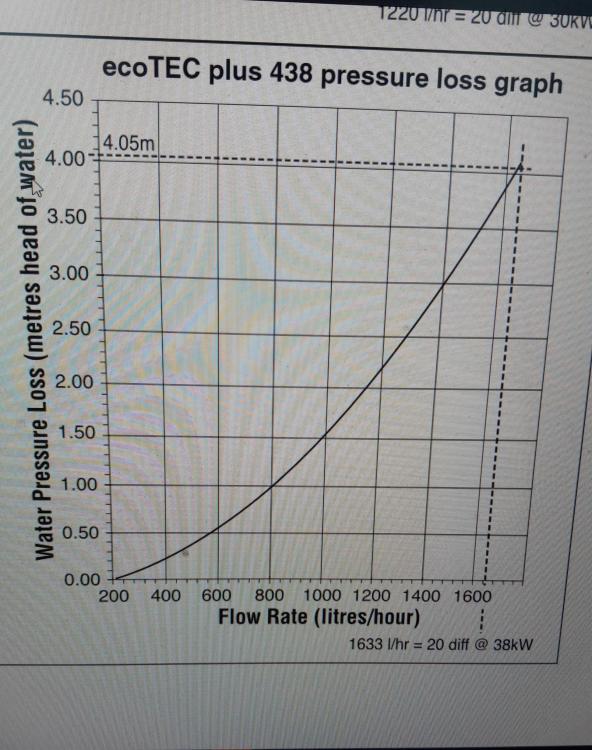
-
What Boiler to prevent short cycling?
SimonD replied to windsor-tg's topic in Central Heating (Radiators)
At the moment I suspect you're not just having issues with the UFH but have a more fundamental system problem. This is because in all your tests so far the boiler return temperature is too low whether or not your system is on rads, ufh or both. It's just that the problem is made much more obvious with just the ufh running. So running these test is going to tell more about the system without ufh distraction. -
What Boiler to prevent short cycling?
SimonD replied to windsor-tg's topic in Central Heating (Radiators)
Yes, please, but run the system for a good hour to 1.5 hours on each pump setting to really let it stabilise. -
What Boiler to prevent short cycling?
SimonD replied to windsor-tg's topic in Central Heating (Radiators)
Would you mind running your ch on its own with ufh off. You can run it in existing setup with pump in 1 and then later with pump in 3. I'd like to see flow and return temps over time. It would also be interesting to see behaviour with boiler range rated back to max output. If you can set flow temp to 70 that would be great too. You have 21 rads? What are their sizes and are they single/double etc. -
What Boiler to prevent short cycling?
SimonD replied to windsor-tg's topic in Central Heating (Radiators)
Having fixed and serviced a few of them now, I'd like to provide an alternative perspective. I'm still trying to get a replacement flue terminal for a customer because the standard unit that was supposed to clip on to the existing one (according to Viessmann's info) has a completely different design so won't go on. According to the Viessmann flue info what I have doesn't exist: Go to about 8:15 I am now personally seriously looking a ATAG Boilers to start installing them. Last year I took apart and then removed one and the engineering in it was very impressive. They're now offering 18 year warranties and they have built in weather compensation that can be configured for mixed radiator and ufh heating systems (with options to have ufh (main zone) + radiators or radiators (main zone) + ufh. The system can be set for weather comp only or weather comp plus room They're also Openterm. -
What Boiler to prevent short cycling?
SimonD replied to windsor-tg's topic in Central Heating (Radiators)
Not as strange as they appeared before! A couple of observations. In your earlier measurements the differential flow/return temperature in your ufh was almost 20 degrees C and your latest readings show up to about 15 degrees C. This is too much should be between 5 - 10. Also notice that your ufh return temp does not go much above 30 (now bear in mind it sometimes takes a long time for ufh return temps to stabilise so you may need to run the system for longer to see what eventually happens). You also have a constantly low boiler return temperature that barely reaches 45 degrees. (do keep in the back of your mind the max return temp when the whole system is open too as that stays quite low) To go back to my initial observations, my first place to look is flow rate and more specifically a low flow rate because the heat is not going through the system. It's also indicated by the rapid rise in heat exchanger (flow temperature) causing the boiler to switch off. Given your current big circulating pump which should in theory be able to cope with up to 8m head and 50l/min flow there's something wrong, particularly given you've got the pump set to maximum. I was going to suggest you try this just to see what happens. Because you know that this behaviour doesn't happen (am I correct here?) when you've got your rad zone open, the problem isn't in your boiler heat exchanger. First port of call for me would be to investigate a flow restriction within the ufh zone (e.g. from and including the motorised zone valve), so either the primary pipework from boiler to ufh and or the ufh pipework. Only once this is confirmed would I look at alternative solutions. You may have already said this but where is the ufh connected to your primary pipework? Is it by the boiler, pump, or somewhere else and if somewhere else, how far away from the boiler? I am slightly curious about the differences you're seeing with ufh zone flow rates.... -
What Boiler to prevent short cycling?
SimonD replied to windsor-tg's topic in Central Heating (Radiators)
Well, with the actuators at least that's one potential issue out of the way! Regarding the pump, as I've learned, it's unfortunately a pretty standard 'answer' lots of heating engineers use to 'resolve' or 'overcome' flow issues in heating systems! "Oh, your radiators aren't getting hot, you need a bigger pump"....Makes you wonder, doesn't it 😊 -
I would humbly suggest that you employ a water engineer that sits you down to have a proper think about the real world water demands and whether all the outlets are actually going to be used at once 😉 I know it's not what many want to hear on BH but the reality is that when you sit down to work out the real patterns in a house the concurrent demands are less than most people think. You've also got the pesky building regs and resultant design guidelines suggesting less water use per person. I know I've said this before but when I designed my system I started off in the same trap. I thought I needed to supply 3 bathrooms concurrently blah blah.However, instead of looking at upgrading the mains supply and accumulator, hot water recirculation and so forth, I looked instead and reducing overall flow rates while retaining pressure so even with less than 30l/min peak flow I can supply all bathrooms and whatever outlets without anyone complaining - although my only complaint is that I feel the kitchen tap (which comes restricted to 6l/min as standard) doesn't fill my pots quite quickly enough when I'm in a hurry. Our current main drench shower is regulated to 6l/min and it works really well. This approach was in part inspired by comments made by @markocosic to a thread I started a while ago about a similar question. Just fundamentally changed how I looked at the problem. You can also use 10mm pipe for toilets, basins, dishwasher, washing machine which also reduces impact on flow.
-
What Boiler to prevent short cycling?
SimonD replied to windsor-tg's topic in Central Heating (Radiators)
This is a curious thing. Do you have any of the design documentation for the ufh at all? This may have some info on design flow rate for your particular installation. Also, what wiring/control centre does your ufh use? What brand ufh is it? If you run the ufh on its own from a completely cold system, what happens? I'm certainly not inclined to suggest going to the expense of any buffer - plenty of these kinds of systems work just fine without them. Given that you've nearly got 30C flow return differential, you're on the brink of an error code so to meit points to a flow problem. My inclination would be go back to the basics, which is to make sure the ufh has been installed correctly - that all the plumbing bits are where they should be and functioning as they should and the same for all the related electrics and controls. Even really simple stuff like making sure the actuators are really working. Then also make sure it's balanced. UFH systems can behave really strangely if just one thing is off. I recently 'fixed' a whole house system in a relatively new build where the ufh was constantly calling for heat and bringing some rooms up to 38C even with the system set to summer mode, meaning it shouldn't be on at all. I noticed that about 4 actuators had popped off their clips which had broken. Manufacturer tech support said I should test all the room thermostats within the wiring centres etc.to make sure there weren't any errant voltages but I decided it best to get the actuators back in place first and then see what happened - as soon as they were back in place, the whole system worked again as it should (which logically shouldn't have been the solution). None of what is going on suggests a blocked heat exchanger or a problem with your boiler, it's somewhere outside in the heating system. But it may be amplified due to a high output boiler with relay control meaning there's no modulation. -
Grundfos sell a number of different 'home boosters' a couple of which have accumulator tanks. Typically the accumulators do act as a break tank from the mains. As @markocosic has suggested, maybe look at a non pumped version. You'll need to decide how long you need the pressure boosted for as that will determine the size of tank. The Grundfos Home Booster tank is pumped and has a usable capacity of 180l @ 0.5 liters/second so about 6minutes worth of boost. Noise level is 65 dB(A)
-
Pressure and flow are completely different things. Increasing pressure does not necessarily increase flow. However, the main issue is that your installer should never have installed an UVC with those kinds of figures - it was never going to work very well. The water regulations also don't permit the use of a booster of more then 12l/min directly connected to the mains, so if you want to boost flow above this you have to have a break tank installed, so some sort of accumulator or a cold water storage tank with a pump.
-
You could also look at Tikkurila paints like the Optiva 3 Ceramic Extreme Protection which is even London Underground approved. With some reviews here: https://www.thedecoratorsforum.com/the-best-flat-matt-emulsion/

