IanR
-
Posts
1857 -
Joined
-
Days Won
6
Everything posted by IanR
-
Welcome! Is the system commissioned? Did you swap from a fossil fuel boiler? What's your predicted space heating energy requirement (heat loss), and what flow temp are you running the radiators at. Did you have to increase the size of the rads? ...so many questions.
-
 No, but it would explain what comes across as a lack of real world experience. You sound like you share the same contempt that @CharlieKLP does. Just because someone does not value your input, it does not mean they are wrong. Compromise does not mean settling for something less than ideal. It just means balancing competing requirements to the client's priorities. Unless you know @CharlieKLP personally, how would you? Comes across as contempt to me. But if the free advice doesn't meet the posters requirement, you can't expect them to "take" it. Agreed.
 -
I'm not really sure who you think you are. From what you have said previously, you are an employee of someone else's Architectural practice, has an actual house yet been built that is your sole design, and not one that the partners have been consulted on. What makes you think you are the arbiter of what a "beautiful" house is? Isn't that for the person paying the bill and choosing to live in the house to decide. House design is a compromise, and one that first and foremost has to be financially viable. There's no point building a "pretty" house in suburbia if what makes it pretty knocks 30m² off the floor plan, a bedroom and £150K off the value. For many plots "beautiful" is down the priority list, and rightly so. You say you want to head out on your own and have the self build community finance your new business venture. However, you appear to have nothing but contempt for them. A little humility, and listen to what the paying customer wants.
-
Not sure what you mean there. wrt RHI closing, System needs to be installed and commissioned prior to midnight 31.03.2022, and paperwork submitted. If you pay a deposit to an installer, make sure it's returnable if they fail to commission and provide you with all required paperwork before 31.03.2022.
-
Is my house suitable?
IanR replied to jayc89's topic in Mechanical Ventilation with Heat Recovery (MVHR)
I'll play devils advocate and say probably not. It's unlikely that your final air tightness will be better than 5m³/m².h @50Pa. Maybe your extension will be built to a level that could achieve slightly better, but it is unlikely that in combination with the existing house that the overall air tightness will be better. Down to an infiltration rate of 3m³/m².h @50Pa, building regs imply that mechanical ventilation is unnecessary since there is sufficient background air changes for reasonable air quality. Yes, these back ground air changes are uncontrolled and have no heat recovery, but they are there whether or not you fit MVHR. If you do fit MVHR you are creating additional air changes, although you should recover 80% - 90% of the energy, but you loose the 10-20 percentage points unnecessarily, since you don't need the mechanical ventilation for air quality. For me, with a ventilation rate above 3m³/m².h @50Pa, MVHR is an unnecessary expense that requires future filter changes and occasional servicing. Room extractors in bathrooms and trickle vents in the new windows are more cost effective. If you want to be sure, pay a couple of hundred pounds for an air tightness test prior to the extension starting and see what your baseline figure is. If it is close to say, 5m³/m².h @50Pa, then maybe it's worth doing the extra detailing on the extension to try and bring the overall figure down to somewhere near where an MVHR system adds value. -
What's leading to the need for expansion joints. On my 26m x 19m insulated raft, expansion joints were discussed, but only by the ground workers that I was asking to quote. In the end I went with a group used to doing warehouses who were happy going 4 times the size without expansion joints.
-
Yes, ASHP effectively runs in reverse, removing energy from the fluid in the "heating" system and passing it to the outside air. Since I have a buffer tank feeding my UFH, it cools the buffer, which is then circulated through the UFH, cooling the slab. You have to be careful to not reduce any un-insulated surfaces to below the dew point, otherwise condensation will form. 14°C should generally be safe. I can run my buffer down to around 12°C which can reduce the slab surface temp to 18°C, without any risk of condensation and I find that quite effective at controlling over-heating, although I do take other measures to reduce solar gain. I've no experience of cooling via radiators, I would imagine, due to the smaller surface area, you would need to drop the temp further for it to be effective, which would then likely put you in condensation territory. Happy to be corrected if others have it working. Others also use fan coil units, cooled via their ASHP, which are reported to be effective. For this it would be relatively easy to insulate all the pipework to allow the ASHP to reduce the temp to its minimum, perhaps 7°C for some quite effective air cooling.
-
Back when I ordered it, the Nibe had one of the better SCOPs, as well as cooling out-of-the-box (if you added the cooling module), avoiding the need for any hack. The MODBUS also allowed for connection to Loxone, including cooling control. The SCOP of the competitors has improved, and I'd expect inter-connectivity also. If cooling is also available (OTB) then I'd have more choice making the decision today. I've found the NIbe as good as could be expected, It requires very little attention, just getting on with the job.
-
The full process is not yet laid out, the obligatory "Consultation" has just closed, so assume Ofgem will provide more information on how the scheme will run in the next few weeks. If you read the Consultation it appears the installers will need to apply for a voucher on behalf of the home owner, so the application needs to be made prior to the install, unlike RHI. https://www.ofgem.gov.uk/environmental-and-social-schemes/boiler-upgrade-scheme-bus https://www.ofgem.gov.uk/publications/consultation-ofgems-administration-boiler-upgrade-scheme https://www.ofgem.gov.uk/sites/default/files/2021-12/Administration of the Boiler Upgrade Scheme - Ofgemconsultation.pdf
-
Very similar to my own install. I paid a few hundred pound more the same ASHP, the 500l version of the UVC, the 200l version of the buffer, plus the cooling module and MODBUS unit, fully installed including all brass and copper. There's quite a few on the forum that paid similar amounts for MCS Installs, but there does seem to be a lot of quotes for +40% more, so some companies do try it on. With RHI soon to be replaced by a lower grant, I expect the companies inclined to profit from the grant are making the most out of the rush to get systems installed and commissioned before the deadline.
-
It's sounding more like a leak than condensation. Are the external finishes all on, you mentioned the sill being in place. Is it possible water is getting on to the rebates and trickling down to pool under the sill and find a way through what is probably expanded foam under the frame?
-
ASHP help needed with my daft questions…!
IanR replied to Tim S's topic in Air Source Heat Pumps (ASHP)
@Tim S needs to establish accurate energy-loss figures, based on achievable air-tightness. The ASHP doesn't need to run all day, especially with wet UFH and a slab/screed to "charge up". Whatever ASHP size you have there will be days when only a few kWh of energy are required. The control side just needs to be set up so that the ASHP doesn't run unless there's at least an hours heating to do, which is made even easier if you have a buffer tank. -
Insulated Raft Slab Foundations - Finished Flooring
IanR replied to TBlew's topic in General Self Build & DIY Discussion
Yes the sole-plate height is generally set on top of the Slab, but windows/doors are best outside of the slab, sitting over the insulated perimeter, or at least partially sitting over the insulated perimeter (to avoid a cold bridge), with the height adjusted to meet your Finished Floor Level, not the top of the slab, unless you are have polished concrete. Something along the lines of This actually has a mat well recessed 20mm into the slab, and the door frame is set over the EPS upstand on a 9mm thick GRP "L" Profile. The door threshold is set at a height that brings it flush with the FFL, which is a 5mm thick poured resin over the power-floated slab. Edited to add: What's you planned wall build up, and does it insulation layer of the wall sit over the insulated perimeter of the slab?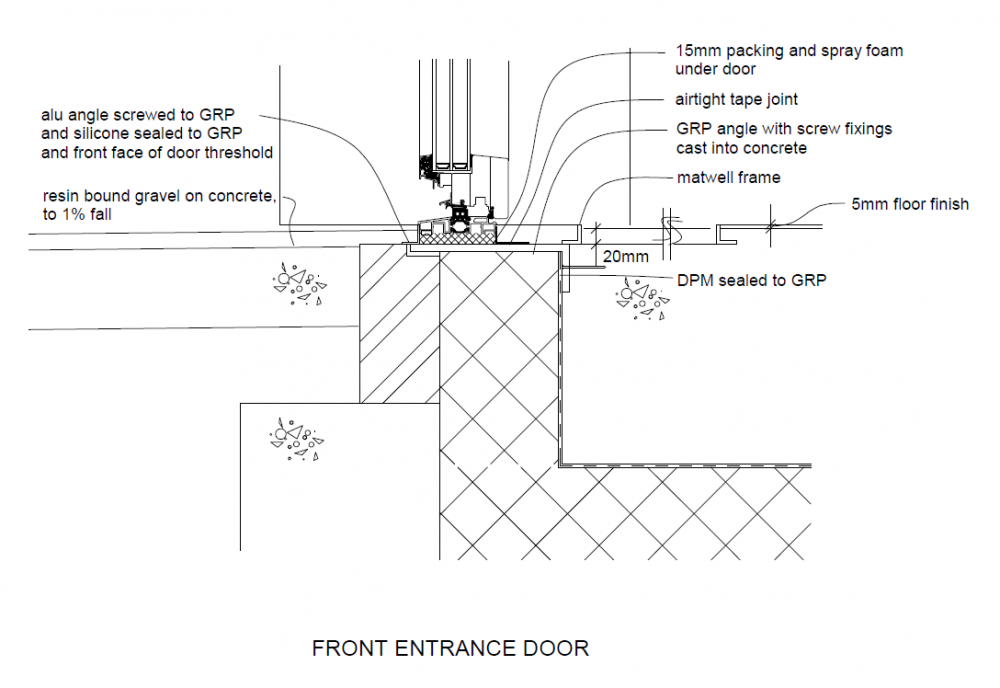
-
Insulated Raft Slab Foundations - Finished Flooring
IanR replied to TBlew's topic in General Self Build & DIY Discussion
Why don't you choose the floor finish you want and then set the threshold at the height above slab that matches the build up of your chosen finish? I've got just 4mm of poured resin flooring on my power-floated slab, and the thresholds are set down to match this. -
3G = triple glazed Just to be clear, Is the white/silver section that is running close to horizontal the window frame? and the sill you mention, is it the external sill, not shown in the picture. I can't make out the black cylindrical object in the top right hand corner. Does this only happen when it rains? Do you ever see condensation on any surface. Or is it the absence of evidence of condensation that has lead the installer to say "it's forming on the screws" Condensation is more likely to form on the inside in your scenario, where the internal air is slightly warmer than external and saturated due to the drying out process, then coming into contact with a cooler surface of the frame or glass.
-
ASHP help needed with my daft questions…!
IanR replied to Tim S's topic in Air Source Heat Pumps (ASHP)
Are you saying your air tightness is 0.7 ACH? and I guess Wunda's energy loss calcs were done with less that the 30° Δt you used. If so the worst case heat energy requirement to maintain 20°C is 3.9kW. Since you don't want the ASHP running space heating all day and it needs to occasionally heat the water cylinder, a 6kW ASHP would maintain the temp with less than 16 hours running in any 24. So I'd go with 6kW if you are confident on your heat loss calcs, incl. air tightness. Yes, ASHPs have two modes that run separately for space heating and hot water. Each can have their flow temp set independently. -
There's just the BUS (Boiler Upgrade Scheme) starting in April to replace RHI for Heat Pumps, that provides the £5K grant for Air Source and £6K for Ground Source.
-
Green Hydrogen, certainly has a place in the future net zero world, my comments relate only to heating homes. There are 70 millions tons of annual, legacy, hydrogen production that need to be replaced, eventually, by green hydrogen. However, due to the costs of green hydrogen and the unwillingness of the hydrogen production industry to start the transition without government incentives, almost no progress has been made on that transition. While some of the legacy hydrogen uses should slowly reduce, if we ever reduce the amount of oil we refine, there are plenty of additional, hard to electrify, industrial and heavy transport sectors whose only option will be to move to green hydrogen and will further increase the the need for green hydrogen. There is no getting away from the fact that as it takes 1.5kWh of renewable energy to produce 1kW of green hydrogen (before any compression, transport or Electrolyser, costs are considered) it can never be more "efficient" or lower cost to use green hydrogen than it is to use the renewable electricity directly. There's little agreement currently about the costs of getting green hydrogen in to the home, but the range is somewhere between 3kWh and 6kWh of energy for every 1kWh of hydrogen. That is a really inefficient use of renewable energy. If the hydrogen that has got to the home is then burnt, that 3kWh - 6kWh of original renewable energy will generate 0.9kWh of heat, with roughly the same NOx emissions as burning natural gas. The alternative is to transmit the renewable energy directly to the house, as electricity and use a direct electric heater with a total loss of 5%, or feed it in to a heat pump and achieve an ultimate gain of 300%. With the heating of buildings having a clear alternative to green hydrogen, that is cheaper and cleaner (no NOx emissions), I see the current trials of up to 20% hydrogen blended into the natural gas supply as a pointless exercise that releases more CO2 than just burning 100% gas would have. My understanding is that at the point of the trial there is no blue hydrogen being used, with first availability being 2025, and the trial happening now. The "low carbon" branding of CCUS Gas, used for blue hydrogen production is currently under dispute. The Gas industry have not enjoyed having their homework checked, and have reacted very badly to reports suggesting their theoretical analysis of the CO2 reduction CCUS can achieve seriously under estimates the fugitive methane released in reality. Methane having 9 times the climate change effect of CO2. Absolutely agree that hydrogen use will substantially increase as we move towards net zero, but not for heating homes. Yes the electricity grid needs continual updating as we move to more electrification. To use 100% hydrogen in the home would require an even bigger upgrade of the Natural Gas network. Due to much higher pressures required and the hydrogen embrittlement of steel, the entire replacement of all pumping assets, joints and valves is needed as well as putting in to question the current steel pipeline network that supports the domestic supply. The gas industry like to point to the fact that the plastic pipes entering home are already capable of carrying hydrogen, but this is a very small part of the story. The domestic gas supply industry is facing an existential crisis, and is trying its hardest to stay in the game. They don't really care if hydrogen is the expensive option for heating homes, they need to protect the asset they have in the form of the gas grid network.
-
I hadn't followed the link, so this is the one with the mini steam methane reforming unit in front of the fuel cell that's about £20K. The efficiency figures are opaque,. The SMR process releases the same CO2 from Methane that burning natural gas does (as long all the carbon monoxide produced gets converted back to CO2). It must be giving itself some efficiency credits back for the electricity it produces, the production of which may or may not be at a time when you use it.
-
I'm not sure how you are obtaining the green hydrogen for the FC boiler, if you are comparing a gas boiler to a green hydrogen fed FC boiler. I personally do not believe green hydrogen (or any colour hydrogen) will ever be piped in to UK homes via a public network.
-
End-to-End it's really not. And what if your hot water requirement and electricity need are not in the balance that the FC boiler delivers them. Using hydrogen today releases more CO2 than natural gas as we do not yet have Green Hydrogen facilities for the volume production of green hydrogen, for the simple reason it is not economic to produce.
-
I wasn't aware they required notifying, but they insisted I upgrade the local transformer for any new connection anyway. If that really could stop you going ASHP, then how about a Gas system boiler with UVC and emitters designed for low flow temp, so it's an easy swap to ASHP later, if when it does break down Gas replacement boilers are banned. Hydrogen for heating houses may possibly be used for properties that don't have the space for heat pumps and it's not feasible to join them to a district heating solution, but as direct electric heaters will be cheaper to run, I can't really see much use of hydrogen in homes. You have to question why the 20% hydrogen blend is even being tested as a stepping stone. It only delivers a 6% CO2 saving, and that's if Green hydrogen is used, which doesn't yet exist in the UK at volume, so currently Hydrogen is made from Natural gas, releasing more CO2 in the process than the saving it provides by displacing 6% of the Natural gas that would otherwise have been burnt in the home. It takes significantly more renewable energy to produce hydrogen, pressurise it (at far higher pressure than natural gas) and pump it to a home than the net kWh of hydrogen you get to burn in the home, it is far more efficient to only loose about 5% of the renewable energy transmitting it to the home across the grid and using an ASHP to at least triple it's energy value to heat a house. Not sure of the logic in a fuel cell boiler... Once you get the inefficient hydrogen into the house you then convert it back to electricity in a far less efficient process than just burning it directly.
-
Timber frame vs ICF vs Traditional masonry for a new build
IanR replied to Indy's topic in General Construction Issues
I'm not sure you can pluck figures out of the sky for pricing. I didn't get just TF prices within 15% of each other, from different suppliers for identical performance, so I'm not sure how it could be said that TF is/was 10-15% more expensive than masonry. In fact I had a 40% spread on just my TF quotes (Beattie Passive were a significant outlier). And, is the difference in cost the same for all performance levels. Is it really more expensive to achieve PassivHaus targets, for instance, in timber than it is in masonry. And does the cost difference include the efficiencies that can be made on the foundation/slab, for having a light weight structure, or does it just assume standard strip foundations for each? -
As I declared, I was making assumptions, and had assumed that the "Efficiency of main space heating system" value #206 in Work Sheet 9a of the SAP Calcs, where for an ASHP should be several hundred (%) gets rolled in to the algorithm to push up the EPC score, but perhaps it's only used for estimating heating costs... Either way, whether it is an ASHP of FF Boiler the annual heat demand for the property should be unaffected.
-
Keen to get started! If only I could find an architect...
IanR replied to jno's topic in Introduce Yourself
Renewables has nothing to do with PassivHaus, and SIPs is a poor way to deliver a structure that meets PassivHaus targets due to cold-bridging, air tightness and decrement delay, which will all require counter-measures to mitigate the inherent issues with a SIPs structure.