


IanR
-
Posts
1857 -
Joined
-
Days Won
6
Everything posted by IanR
-
 For me his study is far from conclusive and leaves too many questions unanswered. We don't know anything about the 4 port buffer that was used, whether it was correctly sized, or even if it was manufacturer recommended for use with the heat pump. We do know it was installed in an environment with a ΔT of 38°C, so would incur 2.5 to 3 times the standing losses of an install within the thermal envelope. The test rig used was a rig built for another purpose, and missed the most important data points, the temps across the buffer. I can speculate that was because the original rig didn't have a buffer, and therefore no sensors set up for it and there was limited investment to re-hash the rig for the new test. Perhaps the buffer used was one that was "laying around" and unsuitable for the installation it was being tested within in, unfortunately we don't know, so that report is open to being questioned. In order to state the major brands operating in this arena are developing, manufacturing and selling an accessory that doesn't perform as specified, better science is needed. There is also the earlier study that stated "very little difference was seen in the predicted COP between the different configurations". There's not enough detail from either study to know which is correct. Yes, a 4 port buffer will require an additional pump. Some installations will require that additional pump anyway. £50 a year, I would suggest, is at the top end of an estimate on the power used. I appreciate I'm probably towards the lower end of the range, but at today's prices and based on 90 - 100 heating days a year, running an average 10 hours a day the annual running costs for the pump is under £12. For all buffers/volumisers/accumulators there are also additional standing losses, which while they will be inside the thermal envelope, are not controllable so can't be ignored. It's an additional drain on the system of a similar size to the pump. Moreover, there is a capital cost to including a buffer/volumiser/accumulator, so there has to be a justified reason for doing so. [Personally, DHW re-heat times make it an easy justification, ie. specifying a heat pump size larger than the space heating requirement for reasonable DHW performance] I don't believe that's the case, they are designed for stratification, ie. no vertical mixing. Through stratification the heating circuit, including circuits to MVHR wet duct heater/chillers or fan coil units receive their flow at the ASHP flow temp (minus minor standing losses), while increasing the system volume to avoid short cycling. As the energy in the 4P Buffer is depleted (while the ASHP is off), there's no reduction in flow temp to the heating circuits until nearly all the usable energy from the buffer has been depleted. ie. the temp gradient to the heating circuit is changed from linear to something approaching exponential. The ASHP should of course have cycled back on before the heating circuits see any of that temp drop off. A 4P buffer therefore maximises ASHP run time while maintaining a constant flow temp to the heating circuits, if correctly sized. This comes at the cost of possibly an additional pump, and, compared to a system with no buffer/volumiser/accumulator, some additional standing losses. I feel they have different use cases. If increasing the volume of your heating circuit with a 2 port buffer gives sensible heat pump run times, and that's all you need, then a 4P buffer doesn't need to be considered. A 2P buffer in the return line reduces the standing losses as far as possible, so is ideal for this scenario. However, it wouldn't be of any use to a low energy home that could benefit from 1kW of distributed heat input, in an evening during the shoulder months of what would otherwise be a non-heating day.
 -
I'm pretty sure they'd be designed for the parameters in which they operate and I'd imagine the primary circuit flow rate very seldom matches the heating circuit flow rate. Perhaps I've missed previous discussions, but where is the evidence that correctly sized 4 port buffers do not operate as designed? Any buffer is an additional expense and will reduce the efficiency of the overall system, so if they can be avoided there's no point in installing them. If you are confident in your energy performance calcs, can leave a zone open that provides sufficient ASHP run time, and don't wish to run an MVHR wet duct heater/chiller or a fan coil heater/chiller, then there's no need for a buffer/volumiser/accumulator.
-
I had omitted pumps and valves in my sketch, to focus on the measurement points. A 4 port buffer requires a second pump on the circuit to the emitters, that some non-buffer installations can avoid. I can't imagine why a 4 port buffer would be designed to mix. The internals of mine are designed very much to not mix. My controller and buffer allows for three buffer temps to be used, top, centre and bottom, but I'm not using that option on my setup. The fact that there are 3 pockets within the buffer for temperature measurement suggests the manufacture believes there will be stratification within their buffer.
-
Thanks for clarifying. I've got the same issue taking measurements, I'd need to peel back the insulation to get to somewhere to measure, and it will need taping up to put it back so won't look the same again. I've avoided going down that rabbit hole of data logging so far, but am now looking at what it will cost to buy a multi-channel temp logger and some probes. I don't believe you can infer that, from the temps provided.
-
@ReedRichards, Can we clarify where you are making your temp measurements? From what you've said, none of your measurements are at B, C, H or J. But I get confused whether you are measuring across the emitter ie. either D to G or E to F I've made a guess below at what your Space heating plumbing might look like. I believe @JamesPa believes you are providing measurements across the buffer ie. B to C, H to J, or perhaps A to D and G to K.
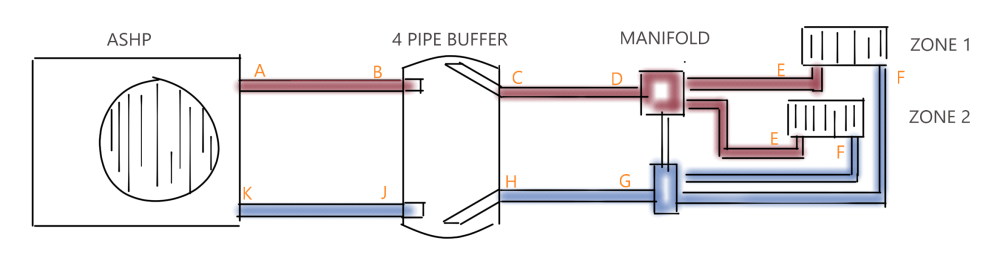
-
OK, now I understand, this wasn't referring to your own 2 port, in the return line. It may be my narrow experience of just one installation designed and installed, but wouldn't a 4 port buffer that is allowing mixing be either poorly designed or incorrectly sized for the required flow rates (or both). I had assumed all 4 port buffers for ASHP space heating were designed and sized to allow stratification. Should your model not be based on a correctly designed system? You would have to allow for the energy to power the additional pump though, should be around 25W, but could be as much as 55W. He did state "with compensation curve" I believe, but then only tested in a steady state, so effectively a fixed flow temp @ 35°C Indeed.
-
Certainly de-risks an install, allowing an over-sized heat pump to be installed to mitigate potential errors in energy loss calcs (more important for retrofits than new builds), allowing zoning of heat emitters, and improves DHW heat-up times. Can you talk me through this, and what buffer/volumiser configuration you are considering with this - I assume your volumiser in return flow. I'm also assuming you are considering this as additional to standing losses.
-
With regards the aspect being discussed here, Buffer tank effect on CoP, the report off the "Kiwa GASTEC at CRE" government website states: "Very little difference was seen in the predicted COP between the different configurations. (Indeed the errors in the predictions probably outweigh the difference, so this should not be relied upon for decision making)". Where as the "Brendon Uys" suggestion shows a 28% reduction in CoP. They are coming to different conclusions, with regards to buffer tank effect on CoP. The report was first written in 2008, and does address that inverter heat pumps are less likely to require a buffer tanks, as you have noted. But there are still good reasons for some installations to have buffer tanks, so I am interested on their potential effect. It's unfortunate that the "Brendon Uys" report has been written as if to prove what he felt was already the case, as well as advertise his services. When his findings did prove what he already believed top be the case, he didn't seek to explore alternative buffer/volumeiser configurations that were less onerous in the system CoP, such as not installing the buffer "outside". Neither report is conclusive, but I feel the "Kiwa GASTEC at CRE" report takes a more balanced approach. There's no denying there will be greater loses from including an additional volume of warm water within the heating system, although that would hopefully be within the thermal envelope for the majority of installations. For a 4 port buffer there would also be an additional (low energy) pump that needs to be accounted for, although with the benefit of stratification if correctly sized. You pays your money and you takes your choice - it's just a shame there's not more conclusive data for the home owner to rely upon.
-
Thanks for that, I've not seen that one previously. Just to offer a different study that brings a different conclusion, I've added the link below. I'd need to spend a bit more time looking the respective Test Methodology, but it seems the "Brendon Uys" study has the Buffer in a space that is at 7°C. If I've understood that correctly, then the message would be to install the buffer within the Thermal Envelope. https://assets.publishing.service.gov.uk/government/uploads/system/uploads/attachment_data/file/198850/hot_water_cylinders_buffer_tanks_heat_pumps.pdf Buffer Tank testing is from Section 5 (page 44)
-
Have you got a link to that study, or has it been discussed here previously? I remember reading an old study that found no effects on CoP of a buffer. iirc. there was a small negative effect from a 4 pipe buffer if the buffer didn't allow stratification due to size/shape. It would be good to catch up, if there's a new study that contradicts it.
-
Apologies for my blunt reply. Before you added this line, which came in an edit just after I had replied, it seemed you were burying your head and not considering you may have erred in your calcs. There's lot's of opportunity for the fabric of the building to not perform as intended as well as you own calcs missing losses and over estimating gains. With regards to building fabric, for instance, you may be using theoretical U values, rather than ones that include the structural elements that cause pinch points with local reductions in insulation thicknesses, or allowing for correct timber fraction, and have you included allowances for thermal bridges.
-
MCS completely over estimated my energy losses, PHPP was closer. I'm surprised that you are not inquisitive about you having U values typically 50% higher (accept for glazing) than most PH houses in the UK, but your calcs are predicting energy losses equivalent to a typical PH house. Especially as your reality and calcs are not currently matching.
-
"windows and doors 0.68 average", not the overall property average. I wouldn't be anywhere near 0.23 for what you are calling a weighted average. Hence me saying you should look into how you are calculating your losses, as they calculate the same as mine, whereas they should be approx. 50% greater than mine.
-
I wouldn't first jump to the conclusion the ASHP Manufacture is cheating the test conditions under which its published (S)CoP figures are based. I'd first look into where your energy losses may be higher than predicted, and the calc used for that prediction. The 88W/°C, for a 157m² house is just inside the PassivHaus target, and very similar to my own PHPP calcs. Summary: Floor old = 0.16 Floors new = 0.14 Walls old = 0.2 Walls new = 0.15 Roof 0.12 Windows doors 0.79 Air Tightness 1.1m³/m².h @ 50Pa For my own property, floor is 0.11, walls 0.11, roof 0.1, windows and doors 0.68 average. The Air tightness figure used in the PHPP calcs was 0.6m³/m².h @ 50Pa My reality is the house uses slightly less energy than predicted, which I can explain by making more of the Solar Gain than calculated and achieving a better air tightness than the figure that had been used in the calcs. I'd look into how you've come up with the 88W/°C, since pro-rata, your losses should be around 50% greater than mine, but you are calculating them at around the same.
-
With regards to the planning rules - within many different Planning "Statutory Instruments" (publicly available on the Gov.UK site), although there is also Gov.UK Planning guidance site that covers their interpretation and can be easier to digest, although it is high level so doesn't necessarily get into the detail. The logic to what appears to be your situation is that, due to NPPF rules the site you have wouldn't be appropriate for a new build. Perhaps it's in the open countryside where the rules are strongly against development "unless there are very special circumstances". Included in those very special circumstances is the re-use of existing buildings. If you are then relying on that caveat to the "strongly against development" rule, you have to base your planning application around the re-use of the existing building(s) on the site. There are then rules about the existing building(s) needing to be structurally capable of conversion to residential with reasonable works. LPA's may treat this slightly differently, although Appeal results tend to keep them within close boundaries of how that is to be interpreted. My local LPA, for instance, has very specific rules about how much of the original frame must exist within a finished conversion of a traditional Essex Barn. They've settled on a figure of 67% and you have to demonstrate how this is going to be achieved. A neighbouring Barn conversion received some storm damage in the early days of its conversion, when the frame was exposed and the scaffold was erected. The LPA issued a stop notice and the owners had to go back to planning to show how they were still meeting the 67% requirement, taking into consideration the portion of the frame that had been damaged. Since you are relying on the re-use of an existing building for your development and that buildings be capable of conversion, a significant proportion of it has to remain in place for the development for it to be within the rules of the planning approval you have.
-
The rules aren't specific to Class Q, they are specific to a Change of Use, in layman's terms, a conversion.
-
Assuming this is for a residential conversion, then your planning with be something like: "Change of Use from X to C3 Residential". That "Change of Use" planning permission stops the conversion from being zero rated. If you did completely remove the primary structure, you would also be in breach of the planning permission. As a Change of Use to Residential, while it's not zero rated, but rated @ 5%, that 5% is recoverable by the self-builder at the end. So it's a cash-flow issue, rather than a cost issue.
-
Mine was installed in 2017, but the market was even more more skewed then with RHI running which could provide double the grant the BUS scheme does. I'd noticed ASHP prices have not gone up since then (including Nibe), but perhaps everything else has.
-
Correct heat pump sizing for passivhaus
IanR replied to markharro's topic in Air Source Heat Pumps (ASHP)
For a 4 bed house I'd go for at least 300l, maybe 400l, even if your own need is less the next owner may have 5 occupants. It would be a shame to have to store water at over 50°C to ensure there is enough. There's improvements to be made on your energy losses (to get Certified), but I'd still pitch for a 5kW ASHP, and a buffer. I'm suggesting the larger size more for the HW side of the requirement and ensuring reasonable heat up times, although it could be argued that with your planned array size, it will be able to cover your hot water demand for most of the year, so you could rely on an immersion for the odd occasion you've depleted your HW and need to use the shower. -
Correct heat pump sizing for passivhaus
IanR replied to markharro's topic in Air Source Heat Pumps (ASHP)
Are those figures from PHPP, or something provided by the installer? What's the delta T the Heat load is based upon? What DHW Cylinder size? Are you planning any PV with divert to Hot Water? -
Yep, that's a bit steep, and I don't believe you get the Nibe 7 year warranty unless it's fitted by an Approved installer. Eco EastAnglia are based in Colchester - pretty sure they cover your area.
-
Can I ask what price you've been quoted for which model? Eco EastAnglia fitted a F2040-12, Cooling module, SMO40, MODBus module, 500l Nibe Cylinder, 200l Buffer, all copper and brass, HW recirc pump + another pump to the MVHR wet duct heater/cooler for £11.5K, which I thought was a reasonable price. First class install.
-
Net zero retrofit requirements
IanR replied to ColdHouse's topic in Energy Efficient & Sustainable Design Concepts
While they benefit the home owner in the march towards Net Zero, there's no direct link. For homes, Net Zero will mean using an energy source that does not create CO2, for heating and hot water. For the majority of homes that will mean electricity. Since the unit price of electricity is higher than that of Fossil Fuels, it's a benefit to the home owner if the energy losses are reduced as much as is practicable, so that a heat pumps will work as efficiently as possible to balance out the cost, or if you can reduce the energy losses enough then use an electrical resistive heating solution that avoids the capital investment of the heat pump. For a retrofit, is unlikely to be costs effective to go to the latter route and more likely the better solution is a heat pump, especially while there is the BUS grant to help with the capital investment. To get a heat pump running efficiently, you need to reduce the flow temp, ideally in the 35°C - 40°C range. To achieve this the heat emitters (UFH / radiators) need to be sized sufficiently large to meet the heat demand at that flow temp. If you can get "enough" insulation under the floor, then UFH is a very effective emitter for a heat pump powered heating system, due to the area it emits heat over. But, it's not mandatory, over-sized radiators and/or fan assisted radiators can do the job, if sized correctly. With regards reducing energy losses it's all about insulation and air tightness, and spending the budget wisely. Roof, floor and walls (including windows and doors). If you have no insulation under the concrete floor, then this really does need to come up and have insulation put down under a screed. While doing this work it is cost effective to include UFH. The roof's got to be where the most cost effective gains are to be made. 3G windows may not be necessary. Depending on the spec of your current 2G, they may be OK, but if you do need to replace them then 3G is not such a premium. For me, MVHR wouldn't be a focus, but air-tightness would. In England a house needs mechanical ventilation if the air-tightness is below 3m³/m².h @ 50 Pa. That's quite a high target, and not achieved by the vast majority of new builds. Adding MVHR above this level, increases the energy losses through ventilation, when it is not necessary. There are significant energy loss gains to be made by reducing the natural ventilation rate to sub 1m³/m².h @ 50 Pa, but the costs to achieve this in a retrofit will be high. It may be that targeting 3m³/m².h @ 50 Pa, including controllable trickle vents on windows and single room air extraction (possibly with heat recover) in wet rooms is the more cost effective option. It's worth spending some time working out where it's best to spend some money, ie. an extra 25mm of insulation under the floor, or an extra 50mm in the roof. One the forum members has created a spreadsheet to help with this. -
I feel you definitely need a Planning Consultant, with Local Class Q experience, to help you with a strategy. The Refused Class Q, for Barn 1 only (and retaining the shed for use as a garage), I believe was only refused as you included the new entrance AND exceeded the permitted curtilage area on the application. Separating the permission for the entrance, and defining a curtilage not larger than the area of the barn being converted, should achieve an Approved Class Q. With regards to the new entrance, I had a quick look on Street View, and it doesn't appear that the lane is a "classified" road, ie. it's not been assigned a number such as B1234. In that case Planning is not required for a new cross-over, although Highways Agency approval is. From your OP, you are now hoping to achieve a larger conversion, than what was covered by the Refused Class Q, by incorporating the area of the lean-too and the shed. I'm not clear on whether the lean-to was part of the previous, Approved Class Q. You may be able to include the lean-to and Shed in a new Class Q, but I'm concerned by your statement: This may stop them being part of a Class Q, as they would need to be structurally capable of conversion with reasonable works. Subjective, but an avenue for refusal if the LPA wishes. However, if they were part of the original Approved Class Q, then the LPA have already accepted they are structurally capable of conversion. The other potential issue for including them in a Class Q, is whether the limit of two "large" conversions has already been met. Combing the 3 buildings into a single residential unit, pushes the conversion over the 100m² threshold, so the new residential unit would be a classed as a "large" home, of which only 2 large homes can be created within an Agricultural Unit and their cumulative area cannot exceed 450m². So, have 2 "large" homes been created under Class Q applications already, or is there room for another. If it's agreed that the lean-too and shed are structurally capable of conversion and there's room on the PD for an additional large home, then that's probably the route to go, which then provides the fall back for all the buildings to be converted to residential. If this was to get Approved I'd then start talking to the LPA about a knock-down and rebuild for the scheme you want, or failing that a Full Planning for the Change of Use that should give you more freedom for a better quality conversion, while retaining the majority of the original primary structure.
-
Hopefully its previous use in agriculture is a matter of fact. ie. it was part of a working Farm, and not part of the residential curtilage of the Farmhouse. A statement of fact from the Farmer would help, and if you are concerned they would add additional unhelpful info, perhaps you could draft the letter for them, "to reduce the inconvenience to them", and ask them to sign. Obviously you need a conversation with them prior to agree what they are willing to confirm. If there is any doubt that the buildings were part of a working Farm, the LPA will likely request proof of the "Agricultural Unit" (Farm number, old accounts, Accountants confirmation etc.) An "Agricultural Unit" had to once be a profitable business, able to sustain a farm worker, it's not enough to be a hobby farmer. They may also request this proof if it is not clear which Farm (Agricultural Unit) the building once formed part of. Its the Agricultural Unit that has the PD, not the buildings or the current owner, and as there is a restriction in the area that can be converted from one use to another the LPA need it to be clear which Agricultural Unit the Change of Use is being performed under. Assuming it's clearly an Agricultural building that was once part of an Agricultural Unit, the LPA should accept this (unless they wish to be awkward). It would then be for them to find evidence that it has had some other non-Agricultural Use since the Agricultural Use ceased.



