


IanR
-
Posts
1857 -
Joined
-
Days Won
6
Everything posted by IanR
-
Agreed, officially the barns were not last used in Agriculture, but is there evidence of this for the LPA find? ie. have they been to the site previously for prior applications where are record of their use may have been made, or is it possible neighbours would be aware of this previous non-agricultural use? So, if the barns were cleared and it as stated they were last used in Agriculture, could that be disputed? Since you over the 150m² threshold the LPA will want a flood risk assessment for a Class R. Do you know if your are in an area defined as 3a or 3b?
-
Insulation under the UFH? Have you considered ASHP? Off-grid fossil fuel boilers are planned to be banned for new installs from 2026. The next boiler your property has is unlikely to be LPG, and the economics of existing LPG's could well shift once all the companies currently doing new and replacement installs no longer have that business. At the moment there's a £5K BUS grant available to persuade you to go ASHP rather than LPG. Once the ban comes in there's unlikely to be grants available.
-
Without the planning history, it's difficult to decipher which application the planning officer is referring to. They state "refusal of the previous Class Q", but follow that with "the approved Class Q has also now expired"... Could you post the reason for Refusal, and what was different to the Approved Class Q Application. "Land-locked" is not a reason for refusing a Class Q. My own Class Q was land-locked. You'd obviously need to resolve the access prior to actioning the conversion, and that may require further planning for a cross-over to the road, but you do not need to own the land between the Class Q property and the cross-over, you "just" require a right of access over the land, which is nothing to do with planning. While I know my "Class Q's", I have to admit I only have a passing interest in Para 80's, but, this line above makes no sense. The NPPF already calls out an exception to the restraint of development in the open countryside for the re-use of existing, redundant buildings, so Para 80 is not required for Change of Use. There are no exceptions, Other than Para 80, for new builds in isolated positions, in open countryside and it is for these that Para 80 exists. But, the requirements to achieve a Para 80 are quite onerous. As well as it being an isolated site, the proposed design "must be of exceptional quality, in that it: - is truly outstanding, reflecting the highest standards in architecture, and would help to raise standards of design more generally in rural areas; and - would significantly enhance its immediate setting, and be sensitive to the defining characteristics of the local area" While there are still hurdles to jump for a standard Change of Use application (in the open Countryside), it is less onerous than a Para 80. You've posted: "SETTLEMENTS" are different to "open countryside", and have different planning rules. Do you feel the site is within a defined settlement, or is it in open countryside. I'd assumed the latter as Para 80 was being mentioned.
-
Hi and Welcome, I understood Para 80 to be an exception that allows for a new home in an isolated setting. I don't believe it can be used for a Change of Use. (Happy to be corrected if someone knows better) My feeling is that your option is a standard planning app for Change of Use from Agricultural to C3 Residential. That's not necessarily a restriction to Class Q, you'd only need to get an access up to the Residential Land, access across it could be handled separately, and wouldn't stop a Class Q Approval. What's more important is if the now redundant buildings were last used in Agriculture.
-
 I feel you need to spend some money to at least get the current status recorded. If you are starting to use the land, when you haven't before, moving plant etc. and plan to build in a few years, which may involve excavation in the proximity of the wall, then you may get in a situation where you are having to prove you did not cause the collapse. If you're spending the money on an SE to do a report, then spend a little more to Engineer a repair. With a plan or works you should be able to get that costed up. It could be the start of an easier negotiation, if you've taken out the unknowns. Maybe it will cost less than they expect to resolve, or maybe you offering to contribute if they take action in the next 12 months unlocks the impasse. Either way it will certainly be in you favour if you have acted reasonably and it ends up in court. They could still do nothing.
 -
VOIP Services can send/receive SMS messages. Don't know if all offer it though. Works with Yay.com and the others I trialled before deciding on Yay.
-
They don't build for current needs. They build what the legislation and lack of checks and balances permit them to, knowing they can sell everything they build due to the restricted supply.
-
2 years later and planning is approved - my long battle
IanR replied to miike's topic in General Self Build & DIY Discussion
Well done for staying the distance. Hopefully you have applied for costs (of the Appeal) -
Happy with my Alu-clad Internorm windows and doors. No drafts to be felt and sub 0.1 ACH on the air test. Lot's of tricks to get car doors to seal, and the main seal into the shut-face of the door opening allows for around 10mm of compression to cover all tolerance conditions. Nearly all modern automotive (front) doors also have an additional outer lip seal to seal off the gap between door upper frame and bodyside, plus moulded rubber, multi-lipped flat seals in all the corners to handle the transitions. Front side doors are generally manufactured with an over-bend in the upper frame so that it's only once the force of the compressed seal acts on the upper area of the door that it bends out to the right shape to match the bodyside. The form of front edge of the upper door frame is always a couple of mm under-flush to the A Pillar. There's so much development work done to get automotive doors to silently seal and allow the doors to close.
-
Integrated solar and standing seam metal roof
IanR replied to Onacrame's topic in Roofing, Tiling & Slating
BiPVco have some products that can stick directly to a standing seam roof https://bipvco.com/ They've been discussed here a few times, most recently: Alternately, there are clamps and kits from S-5 that allow for standard panels to be fixed directly to the roof, without the need for a frame: https://www.claddingmate.com/products/s5-e-standard-clamp I've not come across integrated trays for standing seam roofs as there are for slate and tiled roofs. -
MVHR 125MM flexible inlet/outlet Ducting?
IanR replied to Andeh's topic in Mechanical Ventilation with Heat Recovery (MVHR)
Could you use something like Lindab Tectherm to get through the awkward area? https://itsolution.lindab.com/lindabwebproductsdoc/pdf/documentation/ads/lindab/technical/tecflex400.pdf I used the Ø250 for some of my inlet/outlet route and works fine. -
Daikin Altherma monobloc running cost December 22 cold spell
IanR replied to GHDirect's topic in Air Source Heat Pumps (ASHP)
Your heating system looks fairly typical for its annual usage. As @Marvin states your COP is 4.16 (( 16777 + 8106 ) / 5985) Although I would look into your DHW usage and/or energy losses within the DHW system, as 8106 kWh appears high. Since this will generally be at a lower COP than for heating, reducing this figure will improve your overall COP, and obviously reduce your energy costs. The step up in space heating energy usage you have seen during the December cold spell, does appear excessive though. I wonder if the 7kW ASHP is only just big enough for your property's energy losses + DHW usage, such that during the cold spell the resistive heater in the ASHP was called upon to support the heating requirements. Since your SAP calc concluded a 14500kWh annual space heating requirement , but your actual use is 16777 kWh (for 50 weeks), your house is underperforming v. its design level by as much as 20%. Were any corners cut with insulation levels, or window/door performance? Did you get an air test done? For a full 52 weeks your space heating requirement will be around 17,444 kWh. For a 155m² property, that's an energy loss off 112.4 kWh/m² per year. I feel there's some room for improvement, and perhaps some easy gains to be made if you can find what area of the thermal envelope is not perfuming as designed. Bringing the property at least inline with the SAP calcs, will likely bring the ASHP sizing into line with the property performance and hopefully have it performing better in cold temperatures where resistive heating is required less (if my assumptions are correct). -
I was looking for a reason for the low CoP. Since you have a short distance between inside and outside unit, the reason is not to be found here. But: Suggests you may be relying on resistive heating (the back-up heater) to support short running of the Heat Pump. Using the Back-up heater will lower your overall CoP, since it has a CoP of around 1. I assume the Boost is a short-term increase in flow temp, so ignoring that for the moment, I'd look to block the back-up heater and extend the heat pump run times (or give it longer to lift the temp from 18°C to 21°C), so that it can cover the heating and hot water requirements for the house without any resistive heating. Even if that means increasing the flow temp a little. This will provide better overall CoP. Your hot gas temp is in the correct range, so this doesn't point to any issue, and the water circuit is running at a low pressure. Fingers crossed that it's a coincidence that two heat exchangers have gone, or perhaps Daikin had a quality issue with a batch.
-
What's the distance between the outside and inside units? (I'm assuming you have the split version). How's the pipework between the two insulated? Are you happy that the pipes are insulated to spec? Do you know the return temp, back to the outside unit? Does the "back-up" heater come on in normal use? Can you block the back up heater and does it effect the system performance?
-
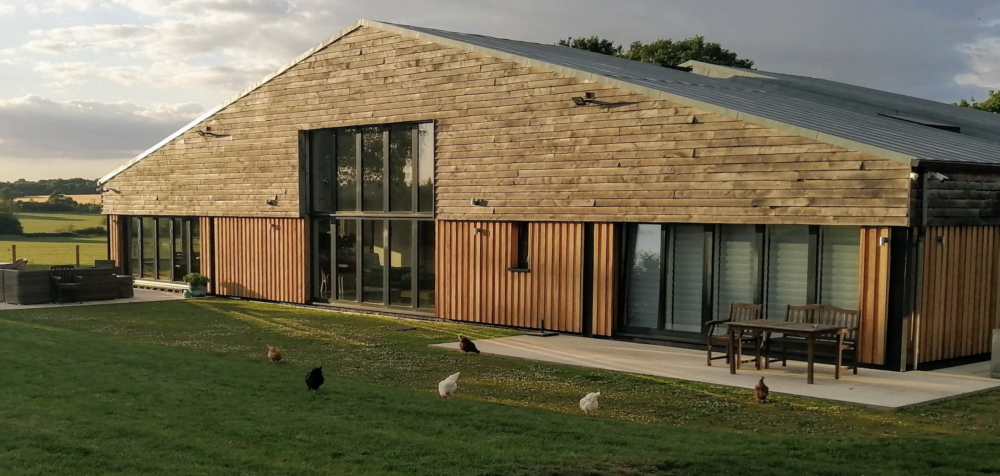
Hi @Furnace, a belated welcome. Once you have some success with the planning app, please come back an outline your walk from Class Q to full planning, especially as it seems you hope to site the new build in a different location to the agricultural building (if I've understood correctly). There's a few Class Q builds on the forum and a couple that have gone to full planning after securing a Class Q Approval. It's good to hear different experiences. I've now been living in a Class Q conversion of a cow shed for five and a half years, built mostly to PassivHaus principles, but without certification. I have an Advanced Foundation Technology Ltd. insulated raft, with a Touchwood Homes I-Joist frame, designed and engineered by Cullen Timber Design and insulated with blown cellulose fibre. I'm not sure if Touchwood Homes are still running, but the two brothers (Reuben & Adam) that were involved in my build are still involved with Passivhaus builds via https://mango-projects.co.uk/our-passivhaus-build-method/ and https://wilkinsonpassivhomes.co.uk/ I've not found the build method they've developed with Cullen Timber Design offered by anyone else, but can whole-heartedly recommend them. It's a very cost effective way of easily achieving Passivhaus performance levels. For window and Doors, I went with Internorm, but was very close to selecting Norsken. For cladding I went with a European Oak, featheredge cladding on the upper half, for a zero maintenance finish that tied in with an adjacent barn, and a board-on-board PAR Sapele vertical cladding on the lower half, that does require oiling every few years, on the lower half.
-
As @SteamyTea says, it needs to be worked out for each house unfortunately. ACH is based upon the volume within the thermal envelope and the m³/h.m²@50Pa figure is based upon the gross inner surface area of the thermal envelope, ie. floor, walls and ceiling/roof.
-
MVHR is key to PassivHaus principles due to the Max allowable air leakage rate of 0.6 ACH @ 50 Pa. The principle is to reduce energy loss via air leakage to the minimum reasonably achievable. A consequence of that is that MVHR is then required to keep the air in the house "healthy". As a rough approximation 0.6 ACH is typically around 1m³/h.m²@50Pa For English Building Regs, houses with an infiltration rate greater than 3m³/h.m²@50Pa do not require whole house mechanical ventilation as it's considered there's sufficient natural air leakage to keep a healthy air environment within the property. If you are above 3m³/h.m²@50Pa infiltration rate then increasing this further with an MVHR system will cause additional energy losses via the additional air changes caused by the MVHR, although +80% of the energy should be recovered at the expense of the electricity running the fans. MVHR is typically an expensive retrofit, and unless you plan to target sub a 3m³/h.m²@50Pa infiltration rate it will never pay for itself. Unless you plan to achieve PH targets, a more cost effective plan would be to achieve a >3m³/h.m²@50Pa, not install MVHR and use room extractors, perhaps with heat recovery, in wet rooms. Although I personally would want adjustable trickle vents in my windows to provide some level of additional, controllable ventilation if required. For info, I have a Airflow MVHR system, and the installation was designed by Airflow themselves. I remember one of their parameters being a Maximum infiltration rate of 5m³/h.m²@50Pa otherwise they wouldn't supply their MVHR system, with a recommendation of below 3m³/h.m²@50Pa.
-
I could have told you this would happen some day....
IanR replied to ProDave's topic in General Alternative Energy Issues
For me, this is the part of the Net Zero strategy that leaves me with some concern. The 14% FF generation is the higher end of the range, but, as part of the NZ Strategy this is Gas with CCUS. Unabated Gas powered generation is below 1%. My feeling is that CCUS remains, to some extent, snake oil and requires a development in technology that isn't guaranteed. I don't believe the industry is being honest about the level of CCUS that can be achieved today and are making unfounded predictions of capabilities for 2050. The NZ strategy currently, for the lowest cost technology mix to achieve Net Zero, I feel, will likely have shift to a higher reliance on either Nuclear or Hydrogen power generation, which will have higher costs associated than is currently considered. -
I could have told you this would happen some day....
IanR replied to ProDave's topic in General Alternative Energy Issues
It's certainly moved a long way from the original topic of Switzerland having a plan where they "may" have to ban EV's for "non-essential" journeys "if" the electricity imports they would normally rely upon in winter get restricted. Trying to connect that story to EV's not being able to replace ICE vehicles in the UK within the next 25 years (the target) is a bit of a stretch. -
Flow rates for Carpet, Wood ,Concrete and Tiles
IanR replied to Ben 64's topic in Underfloor Heating
With a heat pump you need to have the heating system running for much longer periods, this allows you to reduce the flow temp (once the slab is up to temp) and run the heat pump more efficiently. Your heat pump is only capable of putting around 1/3rd of the energy that a gas boiler can, into the UFH, so it needs to run at least 3 times as long to put the same energy into the house. Run it for even longer and you can run at lower temps and improve the efficiency. My system is heated via a heat pump with a flow temp of 32°C/33°C and a return temp of around 28°C, once everything is up to temp. The heat pump is allowed to run for up to 15 hours. It doesn't actually run for all that time, it just comes on and off during that period, when it needs to. At the start of the heating season though, it needs to run almost constantly for the allowed period for a couple of days to "charge" the slab up, but once up to temperature the slab stays a pretty a constant 21°C to 22°C at the surface. For heating, at the low flow temps, the heat pump is running at a COP of over 5. For hot water though the flow temp is 50°C, which drops the average COP a little. If you are struggling with getting your house up to temp, I'd let it run 24 hours a day until the target temp is met, then reduce the flow temps until you are in the 35°C to 40°C range where the heat pump efficiency will have improved, and then see if there's some "head room" in your system to start to restrict the number of hours the heat pump can run for. With regards to flow rates, this is more about balancing the system and getting each zone to it's target temp, at the same time. -
Flow rates for Carpet, Wood ,Concrete and Tiles
IanR replied to Ben 64's topic in Underfloor Heating
Flow rates are not set in stone so you can adjust these to suit your installation. But I'd check a few basics first. 45° is a high flow temp for UFH via heat pump. Do you know the return temp? Are you leaving the heat pump on for long periods or are you using it like a gas boiler, ie. trying to warm the house just during occupied periods? What's your floor build up? and pipe spacing? -
My architect suggest this for a family home, thought
IanR replied to Tennentslager's topic in New House & Self Build Design
Is your Architect a fan of Charles Rennie Mackintosh? https://www.bbc.co.uk/news/magazine-31855385 -
What do you think of Flextron for a zinc roof?
IanR replied to CalvinHobbes's topic in Photovoltaics (PV)
There's a fly-lead connecting to a small junction box at one end, that allows the arrays to be daisy-chained together. If "designed in" the fly-leads will be covered by a profile capping. -
What do you think of Flextron for a zinc roof?
IanR replied to CalvinHobbes's topic in Photovoltaics (PV)
Prices seem to be at a premium currently, unless you know differently. I've looked into similar to retro-fit on my aluminium roof. As well as the value, I didn't get an answer I was happy with regards how to replace them. The roof should have a 60 year life, but the PV 20 - 25, so at some point they will need replacing. When I asked, the manufactures had not run any trials with regards removing the modules and if damage could be avoided. -
Class Q - Steel portal barn conversion cost estimates
IanR replied to Stoph43's topic in Costing & Estimating
I'm going by the drawing provided that shows the outside surface of the Portal frame level with outside surface of the wall. I had assumed the profile sheeting is just in the upper areas, a short distance down from the eaves, as is typical with agricultural portal frames. Even if the profile sheeting went from eaves to floor, the 40mm that gives you, outside the portal frame is insufficient to stop a thermal bridge. You still need a rain screen on the outside of any insulation. The wording in Class Q is that you can't extend beyond the existing envelope at any point. How I dealt with that was to have an upper cladding outside of the portal frame, in the same way the original profile sheeting was, but have the lower cladding inset, level with the portal frame, in the same position the original walls were, which means the portal frame is still visible externally at the lower level, as it was on the original building. It is now recognised in the planning guidance that a Class Q Approval should be taken as material for a full planning. However that doesn't necessarily get you to a knock down and re-build. But it should at least allow the Class Q rule of not exceeding the existing building envelope at any point to be ignored, leading to the chance of brining the portal frame within the thermal envelope, and it should open up additional building works that are otherwise restricted by the Class Q.



