


IanR
-
Posts
1857 -
Joined
-
Days Won
6
Everything posted by IanR
-
If those are the conditions when condensation appears, it would need the inside pane to have dropped to 12.7°C to condensate. I can't find the reference now, but I'm sure I have something that shows the inner pane of 3G only dropping a couple of degrees when 0° outside. Hence the improved "comfort" over 2G. Is the condensation at the edges, where a cold bridge through the frame may be having an effect?
-
I've not experienced condensation on the inside in 4.5 years. What temp do you run your house at? and do you know the relative humidity in the rooms showing condensation?
-

Automation for passivehouse
IanR replied to markharro's topic in Networks, AV, Security & Automation
A 4G mobile router should be more than sufficient for "normal" use, if you are reasonably close to a mast. I tend to get at least 50Mb/s Down and 40 Mb/s Up, but can often see 80Mb/s - 90Mb/s Down. But, a little less robust than FTTC/FTTP, ie. need to reboot the router around once per week as speeds can drop, and sometimes have to play with what Bands the router is using to get LTE+ working. I'm with Three and get unlimited for £20 / month. I have the same view as above regards hard wiring back to a patch panel. If you mean streaming 8K, yes CAT 6 can easily handle multiple 8K streams. For avoiding over-heating, fixed shading, ie. brise soleil or overhang, is a better option, if correctly designed. If not then definitely automated. I believe PHPP assumes only 40% effective if not automated, since, quite rightly, if it's not automated it won't be used at the times you need it, since you are not always in and thinking about the house temp. I have Hunter Douglas external venetians. HD offer Automation with their blinds. I use Loxone for their automation in order to integrate with the other heating/cooling/comfort systems in the house. Other things to be thinking about are heating/cooling system control, MVHR control, roof vents, videocom, cctv, wireless access points, powering tech via PoE, phones (VoIP?). Have a look at whole house systems like Loxone, don't be pushed back by your initial view on price. I found the price of UFH controller, MVHR controller, roof vent controller, external blind controller, house alarm etc., mostly covered the initial cost of the Loxone starter setup. However, once you've got that in your plans you can get a bit carried away and the prices starts to build up. -
It's just for replacing fossil fuel boilers, unfortunately not for new builds. The Boiler Upgrade Scheme (BUS) https://www.ofgem.gov.uk/environmental-and-social-schemes/boiler-upgrade-scheme-bus
-
What product are you thinking of? I used a closed-cell, foam insulation, sprayed on to some internal steel columns, to exclude them from the thermal envelope and stop any risk of moisture getting to the cold, steel columns. It was very expensive in compared to the blown cellulose fibre I used elsewhere. Very difficult to control thickness - I over-sprayed and then trimmed back to the thickness I wanted. Difficult to contain, ie. if you spray in, to full-fill an enclosed timber structure, even with well-screwed ply on C24 studs, the expansion will "pop" open the timber structure.
-
I do have automated, external, Ventian blinds from Hunter Douglas. I'm well insulated, so my issues are over-heating rather than cold. Hunter Douglas can supply all the kit for them to be automated, ie. wind and rain sensors and controller, although I haven't used their automation as that would have made them stand alone and I wanted them integrated into the rest of the house automation, so for me Loxone looks after them. These aren't going to help with security though, nor for keeping the heat in.
-
MVHR Installation Issues
IanR replied to Nickw1982's topic in Mechanical Ventilation with Heat Recovery (MVHR)
I would look at it that the install needs to meet both the 10 year old HM Government guide AND the manufacturer's installation requirements. If one is stating a minimum 300mm separation, and another stating a minimum 1.5m separation, then the install must have 1.5m Min separation to meet all requirements. -
To heat 300l of water from 24°C to 48°C requires 8.4kWh of energy. If you're saying you are using 3kWh of electricity, then that sounds about right as with a COP of 2.8, your ASHP will generate that 8.4kWh of energy. So that doesn't sound like the ASHP is relying on an "additional heat", direct electric element to support the water heating. So heating of the water sounds to be working correctly. Like @ProDave says, it's the heat loss that appears to be the anomaly. Unless you have a very high flow rate on your shower, and you need the ASHP to come on sooner to start heating the water earlier when the temp drops. To stop the short cycling on space heating you need enough UFH loop to be permanently open so that the ASHP has around a 100l volume of water to push around. A Buffer would be better.
-
Hi, and welcome. You say you are limiting the time the HW cycle is running because it is costing too much. Can you give more detail? How much? how are you identifying that the cost is hot water production? What temp is the HW set to? HW is better left on all day, rather than limiting it to 2 x 1 hour slots. Do you know what temp your HW tank drops to and what the ASHP can lift it back up to in an hour? For your space heating, do you have a buffer tank, or does the ASHP run directly to UFH or Radiators? If the latter, is there a permanently open loop so the ASHP has a min 100l of water to push around? 55°C is high for space heating, is that the temp you have it set to? and where is that measured, flow or return? In a very well insulated timber frame with UFH you'd expect a flow temp of around 35°C
-
I believe you' need more than Solar Control glass, and relying on manual shutters won't work when you are away from the house or insolation levels are changeable, unless you just leave them shut, which detracts from having all that glazing. Or, are you powering the shutters and automating their use? Have you considered automated, external Venetians? My experience comes from a similar setup to yours, where I have 33m² of glazing on a South-West facade into an open plan area of a similar size to you, that is also double volume with vaulted ceilings. If I don't deploy the external blinds, then with as little as 3 hours of sunshine in Spring or Autumn the internal temp will be above 25°C and normally heading towards 28°C. In the Summer this would be over 30°C. Due to my window sizing and the wish for single span blinds, I've "only" covered 22m² of the glazed area, so I have 5m x 2.2m area uncovered by external blinds. This is OK in Spring and Autumn, it warms the area without over-heating, but in Summer I have to deploy active cooling through the ASHP. I'm considering adding a film to this window to reduce the cooling need.
-
Design considerations for new homes
IanR replied to SteamyTea's topic in Energy Efficient & Sustainable Design Concepts
In the long term these types of development are going to need a district heating solution. Any amenity land that's been included in the development will have to get repurposed with commercial heat pumps. -
Correct, there's no additional noise from a standing seam metal roof on a deck, than for other standard roofing materials. Profiled metal roofs, directly on to purlins, without a deck, can be noisy, but that's not a typical residential build up.
-
Zinc pricing for me came in around £110 - £120 /m² I paid around £55/m² for aluminium installed (not including OSB deck). My roof is Falzonal from Novellis Which ever metal roof you have, don't walk on it in work boots with stones in the soles. I always put trainers on when I go up on the roof.
-
The renderings looks great. Standing seam really compliments the buildings in my view. I can't help with the choice between two different, steel, pre-formed panel brands, I've not used steel, but I have looked at loads as well as aluminium, zinc and copper while deciding what to use on my own roof. Pre-formed steel appears to give a more clinical, consistent seaming, and from what I looked at tends to show less deformation in the panels. ie. the final result will not always look like the renderings and the brochures, but steel tends to show less distortions and warps. Maybe it's more forgiving to a less well-prepared deck and poor handling. The downsides of using a less ductile steel though is that to my eyes it doesn't look quite the same as a traditional seamed roof, partly because it has less of the idiosyncrasies of a zinc/copper/aluminium roof, but also, due to its less ductile nature, other materials need to be introduced for areas such as flashing to roof lights. There are sometimes flashing kits available that match roof lights to certain brands of steel roof, but that may narrow your choice. The worst case is that you'll need some flexi rubber flashing to integrate the roof lights, vent pipes etc.. My personal choice was to have everything made and formed on site, out of a one material, straight from the coil, to give the look of a traditional seamed roof. I went with Aluminium as it was similarly priced to steel. Forming on site gets you away from issues over panel length, although my roofers wouldn't go over 13m due to difficulties with handling. It also allows for bespoke trims, verges and flashings etc. The idiosyncrasies match well to my agricultural setting, but I do have minimal warping and deformation compared to some I have seen. Darker colours with a matt finish tend to disguise any imperfections.
-
As is often reported on this forum, SAP, and indeed the calcs MCS installers do, tend to over-estimate energy losses of homes that are built to, or close to, PH standards. The inbuilt defaults for cold bridging are an obvious anomaly, but I'm sure there are others. With the RHI grant based upon the SAP energy use, it's likely the figures used will be higher than what PHPP would calculate. I've heard of people gaming the system by not air testing prior to ASHP commissioning, so that a default 10m³/m².h is used in the calcs. I wondered if this was the reason for a push towards RHI payments being linked to metered energy usage, rather than Design Calcs, although that has never become mandatory. That's not my experience of Eco East Anglia. I felt their (MCS) install at mine was reasonable value. I can't see that a chunk was added, just because the MCS allows an RHI grant to be obtained. Yes, I could have got it a bit cheaper, by selecting cheaper products, but I wasn't going to install it myself, so needed someone to install and don't feel I paid that much of a premium for an MCS install.
-
MCS provides the entrance to RHI. My pricing is for Nibe, which are certainly not the cheapest, and I don't believe it would be possible to purchase a Nibe 12kW ASHP, Nibe 500l UVC, Nibe 200l Buffer, Nibe SMO 40 controller + all required brass and copper for £5.5K. My Install was around 5 man days, plus the back office work to fulfil MCS with detail heat loss calcs etc. Mine was around £11K all in, so I can see where the money was spent. I did have several other quotes though that ranged from £15K to £19K, so some companies do try it on.
-
Just read a bit of one of the articles you linked to and I believe the point it was making is that the air permeability tests measuring at 50Pa are over-estimating "general" permeability as the pressure difference is "typically" between 3Pa and 6Pa. The article didn't appear to be considering the max energy loss, but rather what the background ventilation rate is, so it would be correct for it not to consider worst case. (But I have not read the whole article.) For your max energy loss calculation to size your heating system to, you should use air permeability at 50Pa (windy day), 30 degree temp delta and ensure there is some head-room for hot water production.
-
Your energy loss also works out at 15W/m². You've done exceptionally well on a refurb if you've achieved that. 0.43 ACH is very low. Specialist builders (or self-builders), doing a new build with lots of tape and gaskets for all penetrations would be very happy with that level of air tightness. Have you got mechanical ventilation? you need it with that level of air tightness in order to bring fresh air in. If you've done lots of working fixing all the leak paths then I'd go with 3ACH on a refurb, and somewhere between 5 and 10 if you haven't. Better to over-estimate the energy loss, rather than under spec the heating system. Without the UFH you can expect to pay £10K - £12K for the install from a decent MCS installer. With the cost of the UFH on top, it depends on the work and the spec, but the price sounds a little expensive. Have you tried Eco East Anglia? The RHI is to cover the cost of the ASHP & UVC, over and above what gas combi would cost. Are you saying that's unlikely due to you not being able to get it commissioned by 31.03.2021?
-
Seems low for a refurb. What's you internal floor area? what Air tightness value did you use? and what inside to outside temp delta have you based the calc on? My total energy loss at a 30 degree delta T is just under 15W/m². My U values are Walls 0.12, Roof 0.11, Floor 0.09, Windows and Doors 0.65, no/minimal cold bridging and air tightness is around 0.1m³/m².h@50Pa Edited to add: Actually, that's my calculated energy loss which used an air tightness of around 0.4m³/m².h@50Pa iirc, rather than my actual air tightness.
-
MVHR Installation Issues
IanR replied to Nickw1982's topic in Mechanical Ventilation with Heat Recovery (MVHR)
Ref. https://www.vent-axia.com/file/792933/download?token=6vlpcIyG It also states: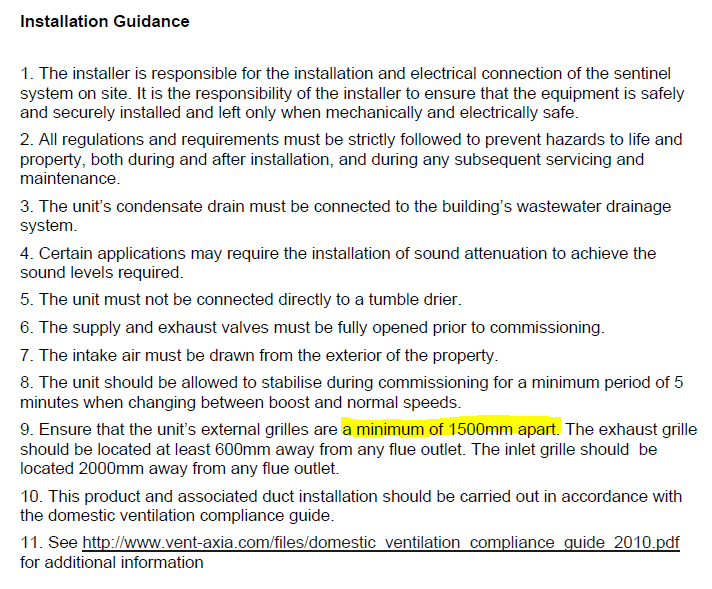
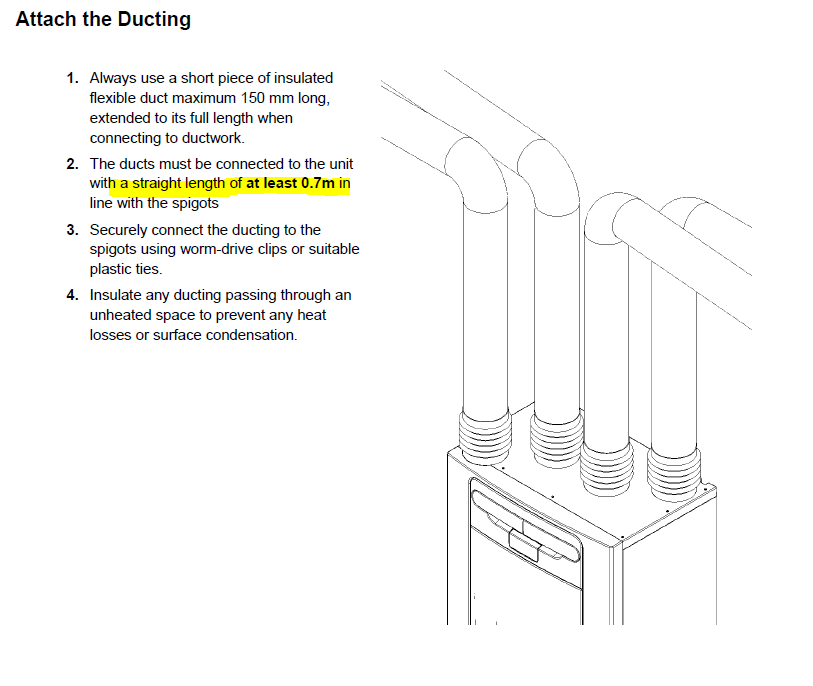
-
MVHR Installation Issues
IanR replied to Nickw1982's topic in Mechanical Ventilation with Heat Recovery (MVHR)
Without an air tightness test there is no knowing even if an MVHR will be effective at heat recovery. Opening a window is likely a better option. Today's Building Regs in England require an air tightness in a new build of better than 10m³/m².h @50Pa. MVHRs are ineffective (for the heat recovery portion) at more than 5m³/m².h @50Pa . At less than 3m³/m².h @50Pa building regs wants centralised mechanical ventilation to ensure sufficient fresh air. It's unlikely a 2012 house, built by a volume builder has achieved better than 3m³/m².h @50Pa, unless a subsequent owner has done lots of work to improve air tightness. If you are feeling it is hot a stuffy up stairs, there could be plenty of air flow, but the fabric of your building has heated up and is rewarming the fresh air as it comes in, giving you the impression there is no air flow. Dormers and rooms in roof are especially prone to this. -
MVHR Installation Issues
IanR replied to Nickw1982's topic in Mechanical Ventilation with Heat Recovery (MVHR)
Hi Nick, and welcome. All the points you have made are valid. The only one they could argue is the 3rd. While the fixings do not look substantial enough, it hasn't failed (yet). But I wouldn't be happy with it. As per @MJNewton, I'm more concerned that MVHR will not fix your issue, and is not required in your house. Why do you think it is "air tight", have you had an air infiltration test done? Do you know the air tightness figure for the house? When you say uncomfortable, are you referring to excessive heat? Are you a full 2 storey, or do you have rooms/dormers in the roof? If the MVHR was installed to get rid of the excess heat, unfortunately it will have negligible effect during the day when it is hot, and only start to help overnight when the ambient temperature outside drops. -
Not for then pumping into homes for heating, as far as I know. It seems to be being considered as part of the energy storage mix for power generation, although co-located with Nuclear and powered by excess Nuclear, when renewables are fulfilling the demand. Whichever way, you can't then consider the excess usage for hydrogen production to be free or low cost, if you're able to make use of more of the renewable energy generated, then it lowers the overall cost of that energy, which is a good thing, but it still requires 6 times more of that energy to heat a house with hydrogen, than it does with a heat pump.
-
Installation Deadline for ASHP for RHI
IanR replied to Andeh's topic in Air Source Heat Pumps (ASHP)
Are you paying the builder in instalments? If the planning you have at present is for an extension, then the builder will need to charge you VAT for that work. He'll only be able to zero rate the invoices once you have Planning Approved for the demolition and rebuild. You won't be able to recover the VAT charged on the invoices from the builder prior to when you have the new Planning is Approved. The HMRC recommendation for a build that changes from an extension to a demolition and rebuild is that all work stops until the new build planning is in place. -
I believe that current commercially viable green hydrogen production requires 2 - 2.5 kWh of renewable energy to create 1kWh of hydrogen.



