


IanR
-
Posts
1857 -
Joined
-
Days Won
6
Everything posted by IanR
-
I've been looking at similar for my own roof. There seems a bit of a premium to pay over conventional rigid module on frame (or direct bracket mounted on to seam) We're you involved in this install.
-
That's really good news. Seems the Boiler Upgrade Scheme will be extended to include to include self-builds, as per RHI. It's the logical step to ensure self-builds continue to consider ASHPs up to 2025, when they will be forced to. Assuming the BUS legislation retains this once it gets on to the statute books, then for this scenario ASHP seems a "no brainer". The £5K grant should more than cover any additional cost in installing an ASHP. The Building Regs changes for next year require a "low temp" (under 55°C flow temp) heating systems, so I assume that will bake in a Hot Water cylinder into the install costs for any system in a new build and swing the needle in favour of UFH. The £5K grant only then needs to cover the difference in cost of LPG/Oil Boiler + tank with the cost of an ASHP. A benefit of ASHP and UFH is that it can also bring some active cooling to the house, assuming the BUS rules will allow ASHPs to cool, as they do under RHI with the revised rules. I don't believe this is correct, off-gas-grid fossil fuel boilers are already in the sights of the Government to be tackled first. As well as banning their replacement from 2026 I'm sure they will pull on all the levers they can to persuade owners to move over to ASHPs.
-
Can you still get LPG at that price? Local to me it looks around 67p a litre. Day to day running costs for ASHP are lower than Oil and LPG typically, but not if you can currently buy LPG for under 40p per litre. If you can then LPG for you will be a similar cost (day-to-day) or slightly cheaper, at the moment. The Government have stated they will move the Green Taxes from Electricity to Fossil Fuels. Currently there are 22% green taxes on Electricity, so this will move further in favour of Electricity, however they've only said it will be done this decade, so may be a gradual change. Off-gas-grid, fossil fuel boilers are the low hanging fruit that will become the first victims of the move to Net Zero. iirc the plan is to ban their replacement from 2026. Across the year a well spec'd ASHP costs the same to run as a gas boiler in respect to day-to-day running costs.
-
Your EPC looks around about correct for the U Values. All need to improve. The 250mm Jet floor is 250mm hollow-core concrete is, it not? so not helping with your U value. 150mm PIR on top is insufficient if you wish to build better than building regs. Same for the roof 125mm PIR in the roof just isn't enough, (if you wish to build better than building regs.) As Dave says the walls also need improving, although on a bungalow I'd invest more into floor and roof.
-
I've never worked through a Class R, so am not aware of the intricacies, but, if the land and building met the requirements for a Class R change of use to to flexible business Use, does it not meet the requirements for a Class Q to C3 residential? You've mentioned "dilapidated", perhaps Class Q has a higher bar for being structurally capable of conversion? Once the development is capable of being Used, within its new Usage category, the material change of Use occurs. But, that still allows a permitted (but not actioned) Change of Use to be taken in to consideration by the LPA when considering a subsequent Planning Application. ie. LPAs should consider an existing Approved Class Q as material, if a Full planning application is submitted for the site.
-

Heat in Buildings Strategy Statement
IanR replied to IanR's topic in Environmental Building Politics
I missed that the UK Government got their Heat and Buildings Strategy launched at the end of October. It must have been the shortly after the Commons statement. https://assets.publishing.service.gov.uk/government/uploads/system/uploads/attachment_data/file/1036226/E02666137_CP_388_Heat_and_Buildings_Accessible.pdf The time-line as set out: Looks like the Gas industries lobbying has had the desired effect and a door has been left open for Hydrogen Boilers supplied by the Gas Grid, with a decision in 2026 on whether to keep this as an option. In the meantime, off-gas-grid properties will be banned from replacing fossil fuel boilers from 2026. A decision on the role of Bioenergy in decarbonising heat is also due in 2026. To me, that suggests off-gas-grid properties should make use of the RHI/BUS grant, while it is still available.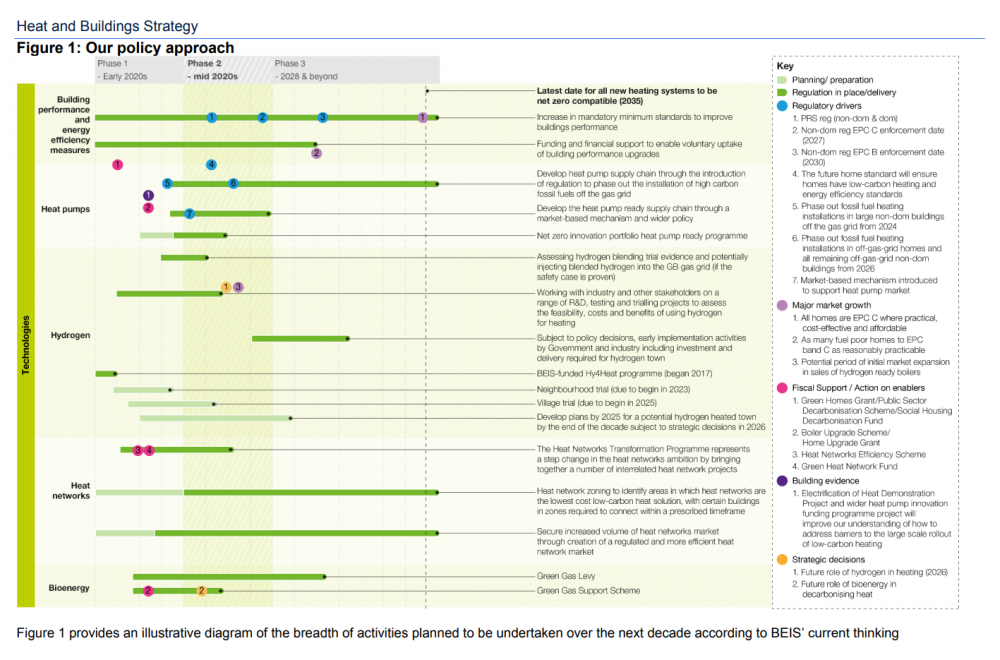
-
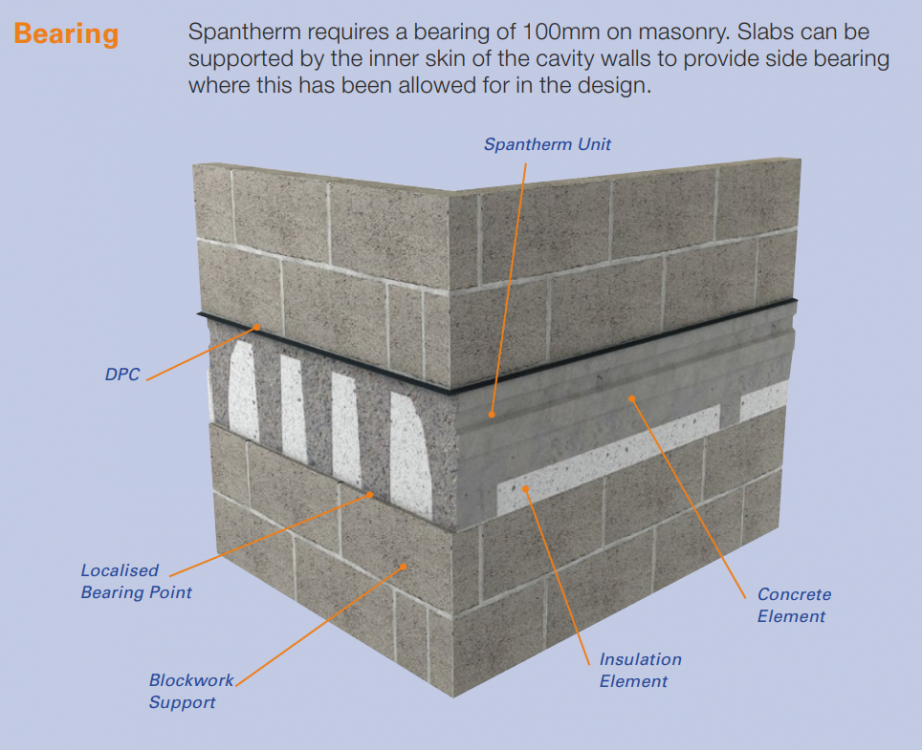
I don't believe that section shows he whole picture, as I mentioned before the EPS can't take the loads on to a 100mm block plinth. This image shows it better While the section you showed is not wrong, If you the moved the section along the span a little it would show pre-cast concrete going all the way down to the block plinth. But, this image also shows that along the length of the pre-cast section, there's only 1 localised bearing point every 1m or so, which isn't bad. Although along the width of the pre-cast section it looks like 100mm of localised bearing point (cold bridge) for every 100mm on EPS.
-
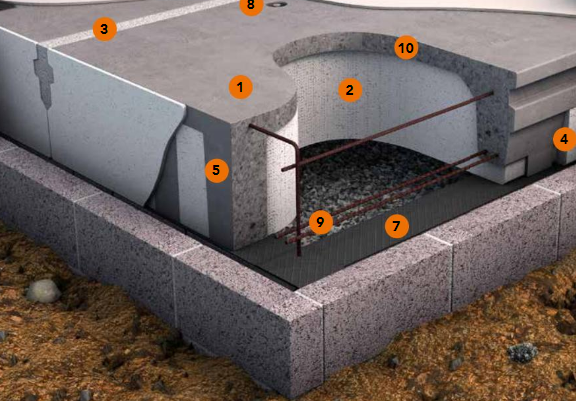
I don't believe it sits on 60mm for the entire perimeter, EPS couldn't take the loads on such a small area, so the there's concrete going all the way down to the blocks. The brochure gives a 2D Psi calc for the cold bridge, that looks reasonable, but it does cut the section where there is EPS between concrete and block plinth. Would be good to see the same calc done for the section where the concrete goes all the way down to the block plinth. Having said that the overall U value they calculate (0.11W/m².K) includes the perimeter cold bridges. As long as they are not using smoke and mirrors then I feel the UFH could go in a screed straight on the precast sections. I probably wouldn't run the pipes too close to an external wall though, ie. at least 200mm away as there is still a bit of a cold bridge.
-
Is there a cold bridge through slab -> block work -> ground beam -> piles? I can't imagine there's EPS sandwiched between Slab and Block work? There wouldn't be the surface area to take the loads...would there?
-
I'm not understanding your build up. Is the slab ground bearing? ie. you are placing EPS on a prepared sub-floor that is sitting on earth, and then you plan to place precast concrete sections on to that EPS? What are your load bearing walls sitting on? A Wall-Floor Section would help. Wunda probably isn't expecting you to have 325mm insulation under your slab, hence the thermal break to the screed.
-
Have you poured the Slab yet are or you at design phase? Most of us with insulated slabs/rafts, put the UFH in the concrete without a screed. But, typically, minimum 100mm thick, rather than 50mm. Who spec'd the slab? If you've poured already, 60mm screed on 50mm slab, is pretty close to what most of us have, ie. 100mm concrete. UFH works fine. Some have 200mm concrete an still report no issues.
-
Yes, in relation to your opinion that: "what seems to be happening in this thread in particular, but also more generally in the climate debate, is that healthy and necessary scepticism is being misinterpreted and mislabelled as "denial." Which could not have been in relation to your own comments, as you had not made such comments in this thread, so you were speaking about others' comments that you felt were being misinterpreted as denial. Again, I made no such claim about your posts being denial, and have not seem others' make such a claim about your posts. I'll not be commenting on this again.
-
No. I've made no such claim about your posts, not seen your posts labelled as denial others. I have commented on your opinion that. My recollection is that your own posts in this thread, were focused on disputing what science is, rather than any particular aspect of climate debate itself, so your opinion above was how others' posts were being treated.
-
Unfortunately Ofgem are a bit slow in providing any new info about the new BUS scheme, so there's nothing on topic to discuss for the time being. We'll just have to make do with off-topic discussion until Ofgem jump into action.
-
You are conflating 2 separate debates. Claiming climate change is not happening and the evidence that it is is produced by corrupt Scientists, is denial. With Climate Change an accepted phenomena, debating what we do about it is entirely valid, and disagreeing with the current direction of travel is not denial. However to have a discussion of value you'd need to propose an alternative, not just reason why it is wrong. The opinions shot down within this thread are the former. I made no comment regarding the IB post.
-
I must be reading a different thread. I'm only reading regurgitated, +10 year old disproved conspiracies about corrupt scientists working in cahoots with political leaders to deceive the world's population. That's not new thinking, healthy scepticism or alternative forms of knowledge, that is denial. Thankfully the debate between the grown ups has moved on to what can be done to limit the damage that climate change will do.
-
And you offered "philosophers of ancient Greece for theorizing about the existence of the atom" as an equivalent to disputing Climate Change, which of course it is not, since the ancient Greek philosophers were not disputing overwhelming evidence against the atom's existence.
-
But there wasn't overwhelming evidence the atom did not exist.
-
That's pretty vague, what is that NASA released that had been tampered with? Again, pretty vague. "tampering" and "manipulated" is to say a deliberate action to change the data in a way that it provides a fake outcome. There are of course many genuine reasons why data is filtered, which wouldn't fit the definition of tampering or manipulated.
-
When was the first case of data tampering?
-
If internal temp is still at 20°C, then dew point is up to 13.7°C with 67% RH. So, yes, inner pane is above dew point. https://www.calculator.net/dew-point-calculator.html
-
RH inside will tend to drop when it's cold outside. Mine is in the 40% - 50% range at the moment. I'd normally be at around 60% in the summer.
- 131 replies
-
- 1
-

-
- triple glazing
- condensation
- (and 3 more)
-
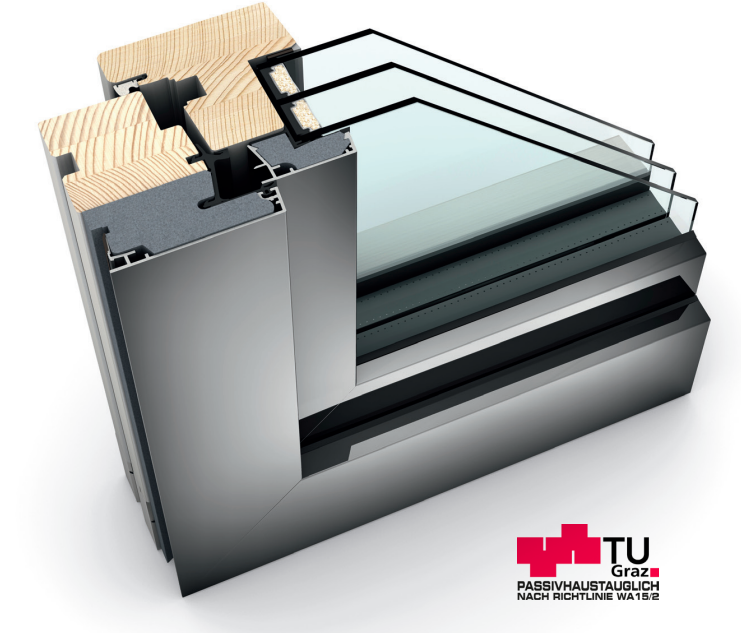
I've got the 310's with the foam under the cladding, which is what I thought you meant by "thermal breaks" Looks like most of their Aluclad options now have something similar. It wasn't on all their ranges when I purchased.
-
How odd, I have the same windows, with the extra foam between cladding and timber frame.
-
Is it an Aluminium frame? Obviously thermally broken, but the thermal breaks can be quite thin, I wonder if there's a small cold bridge.




