IanR
-
Posts
1841 -
Joined
-
Days Won
6
Everything posted by IanR
-
I've got both internal and external blinds. I'm happy the external blinds block out enough light. I only get leaks through the small apertures in the blinds through which the chords run and when the blind is closed the chords (tapes) mostly fill the aperture. But, the blinds need to be lifted in moderate to high winds, so sometimes you need the internal blinds for privacy.
-

Boiler Upgrade Scheme Grant - Actions to Take Now
IanR replied to Green Power's topic in Air Source Heat Pumps (ASHP)
I'd sort this out: Loft and cavity wall insulation is not only a "no-brainer", but also prepares the property for an ASHP heating system where reduced energy losses better support a lower energy input into the property over a longer period of day. Next I'd look at improving the output of the emitters, either by increasing their size or swapping for fan assisted radiators, to allow a lower flow temp for improved ASHP efficiency. -
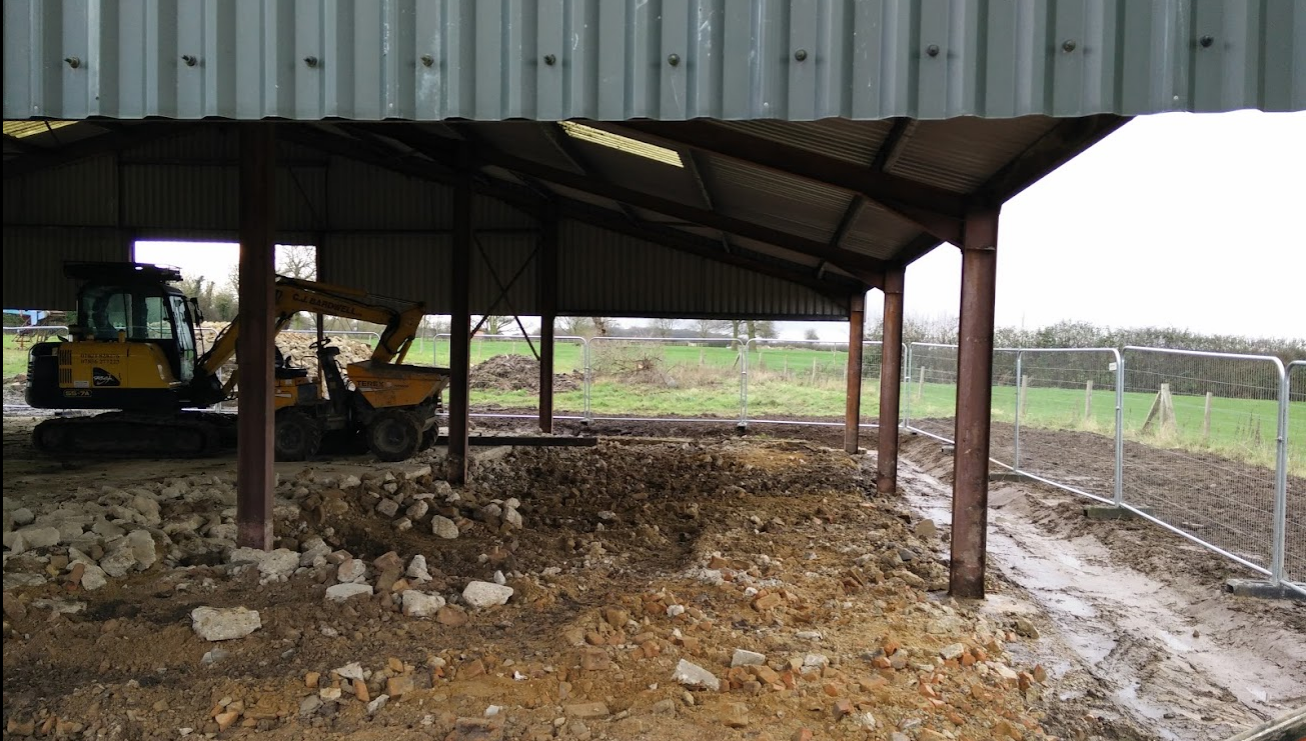
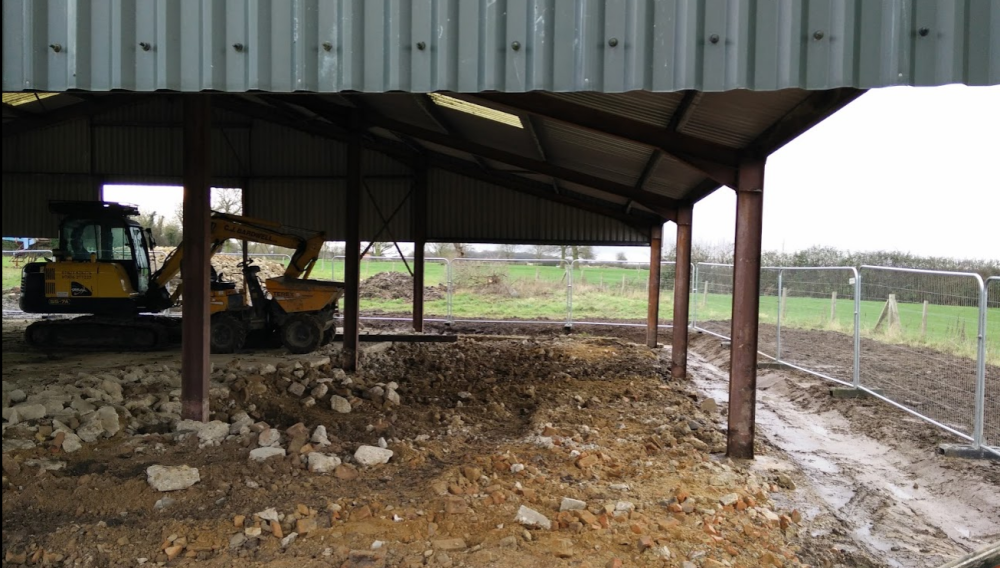
We pulled up around 500m² of agricultural slab in just over a week with a 5T excavator, pecker and a 1T dumper. We were slowed down by a reinforced perimeter ring-beam that had 30 - 40mm rebar in it and had to cut the rebar into manageable lengths. Ours was also a cowshed, so had a significant rake on the slab for slurry drainage. We'd have lost a lot of height to have mass infilled over the top and then insulated. The 5T machine broke it up quickly. I did other channels through hard-standing areas with a 1T, and that was hard going.
-
Timber frame vs ICF vs Traditional masonry for a new build
IanR replied to Indy's topic in General Construction Issues
Ground-bearing insulated raft for me also. The sole-plate was sealed to the slab with a non-curing butyl sealer and bolted down. The loads from my internal load-bearing walls were just low enough to have avoided internal beams, however we still included them to stabilise the raft and remove any risk of it curling up as it cured. The internal beams were 200mm thick, and the integral perimeter ring beam was 300mm. The majority of the raft is 100mm thick with 300mm of EPS100 under. The UFH was stapled to the EPS with A193 mesh over the top. With a light-weight super-structure I didn't need the external, separate ring beam for strength, but it removed all thermal bridges. If I did it again I'd avoid this extra detail and small gain it delivers. The raft sits on 40mm of pea shingle over 160mm of compacted Type I, directly on to clay. A few pictures: I went with a power-floated finish as I planned a 4mm thick poured resin floor finish directly over the top for the living areas.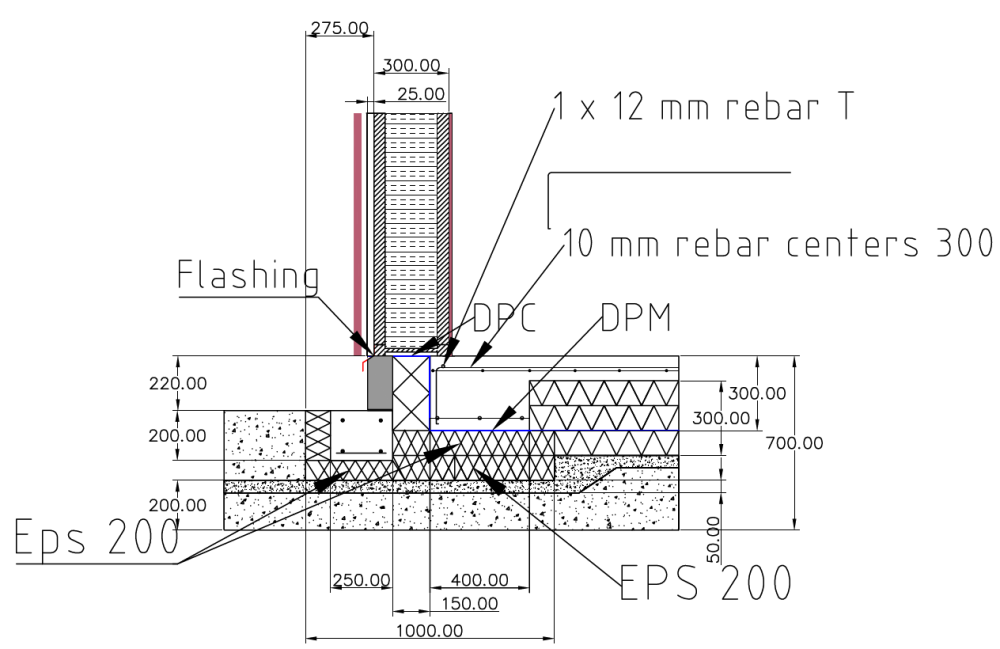
-
I've edged my front path with Granite kerbs and inset some LED lamps in 8 of them. They needed 32mm holes through the 150mm thickness. I really regretted not getting them pre-drilled, which the supplier offered, it was an awful job. I used diamond tip core drills that were £65 pound a pop and got two or three holes out of each drill. Had to take it slow and use water to keep it cool. If you go too fast the tool just melts. I'm sure it took me over an hour each hole. Good luck.
-
Poured Resin Floor finished and a definite success!!!
IanR replied to IanR's topic in General Flooring
I definitely would. 5 years in and it still looks like new....almost everywhere.. We were very careful with it while the build finished, covering with a thin cortex sheeting, and giving all the trades mats or similar for putting doors, cabinets etc on to to avoid any accidents. We are still careful, in a similar way you would be with a wood floor. All our furniture has felt pads, outside shoes tend not to make it beyond the boot room. Our boot room gets very heavy use, we live on an ex-farm and have 3 young boys and two 60kg dogs. The floor gets filthy, and outside boots come in with stones in the soles. Even this floor will mop up and look excellent, if not quite brand new. In the boot room there are two surface scratches, that are noticeable as the dirt catches in them and our floor is a light grey. The scratches are our fault, a metal dog crate got dragged across it without thinking, but work boots haven't made any wear marks. We found a slight oddity with getting "dull" patches where we have some rugs and mats. Only just noticeable and seems to be worse if there's a backing on the rug/mat that is dark in colour. Remove the mat and these patches seem to fade away after a while. Overall, I would definitely have it again. The groutless/seamless finish leaves no dirt traps. We can leave a robovac to take away 95% of the daily detritus from children and dogs, and just mop it perhaps once a week and it stays looking spotless. If you accept it's not as hardy as a porcelain tile, it's a fantastic floor finish. I understand that it can go down on a suspended floor, but I believe there's more prep in the way of additional layers of, I think, ply to reduce the risk of any movement. -
Decentralised MVHR
IanR replied to HelenS's topic in Mechanical Ventilation with Heat Recovery (MVHR)
Hello @HelenS, and welcome. I can't help with the decentralised MVHR, but just taking a step back, are you renovating to a level where there is a benefit from Heat Recovery? ie. planning to get at least below 5m³/m².h @50Pa infiltration rate, and ideally below 3m³/m².h MVHR can be over-sold, and really only comes in to its own when you are sufficiently air tight that mechanical ventilation is required for good air quality. -
My installation has the 12kW F2040 about 500mm off the side of the house. I then have around 14m of pre-insulated, Dia 32mm twin duct bringing the heated water under my slab and up into the house + a further approx 9m of insulated 32mm pipe continuing the route up to the 1st floor storage area. That 23m pipe run is far more than the suggested 10m limit, so I took care with insulating this pipe to reduce heat loss. I then have a 200l buffer for space heating and cooling via UFH and a 500l UVC for hot water. I have the SMO40 controller and MODBUS link. Flow temps are run at 50°C for hot water, 33°C for space heating and 12.5° for cooling. The ASHP App requires a subscription to allow any control, and then I don't know what you get to control. Without a subscription it gives you the current status and a month's history data, which is reasonably handy. If you want a "Smart" heating App, that would be from the Smart Thermostat you went with. I have the ASHP and UFH manifolds linked up to my Loxone HA, via the MODBUS link (for the ASHP), and Loxone has an excellent App, in my view. The 12kW F2040 has no problem supplying hot water to the 500l UVC for our family of 5, we've never been short of hot water in 5 years. For space heating the 12kW unit is oversized for my heat loss, but the buffer stops any short cycling.
-
F2040 - Yep, got one of those. Nibe is a good brand, I've had no issues with mine.
-
Welcome! Is the system commissioned? Did you swap from a fossil fuel boiler? What's your predicted space heating energy requirement (heat loss), and what flow temp are you running the radiators at. Did you have to increase the size of the rads? ...so many questions.
-
No, but it would explain what comes across as a lack of real world experience. You sound like you share the same contempt that @CharlieKLP does. Just because someone does not value your input, it does not mean they are wrong. Compromise does not mean settling for something less than ideal. It just means balancing competing requirements to the client's priorities. Unless you know @CharlieKLP personally, how would you? Comes across as contempt to me. But if the free advice doesn't meet the posters requirement, you can't expect them to "take" it. Agreed.
-
I'm not really sure who you think you are. From what you have said previously, you are an employee of someone else's Architectural practice, has an actual house yet been built that is your sole design, and not one that the partners have been consulted on. What makes you think you are the arbiter of what a "beautiful" house is? Isn't that for the person paying the bill and choosing to live in the house to decide. House design is a compromise, and one that first and foremost has to be financially viable. There's no point building a "pretty" house in suburbia if what makes it pretty knocks 30m² off the floor plan, a bedroom and £150K off the value. For many plots "beautiful" is down the priority list, and rightly so. You say you want to head out on your own and have the self build community finance your new business venture. However, you appear to have nothing but contempt for them. A little humility, and listen to what the paying customer wants.
-
Not sure what you mean there. wrt RHI closing, System needs to be installed and commissioned prior to midnight 31.03.2022, and paperwork submitted. If you pay a deposit to an installer, make sure it's returnable if they fail to commission and provide you with all required paperwork before 31.03.2022.
-
Is my house suitable?
IanR replied to jayc89's topic in Mechanical Ventilation with Heat Recovery (MVHR)
I'll play devils advocate and say probably not. It's unlikely that your final air tightness will be better than 5m³/m².h @50Pa. Maybe your extension will be built to a level that could achieve slightly better, but it is unlikely that in combination with the existing house that the overall air tightness will be better. Down to an infiltration rate of 3m³/m².h @50Pa, building regs imply that mechanical ventilation is unnecessary since there is sufficient background air changes for reasonable air quality. Yes, these back ground air changes are uncontrolled and have no heat recovery, but they are there whether or not you fit MVHR. If you do fit MVHR you are creating additional air changes, although you should recover 80% - 90% of the energy, but you loose the 10-20 percentage points unnecessarily, since you don't need the mechanical ventilation for air quality. For me, with a ventilation rate above 3m³/m².h @50Pa, MVHR is an unnecessary expense that requires future filter changes and occasional servicing. Room extractors in bathrooms and trickle vents in the new windows are more cost effective. If you want to be sure, pay a couple of hundred pounds for an air tightness test prior to the extension starting and see what your baseline figure is. If it is close to say, 5m³/m².h @50Pa, then maybe it's worth doing the extra detailing on the extension to try and bring the overall figure down to somewhere near where an MVHR system adds value. -
What's leading to the need for expansion joints. On my 26m x 19m insulated raft, expansion joints were discussed, but only by the ground workers that I was asking to quote. In the end I went with a group used to doing warehouses who were happy going 4 times the size without expansion joints.
-
Yes, ASHP effectively runs in reverse, removing energy from the fluid in the "heating" system and passing it to the outside air. Since I have a buffer tank feeding my UFH, it cools the buffer, which is then circulated through the UFH, cooling the slab. You have to be careful to not reduce any un-insulated surfaces to below the dew point, otherwise condensation will form. 14°C should generally be safe. I can run my buffer down to around 12°C which can reduce the slab surface temp to 18°C, without any risk of condensation and I find that quite effective at controlling over-heating, although I do take other measures to reduce solar gain. I've no experience of cooling via radiators, I would imagine, due to the smaller surface area, you would need to drop the temp further for it to be effective, which would then likely put you in condensation territory. Happy to be corrected if others have it working. Others also use fan coil units, cooled via their ASHP, which are reported to be effective. For this it would be relatively easy to insulate all the pipework to allow the ASHP to reduce the temp to its minimum, perhaps 7°C for some quite effective air cooling.
-
Back when I ordered it, the Nibe had one of the better SCOPs, as well as cooling out-of-the-box (if you added the cooling module), avoiding the need for any hack. The MODBUS also allowed for connection to Loxone, including cooling control. The SCOP of the competitors has improved, and I'd expect inter-connectivity also. If cooling is also available (OTB) then I'd have more choice making the decision today. I've found the NIbe as good as could be expected, It requires very little attention, just getting on with the job.
-
The full process is not yet laid out, the obligatory "Consultation" has just closed, so assume Ofgem will provide more information on how the scheme will run in the next few weeks. If you read the Consultation it appears the installers will need to apply for a voucher on behalf of the home owner, so the application needs to be made prior to the install, unlike RHI. https://www.ofgem.gov.uk/environmental-and-social-schemes/boiler-upgrade-scheme-bus https://www.ofgem.gov.uk/publications/consultation-ofgems-administration-boiler-upgrade-scheme https://www.ofgem.gov.uk/sites/default/files/2021-12/Administration of the Boiler Upgrade Scheme - Ofgemconsultation.pdf
-
Very similar to my own install. I paid a few hundred pound more the same ASHP, the 500l version of the UVC, the 200l version of the buffer, plus the cooling module and MODBUS unit, fully installed including all brass and copper. There's quite a few on the forum that paid similar amounts for MCS Installs, but there does seem to be a lot of quotes for +40% more, so some companies do try it on. With RHI soon to be replaced by a lower grant, I expect the companies inclined to profit from the grant are making the most out of the rush to get systems installed and commissioned before the deadline.
-
It's sounding more like a leak than condensation. Are the external finishes all on, you mentioned the sill being in place. Is it possible water is getting on to the rebates and trickling down to pool under the sill and find a way through what is probably expanded foam under the frame?
-
ASHP help needed with my daft questions…!
IanR replied to Tim S's topic in Air Source Heat Pumps (ASHP)
@Tim S needs to establish accurate energy-loss figures, based on achievable air-tightness. The ASHP doesn't need to run all day, especially with wet UFH and a slab/screed to "charge up". Whatever ASHP size you have there will be days when only a few kWh of energy are required. The control side just needs to be set up so that the ASHP doesn't run unless there's at least an hours heating to do, which is made even easier if you have a buffer tank. -
Insulated Raft Slab Foundations - Finished Flooring
IanR replied to TBlew's topic in General Self Build & DIY Discussion
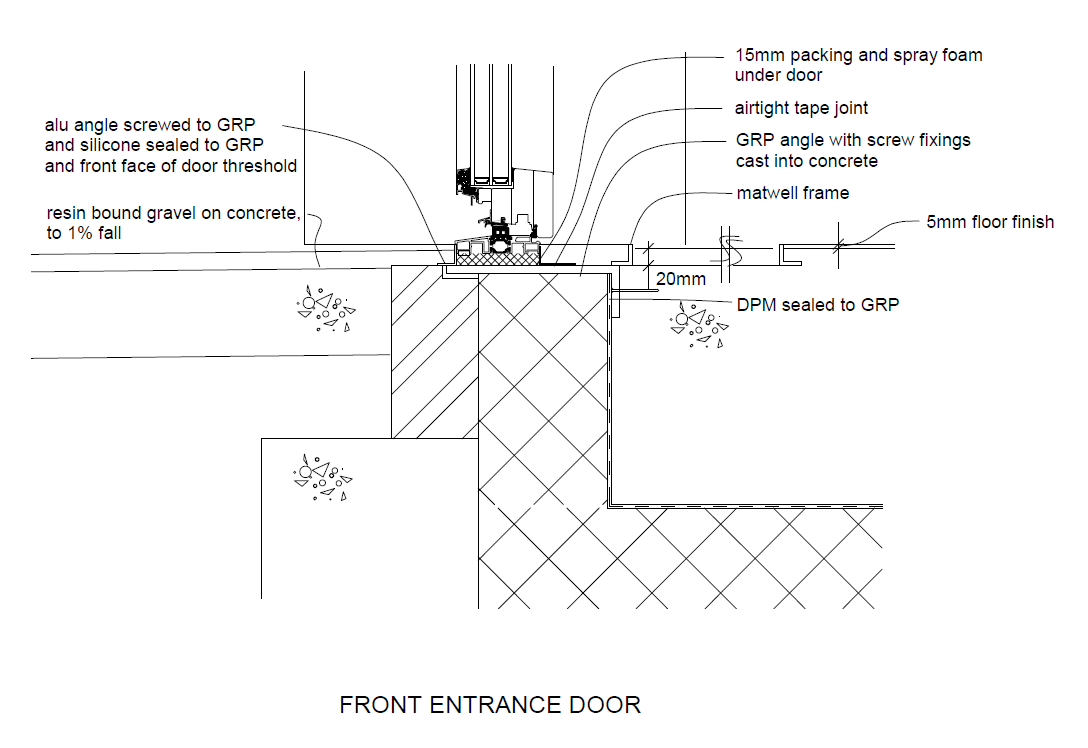
Yes the sole-plate height is generally set on top of the Slab, but windows/doors are best outside of the slab, sitting over the insulated perimeter, or at least partially sitting over the insulated perimeter (to avoid a cold bridge), with the height adjusted to meet your Finished Floor Level, not the top of the slab, unless you are have polished concrete. Something along the lines of This actually has a mat well recessed 20mm into the slab, and the door frame is set over the EPS upstand on a 9mm thick GRP "L" Profile. The door threshold is set at a height that brings it flush with the FFL, which is a 5mm thick poured resin over the power-floated slab. Edited to add: What's you planned wall build up, and does it insulation layer of the wall sit over the insulated perimeter of the slab?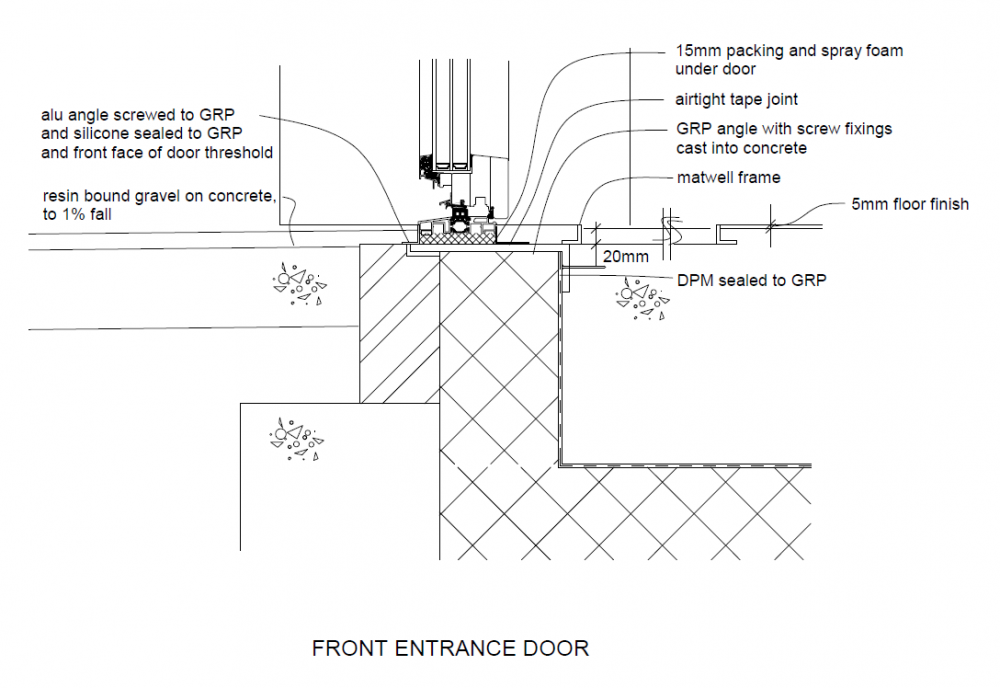
-
Insulated Raft Slab Foundations - Finished Flooring
IanR replied to TBlew's topic in General Self Build & DIY Discussion
Why don't you choose the floor finish you want and then set the threshold at the height above slab that matches the build up of your chosen finish? I've got just 4mm of poured resin flooring on my power-floated slab, and the thresholds are set down to match this. -
3G = triple glazed Just to be clear, Is the white/silver section that is running close to horizontal the window frame? and the sill you mention, is it the external sill, not shown in the picture. I can't make out the black cylindrical object in the top right hand corner. Does this only happen when it rains? Do you ever see condensation on any surface. Or is it the absence of evidence of condensation that has lead the installer to say "it's forming on the screws" Condensation is more likely to form on the inside in your scenario, where the internal air is slightly warmer than external and saturated due to the drying out process, then coming into contact with a cooler surface of the frame or glass.
-
ASHP help needed with my daft questions…!
IanR replied to Tim S's topic in Air Source Heat Pumps (ASHP)
Are you saying your air tightness is 0.7 ACH? and I guess Wunda's energy loss calcs were done with less that the 30° Δt you used. If so the worst case heat energy requirement to maintain 20°C is 3.9kW. Since you don't want the ASHP running space heating all day and it needs to occasionally heat the water cylinder, a 6kW ASHP would maintain the temp with less than 16 hours running in any 24. So I'd go with 6kW if you are confident on your heat loss calcs, incl. air tightness. Yes, ASHPs have two modes that run separately for space heating and hot water. Each can have their flow temp set independently.