


JohnMo
-
Posts
13292 -
Joined
-
Last visited
-
Days Won
200
Everything posted by JohnMo
-

Acoustic insulation thickness and wiring in studs
JohnMo replied to junglejim's topic in Timber Frame
We used Rockwool Flexi and it stays put very well. Just make a slightly interference fit. -
Would add to this - if airtight isn't at the top of your list of priorities, don't bother with MVHR. Look at demand control dMEV or MEV instead. No need to add heating to the MVHR unit, a good unit is a big block of insulation. Outside the heated environment all your ducts need good insulation and vapour protection to stop condensation. In a loft you need access ladder, access walkway and a maintenance area all as proper flooring. Or better still don't put it it up there.
-
Acoustic insulation thickness and wiring in studs
JohnMo replied to junglejim's topic in Timber Frame
50mm in the centre of the studs. The air gap make the whole wall perform better from noise perspective. And the wiring has somewhere to go -
For a Passivhaus you are make stuff complex. Just do the towel rads with electric heating elements, then you can use them for the 70% of the year you won't want the heating on. You can then run the heat pump at 26-28 degs.
-
You are really running your UFH like a radiator system, it's your system your choice, but keep an eye on floor surface temperature. Actual flow temp doesn't mean much, floor surface temp does.
-
Computer models just use some basic science. This chart and room by room heat loss calculation is about all you need. You then vary spacing to suit your needs. Start in living room with say 200mm to 300mm spacing and then move the spacings around to W/m2 based on heat loss and target room temperature. Your flow temp max shouldn't be above 30 degs. Key to this knowing room heat loss. @SimonD has a tool in boffins corner I think. As @Nickfromwales says loops don't need to be by room. One of mine partly heats hall, bathroom and kitchen.
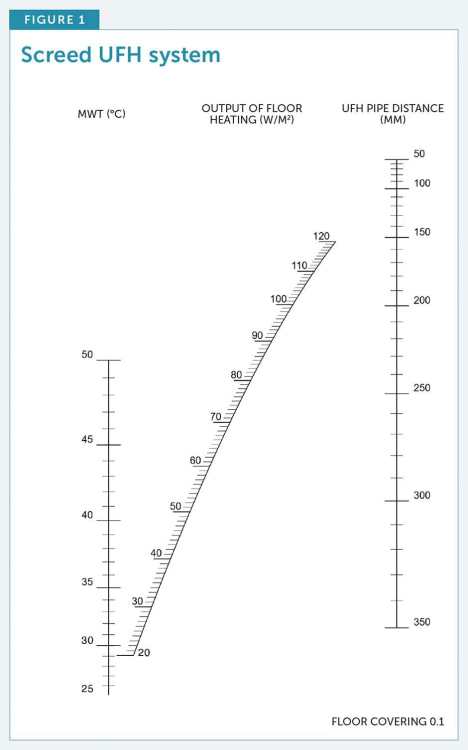
-
Trouble is they are just making pretty pictures. There is zero balancing of room output. All designed around a thermostat controlling the room temperature.
-
Diy(ing) an air to air unit
JohnMo replied to G and J's topic in General Self Build & DIY Discussion
A few differences, mainly they are designed not to produce condensation, a normal fan coil is designed to run below dew point. So these units will have no condescension tray etc. -
Diy(ing) an air to air unit
JohnMo replied to G and J's topic in General Self Build & DIY Discussion
The Panasonic one you referenced is a wall mounted also -
Diy(ing) an air to air unit
JohnMo replied to G and J's topic in General Self Build & DIY Discussion
More info here https://community.openenergymonitor.org/t/is-is-still-possible-to-recommend-a2w-for-none-detached-properties/30194/19 That is where I first saw them -
Diy(ing) an air to air unit
JohnMo replied to G and J's topic in General Self Build & DIY Discussion
Why not just get some Jags Strada Hybrid or similar. They are designed to run cooling a above dew point, same as the UFH. So no condensate drains etc. Another option is https://www.trimley.uk/ which is local to you I believe. Through wall are fine, the Panasonic one you refer just needs two 100mm holes through an outside wall, plus the condensation drain - which can be through the wall also. But no idea why your having issues getting a fan coil -
Easy answer no. More difficult - for you to work out, what is CoP increase compared to normal heat pump cylinder. Then apply your tariff and charge periods. Calculate daily cost savings. Normal cylinder CoP 3, HG cylinder 4. But you only pay 13p per kWh. Your cylinder needs say 4kWh. Normal cylinder costs 17p to heat, HG costs 13p. You heat once per day, your £15 a year. If cylinder cost and £1000, that's a 66 year pay back. Pop in real numbers and away you go. Mine costs 52p using same maths, but can heat pump longer in cheap rate doing heating. You still take a decade or more to beat me on costs with a HG cylinder. Or just buy a direct UVC for £600. Heat via immersion. Then in cheap periods you heat house and heat DHW at the same time. Heat pump does it's thing, so does immersion. If you have solar as well heat during the day via solar.
-
Should I ditch the installers and DIY my ASHP?
JohnMo replied to jimseng's topic in Air Source Heat Pumps (ASHP)
But the scheme is different in Scotland - heat pump mandatory on a new build so no grants for us. -
That also increases U value, I looked at additional PIR on our build but the difference between an unventilated air space and actual PIR is too small to worry about.
-
At 0.26 your wall insulation must be very poor. I would look to add 50mm or more externally, if the figures are correct. Floor is likely to be around 0.08 U value. 32W/m² is huge. Similar build to ours is closer to 15W/m² at -9. Heat loss at 7.3kW sounds excessive.
-
Should I ditch the installers and DIY my ASHP?
JohnMo replied to jimseng's topic in Air Source Heat Pumps (ASHP)
Timings as @ProDave says is pretty real. If your using a ToU tariff, I do and have the following 4kW heat pump - Hiaer monobloc. Then a use a direct UVC, so is charged via immersion (have plenty of solar also). Heat pump is then not trying to do heating and DHW in a cheap period, they are independent of each other. Going that route Heat pump under £2k when you claim the vat back. Cylinder £600 incl vat. Drive via simple time switch. £20. Plumbing very simple. You have loads of water volume. -
Comfosense 67 reliability
JohnMo replied to hauntedicecreamvan's topic in Mechanical Ventilation with Heat Recovery (MVHR)
I went down the route of looking at CO2 sensors etc. 5 years in none of it is really needed - nice sales accessories. We need a CO2 monitor in master bedroom (Scotland) and I used to monitor it, all the time (very rarely look at it ever now) I tweaked MVHR flow rates to get CO2 max I was comfortable with overnight, and that's it. We have dry contact switches outside each wet room to boost and a humidity sensor in the MVHR unit. MVHR almost never goes in to boost. It just doesn't need to, house humidity doesn't rise much for long. -
150mm is fine, but filling just floor is lazy. A new build requires so little heat. Layout on software, you can simplify it a little by making the angle 90 degs between the two wings. One manifold or two the supply and return will be similar lengths. I would aim to use one manifold. You will not need a pump and mixer on the manifold, so don't let anyone sell them to you. Just run supply and return in 28mm you will have zero issues. Would suspect heat loss is below well 4kW, do don't let anyone sell you a big heat pump. I had a 6kW and found it too big, so swopped it out to a 4kW last winter. Note on your loops A-1, move manifold in room and all pipes passing through room do the heating - delete dedicated loop. A-2 and A-6 delete and use pipes passing through that area, spread them out instead of bunched up. Pipes can be 100m long. Loops A-10,11 and 13 add up to less than 200m, so could be 2 loops instead of 3. But if using 1 manifold that may not be possible, however an optimised design may allow 200 or 250mm centres do then that room and room next it could reduce the loop count.
-
I used loopcad via a trial app. UFH is very similar in a lot of respects to a radiator. A radiator you size to the room heat loss and target room temperature, each room has a radiator of a suitable size for the heat loss/temperature and the system as a whole is just about balanced out the box. The exact same applies to UFH, you size your loops in the floor to match heat loss and target temperature for that room. You can fill the floor with pipes but it's a bit like sizing a radiator to fit your longest available wall - you wouldn't do that. Can't see the dimensions on your drawings but guessing around 200m²(?). If so we are about the same size and only 7 loops. Our flow temps are also super low.
-
Do yourself a favour and do your own design - there is zero room balancing by design. The design is for multiple zones/multiple thermostats, not single or limited zones for ASHP. Suspect you can easily delete a few loops by spreading pipes that transition through various areas.
-
Comfosense 67 reliability
JohnMo replied to hauntedicecreamvan's topic in Mechanical Ventilation with Heat Recovery (MVHR)
Obvious question, is why do you even need a controller - once set what is there to adjust. MVHR commission forget, except filter cleans/changes -
Shower light with extractor fan - heat loss & air leaks
JohnMo replied to renovator123's topic in Ventilation
But do you really need a dehumidifier with MVHR is winter. Our humidity levels are pretty low anyway. Overnight and they are dry next morning. MVHR doesn't even go into boost. We only dry stuff that doesn't going the heat pump dryer. -
Passiv house costs.
JohnMo replied to Oz07's topic in Energy Efficient & Sustainable Design Concepts
Yep, even in Somerset. UFH is so cheap to install, why wouldn't you, insurance even if not connected. Good for cooling as well. Passivhaus still allows 10W/m² for heating demand so a 200m² house that's still 2kW heat demand on the coldest day (48kWh). I would rather that supplied via the floor than and electric panel heater being moved about. Sensible in ALL houses -
Passiv house costs.
JohnMo replied to Oz07's topic in Energy Efficient & Sustainable Design Concepts
@MPx is this Passivhaus or "a passivhaus" as certified or sort of a Passivhaus? ASHP is now about £2k for a 4kW Hiaer. UFH shouldn't cost more than £1k. Do a direct UVC for domestic hot water, about £600. £60k is a lifetime of direct electric heating on a decent tariff. -
Passiv house costs.
JohnMo replied to Oz07's topic in Energy Efficient & Sustainable Design Concepts
Unless you are in Scotland and then a score better than 3m³/m² @ 50Pa has to have MVHR - so applicable to any low energy loss house, so not an extra really for Passivhaus.



