


JohnMo
-
Posts
13292 -
Joined
-
Last visited
-
Days Won
200
Everything posted by JohnMo
-
 Or do a proper Scottish roof. With sarking boards and small gaps between them. Then you can full fill insulation with a breather membrane. Do slate instead of tiles and don't need battens either. Using ply isn't really Scottish roof. It's just ply on a roof.
 -
I'm not a 1.5 storey fan although I have lived in a few. Single storey form factor is pretty pants especially if every ceiling is vaulted, like our house. You can compensate but insulation value needs to be sub 0.1 everywhere. We settled for 0.09 floor and 1.1 roof and 0.14 walls and triple grazed. But would add more insulation doing it again. Single storey is great to live in, when my wife broke her ankle, life was pretty normal - toilet, showers, beds all just as normal, no special arrangements. We did 193m² and it's 3 bed all bedrooms are generous doubles, lounge is good and roomy etc. It all could have been smaller.
-
Finding ASHP installer who understands fan coils
JohnMo replied to flanagaj's topic in Air Source Heat Pumps (ASHP)
If you want all the cooling now, go for two temperatures, if you want slow and steady cooling just do one temperature. Really depends on the depth of your pockets now and for running costs. Cold temperatures are just like high heating flow temperatures they take a big chunk out of your expected CoP. -
Finding ASHP installer who understands fan coils
JohnMo replied to flanagaj's topic in Air Source Heat Pumps (ASHP)
Mixer is on the UFH heating. So in heating it is mixing return water to bring down the flow temp, in cooling mixing return water to make supply water warmer than used by the fan coils. Its just the same as you would do for UFH and radiators. Pumps I would set up a primary and secondary loop, primary loop is just the ASHP circulation pump, for the UFH and fan coils I would have a close coupled tee (CCT) for each circuit, first CCT for the fan coils and second for UFH. Each circuit from the CCT would require a pump. So sort of 2 zones one for UFH (mixer as well) and the other fan coils. Set the two secondary pumps to run fixed speed. Then flow match the primary pump speed to match the combined flow from the 2x secondary. Fan coils output is governed by fan speed (which is controlled via a thermostat), so the flow can be left to circulate the whole loop, so then run both pumps when ever you have a call for heat/cool. Otherwise expect to need a volumiser or a buffer. But personally I really wouldn't bother doing fan coils below dew point, save the complication and you can buy something like Jaga Strada Hybrids to do above dew point cooling, no mixer etc. -
Finding ASHP installer who understands fan coils
JohnMo replied to flanagaj's topic in Air Source Heat Pumps (ASHP)
Here is a Haier scheme, you just setup as a 2 zone system. Each zone with a different flow temp fixed or WC. The image shows a buffer which is unlikely to be needed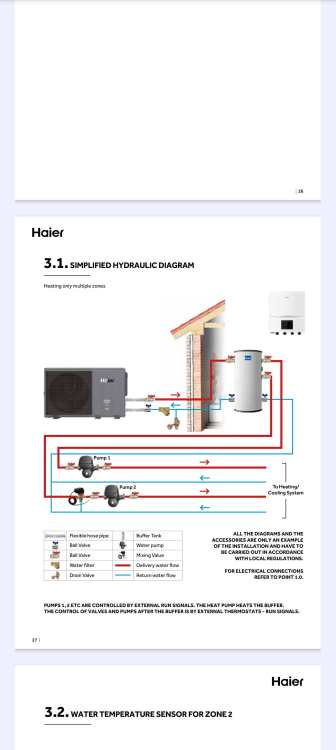
-
Or you could do mineral wool between and PIR below
-
Classic bad design hybrid roof - that is the cause of your issues. Either do the insulation above or below. If doing both a smaller amount below than above.
-
Keeping stuff mould and rust free in integral garage
JohnMo replied to Sparrowhawk's topic in Garages & Workshops
Insulate, that helps mitigate temp swings, which helps stop water condensing on thing in your garage. That will never help the situation Get an insulated one, or just add 25mm PIR to your existing door. -
Corrugated Asbestos Roof Crack Repair
JohnMo replied to Steve1309's topic in Roofing, Tiling & Slating
But wear mask gloves etc to protect yourself - if it is indeed asbestos. -
UFH balancing and understanding how it works
JohnMo replied to peredelkin's topic in Underfloor Heating
Really depends on floor buildup and house heat losses. UFH is a low and slow heating system so you want the temperature as low as you can get away with, you want long run times. Boiler flow temp reduced as far as you can while still getting the water temp you need and the boiler doesn't cycle. -
The right is the thermostat and left is overheat protection required for an unvented cylinder - so you only need bother with the right hand side.
-
Or just unscrew the whole metal piece and replace with new assembly - you seem to find spares for this stuff
-
Go from underneath take the u bend off to get access.
-
Plenty on here have calculated and ended with huge numbers. The period of time when you get the heat gains is pretty short, and generally solar gain. Just get a small unit and run it longer. If you are wanting to cool with limited solar gain (it's just hot outside) you are only cooling less than 10 degs, so listen to @G and J about realistically sizing.
-
UFH balancing and understanding how it works
JohnMo replied to peredelkin's topic in Underfloor Heating
Few ways to look at flow rates. 1. Determine loop length and set flow rate 2. Auto adjust actuators, these read flow and return temp and set flow rate to achieve to pre programmed differential temperature. 3. Mine are set fully open - the highest flow rate (by reading the flow meters) are tweaked down, similar to that as discussed by @Nickfromwales. I have also further adjusted to get room temp close to where I want. Wouldn't get too hung up on exact flow rate for each length, open flow meters fully. Set circulation pump to achieve close to 2 to 2.5L/min and leave it at that. Then adjust any loops that are over 2.5L/min down with the flow meters. Your thermostats will do the rest. -
UFH balancing and understanding how it works
JohnMo replied to peredelkin's topic in Underfloor Heating
If your operating as a single zone I would keep you money in your pocket. Salus auto balance work when different zones are opening and closing and keep a steady flow rate through the open loops, ensuring there flow rates do not change. What is you heat source, single zone or many zones? (zone being a circuit or multiple circuits that are switched via a thermostat) -
Collateral warranties required?
JohnMo replied to timhowes's topic in New House & Structural Warranties
Plans and reality aren't the same, have sensible budgets, otherwise it will be a money pit. -
Collateral warranties required?
JohnMo replied to timhowes's topic in New House & Structural Warranties
Certainly would do that, pay them staged payments based on work completed and approved. Pre paying for to be done is not the way to go. There may be some material costs to pay up front, and how that is handled would be worked out so zero risk to you. If contractors are expecting full up front cost walk away quickly. -
New self build design, heat and architect
JohnMo replied to Jack757's topic in New House & Self Build Design
Living in Malaysia and Singapore at at the time. -
New self build design, heat and architect
JohnMo replied to Jack757's topic in New House & Self Build Design
Yes - drafty things unless you buy well and pay plenty for good units. We ended up switching ours off in the bedrooms and opened the windows and got used to 34 degs every night. -
New self build design, heat and architect
JohnMo replied to Jack757's topic in New House & Self Build Design
Not sure about that, some people or a lot of people see Aircon and see £££ bills. Having lived with almost mandatory Aircon (hot country) for a few years, I am not a fan of it. -
New self build design, heat and architect
JohnMo replied to Jack757's topic in New House & Self Build Design
Titon HRV10 Q Plus, £250 delivered Titon HRV1.75 Q plus, £320. Retail was is about £1300 for the smaller one and £1500 for the large one. -
New self build design, heat and architect
JohnMo replied to Jack757's topic in New House & Self Build Design
Yep I was quoted £10k for single storey 193m². So just waited for things to be the right price. Less than £2k for me fully installed and commissioned. Spending any more than that is money you will never recoup in energy savings. You may as well go for a smart MEV or dMEV system. Yep, I went Titon HRV, well built robust, never switched off unless I am servicing. -
Bathroom ceiling, Permawhite?
JohnMo replied to Super_Paulie's topic in Bathrooms, Ensuites & Wetrooms
I just Dulux trade white. 5 years on all good, did all painting with it, one coat 50:50 with water, then two coats full strength. -
That's a shame about the wiring centre, mine was in the box. Not sure how thick you screed is but I ran into issues with the heat pump hunting. We have 100mm screed and wide pipe spacing (300mm) and found the heat pump wasn't getting the response it expected from the return temperature and it would hunt (power and temperature would yoyo) killing CoP. I have full monitoring and you would have noticed the hunting otherwise as it's not that easy to notice. But it knocks 1.5 off the CoP. I have since hydraulically separated. So have a primary loop around 6 to 8m long, with close coupled tees. The secondary side has its own pump. I then run it at fixed speed on the primary and secondary side, with secondary side slightly lower flow rate. This gives the heat pump some feed back - so far in cooling it's been great. Also the pumping power dropped with the second pump as both were doing less work individually and maybe at a better efficiency point. I also don't bother doing cylinder heating with heat pump. Logic for me, I have plenty of solar, but also I can leave the heat pump to run long and slow heating the floor. Time of use tariff make it cheap enough even without solar. If you any questions just ask. Believe your warranty requires either anti freeze valves or glycol. Glycol is the work of the devil, so go that route. The antifreeze valve is only to protect the heat pump. I have isolation valve on the screwed connectors on the heat pump and then the antifreeze valves. What you pipe does after that doesn't matter the heat pump is protected.



