


JohnMo
-
Posts
13292 -
Joined
-
Last visited
-
Days Won
200
Everything posted by JohnMo
-
here you go, they do 15mm euro cones for your pipes. I had good service from them. https://www.outsourcedenergy.co.uk/product-category/manifolds/underfloor-manifolds/ Suspect you will have lots of boiler or heat pump short cycling if the have a thermostat on each loop. Been there and then removed and simplified, after I saw my first months gas usage. If I was you I would have a single zone and use the bedroom stats as limit stops (balance flow to get the temperature correct). Join all other loops to operate off a single thermostat.
-
Your boiler flow has to be higher than the set temperature of the cylinder. So if you want 60 degs in the cylinder, the flow temp coming from the boiler will have to higher. That the first thing to check. If the flow temp is 50 the cylinder will only get to 50 if direct or lower if indirect (heats via a cylinder coil).
-
Could you not use an immersion diverter, after all, a storage heater is just a series of immersion elements in stone/metal/concrete blocks
-

ICF and Foundation design
JohnMo replied to Renegade105's topic in Insulated Concrete Formwork (ICF)
I would be speaking to the structural engineer first, all respect to the ground workers but they are not qualified to make engineering design changes. -
From what was attached it makes to up the efficiency to 90%. Looks like the individual room rates will need to changed to reflect the total ACH of 0.3.
-
But I wasn't talking about your sofa or your dashboard I was specifically talking about spray foam insulation. Which isn't seat foam.
-
Here you go, most in the low 80s, some in the 70s some in 90s. Those all passivhaus certified, other may not be as good, even if they are. https://database.passivehouse.com/en/components/list/ventilation_small
-
Your MVHR is just a ventilation tool, which also recovers heat from the outgoing air and gives it the incoming air. All houses need to be ventilated, an airtight house has to be ventilated by mechanical means. Building regulations require a balance supply and extract. Building standards normally require around 0.5 ACH (varies with UK country) Your ventilation rate is 0.3 ACH, it nothing to do with with your air tightness test. In addition to your MVHR flow rate, you will have a natural infiltration through the building fabric, which is not controlled, this will be small and is linked to your air test results and the prevailing wind speed and direction. The rate of flow of the MVHR is based on a number of ACH, in your case 0.3 ACH. Your SAP report will have a number it which represents natural infiltration, this should really be added to MVHR rate to get the worst case heat loss. So your ventilation rate would be 0.3+ something, of which heat recovery would be 80-90% efficient. So your effective ACH would be 0.3x0.2 = 0.06 ACH, with respect to heat loss. Qv = 0.33 × n × V × ΔT watts. =0.33x0.3x your volume X 24 =0.33x0.06x your volume X 24 The difference between the two figures is the benefit of MVHR. Less the running cost for electricity and filters. Which is generally lower the energy saved for heating.
-
So where does this appear in any building loss heat calculations? You are normally after the worst case heat loss, so if it's as significant as you seem to suggest, it should there?
-
In a close to airtight house an exposed windy location, shouldn't have any undue effect on the heat loss calculation as the wind cannot get into the house. Unlike a humans, objects such as house do not suffer wind chill. The air temperature is what it is.
-
Not sure why you are not just using the heat loss calculations in the boffins corner, it lets you set the ACH and MVHR efficiency. It free easy to use and pretty good representation of what to expect from your house.
-
Well my smart meter installed failed to communicate correctly, so has now been abandoned. Now have a manual read smart meter. Neighbour applied today to get meter installed, after a bit of a ring round, EDF are installing in two weeks.
-
Planning - visibility splays (why is it so frustrating)
JohnMo replied to Kelvin's topic in Planning Permission
just measure back from rad edge X metres, then along the road x metres depending on the speed limit, see attached trbo-advice-on-planning-for-small-development-march-2016.pdf -
Basically doing a bodge job, while demanding money to do so. Interesting the article refenced specifically states polyurethane foam. The foam mentioned at the start of the thread is a polyurethane, while something like Icynene isn't. Its cater oil and water based that open cell and quite soft and flexible compared to polyurethane foam, which is quite rigid.
-
What thin insulation under wet underfloor heating?
JohnMo replied to Mattsville's topic in Underfloor Heating
Strange my structural drawings show PIR with 75mm concrete screed. Many on here have also used the same, other not but more to do with cost, choosing thicker EPS/XPS at a lower cost for same U Value. -
New owners, so back from the abyss. BBA certs are available if you do a search, would assume the build manual is still on their website, which has all sorts of info. We have stone slips, adhered to the Durisol wall directly and wooden cladding.
-
Direct air kit (multi-fuel stove 5kw)
JohnMo replied to Smcmullan88's topic in Stoves, Fires & Fireplaces
Makes sense primary and secondary air come from duct. Outside air connection is just a hole in the wall connected to stove by a duct. Air is controlled the same way with or without duct via normal stove control -
What thin insulation under wet underfloor heating?
JohnMo replied to Mattsville's topic in Underfloor Heating
20mm PIR would be 30 to 40% better performing than your suggestion. The other option is aerogel (not cheap), 30% better performing than PIR. I have a single piece of UFH pipe in the kitchen, between the wall kitchen units and the island. Not sure it actually contributes that much. Kitchen is always warm. The single pipe at the bottom of the image by the red thing, that is the kitchen, the bit to the right is the dining area.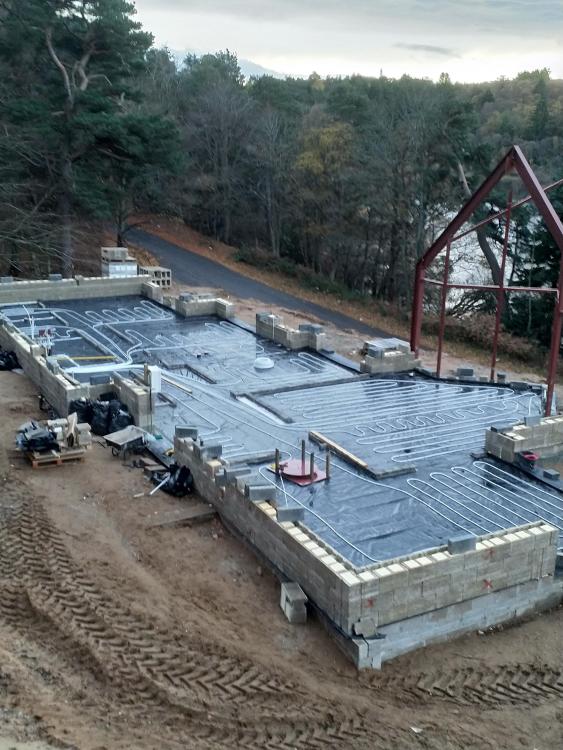
-
dMEV, decentralised Mechanical Extract, Ventilation. Only extracts, no heat recovery. Aereco, Vent Axia, Greenwood Some bedtime reading below https://www.aereco.co.uk/knowledge-centre/how-to-choose-between-a-humidity-controlled-mev-and-mvhr/ Atamate_SDAR+Paper+2019+(1).pdf
-
normal cement, and hydrated lime. I mixed mine as 1x 25kg bag of cement, 3x 25kg bags of building sand, and think it was about 2 to 3 shovels of lime. The lime gives a creamy consistency. Add enough water to make a double cream. Makes a mess, wear safety glasses
-
Unless your airtightness is better than 3m3/m2 you would be wasting loads of money and time installing MVHR. You would be better with dMEV, constant background ventilation low running cost, easy to install. You can get them so they operate the ventilation rate based humidity, increase and decrease ventilation rates.
-
Whatever the insulation you use you will be installing a Vapour control air tightness layer below it. This is draped on to the wall internally and glued or taped to the wall.. That is is your airtightness sorted. Then use whatever insulation to the required U value.
-
What thin insulation under wet underfloor heating?
JohnMo replied to Mattsville's topic in Underfloor Heating
Is a step an option? With that little insulation in the floor, you should really reconsider if UFH is the right thing to do for that room. The downwards heat loss will be big. Your downwards heat loss, will be the delta of the water flow temperature (could be around 35 to 40 degrees and the ground temperature, around 7 degrees, multiplied by the u value and area. Superfoil requires an air space either side of it to get advertised performance. So don't go there. Your need to use PIR or better still PUR. -
MVHR Duct Design
JohnMo replied to Triassic's topic in Mechanical Ventilation with Heat Recovery (MVHR)
Practical experience of two systems. Commissioning easy as a single system, as long as each unit is balance, same going in as going out and the system as a whole as a whole has the same coming in as going out. The air doesn't care which unit it is extracted by. No fighting experience at time with the two systems. Reliability, we had an issue with one unit that required a new fan motor. The other ran and provided enough ventilation for the house. Two sets of filters required, an additional ongoing to expense. Electric costs same or lower, as you can position the units to reduce duct lengths and have a lower system pressure, the fans run lower on their performance curve so use less electric. Boost, generally only our small unit is on boost from showers etc. The large unit is rarely in boost. Reducing ventilation heat loss. A single unit would boost the whole house ventilation. -
The issue with spray foam, is when it's applied to roof in the incorrect manner. Ie normal cold roof space, then spraying in the back of the roof tiles, closing all the required ventilation. Mine was applied by a recognised builder. But what ever system you go for, you need to an interstitial condensation analysis.



