


JohnMo
-
Posts
13292 -
Joined
-
Last visited
-
Days Won
200
Everything posted by JohnMo
-
I very much doubt a tin skin will add any more strength than wood cladding correctly installed. There are certainly way less fixings involved in a tin skin. Who is making the claim, it will be stronger with a tin skin?
-
You don't have manifold mixers? Use what you have got.
-
Just use the fresh air row under passivhaus as reference

-
Sorry I am lost.
-

Carbon dioxide levels in a MVHR home
JohnMo replied to Seeoda's topic in Mechanical Ventilation with Heat Recovery (MVHR)
In Scotland they have to be hard wired, record actual, peak and average over the last 24hrs. Mine is a DETA 1142 (I think) -
Not sure if something is wrong with the calculation, but passivhaus, build regs specify between 0.3 and 0.5 ACH. A real example - My bedroom has an ACH rate of around 0.5, with 2 adults and dog with door closed and 10mm door undercut 838mm wide, CO2 will slowly increase to around 1000ppm overnight. With door open it sits no higher than about 700ppm.
-
Carbon dioxide levels in a MVHR home
JohnMo replied to Seeoda's topic in Mechanical Ventilation with Heat Recovery (MVHR)
Our bedroom normally has me, wife and dog (don't ask), last night's peak was around 750ppm. Door was open, prior to dog in room, the door would be closed and it would peak around 1000ppm. Think it's the reduced flow moving air under the door undercuts. -
Previous owner obviously liked a hot house. Room temp, set to what is comfortable to you. Let's say 19-20. Limit, set it low say 30-35 deg, if your room doesn't heat up after a about 6 hours add a little more heat. You want flow temp (limit), as low as possible to prevent temperature overshooting. Your flow temp depends on your insulation and general house insulation. The better the insulation the lower the flow temp. Leave the system as it is, your system does the the same as mixers on each manifold.
-
Incoming Air Pipe Reduction
JohnMo replied to Crumpetman's topic in Mechanical Ventilation with Heat Recovery (MVHR)
You would need to calculate the pressure drops over the system based on your flow requirements. So no easy yes or no I am afraid. You should be able to datasheet from the manufacturers website for ducts etc. You want as low a pressure drop as practical to fan speed down and noise.- 1 reply
-
- 1
-

-
You need damp or humid air for mould to form and grow. Damp could be cold bridging, as previously described and or relative humidity at it or above 70% for prolonged periods. You should aim to have a relative humidity in house of around 50%. If your house is colder than outside the relative humidity will be higher inside than outside. As the cold air cannot carry as much moisture. A warm well ventilated house should not have the physical environment to support mould growth. The need for mechanical or stack ventilation is written in to building regs for a good reason. Question how is your house heated?
-
New series of Grand Designs 31st August 2022
JohnMo replied to Thorfun's topic in Property TV Programmes
Been away for the weekend in normal houses, came home on Monday and thought our house was big/spacious (190m2), got used to again. -
New series of Grand Designs 31st August 2022
JohnMo replied to Thorfun's topic in Property TV Programmes
Also made me chuckle when they said a low energy house, with full glazed walls, even triple glazed that's only 0.6 u value. Even if a vanity architect project, the owner should look at the drawings and say that's huge, are we sure it isn't too big. -
New build design & floorplan - Comments please!
JohnMo replied to jimmyharris80's topic in New House & Self Build Design
Our doors are Louvre doors on magnet catches, that may be the difference. -
Sounds like a flow issue, is your pump working?
-
Not sure I agree it's a total bodge. Just an older way of doing things. Here are a copy of the operation instructions emr-11.pdf
-
New build design & floorplan - Comments please!
JohnMo replied to jimmyharris80's topic in New House & Self Build Design
I'm not convinced by that one - it means you need 2 hands to open both doors so have to put things down Works for us, open one door then the other, only need one hand. Not sure where the requirement of opening both doors at the same comes in. If you have nothing in your hands open both together, same is true when closing also. -
New build design & floorplan - Comments please!
JohnMo replied to jimmyharris80's topic in New House & Self Build Design
We have a clean island, in this house and the last. Not keen on sinks or hobs in islands and I'm the one who cooks. -
New build design & floorplan - Comments please!
JohnMo replied to jimmyharris80's topic in New House & Self Build Design
We used small double doors (total width 838mm) in the utility to the UFH and airing cupboard. Works well doesn't take space away from utility. Get a price for standing seam metal roof, can be very expensive. We were quoted £165/m2 3 years ago for either zinc or aluminium. We paid £65 (last year) for a Sarnafil standing seam roof. We had a 194m2 of roof to do, so a considerable price difference. -
That's not really a mixer valve, as a proper mixer valve modulates to maintain the flow temp. You would need something like this (first image I found). Your system is relying on the heat source controlled flow temp, so has no real protection from over temperature.
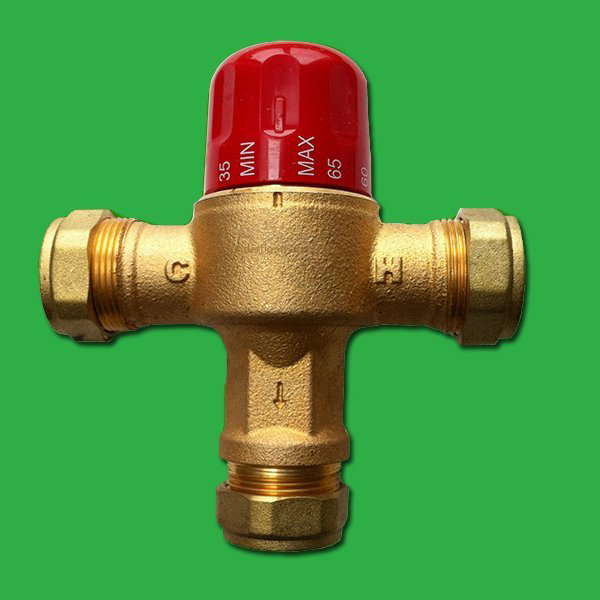
-
I would look at building regs in your area, you may need a balastrade or steps.
-
Manage it in bite size chunks, make decisions once and stick with the decision. Changing your mind later costs money and time. Try to keep the design simple, complex can look good, but is a pain to construct. Use a build method that isn't much of a learning curve for the builder or you, if you are doing it yourself. Be careful you don't make rooms to big, it's very easy to do, watch out for evening heat gain from a low westerly sun. Good luck, but enjoy it. Try to get most the decision making done prior to build.
-
Not sure what you mean by a stop cock. The manifold should have a mixer valve and pump, the flow loops each have manual valve or actuator and a flow meter. The mixer valve set that to the flow temp you need. The manual loop valve, open fully. Set the flow to the flow required for the loop length. If all room get too hot the mixer valve temp needs reducing, too cool increasing. Once these are set you can fine tune the room temperature. Increase flow will give a smaller difference between flow and return and increase heat transfer to room, reducing flow to opposite.
-
Mine did similar, it was air in the system. Needs a good blow through with the hose pipe. Once air purged, worked as it should.
-
The mould is caused by moisture either coming in from the outside or inside trying to get out. How are your wet rooms ventilated? Do you have a good coss flow of air between rooms from dry to wet? New builds tend to have quite a bit of moisture trapped in the fabric and it wants to come out. Good ventilation by air movement is required. An open window is great when it's windy, when air is still no ventilation, or on a rainy day you will let 100% humidity in, which will not help. You mention you had no fans, assume you have now, what sort are they and how do run?
-
New build design & floorplan - Comments please!
JohnMo replied to jimmyharris80's topic in New House & Self Build Design
Your windows look messy, with the multitude of shapes and sizes. You seem to have lots of glazing on the north side, which isn't good for heat loss. On the kitchen diner you have two big sliding doors, I doubt if two would be opened at a time, so consider dropping to a single one and window in kitchen, this would also give more wall space. Your lounge looks small when you compare to the study which looks huge. Not sure why you have an external door in the playroom. Pocket sliding doors in a utility looks like an expensive solution in to what looks like a plant room. I would be moving things about to get a second en-suite. Do you need two baths? A lot of dead space on the landing. The recessed wall area at the front door seems a waste of internal space, you have two external walls to build, increase heat loss for little gain, as it doesn't appear to covered either, so would end up a damp area. Your heat heat pump is near the utility window and back door, it may be better around the corner and give less noise intrusion.



