


JohnMo
-
Posts
13296 -
Joined
-
Last visited
-
Days Won
200
Everything posted by JohnMo
-

Insulated Concrete Slab Garden Office - Questions
JohnMo replied to Ticky's topic in Garages & Workshops
You can get the blocks 100 or 140/150 wide. But you may be able to have block less wide than the wall and carry up the perimeter strip to the base of the wooden walls, to remove the thermal bridge as the block comes out of the ground. -
Yes, you can also hire them on here for that purpose
-
Insulated Concrete Slab Garden Office - Questions
JohnMo replied to Ticky's topic in Garages & Workshops
Why not a simple strip foundation blocks on that, nothing to complex needed inside the blocks, harcore, sand DPM, insulation with upstand around perimeter, with concrete screed or floating wood on PIR. Do the blocks below ground mostly, have 50 to 100mm showing above ground, build from there. Gravel around the external perimeter to limit rain splash. Job done. It's not a 100 year design life, like a house. -
You need a certified/calibrated flow meter to do final testing and setting up flow rates. The certificate number and or a copy of certificate gets recorded on commissioning certificate. Depending on what your planning control require.
-
No certified body that I saw. Anyone can install, mostly plumbers around us, most no real idea what they are installing.
-
Heat basically moves towards cold. The insulation in a floor slows the downward migration of heat towards the ground, promoting the upward flow to the floor surface. The less insulation you have the more downwards flow of heat you have (the more energy going into the floor that is wasted). The hotter you have to run the UFH flow temperature to get the floor surface temperature at the temperature it needs to be to balance the heat loss. So a floor area that is part insulated, part uninsulated, will require two very different flow for each part of the floor, making control very difficult. One part will be too cold, the other too hot. Then as pointed out in other posts you may as well burn your money it may be cheaper than running the UFH.
-
The way I looked at, is 10mm of the blue foam is best to no insulation, there to soak up some expansion really. PIR much better insulation value, you don't need much to go around the house. Our were but 300mm strips, so 4 strips out of a board, so 10m almost length from 1 board. You could put 40mm in there very easy. 25 + 12.5, would only strick past the plasterboard 2.5mm.
-
Maybe there's a good reason you cannot find anything, as they are two different independent systems. MVHR does around 0.5 ACH, so cannot carry enough flow to effectively cool the house, in heating mode, a passivhaus is designed around the max achievable heat flow through the ventilation system that being 10W/m2. The flow figures for Aircon are something like 47.0 - 60.5 L/S per kW of cooling capacity. That's about the same flow rate for our MVHR for near 200m2 house. So MVHR would be able to carry about 1kWh for our house, which would be rubbish and not worth the effort. If you want Aircon, get an Aircon unit or consider floor cooling etc.
-
That's what we did, 70mm around the whole perimeter. The walls were ok, as they got battened out 50mm plus plasterboard. The doorways were a bit of a pain. But everyone coped and got the floor finish completed.
-
Why not a hall feed system?
JohnMo replied to Petrochemicals's topic in Mechanical Ventilation with Heat Recovery (MVHR)
This is a system design for our house, although I couldn't get the correct rates to keep building control happy. But could see no real reason why it wouldn't have been a good working system.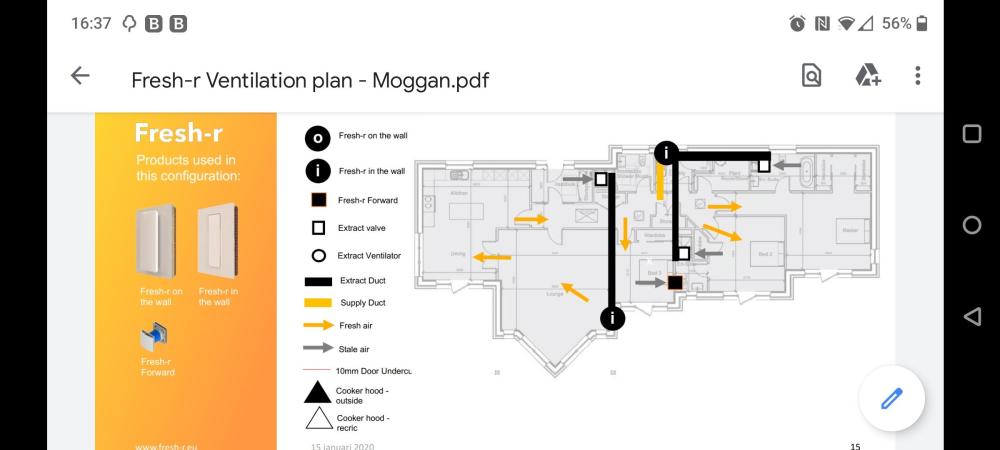
-
Gee, that's like summer. Was -5 when left home this morning and is -2 now and not been much warmer all day.
-
It's great have other cooling means, for the summer but there will times when you need to cool house as well as heat the house during the same 24 hour period, so cooling the slab is not appropriate. Real example the other day, we had a low of -5 and high of +1, but the sun was out all day. So by 3pm the house was starting to get hot, so I opened the windows for an hour or so. If you need to cool a house naturally you do it by cross ventilation i.e you open windows and front of the property to wash air through the building. MVHR does little or no cooling due to flow rates being low.
-
Have you reviewed all their profiles on the aluk website, some are good other are rubbish. Could you just change the profile to fix the issue. Not sure where you get that idea. Windows still need to be opened to help shift the heat out in the summer. We moved out of 1830s house its just not relevant to your new build. A modern new build house with today's energy prices needs to be well insulated, cheap to run etc... Big difference with windows is the comfort factor sitting by the window, and general heat loss. The window will typically loose heat 10 to 15 times of an external wall. Sitting next to a window when it's -5 outside (this morning) can be comfortable or not. Triple glazing is comfortable, however the frames you suggest would be sucking the heat from you and feel quite uncomfortable.
-
The added requirements of an ASHP is defrost. All ASHP manufacturers state a minimum engaged volume which is used for defrost. It's also a throw back to heat pumps having a fixed duty.
-
Just a variation of a theme. Wall and ceiling heating have been around for decades. Again lots buzz words making it sound great and extra special. If you want a low inertia floor, that can be done also.
-
Either the system is a single zone or it has a buffer or low loss header. Mostly the buffer or LLH, which naturally provide a by pass.
-
Really depends on what is being compared and the size of the internal coil. You also add the cost of running a pump. PHE and controller is also additional extra on top of the cost of the cylinder, if want to divert PV that's another extra.
-
I think quite a few have zero idea
-
The Telford ones have a pretty big coil, about 3.2m2. You can also get the custom made to suit you. Extra insulation, 28mm inlet and outlet etc.
-
Unistor may not be the best choice, believe they need an anode and associated maintenance, the coil size is the minimum they could get away with. Others will give 3m2 + coil for better reheat times but more importantly a lower supply temp from HP to get same cylinder temp.
-
Your DPM should be below you concrete slab. The is no DPM above the PIR, that's just a seperation layer to stop the concrete in the screed making contact with the aluminium foil and causing a chemical reaction. As mentioned your boards should be butting up against and insulation upstand.
-
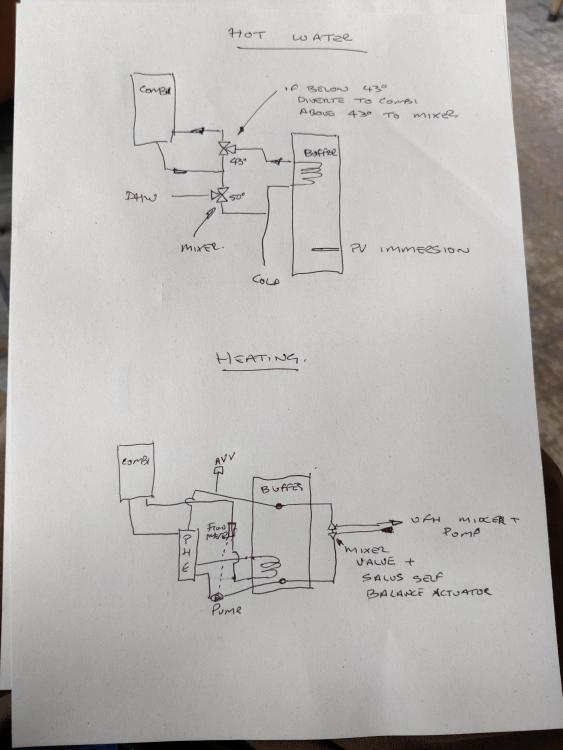
Ok, then does the combi not fire DHW to all outlets via the buffer? Eg when any hot water tap is run, the combi diverts to DHW mode? The buffer is the combi thermal store. Cold water goes through the upper coil, all the time, if buffer is warm or hot, cold water is pre-heated, if above 43 degrees a diverter valve sends all preheated water to a mixer valve, if below 43 it all goes to combi boiler for heating then and gets mixed with cold via the mixer. Combi boiler water temp is set to 65, this gives the best gas usage overall. Multiple taps and showers at same are no issue.
-
Yes a Combi boiler and a combi-nation of components
-
Not sure I am following. Mine has no option but to be pre heated via a 160l combi thermal store the preheat circuit.is always on. As that's the only way the water flows. In winter even a few of degrees reheat gets the same performance as you would in summer. KWh for kg of water https://www.omnicalculator.com/physics/water-heating
-
We should have installed air conditioning… now what?
JohnMo replied to Adsibob's topic in Other Heating Systems
Not sure the incentive helps, just causes more rip off companies to start up, rip of clients and then close the doors. To buy a 6kW ASHP and the balance of materials can be around £2.5 to 3k, as a priced example a Grant Aerona³ 6kW is £2300 incl VAT (I paid £1300 for different make) plus 2 to 3 days plumbing and a day electrical to install. So no idea how these companies can justify £15k.




