JohnMo
-
Posts
13296 -
Joined
-
Last visited
-
Days Won
200
Everything posted by JohnMo
-

How to go about a refund from builder?
JohnMo replied to johnhenstock83's topic in General Self Build & DIY Discussion
Building control are not there that much, so really depends on what they did or didn't see. -
A basic three port buffer, search on the internet. You don't want mixing of flow and return as it cools the supply temp requiring heat pump to over compensates with higher flow temp. You can use the buffer as a volumiser with either the supply or return only passing through so no mixing. Or operate the heating system as a single zone, and most likely no buffer.
-
Normal ill conceived, sound good to the the greater public, most of which may still be using a heat pump like the gas boiler they had before. So may be good for them. Until they put the oven and electric hob on for cooking the tea.
-
So immersion will be doing around 25 to 30kWh per day at a CoP of 1. Also assuming cylinder will have to be charged from 40 to 45 twice a day at an ASHP CoP of 3, another 10kWh, 5 at peak rate after showers and 5 at off peak, prior to showers and immersion heating. So 35kWh off peak at 15p, is £5.25 per day and say 50p kWh, as your on a time of use tariff, peak another £2.50, so £7.75 per day, or £2800 per year. So 900l of water 70 degC water diluted 50/50 with cold water, will give 1800l of water. At 20 l/min X 4 will give 4 showers for 20 mins. Why would you send 20 mins in a morning shower? If we all did that, there would be hose pipe bad in the winter as well. Hope your on a water meter. Heat pump size will also be affected by heating demand, and size of buffer required, bigger the heat pump compared to heating demand the bigger the buffer likely.
-
In general WC allows the lowest supply temp, as heat loss equal to heat supply. Needs a mind set change as heating is on 24/7, limited use of thermostats
-
Just to stray of topic, I have a 32kW combi and can do 3 showers at once, the secret is a pre heat cylinder upstream of the boiler reheating the cold water going into the combi, this lowers the delta T required across the combi. Giving huge flow advantage and never ending water. Best efficiency may be this. Circa 500l heated to about 48/50 degs by ASHP. The flow out of this routed to a solar diverter valve, so anything above 45 degs goes direct to tap. On a long draw of hot water, the cylinder temp drops, to below 45 and water diverted to combi for additional heating. Most of the time cylinder provides DHW, sometimes cylinder and Combi. Combi boiler that can take preheated water, Alpha, Atag plus others Variable could use the CH combi circuit to lift cylinder to 70 from 50, at shower time. Central heating by ASHP. Use the strengths of both systems. Endless hot water, standing charge for could be lower than the losses keeping 3 cylinders hot.
-
Think reducing water consumption will have a bigger impact on the planet than going all electric.
-
That is only true until the cylinder is about 50 degC. The PV diverter can then drive the heat to max the cylinder can take say around 70. Vastly increasing usable hot water. Why, just copy your last design if that gave limitless hot water - find it hard to believe the whole house will have a shower that the same time, unless its a hotel. Most dishwaters and washing machines only take cold water these days, so ensure yours takes hot also. Isn't the 20l a mix of hot and cold water, not just hot. Again what is your design temp for the cylinders this will have a huge impact on the design capacity required. Why do you say that - it makes a big thing about being able to part charge - you need 3x300 or 900l?
-
Any good places for bulk screw deals?
JohnMo replied to Arnold9801's topic in General Self Build & DIY Discussion
I had been using fischer screws and tried some turbo gold, the difference was like night and day. Fischer being so much better, easy to drive in and remove. -
That's just for heating, when the heat pump gets a signal for DHW heating, it changes its settings, normally to something like 55 degrees and circulation pump ramp up to max speed. A modern inverter heat pump are all pretty close to each other efficiency wise. Download the technical handbooks from the internet, takes a bit of searching, but most are there. Compare output/CoP tables. So in winter you will heating 900l of water during the night, as you may get little or no solar. Sounds expensive How have you sized your storage of hot water, at what temperature did you design it? Why 3x cylinders and not one, less piping, smaller surface area for heat losses etc. Less complications. You can also get much bigger surface area coils for more effective heating.
-
No matter which route you go down, the small cost no of future proofing is worth it. 28mm insulated pipes routed from outside to location of your cylinder. I would install UFH pipes, you don't need much pipe in the floor to have effective UFH when well insulated. We have 7 loops and just under 600m in our 192m2 floor. In the first instance just install 2x Willis heaters (one duty the other as an installed spare), batch charge floor on cheap rate. If at a later date costs change for energy you have pre installed options. As mentioned cooling is something to consider. I was sure we didn't need it, couldn't justify the cost of a heat pump. 3 years later from that decision I am installing a heat pump, mostly for floor cooling. A heat pump doesn't have to cost a fortune, mine with everything installed and working will be circa £3k.
-
Where do you get this requirement from? Would normally be a boost of 125% if I recall correctly.
-
Is that just HP kWh or total kWh?
-
Unfortunately our smart meter doesn't want to communicate, we have had several and they have all been the same. So cannot use a tariff that requires a smart meter.
-
Inflation is killing my build
JohnMo replied to farm boy's topic in General Self Build & DIY Discussion
They also trust the work the person does to be a good match with theirs, and are not rubbish to work with (for lack of other word that should be published). That's the approach I took, although I did take a gamble to two contractors and they worked out to be good. -
Thanks for that, been going round in circles with this, with so many people talking about time of use tariffs.
-
In the process of installing the ASHP waiting for the weather to warm up a bit before I finish off. So operating modes I can use, weather compensation - run 24/7 on normal price electric or a hotter WC curve (lower CoP but cheaper electric) to batch charge the UFH based on outside temperature but do the charge in a reduced cost tariff period of 7 hours at night. The reduced tariff is 15p while the day time jumps from 34 to 49p, so from experience is a favourable night tariff worth it?
-
Get a lock up, and start filling with the expensive stuff, when you see a bargain. I bought the full heating, ventilation, solar PV system well before I started, all bought in the pre lockdown sales in March 2020. Our planning came through in September 2020.
-
Inflation is killing my build
JohnMo replied to farm boy's topic in General Self Build & DIY Discussion
I started March 2020 (the start of first lock down) me and a man in a big digger, got the completion cert last week. Conversely I would love to do it again, but get other people to do the heavy lifting instead of me. I would manage them. Loved the learning curve, looking for bargains... -
Best floor type for the discerning selfbuilder. Go. :)
JohnMo replied to puntloos's topic in General Flooring
I built, wife did interior design, she did the choosing, I paid for or did the fitting. Is the thick wool bedroom carpet compatible with UFH, no, but.. it's a good job we like cool bedrooms. -
Inflation is killing my build
JohnMo replied to farm boy's topic in General Self Build & DIY Discussion
It's never easy, everyone has to sacrifice doing a self build, they can be a money pit. Spend your time getting the best price, you can do that sitting down. Search for best price, check online, ring for best price, play one supplier of the other, huge savings can be made. Paint white throughout, can you close off sections, to do later? Basic not flashy. Ex display kitchen and bathroom? B&Q flat pack all save money and don't really mean compromise. Don't scrimp on things you cannot change later, like insulation, windows etc. Do you need a stove now - no Do you need a flashy kitchen and multiple bathrooms - no Do you need a heat pump installed at a stupid price, so you can save £5k. Shop around eBay etc, you will be supposed what's available for half price of less. Do you need more than one toilet, shower or sink - no, except for completion you need the accessibility bathroom complete. Do you need curtains and blinds, maybe, maybe not. Floor covering, just seal the concrete floor if that's what you have to stop dust. You are likely to need, electric install certificate, ventilation performance certificate, boiler installation certificate, air tightness certificate, drains test. I had to sell cars and all sorts to finish ours, it's what you do. -
https://www.dimplex.co.uk/product/edel-hot-water-heat-pump Best to have plumbed to outside air, but you could configure to take the waste air from the MVHR possibly Cylinder2go will do custom, not sure they are any different in price
-
Buy a timer? Get the electrician to hard wire it in
-
You either accept the cost and the same for the next quarter, or speak to the contractor to resolve or agree how or who will foot the bill. What in your contract?
-
Insulated Concrete Slab Garden Office - Questions
JohnMo replied to Ticky's topic in Garages & Workshops
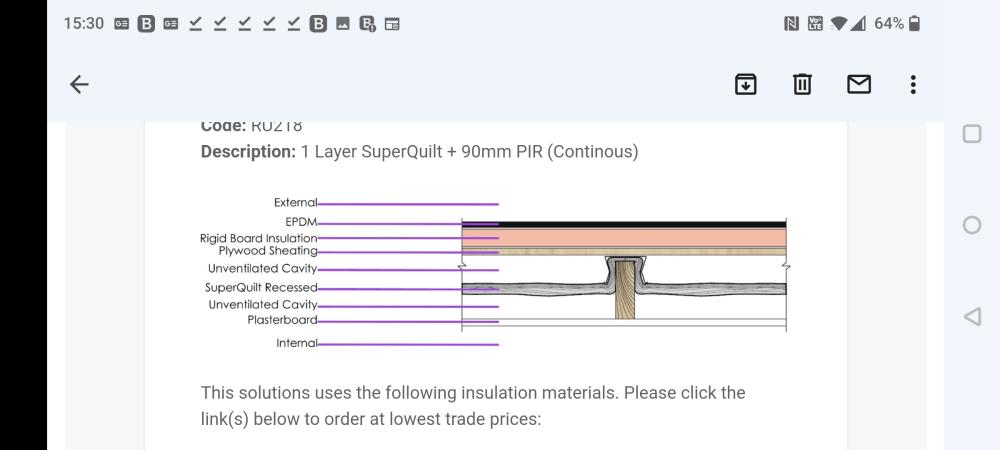
I'm keeping it super simple. Slabs on concrete, 175x45 timber upstand, spaced 10mm off the slab, DPM inside and up the wall level, taped to DPC. Inside 100mm PIR, 11mm x2. OSB glued and screwed (floating on PIR), 50mm battens (screwed to OSB at 40pmm centres) and 50mm polystyrene UFH grooved insulation panel at 115mm centres, between the battens. Timber floor to battens. Building will be 70mm logs, with breather membrane inside, fully tapped to walls and all joints, with an independent 65mm stud wall inside spaced 25mm from outer walls (not attached to walls or roof), with 90mm Frametherm 32 insulation vapour control layer, airtight glued to OSB in floor and the multifoil in the roof, them plasterboard. Ventilation will be dMEV fan operating on humidity and PIV sensor, with back flow damper. Replace the timber for your blockwork on a simple strip foundation, or concrete pad. Surround building with gravel to stop splashing of rain water. Roof I'm actually going to use multi foil and PIR, as below but with 100mm PIR. I need a vapour protection layer, so thought use multi foil the way it's supposed to be with the correct air gaps. If it adds to the insulation value great as it's added no more height than I wanted, if not, I have vapour/air tight layer and was only going to use 100mm PIR anyway.