


JohnMo
-
Posts
13300 -
Joined
-
Last visited
-
Days Won
200
Everything posted by JohnMo
-
Only thing I would worry about is the kitchen does not seem to be covered by ventilation? Is the bedroom also having dMVHR? If it is, really confirm noise levels, anything above 30 to 35 may sound noisy in the middle of the night. But I would really concider a simple condition based dMEV setup. Put humidity activated vents near patio doors and in bedroom, these are silent in operation and need no power. Then a dMEV in kitchen and bathroom that runs at all times at a very low background ventilation rate and is automated with humidity sensor to boost only when needed. Greenwood dMEV is silent in operation while doing background ventilation and have a humidity sensor built in.
- 1 reply
-
- 1
-

-
Simple answer is no. UFH without insulation and in a poorly insulated house will have a quite high flow temp, so an ASHP will cost you loads to install and give you no running cost benefits. Spend your money on radiators in the areas covered by UFH and leave the UFH off. A listed building doesn't always mean you cannot insulate or fix drafts - speak to listed building person, in the local council office, you may get grants to do most things, if you are lucky.
-
Thanks will have a look, another day of learning.
-
I went to get a couple of quotes before we started our build, basically told by two companies, that once they start building, I had to be invited to site, I wasn't allowed to enter unless expressly invited and there would be no decisions to make during the build. May suit some, so called 'self builders' but not me. I ran a mile.
-
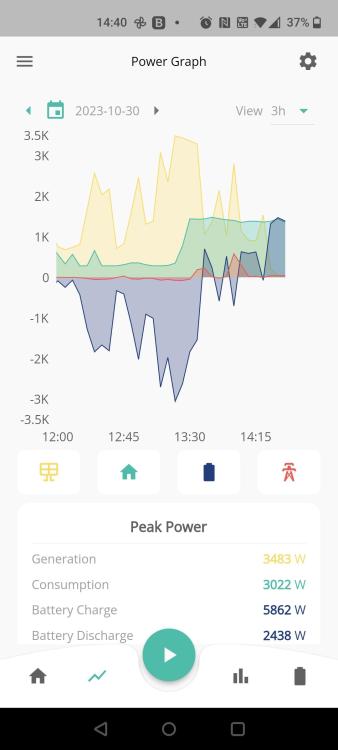
Looking for assistance to do some automation. Background have solar PV, a battery an ASHP and Home Assistant. Also I am on E7. Normal running period for the ASHP is during the night on a low tariff period. Today was better than expected for solar generation, so this afternoon I forced the ASHP to run for an hour. As there was plenty of solar the battery didn't loose much charge during the hour run. The yellow is PV generation, the green band is the house loads, the step up is the ASHP running. So looking to automate this function. So on a sunny day I can make the most of and run the ASHP. Home assistant has all the PV and battery data already available. The heat pump started and stopped via a zero voltage contact. So is it as simple as adding a smart relay that Home Assistant can control and then making a rule - if battery is above x% and PV generation is above x kW, close relay for one hour or until the battery has depleted to y%? Any assistance appreciated.
-

MVHR self install - tips and experience
JohnMo replied to flinn's topic in Mechanical Ventilation with Heat Recovery (MVHR)
It's easy enough if you are methodical and have half a day to spare. You also need the calibration certificate for the flow meter you are using, for building control. I set it all up, with equipment without a calibration cert, then got a man in, with the right kit to certify everything. The duct just has a slow gentle flow of air going through it, I just used metal strapping to stop it moving from A to B over time. -
Are you sure 4 months is realistic? I would expect a good quality build to take way longer. Ours although I did a lot myself took a year. Prior to that the person we bought the land from took 5 years to get planning in place, we took another 10 months for the council to allow us start the build (building warrant). In that 10 months we took about 3 months clearing and levelling the site. Things will start to move the budget if you change things, after starting, one change means, 10 other things have a change, or can seem like it.
-
EDDI exporting despite my SunAmp not being 'full'
JohnMo replied to ToughButterCup's topic in Photovoltaics (PV)
Is there a threshold (W) where the Eddi starts heating water, mine not an Eddi, doesn't make hot water until the export is over 100W. -
Any plumber can do the UFH, hot water cylinder and the plumbing between ASHP. Our electrician did the ASHP connections. Just a matter of finding someone prepared to read a manual. Government may be offering loads of cash, but off over inflated prices, where you don't what you ask for. That's why I went DIY, learnt loads on the way.
-
Could just as easily go in the return line, would be cooler flow.
-
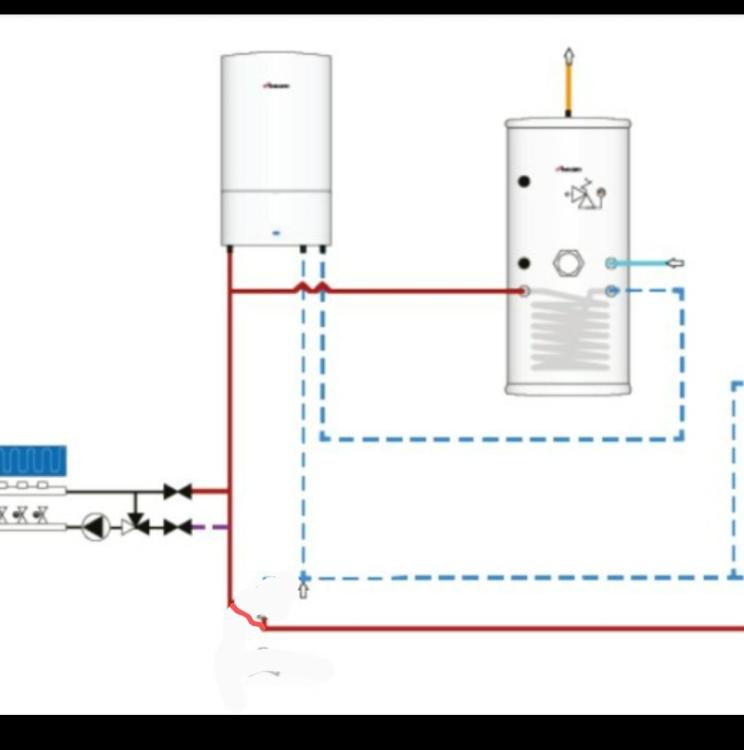
The return line isn't involved, if you connect it in to there it will just short circuit, not what you want. The flow comes down, add the cct's and the flow continues to the radiators. The return comes from the radiators back to the ASHP. Basically just do it like this (below) - you just borrowing small amounts of water from the primary flow and giving back a little cooler.
-
A cct doesn't go to the flow and return, both tees are in the flow line next to each other. Your just doing what's on the Bosch sheet without any zone valves (2 way or 3 way) to complicate, your UFH will never run on its own, as it's just to small for the ASHP. Just add two tees in the pipe going to radiators one pipe size bigger, than the pipe. The flow going to the UFH will come from the upstream tee, the flow going back to the system will go into the downstream tee. This will cool the radiator flow temp slightly but not much as the flow rate being taken by the UFH is so low.
-
metres per sec to m3 per hour.
JohnMo replied to Coanda's topic in Mechanical Ventilation with Heat Recovery (MVHR)
The house is measured in metres so its volume in m3 is an easy calculation, air changes an hours (ACH) is m3/h - an easy outcome, so the maths in the same units is super simple. Changing the litres/second don't see the point. House 200m2, 2.5m tall, is 500m3, 0.5ACH, is 250m3/hr. All maths done in the head, my flow meter works in the same units, you just need to work out the room flow rates from there. Why bother the litres/sec -
The tees will be at least one size bigger than the pipe they are installed in, the drop in velocity will create a nul point in the system. The UFH pump will only draw enough water through the CCT to match what is required to satisfy the UFH flow rate - possibly less then 3L/min. out of 20 plus. Not sure that makes sense, a CCT can be anywhere in a circuit, its a pressure modifier due to the step change in piping cross section. Its function doesn't care where its in the system You do not do a CCT like the video shows it, he has the primary loop and secondary loops mixed up, assuming he is showing the boiler at the top. The boiler is the primary loop the secondary loop tees out and back in again, the low velocity zone means the primary flow doesn't notice fluid coming and going. I would just plumb as detailed on the Bosch Tech bulletin (attached). A CCT with an additional 3 port valve to give the return back to the heat pump if only the UFH is on. But not sure if only 2 loops of UFH will be practical on it own without lots of short cycling and the UFH will have a very different time delay heating/cooling than the rest of the system. As the rest of the system will be on long and slow, I would be tempted to do the following. Batch heat the floor (storage heater mode), running a slightly elevated temperature, so it only needs to run 4 to 5 hours a day (when the radiators are on), and use the thermostat for that room to switch on/off the UFH pump. If you do that you would need a zone valve at all. I used the Ivar manifold mixer for last years heating season (no longer installed as I run direct from the heat pump, with no radiators), they work well but be prepared to do some adjustments and fine tuning to get the best out of them. TB_0137_b_-_Hydraulic_separation_of_UFH_via_closely_spaced_tees (1).pdf
-
It's call commissioning, that's why so many installs are pants, it just not done, there is plenty of fine tuning to do. Then you need to run it different modes to find out which is most effective from a heating perspective and running costs.
-
Doesn't mean its a bad idea. A gas boiler needs to be installed by a Gas safe installer, but doesn't stop people recommending them.
-
It's set up to take the API direct from Octopus out the box. I've had to manually program in the E7 settings (old technology), but using home assistant GivTCP, which also takes the Octopus API, grid import is limited to what you need, rather charging to a full battery all the time. (Only exception is Nov to Feb, as solar generation can be a bit hit and miss event, the charge percent is set to 100% everyday).
-
When you read up on passivhaus design, they explain why different concepts developed, where the U values come from etc. One of the topics is glazing, and how the glazing affects the way the room feels. Across the glazing there is a temperature gradient between inside and outside air temperature and depending on the U value, is where the inside of the glass settles temperature wise. The lower the U value the closer it is to room temperature. The glass can suck the heat away from your body. Imagine an Infrared heater in reverse, your body being the heater the window being the body being heated, the lower the glass temperature inside the more it extracts heats. Same is true for the external walls also. Passivhaus push triple glazing because irrespective of outside temp the inside of the glass is alway within a degree or 2 of the room temperature. So the window doesn't affect the way your body responds to the actual room temperature. That is the principal reason why we feel can feel differently in the same room temperature, the heat is being sucked out of you.
-
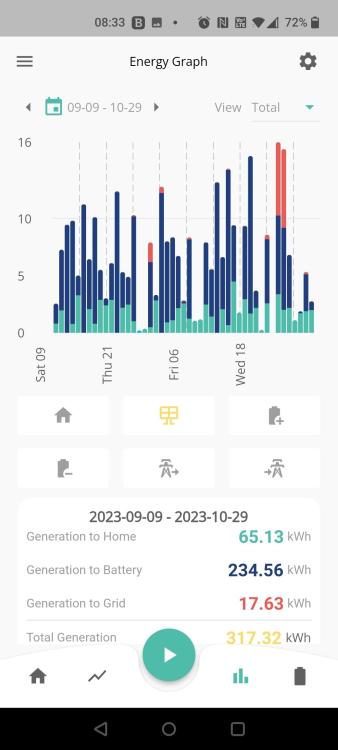
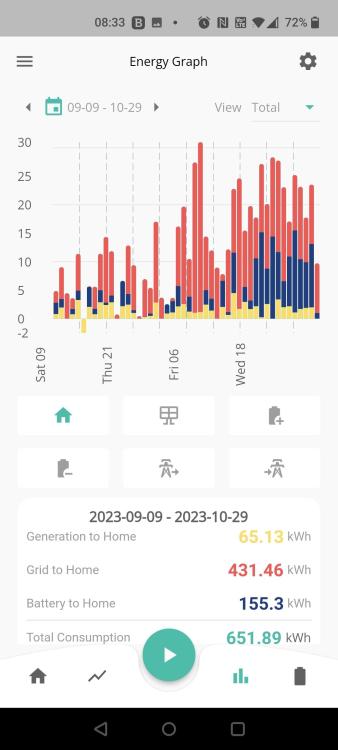
You can get various view of the data to show where electric is going and how it's being used. Not seen any mean values.
-
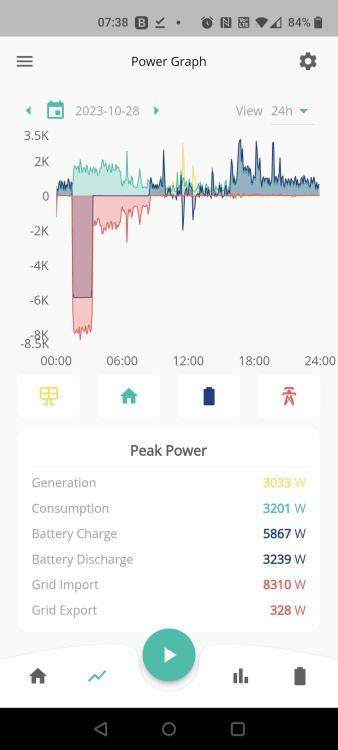
For those not aware how the battery and time of use tariffs work to together, I have a screenshot from the battery app So the above is 24hr window. In this view the cheap rate period was from 01:30 to 08:30. Below the 0 line is power either being taken from the grid or being added to the battery. Above the line is consumption and solar being generated. Starting on the far left, the blue section starting at midnight is the battery being used to supply the house. At 01:30, the big dark red section dropping down is the battery being charged, the lighter red is the total imported electric for battery charging and supply to the house. Once the battery is fully charged it stays unused until the end of the low tariff window at 08:30. The red wiggly line showing electric being imported, this line stops at 0830. It's a mirror image of the consumption in green above the 0 line. Above the 0 line, the green section is mostly the ASHP running with an electric heater and other background loads. These are all running on cheap rate electric, until 08:30. The remainder of the day is the general house loads bing supplied in blue from the battery. The yellow spikes and green areas are solar either supplying the house or adding charge to the battery. The downward spikes around midday are the battery being charged via solar.
-
My advise is don't connect to the same heat source as the house, unless usage patterns and heating rates are the same. I tried it with a summer house and the flow temperature required were too different. So although hooked up and flowing water, not much effect on the heating. We are using an electric heater at the moment, but using more electrical energy heating a well insulated summer house, than the main house. As @saveasteading says above would be my vote for heat. @zzPaulzz Dust extraction is another question, for a different section on the forum. I would raise a specific question on that.
-
What are you using to read the independent temperature?
-
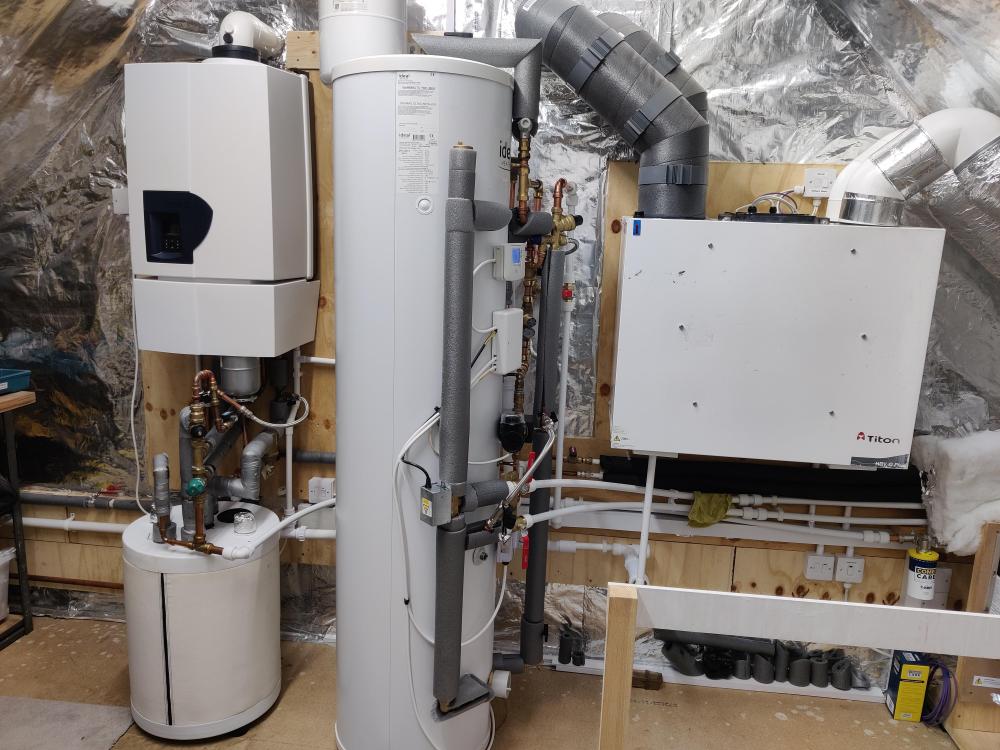
Comparison photo, showing 210L slimline UVC next to a combi boiler with an Alpha Flowsmart 50L preheat cylinder below it. So if you have a wall hung combi boiler, you can install a decent sized heat pump cylinder in the same space. The white box to the right is the MVHR unit.
-
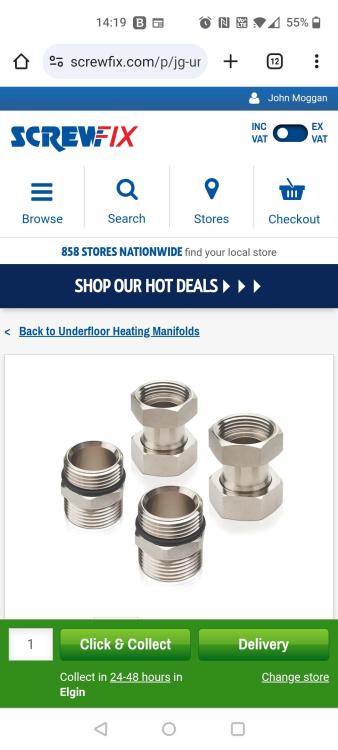
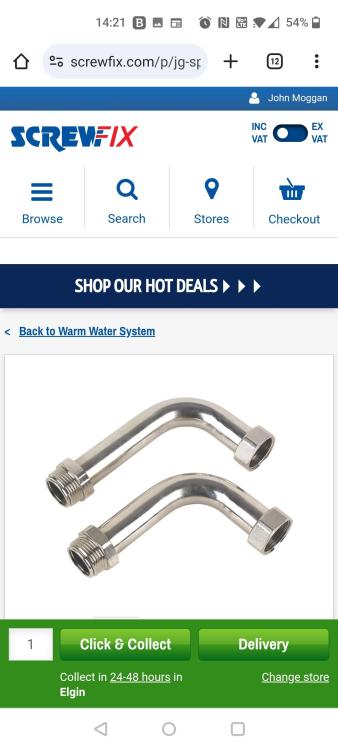
A 5 second search in Google, for UFH manifold joint, straight connection or 90 deg.
-
No we need better laws such as the one in Singapore - 'for the greater good', basically 'shut up, your feelings don't matter, we are doing it'. Because it provides more benefits to people or the environment, than just you.







