JohnMo
-
Posts
13299 -
Joined
-
Last visited
-
Days Won
200
Everything posted by JohnMo
-
 Two news items this week on TV, with the people being interviewed in tears, one complaining about a proposed wind farm, calling it a ring of steel and the other a solar farm. And both stating they are all for renewables, but, basically as long as it's somewhere else
 -
When you take seawater and make hypochlorite, which they have been doing for decades offshore, for local injection into seawater lift, to kill of marine growth in piping systems and heat exchangers, one of the byproducts is hydrogen.
-
So eventually got E7 tariff yesterday, after the failed attempt to getting a smart meter working. Also got the Home Assistant GivTCP, automation for the battery inverter working (been trying that for the past week). It reads the expected solar production, from a solar forecasting site, it also collates your usage data and sets the battery state of charge level accordingly, to only cover what's required. Yesterday the state of charge was set to 64%, we didn't run out of battery energy before the next charging period. Last night the charge was up to 78%, as less solar is expected. Have the ASHP charging the floor in the low tariff period also, at the moment it's running anywhere between 3 and 5 hours, running off the time clock in the thermostat, basically we bump the demand temperature up 1 degree at the start of the low cost period and back down to normal target temp about 5 hours later, if the ASHP needs to run longer on very cold days it can. Yesterday we used 0.5kWh peak electric. Everything else was off peak and from the battery and a little solar. The 0.5kWh is the small amount the battery seems to send back to the grid all the time, not sure if it's as a reference value or what? Our average winter electric consumption last year was 13kWh a day with gas heating. We have added a garden room, which my wife uses daily and that it is heated by an electric heater, yesterday it used 5kWh. Yesterday our electric consumption including our normal house usage, heating with the ASHP, and heating the garden room, we imported 18.7kWh @ 15.16p per kWh.
-
Documents required for building control sign off
JohnMo replied to Moonshine's topic in Building Regulations
Who ever installed/commissioned the UVC. The Benchmark Certificate comes with the cylinder in the back of the user install manual. The installer has to leave the user install manual with the end user as it's also the record book for servicing. -
Heat recovery performance
JohnMo replied to LinearPancakes's topic in Mechanical Ventilation with Heat Recovery (MVHR)
Have you balanced the the supply and extract nozzles room to room. If you haven't it's shite in shite out, not commissioned. Unless set up correctly what your screen says is meaningless. -
Recommendations - Storage combi or Normal combi?
JohnMo replied to Del-inquent's topic in Boilers & Hot Water Tanks
That's the same as the info I provided above but in a wall mounted version, closed coupled to the boiler. Not all combi boilers will take pre heated water, Alpha , Atag, and Intergas do, most other companies are a bit sketchy on details, I suspect most would but tech support in the UK don't come across it much, so outside comfort zone, so they just say no. -
MVHR doesn't move much heat around. We are in a bungalow with all the above, just keep the bedroom doors closed and don't heat the room much. It's then colder in the bedrooms. Want to even the temperature up, open bedroom doors. In summer we open the bedroom window and run the UFH in cooling mode when we get most solar gains.
-
City plumbing - Ideal heat pump cylinder 210L £805 (includes 3 way valve) Samsung 5kW ASHP £1681 (you may need to add a controller) You will need, Flexi pipes, Flexi feet, and pipes to join ASHP to cylinder and UFH £500 Above is about £3k (leaves you £1k for the UFH and electric towel rails in bathrooms) the prices are plus vat, but a new build can claim all that back. There are other options for ASHP, I paid £1300 delivered incl Vat. Do it single zone one thermostat required £50. Passivhaus house heat demands are exempt having multiple room zones. Above needs to add labour.
-
All depends how you buy really. £4k would get you an ASHP with cylinder and UFH. Without a grant, if you want. You could do most/all your heating off peak, you would struggle to do that with electric heaters. Off peak nearly half the price of full cost ASHP will have SCoP of 4, so 4x2, 8x cheaper than direct electric heaters to run.
-
I am in the same mind set as @ProDave skeptical about claims we have no heat and we only xyz heaters, i.e. they have heating. Back to topic. Not sure blowing damp air around the house is the best thing, as the cold air you propose to use is likely to be below its dew point being sub cooled. KISS, UVC for hot water, UFH for heat, reversible ASHP to drive it. 5 to 6kW will do most house sizes, have a 100mm screed heat during off peak, cool in summer either off peak or via solar PV. You will need MVHR under Scottish regs anyway.
-
Balancing MVHR
JohnMo replied to Ambaz79's topic in Mechanical Ventilation with Heat Recovery (MVHR)
Basically you are seeming to over complicate. Room size makes no real difference to much, it the overall house size and room function that dictate flow rates. This will give you a starter. But look at current building regs also. Plus if it's getting signed of you will need a certificate of calibration for the flow meter. Inward and outward flow need to match also. But clear how you designed the system with no clue on your target flow rates?
-
Recommendations - Storage combi or Normal combi?
JohnMo replied to Del-inquent's topic in Boilers & Hot Water Tanks
Gas is really the past. But if you insist on gas you have the two options you mentioned plus combi with pre heat cylinder. The issue with all combi boilers in the UK is they are fitted with a flow restrictor to help with the production of hot water in winter and the required extra heating needed as the cold water coming into the house get colder. So even the best performance on paper can be an issue in reality. Combi-SuperFlow-White-Paper-v1-2-4.pdfCanetis-SuperFlow-Product-Sheet-WE-050318.pdf A combi storage gets around this by having a volume of water heated by the CH circuit. A pre heat cylinder does the same thing. And is more flexible space wise.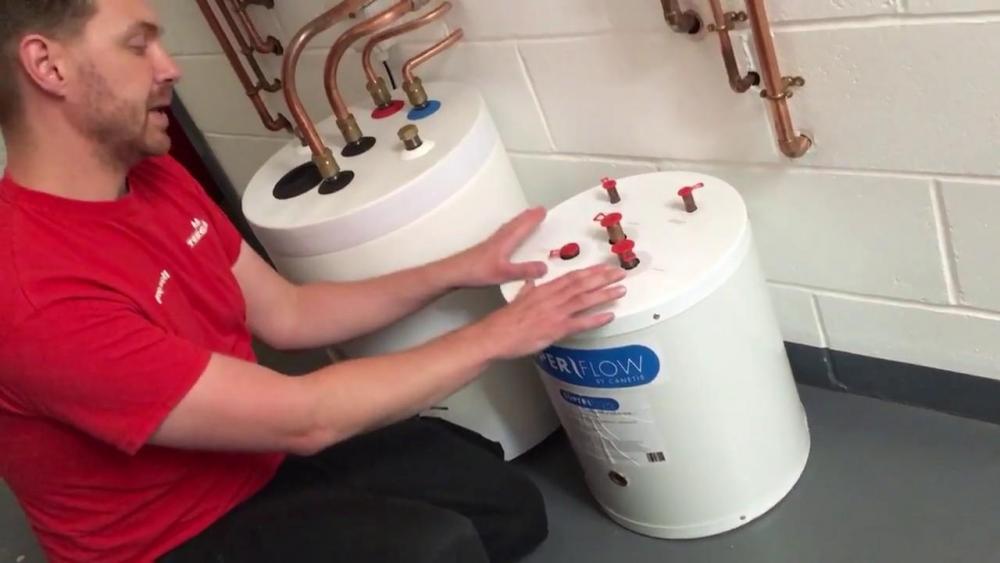
-
New member with problems.
JohnMo replied to Coanda's topic in Mechanical Ventilation with Heat Recovery (MVHR)
Getting the RH down does take a while, as the damp permeates the whole structure. MVHR isn't the only solution, the other is MEV, but with humidity sensing extract points and humidity inlets, these can be trickle vents on the window or through wall. The system only really extracts air when its needs too, and only at the ventilation rate it needs. The fan speed modulates based on the extract nozzles that are open. It does not recover heat, but this benefit is offset with lower overall running costs and only running as required. -
What to put where & what to allocate for the future ? UFH
JohnMo replied to syne's topic in Underfloor Heating
A little confused, why is the UFH manifold looking like it's in the garage? Assuming the 150mm slab is reinforced, if so attach the UFH heating pipes to the reinforcing mesh. Do the pipe in 16mm pert-al-pert pipe. Centres really depend on the overall W/m2 you need to generate, do you know? Ivar are quite good manifolds etc. You really don't want to be planning for joints in the concrete! Can you not take pipe through doorways? -
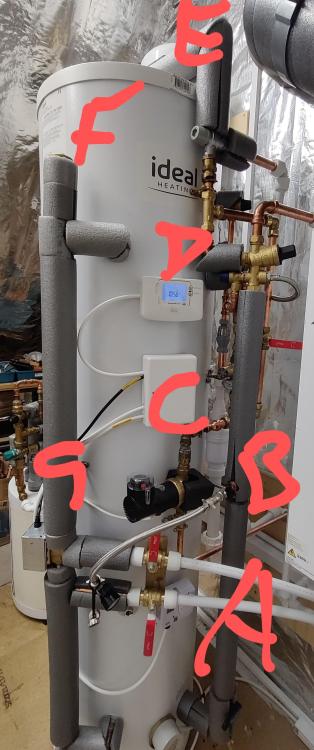
Quick run down on what's on the cylinder. A - flow and return from ASHP B - secondary turns pump, has integrated timer C - wiring centre, timer timer, thermostat, 3 port valve and secondary returns pump. D - timer for DHW heating E - check valve on hot water outlet. Expansion vessel is the white bit above cylinder. Tundish is visible to right of C and D. Between D and E is the water outlet mixing valve. G - is a 3 port valve F - air release valve So basically water from ASHP comes in via the top pipe at A, if the 3 way valve allows it passes water upwards to the top of the coil, water passes through the coil and out the bottom of the cylinder towards the 3 way valve out the lower pipe at A. Any air in the coil can be bled out of the air release valve at F. As this is a retrofit, the cold system is not directly balanced to 3 bar, so a check valve is installed on the cylinder outlet at point E. This prevents any reverse flow through the system. I decided to put all the electrical bits on the cylinder so I have just one power cable and the immersion cable coming off the cylinder. Call for heat from the heat pump is via a radio signal.
-
Could you do that in the consumer unit with a timing circuit breaker or a smart one? Not sure how you would control temperature? My TTIR controller sits on the sill, so no faceplates or holes to worry about.
-
I used a generic towel radiator designed for water system, but installed Terma One heating elements and have their TTIR wireless controller. Just filled the radiator with some leftover car antifreeze and tap water. Wiring is just as @Conor describes, but the controller switches on off by temperature and time window.
-
Not sure I would start adding insulation below and between the pozi rafters, as you start getting into hybrid roofs and very carefully details, otherwise you end up with condensation etc. You could go up to 200mm then after that it's very diminished returns. 200mm will give a U value circa 0.1.
-
Balancing MVHR
JohnMo replied to Ambaz79's topic in Mechanical Ventilation with Heat Recovery (MVHR)
Depending on your airtightness then, you will need a full time (cannot be opened or closed) ventilation source in the same room as the log burner. Building regs give the criteria and size. Pretty sure your mechanical ventilation doesn't count as ventilation for a non room sealed stove. I pretty much say having a supply and extract in the same room is not the best move. If you have your fire on and the room is otherwise quite airtight you could start to comprise the fires seals and the chimney effect and start letting smoke into the room. As the fire and the extract will be depressurising the room. I would go further to say unless you address it now - quite dangerous. If you haven't bought your stove, get a room sealed one where primary and secondary air are taken from outside. -
With that roof buildup I wouldn't bother with the service space in the ceiling. As it's giving you nothing. But I would increase the depth of the insulation above the roof, to 150mm as a minimum.
-
@ProDaveI added that bit (possibly while you were looking at my reply), when I realised the drawing was showing a floor above.
-
Depends if you need a vapour barrier or not. I needed one, so did a 50mm service void in all ceiling to allow spots to be installed and running wires without compromise of the vapour/airtightness. But would only do this where the ceiling is with the roof.
-
Depending the make of either the radiator or the heating element, you should be able to get an external battery powered time thermostat.
-
Not sure the above really answers your question. You are not directly connecting the battery or BMS to the grid, you would be using an inverter also. The bit the DNO is interested in really is the inverter and how that works with the grid. So that would need to be certified.
-
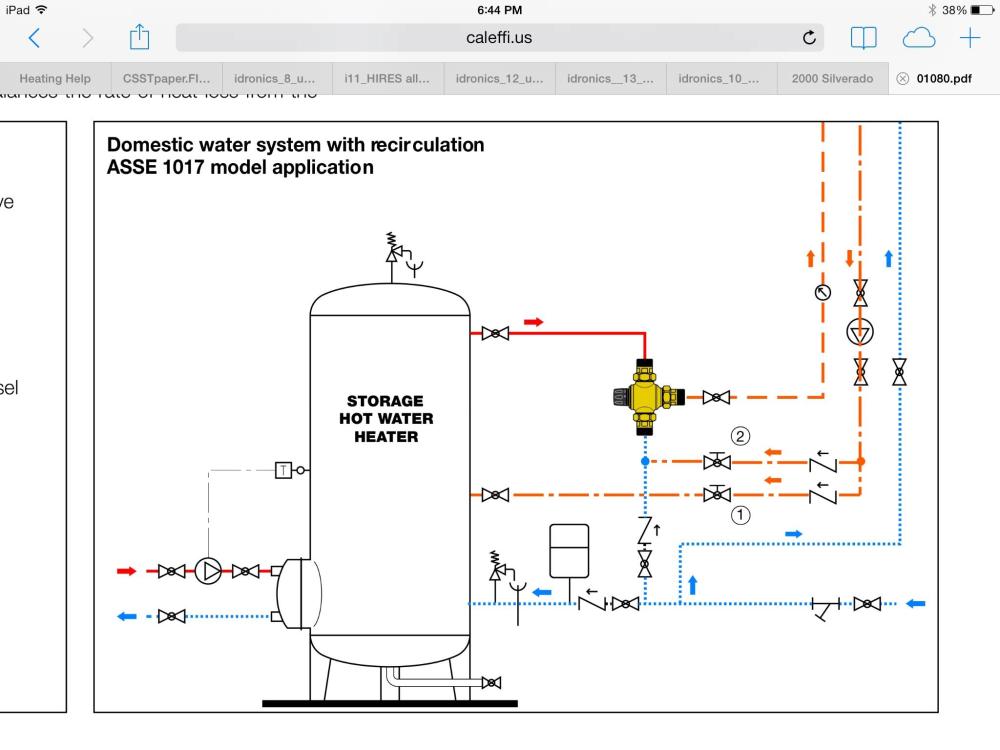
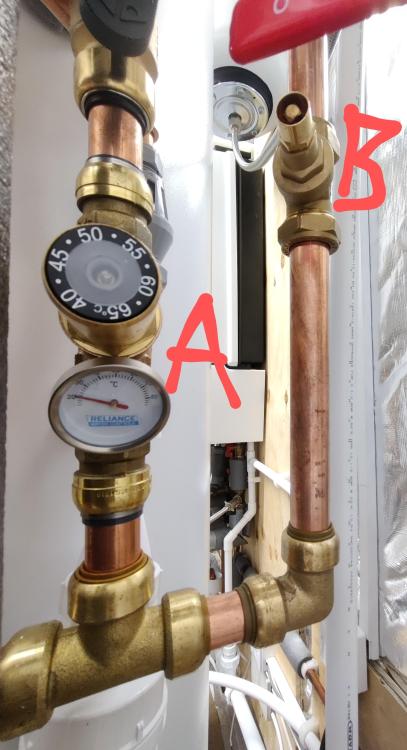
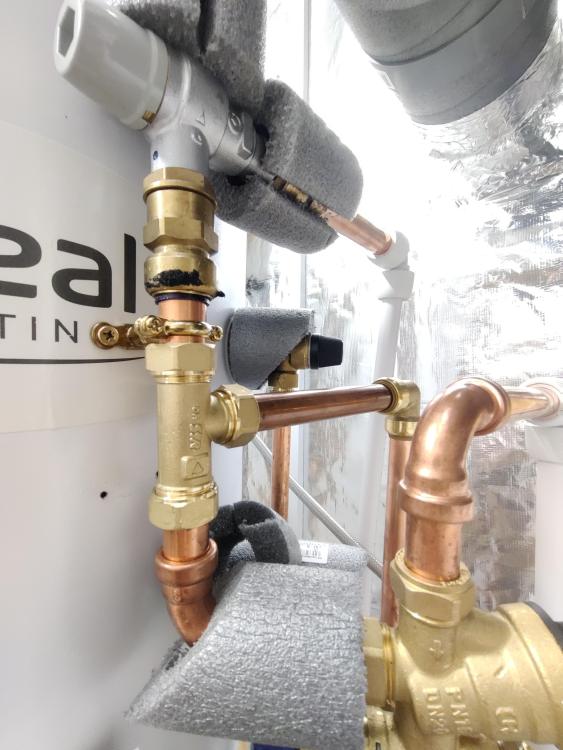
Several months ago I purchased a 210L slimline Ideal Heat Pump UVC. Then completed the UVC training, so I could self install and certify. There will be secondary circulation also. An interesting thread, a while ago, brought up an issue of secondary returns temp being high if you have a mixing valve on the cylinder hot water outlet, as cold water cannot enter what is a sealed system. So what you need is a split in the piping after the returns pump to allow water two different flow paths either to the mixing valve or back to the tank. So although this is a heat pump system and cylinder temps should be now higher in theory than 46 degs, solar excess is being diverted also. So have replicated the above with a little mechanical automation using a Reliance valve and a gate valve. The reliance valve is adjustable to close at an adjustable temperature. So the theory is 1. Secondary returns pump starts 2. gate valve (B) is set to reduce flow going to mixing valve, so all or most flow goes via reliance valve (A) to cylinder, 3. once return temp gets to set point, the Reliance valve closes and all flow goes via the mixing valve The Tee below the mixing valve incorporates a check valve, pipe entering the side port of the Tee is the gate valve (B). Will give an update as things progress