JohnMo
-
Posts
13300 -
Joined
-
Last visited
-
Days Won
200
Everything posted by JohnMo
-
You should be setting on something like wet concrete, tile adhesive etc, read your instructions - they will tell you how thick a bed you need to set it in.
-
Sorry if you are connected to the CH system, that will have corrosion inhibitors in it ,so you don't need to add anything. If it was electric only you would.
-
Not sure about using a dT of 18, so a design temp of -3 would be 24! So heat demand is closer to 6kW No, useless you have passivhaus heating requirements. ASHP v gas boiler DHW complication - there is no difference. Both have a cylinder with a coil inside, ASHP just has a bigger coil and slightly bigger cylinder. Well insulated house with constant background heating don't feel hot, MVHR gives you fresh air constantly. A small setback at night job done. You don't have to heat bedrooms as much as the rest of the house. Look on eBay cheap ASHP come up the time, I paid £1300 for mine, other on here way cheaper. I got my completion certificate in March with a gas boiler, installed an ASHP the same month. Mainly for cooling, which gas boilers aren't good at.
-
Vaillant R290 is capable of 75 degs, my R32 is only capable of 60 degs. That could be down to a bigger plate exchanger or the refrigerant? Nearly all ASHP are monobloc so no one is touching or exposing the refrigerant so both the same. R32 is an F gas, so only qualified people can use or fill systems, such as split systems, R290 is not an F gas but flammable.
-
 All door have a small undercut at the bottom, about 10mm between floor coverings and the door. Closed doors make no difference. There is zero pressure increase. The constant air flow, leaves bacteria in a place it doesn't survive. So smells don't tend to be an issue. I would say no, the whole idea is the flow of fresh air, dilutes the humidity and CO2, continuously, the further it travels the better. CO2 and humidity disperses very quickly it doesn't just sit there. You would never ventilate at 180m3/h. And the guidelines don't say that. You only have a max required airflow rate that is equal to the bathroom and kitchen extract rates. Boost would be 20% more than normal flow, no more is required. You don't size the ventilation, on the off chance you get a gang of mates coming round. If you have six people over and it gets stuffy, you open the window! I have a small MVHR doing two bedrooms and ensuites, I used two of these as a plenums https://www.paulheatrecovery.co.uk/product/7178/ So it runs - MVHR to plenum with a silenced duct, to 90mm duct, the duct to outlet plenum/nozzle. And similar for the extract. My longest duct run is about 9m and it's fine as a single 90mm.
 -
Had a lot of similar comments, with that and mould related comments, and wasting your money insulating the slab, because heat rises - it doesn't go down.
-
Longi 400W PV, £69 per panel x5 to give 2kW, plus VAT, is £414.
-
But the controller would be next to useless as only suitable for charging lead acid, so you need an inverter also, so starts to add up. But the base unit is cheaper than I found.
-
I would run around the wall, but it will need to be insulated, not in conduit. Use 25mm wall thickness insulation.
-
Bigger difference in performance is obtained by good design of the system it's connected into. Everything that is different is small percentage points, but a R290 does give a much higher ASHP output temperature if that is important to you - 75 compared to 60.
-
Yes as it contains a corrosion inhibitor, or you will need a corrosion inhibitor. if it's not connected to anything else, use car antifreeze, cheap easy get hold of.
-
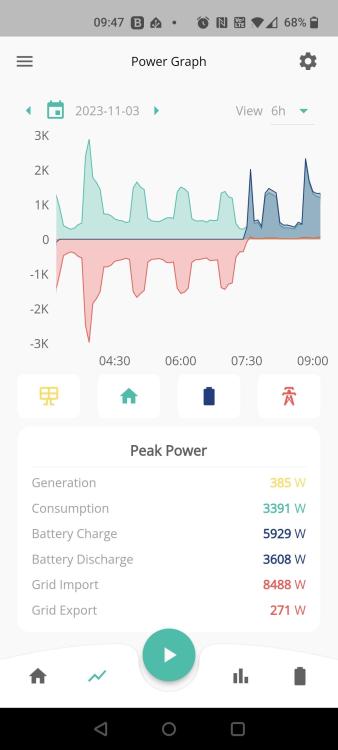
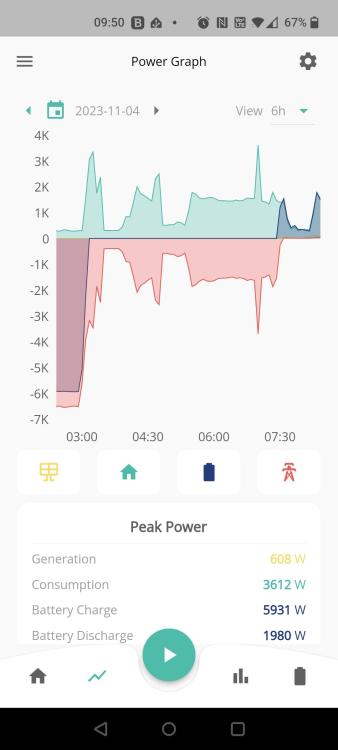
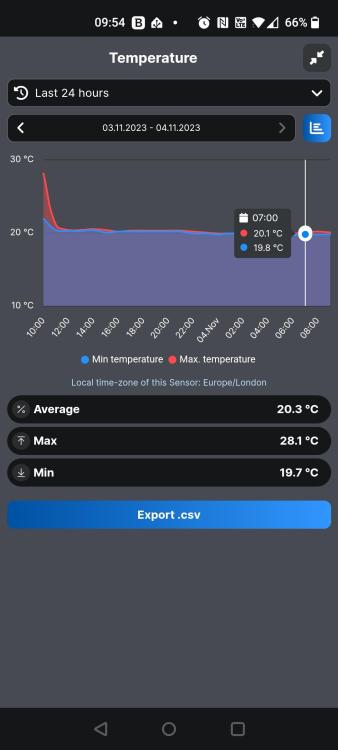
We have it at 20 degrees, the temp over the last 24 hr has been very stable. Found that any hotter is too hot with the UFH, much cooler you are looking for a jumper. However there was zero sun yesterday, as it was peeing down all day, 8 degs in the day. Outside temp in the evening and overnight dropped to 4 degs for about 10 hrs. More of a brighter day today, so will get some solar gain, so will see how things react in the house and the ASHP. This was the cycles of the heat pump on a 7 deg night (couple of nights ago)- short runs long off time. (Green spikes are the ASHP) Last night at 4 degrees, run time extends with one run over 2 hours. Some of the bigger spikes are the dishwasher, the one 7am is kettle. House temps, the big spike was the H&T in my hand.
-
Settings are down to heat loss and are different for every property. Start at a setting say 40. If you are controlling with a thermostat in your rooms, look to see if you have room temperature over swing, so set temp is 20 and room drifts up to 21, then your flow temp is a little too high, so adjust down a little. Same if the room never reaches set temp, turn up a little.
-
Pipe runs for water, run in a way that doesn't encourage air pockets, high points will need a bleed point added. Going up, across and down, will need a bleed point at a high spot, that may not be accessible now or in the future. So not best. Going down, along and up, the bleed will be at the ends and likely accessible now and in the future, so better. For gas pipe do what he wants, he has full responsibility, you providing parts becomes your responsibility, should anything be wrong. Your plumber should be telling you this.
-
Only thing I would have different is made the tees 28mm not 22mm. To get a step change in velocity at the tees.
-
I also was just a DIY er, but after getting some stupid quotes, decided I would do the PM role and lots of other roles. First have a step by step plan. Dates not that important but the logical build sequence is. Mine a little different from some people Foundation, floor installation, UFH pipes, concrete floor, all done prior to walls getting in the way. While that was happening I got all services to site, including a water borehole. Build walls etc... You have to be on site, at any time you have trades there. Coming and going just doesn't work. Doing it and a normal day job a big no. You have to be able to make decisions and not dither about. These will range from that dimension doesn't work, what do you want me to do, to putting a light there looks stupid, are you certain it goes there? Scaffold will likely need to moved about for different trades, so you need to on top of that etc. You have to be at least two steps ahead of everyone else on site, they are there to one scope. Ask the trades on site for recommendations for the next trade you need. They will have people they like to work with, and more importantly don't want to work with. Be prepared to get your hand dirty, fill skips, tell people that's how I want it done. If you are going airtight you have to reinforce the message to every trade most days. Try to get fixed prices for scopes, way less stressful, nothing worse than seeing someone in the van on their phone, when you are paying by the hour - on a fixed price, that's someone else's issue.
-
May be similar, may not match at all. Red circle is some mixed flow, the mixer valve is just letting enough water in to get the mixed flow the correct temp. You would adjust the blending valve to get the temp on the gauge where you need it. Don't try to overthink it. If your house isn't getting hot enough, you would just increase the mixer setting, getting over swings in temperature, you just reduce the mixer.
-
A gas explosion https://www.yachtingmonthly.com/sailing-skills/crash-test-boat-gas-explosion-29779 A Vaillant ASHP has around 0.6kg of R290, so a volume in a liquid state of 1.2L, however in the gaseous state it expands, that increases the volume to 320L. A leak in the high pressure circuit would result in a big instantaneous pressure drop and any liquid would convert to gas and freely mix with any oxygen. Then you just need an ignition source. So not sure the dangers are that exaggerated. Would certainly lead to more than a bad hair day, if things did go wrong.
-
Testo 405i setup
JohnMo replied to Deniance's topic in Mechanical Ventilation with Heat Recovery (MVHR)
Have set the correct pipe diameter into the Testo? -
New build originally designed around a gas boiler and UFH, flow temp are low as could be, due to 300mm pipe centres. So previous setup was, gas boiler, big buffer, mixer and pump on the manifold. The flow temp out the buffer was consistent, but filled based WC (Weather Compensation) curve. Flow temps varied between 26 and 34 degs (at -9 OAT). The heat pump is installed without a buffer, all UFH loops open, with no actuators, mixer or pump on the manifold, so as simple as it gets. Have a single thermostat, just to give a start permissive for the heating. Couple of observation 1. The min heating temperature of the heat pump is 25 degs, dT is 5.4 degs, so a return temp would be 21.5. 2. After one heat cycle at a low flow temp (26 degs), the floor doesn't cool down enough to allow to ASHP to start up again. So heat pump would not restart. That didn't work 3. At low loads heat pumps cycle, I typically have a 10 to 20 minutes run time and 45 minutes off. The recirculation pumps continues running at all times. If the heating load decreases (OAT, solar gain etc), the heat isn't transferred out the flow as quickly, so the off period of the ASHP increases. 4. To compensate for the on/off run nature of the ASHP, and to get the required heat into the floor, you need to flow at higher temperatures at low loads, than you would expect. 5. So to make up for the on/off nature I increased the flow temp to 29. The flow temp pattern through the floor is typically (8 deg day), heat pump ramps up to set temperature and when it cannot modulate to control dT the heat pump shuts down. The flow temp and return temperature stabilise down to about 24 and flow will slowly cool over over the next 40 minutes, down to about 23 and the heat pump starts. 6. Very small increments in flow temp have an impact on house temp, less than 0.5 degs change in target temp, can be felt in the house. 7. Been tracking the temp on a Shelly H&T today, temperature drift in the house is around 0.2 degs. Have tested the 3 basic modes of operation so far, operation controlled by thermostat, batch charging overnight on cheap rate, and continuous running 24/7 on straight weather compensation. So far leaving it to run all the time seems the cheapest to run and easiest to implement. Have a simple Shelly H&T set up in the hall, to record how temperature moves over time and OAT changes, this will allow fine tuning of the WC curve.
-
A quick look at a data sheet shows a 1kW turbine at 8m/s produces 2500kWh per year, so is you stained 8m/s wind speed all year you may get 2500 / 365, 7kWh per day, nearly half what you are claiming. Good dent but not a 12kWh dent. But the turbine and pole is £4k, not £1k.
-
Update, after lots of messing about to get a smart meter working, went E7, but since this thread started I have a battery also. So currently 90%+ of the electric is coming from E7 and only a couple of kWh at full price, for whole house use including heating via an ASHP.
-
So since the above, I have now switched to run the heat pump 24/7 under weather compensation (no longer doing batch charging), fairly simple WC starting at +8 OAT and down to -8. Starting flow temp is 29.4 end flow temp at -8 is currently 34.4. Had to make a few changes to the running parameters to get it running right, ASHP now cycling on and off much more at low loads (like it should). So currently about 8 degrees outside and the ASHP cycles to heating mode, running for 15 mins and then, 45 mins off, the circulation pump stays on throughout. The battery and economy 7 able to provide nearly all the electric for the house and heating at the moment, yesterday we imported 2kWh of full price electric. Morning temperature was about 1 deg outside, the highest temp was 8 deg. The starting flow temp of ASHP is higher than I expected but this is due to heat pump running about 15 minutes per hour when it's 8 degs outside and 20 inside. So most the time the water flowing through the UFH is around 23 to 24 degs. Upside of this, is the summer house UFH is able to keep the temp at around 12 degrees, so electric heating only required for those hours the wife is actually using it. Saving 6 to 7kWh of electric per day. Running the ASHP all the time is actually slightly cheaper than batch heating also. So win win.
-
Decided to keep things simple. So I have just started to run the heat pump 24/7 under weather compensation. If the sun's out the heat pump uses the energy available anyway.
-
LG Therma V monbloc DHW recirculator pump not running
JohnMo replied to Willits's topic in Other Heating Systems
I would start at the heat pump end, select the pump on, and actually check if the terminals have power, if they don't, it's a setup issue, or that option isn't included in your particular ASHP. If they are powered you have a wiring issue to sort in the house.