
JohnMo
-
Posts
12470 -
Joined
-
Last visited
-
Days Won
179
Everything posted by JohnMo
-
So about 7,000kWh export required if you can get 14.5p or 22,000kWh if you get 4.5p to break even - Really not worth the effort or hassle. The first figure is close to 1.5 years full production being exported, which never occur. This month so far, just about zero exported.
-
 Nothing wrong or cheap and nasty about any of the below. Look at city plumbing or similar. Panasonic 5kW £2300, 7kW £2800 LG 5kW £2100, Ideal 5kW £2500, Grant 6kW £1900. £10k they have seen you coming and are ripping you off. Simple monobloc is all you need, others on here state that Panasonic are great bits of kit. You can pay an extra £2k for Vaillant if you want, but no idea why people do. Mine cost £1300 vat included, last year, does heating and cooling out the box, is cheaper to run than my gas boiler - what's not to like. My Ideal 210L slimline cylinder was £900 incl vat.
 -
And a bunch of money to pay them upfront, which would take umpteen years to get back, no point. Plus I believe if it's not a new build you need the structural engineer report to certify your roof is suitable etc.
-
Just look at the prices yourself New build so heat loss shouldn't be huge so assume a 6kW - about £2500. Cylinder £1000, should come with full safety group and expansion and maybe a 3 way valve. Feet and Flexi hoses for ASHP. Some 28mm pipe either copper or Hep2O. UFH manifold, 16mm UFH pipe and staples and a decent thermostat. That's the full shopping list just about. About £5k should do it.
-
You could explore this https://coolenergyshop.com/collections/air-source-heat-pumps/products/activair-3kw-indoor-air-source-heat-pump Tee it into you MVHR pipes that go outside, you would have to take a proper look to see if it works. There are no noise figures so that would need to be understood and it's a little vague on cooling, it seems to have an icon but no other mention. Then connect to a fan coil radiator.
-
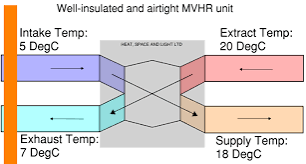
Here is a typical schematic showing the flow paths. No heaters attached to my MVHR. But as I mentioned to gain 2 degs at best more likely 1 Deg or less) not worth the effort, for the marginal gain in CoP.
-
Just looked at a photo of the temperature when it was 3 degs outside outflow are was at 4 ish. It's a cross flow heat exchanger so the outgoing air will be cooled to nearly incoming. Incoming air will be heated to nearly the same as the air being extracted from the house. Actual temps were OAT 2.9 Extract to outside 4.6 Room extract temp 19.8 Room supply temp 18.9
-
Scottish government declares national housing emergency
JohnMo replied to Guest28's topic in Housing Politics
They want us back in the EU = unlimited immigration -
Scottish government declares national housing emergency
JohnMo replied to Guest28's topic in Housing Politics
SNP, wants almost unlimited people coming into the country, they have been in power for donkeys years and anything not right, is the UK government problem not their and of their making. SNP have frozen council tax for about a decade and wonde why councils have no money. Sooner they get voted out the better. -
Surplus solar diverter + battery storage issue?
JohnMo replied to lakelandfolk's topic in General Alternative Energy Issues
Not really sure how they modulate the power to match what's available? Maybe they vary volts to keep things in balance - could be talking rubbish. @ProDave maybe able to shed some light on it as he built his own diverter. -
Different system, the one the OP is referring to takes tap water through an indoor heat pump unit (W2W or water to refrigerant) and then said water is routed to drains never to be seen again. Many (100s) m3 of water goes to drains system over a summer period even when there is a hose pipe ban in force.
-
Simple facts are MVHR airflow rates are way to low to have much or any effects on room temperature. You are only exchanging the air once every two the three hours. Read above, plus that form of cooling works by adding water vapour to the air to cool it down and play with dew points etc. but in the UK generally the humidity in the summer is high so effectively, it's not much use. Water based Aircon is a waste of good water unless you can recycle the water via buffer or something. If you can't do a split Aircon or traditional heat pump, I would look at through wall Aircon. Basically two duct holes in the wall and everything sits in the room like a radiator. Not a recommendation just the first site I came to https://www.nationalheatershops.co.uk/c/ptacs/
-
Mount cast iron radiators vertically..?
JohnMo replied to Cognis0's topic in Central Heating (Radiators)
Yep - maybe, would that sort of radiator looks daft in the wrong orientation? Do it and report back (you are not wanting to here the answers being given above) - but would the brackets that hold the radiator on to wall, even work in the wrong orientation? Or just buy the correct radiator for the job. They are available, we had them in our last house. Not that expensive, if you shop around. -
I did do some calcs for something similar, and a 2 Deg uplift in temperature is worth approximately 0.3 CoP increase. Looking at my inlet and out temperature difference on the MVHR there is only 1.9 degs difference. So we are looking at a CoP uplift of 0.3 at best. There are a few practical issues The condenser wraps it's self around the ASHP in an L shaped, so the MVHR outflow would only hit some some parts of the condenser not all. So even if the air was hotter than outside air the impact on the condenser maybe much smaller than anticipated. Getting the MVHR outlet and heat pump inlet in the same space may be difficult or not practical. Or just look a mess. My conclusion was it really wasn't worth the effort for very marginal gains.
-
Was it installed via the MCS grant scheme?
-
Can you not surface run it, instead of underground?
-
Please see the other response on the other thread. The article uses 25mm of polystyrene insulation under the slab so downward heat losses are huge and make the whole article a bit of a joke and at best misinformation. The lowest output they mentioned is a mean flow temp of 35 degC for 47W/m2. Highest is 95W/m3 at 56 degC mean flow temp. All pretty huge, maybe ok for energy rich USA.
-
UFH pipes in concrete slab, on insulation or tied to mesh
JohnMo replied to Chanmenie's topic in Foundations
See my other response. Plus below on the article From the article "This increases the time required to warm the floor surface to normal operating temperatures following a call for heat. It also lengthens the cool-down time after heat input is interrupted by system controls. A fully “charged” slab can hold several hours worth of heat that will continue to flow into the space as long as the air temperature and / or interior surface temperatures are cooler than the floor surface. This can be a real problem in buildings with significant internal heat gains from sun-light or other sources." Comments With batch heating the long storage time constant is what you want. Heat for 7 hours, live off the heat for next 17 hrs until next heat cycle. Charge with a low hysterisis thermostat ensure little temp overseeing in the rooms. Well insulated ensures heat doesn't escape and also floor surface is only a couple of degrees warmer than the room so the floor output self modulates. One of the FEA models I constructed is shown in Figure 1 (on Page 14). It consists of a 4-inch concrete slab sitting on 1-inch-thick extruded polystyrene insulation. Comments - 25mm of polystyrene insulation is a joke and undermines the whole premise of the article. -
Not sure what to state is real in reality. Unless your heat losses are huge of course - but then you wouldn't be installing UFH unless you were mad with money to burn. If I needed 70+W/m2 the house would require 13kW to heat, reality is I need 3kW at -9. So why would I design the UFH to give out that much heat. Mines at the bottom of a 100mm concrete pinned to insulation and at 300mm centres. Slow to respond yes, does it make any difference - no, as you keep the slab (60 Tonnes) up to temperature, by low and slow heating or batch heating on E7.
-
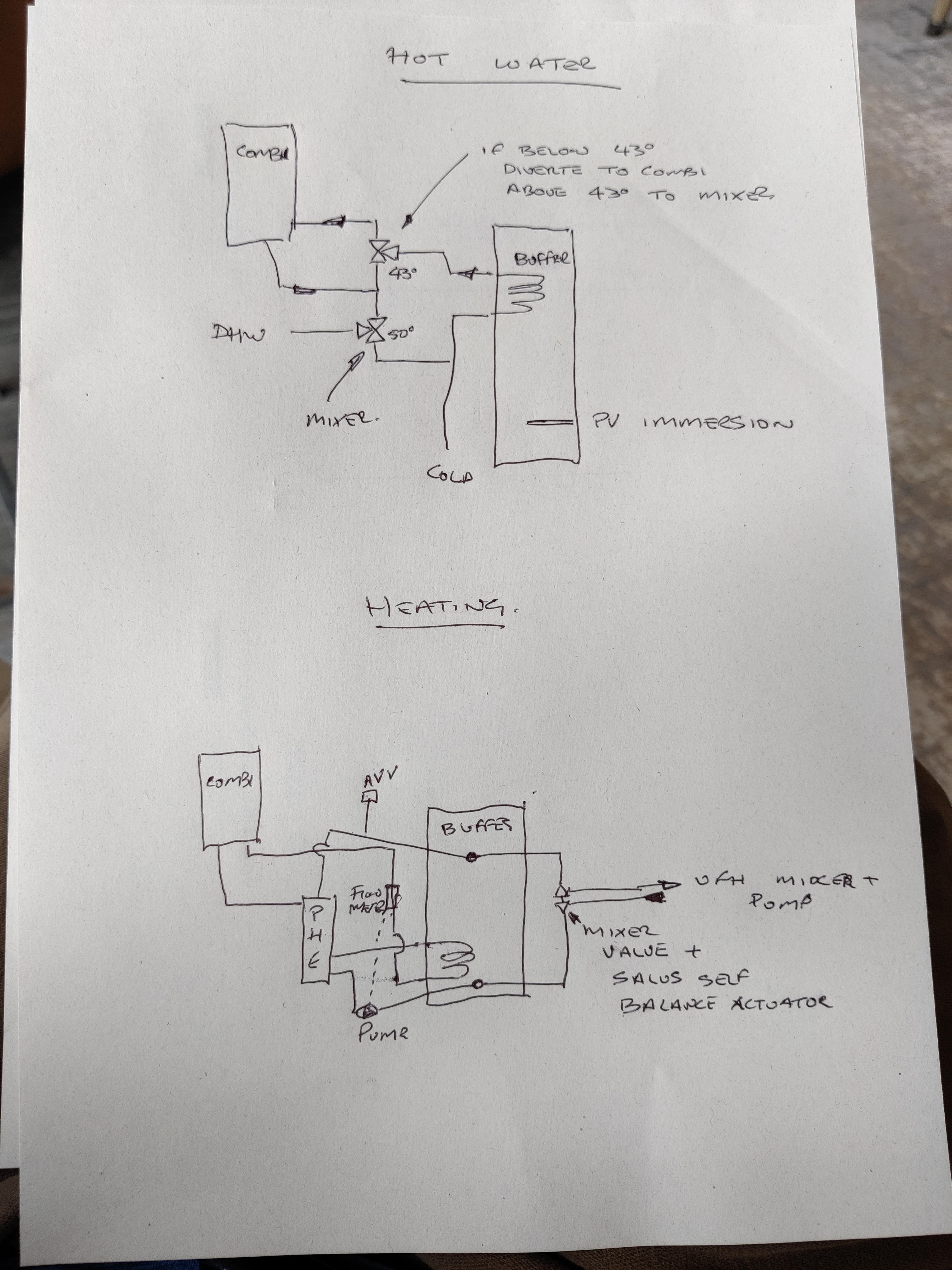
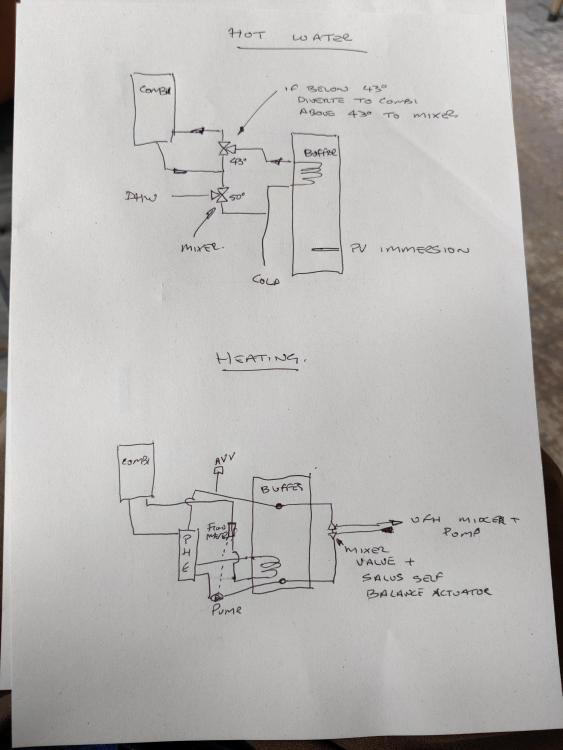
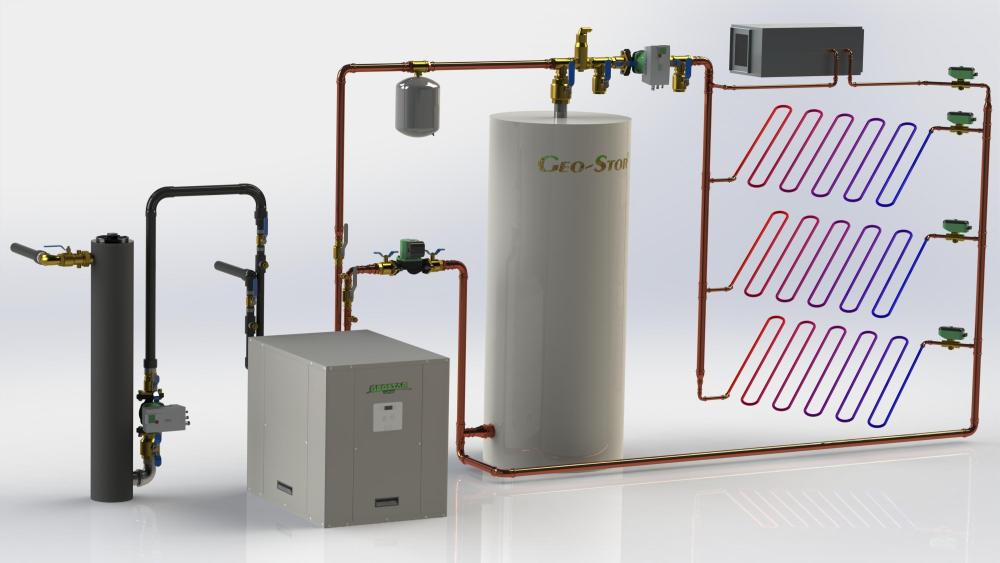
So basically using the UVC in reverse as a buffer. I would plumb as a 2 port buffer. So basically it simplifies the install. The grey box is your boiler there is an oversized tee on the top connector, this forms a hydraulic nul point, after that you have a secondary circulation pump. Water flow is to central heating first, zones closed flow is automatically diverted to buffer, no zones open around buffer only. You control the secondary pump by the heating demand, you control the boiler by the cylinder thermostat. You are likely going to need a larger heating system expansion vessel to match your increased capacity. How it works - So cylinder hot, house heat demand the secondary pump pulls from the buffer until the buffer calls for heat, then the boiler starts. Once house demand is finished secondary pump stops and the cylinder is heated ready to go. At the end of the heat season switch the boiler off, but it likely your solar excess will do that anyway. The DHW would look like the top image below, with a Watts solar diverter. You need a cold water safety group and expansion vessel if not already installed. Safety There must be no valves (if valve the handle removed) between cylinder and heating system expansion vessel and safety group. Or you install the full safety group on the cylinder - this is a zero cost option as all the kit comes with cylinder anyway.
-
Just checked the house dew point and it's about 14.5 degs currently, the UFH manifold is just feeling cold but looks dull so some water is starting to form. But I operate cooling for 3 hrs in the morning and 3 hours in the afternoon with 1.5 hrs off around midday, allows for hot water production, but also keeps me mostly away from dew point. Flow temp starts at about 17 and takes the cooling period to get down to 12. Found last year if you try to leave it cooling all day you start to get drips from the UFH manifold. If I run any warmer the heat pump cycles too much. At 12 Deg set point it run non stop the whole cooling session. Also found last year UFH cooling really just helps temper the temperature and stops the extremes, rather than real cooling. Our living room is currently 25.6 at 1.5m high and it's 23 in the hall at 0.5m high, but feels more like 22. The floor is pulling the heat from your body, similar to wind chill in some respects. Humidity is 56% in the house (MVHR) and the summer house where the fan coil is is 52% (with dMEV). Without underfloor cooling the room with all windows and blinds closed gets to nearly 28, because of the wall of glazing. Windows and door will be opened to purge the hot air in a while.
-
Just looked at our fan coil, it's being supplied with about 12 Deg water same as the UFH, no condensation at all. Fan coil pipes aren't insulated.
-
Yes, I just slip them on the spring prongs that hold the terminal in place
-
I use similar to those in all my extraction points, it's amazing the amount of stuff they collect in 6 months, and makes you wonder how contaminated the ducts would be if not using them. The main MVHR extraction side filter is almost always clean when I inspect.