


JohnMo
-
Posts
13308 -
Joined
-
Last visited
-
Days Won
200
Everything posted by JohnMo
-
 Hi welcome Number of people make no real difference to heat loss calcs. Do you own heat loss calculations. All those numbers sound plain stupid. Our house from your description is similar to ours and our heat loss is 3kW. So sometimes well off. Are you a new build? What does you SAP report state?
 -
Think if your design requires a tight control on internal or external humidity, I think you change design. Summer humidity even with MVHR is all over the place, especially if you are cooling, have the windows open or both. We were hot this morning, cooling on (always on really in summer) 59% at midnight and by 8am at 69%, house basically cooler than outside. House between 20 and 22 outside 22 to 25. Over the last month has been mid 50s and above.
-
Pretty useless inspection, if he doesn't know the details of what he is there to inspect.
-
Wood Kraft Moray based in Elgin
-
Architects initial drawing. Not sure it works?
JohnMo replied to flanagaj's topic in New House & Self Build Design
I would keep inside and access from the inside. For all the reasons above. -
Mini Store - Heat Geek / Newark Cylinders for ASHP
JohnMo replied to Nick Laslett's topic in Air Source Heat Pumps (ASHP)
The tables make interest reading. If you have a coldish 10 Deg fill water from the mains, and a decent shower flow, they just don't work well, even at elevated storage temps that a R32 ASHP really wouldn't manage. So unless you really had to I wouldn't bother. -
Yep
-
I found the same so looked at what actually makes up a unit and nothing much. Break down of parts I have used Resin Purolite MB400IND Mixed Bed Indicator DI resin 60/40 1L from Complete Aquatics - I bought 2L for £32 delivered (only used just under 1L so far and its 50% depleted) VYAIR 10" Refillable Transparent filter housing (empty for DI resin - £7.99 from Amazon, this holds the resin and goes inside the 10" filter housing 10" transparent filter housing with 3/4" tappings - £20 from Amazon 3/4 male X2 (for filter housing) and 3/4 female X2 (for fill and flush manifold) garden hose tap connectors - Amazon £14 Some off cuts of garden hose and garden hose end connectors Already had a fill and flush manifold in the system. So about £75 all in (plus the fill and flush point) and have enough resin to treat around 2000L of water. All you do is replace the resin when it all changes from blue to brown. So £16 instead of £160 charged for complete cartridge.
-
Easy install them and then set to 24 or above, so they stay fully open, as if they are not there. Risk taken away. Various way to achieve the same thing. Why would you call in a Building Inspector?
-
Not really true, have you actually read many of my posts. I have run every mode possible, over the last couple of heating seasons, to get the best output per pound spent. Had a thermostat in every room (still have, but no longer connected). The best cost wise with thick screed given a large enough heat source, is batch charging the floor with gas or ASHP on TOU tariff. But my heat pump isn't big enough for that below zero. So straight WC is the next best thing. My house doesn't need, thermostats or TRVs, but like a good radiator system, the UFH loops are sized to give a equal output to heat loss expected for each room, the difference is made up by tweeking flow rate. Heat losses are low, floor temp extremely close to room temperature so the heating system responds to changes in room temp without intervention. The further the room and heater diverge from each other the more reliant you are on control. So flow temperature of 35 for radiators, is way better than a lot systems being installed at 45 to 55. A 35 deg radiator can much better vary it's output on its own in response to solar gains, than a 45 Deg one. Currently cooling the heat pump compressor ran 9 times over the last 24 hrs. Gaps between run varied from one hour to four hours, in response to room temp changes. Compressor restarts when average return temp goes above 19.8 degs. The word general makes the whole sentence meaningless. As it permits deviation and allows you not exactly follow to the letter. So wide open to interpretation. If you are to follow exactly, it would say must or shall or even should.
-
The document also says in the heat pump section: 6.38 The heat pump unit should include controls for all of the following, in addition to meeting the general requirements for heating and hot water systems in Section 5. 6.39 The heat pump should have external controls that include both of the following. a. Weather compensation or internal temperature control. b. Timer or programmer for space heating So for a heat pump you can either have room controls or WC. The timer or programmer normally comes with the heat pump or a timer thermostat can be used as overheat protection.
-
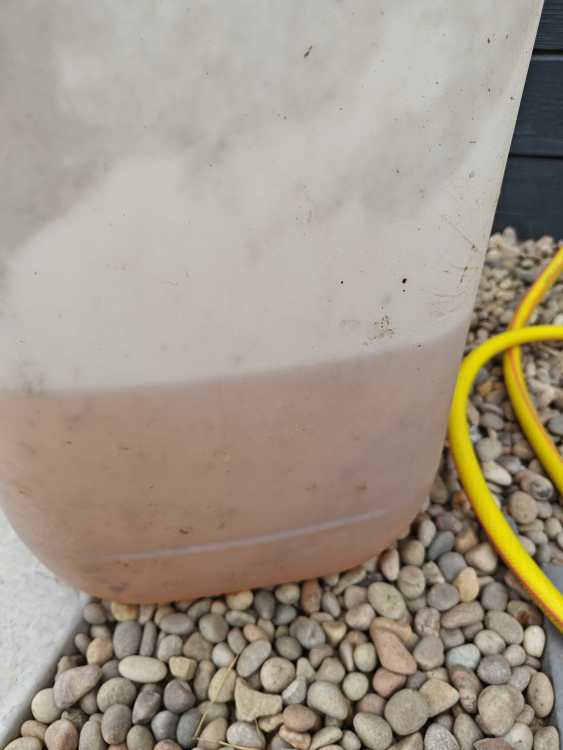
It tap water going through an Ion Exchange resin in a 10" filter housing. The water that came out was brown and although had glycol it has obviously had picked some corrosion from a carbon steel buffer I had in the system. The water circulating is correctly sitting at 168ppm dissolved solids and 341 micro seimens conductivity. pH is about 7.3, but this should move over time to about 8. Have a slip stream through the resin, setup which I am going to run again tomorrow for a few hours, the aim is to get the ppm down below 150.
-
Ergovent Rondo invisible ceiling air valve, Installation.
JohnMo replied to squealeyhealey's topic in Plastering & Rendering
Looking at images they look more suited to dry lining, than plaster on plasterboard. Curved edge and recess, could look naff. -
Interesting question. I read the Scottish building regs compliance notes 2022. And also came Kent Council compliance notes. Both say For all boiler types except heat pumps, it makes very detailed mention of individual room temp control and thermostats or trv's and time controls, multiple zones etc. For heat pumps it states (Scottish) • weather compensation or internal temperature control • timer or programmer for space heating No mention of zones at all. (Kent) External controls should include: • room thermostat to regulate the space temperature and interlocked with the heat pump unit operation; • timer to optimise operation of the heat pump. Scottish compliance notes also mentions MIS 3005, which makes no mention of trv's. So don't believe current regs drive the use of trv's, certainly not in Scotland. In England the use of the singular (thermostat) as opposed to the plural could be just the heat pump controller.
-
I have just taken out the glycol on my system and now using VDI2035 (straight water with testing). Without any other changes the water flow rate jumped from 1m³/h to 1.3m³/h. So glycol slows the system right down.
-
Basically started flushing yesterday by slowly pushing out the old heating water with demin (ion exchange) water at a rate of around 1L/min. The old stuff was brown and smelling very unhealthy. When I stopped last night is fully clear, but you could still smell the glycol. System was left to circulate overnight. This morning. Moved to having the ASHP circulation pump on and slip steaming demin (ion exchange) water in, so 1 litre in 1 litre out, this morning and got the water to just better than tap water. Checking tap water and circulation water at the same time. Tap Dissolved solids 180ppm Conductivity 380 microsiemens Circulation water Dissolved solids 166ppm Conductivity 320. Now have a side stream set up to push circulation water into the ion exchange filter, without adding new water. Aiming for below 150 ppm dissolved solids or below - currently at 166 compared to tap water of 180 ppm. Using a simple garden hose flow meter from B&Q. One thing that surprised me was the effect on system flow rate. Nothing had been changed except the fluid pumped, it is now straight water. Prior to clearing the glycol mix from the system, it was circulating 1m³/h, this morning just below 1.3m³/h. So a question Do I leave the flow rates high or adjust the UFH manifold rates down to bring overall rate down?
-
Quote for ashp - didnt expect that much!
JohnMo replied to TheMitchells's topic in Air Source Heat Pumps (ASHP)
Plus you have to run mixer and another pump due to the flow temperature difference. Unless you do dT15 radiators and flow a max of 35 degs -
-
So you pay to do the fiddly expensive stuff. MCS installer comes along runs to pipes from heat pump to your stuff, will say you need to change this that and other, because it's not how he would do it, pockets £7500 and charges you a couple of grand for being there. If you can run pipe you can install a heat pump. Just keep everything really simple. But it's just as @Dave Jones says.
-
Quote for ashp - didnt expect that much!
JohnMo replied to TheMitchells's topic in Air Source Heat Pumps (ASHP)
Or a heat pump that delivers 7kW at your design flow temp and your outside air design temperature. Plus an allowance to heat DHW. Allow 2 hrs for DHW, would require the heat pump to be able to provide heat to home in 22 hrs. So (7x24)/22=7.6kW. -
What do your drawings state? That is the builders go to document. If they haven't built to drawing, the build is wrong. It is the builders responsibility to fix and make good, so your build complies with the approved drawings. In planning you are only allowed to build to the agreed specifications, deviation requires approval.
-
Quote for ashp - didnt expect that much!
JohnMo replied to TheMitchells's topic in Air Source Heat Pumps (ASHP)
I guess £10K plus your grant. -
Just any old doors as long as they are steel or a particular style?
-
Sound like a spaniel cross with another dog.
-
How do you call for heat when heating? If you are using a buffer the call for heat may come that, if so you need to change it's temperature activation temperature. If you are using house thermostat(s) then you need to wind them above your actual room temperature so they call for heat. If you using radiators don't waste your time. Just because you have enabled cooling, doesn't mean the heat pump will do anything. It needs a call for heat or cooling to start.




