


JohnMo
-
Posts
13299 -
Joined
-
Last visited
-
Days Won
200
Everything posted by JohnMo
-
 The only issue I have with AI, you get the good stuff and the rubbish, all given you, youras if it's all correct. The not so rigorous reader (not doing correct due diligence) could easily go off on a tangent and do exactly the wrong thing. Sometimes it's just easier, less time consuming, and you get the correct information first time, to just read the rules and regulations directly.
 -
The trouble with a lined tank, is any area where the lining is flawed or has a defect (crack, pin hole etc), the base material of the cylinder is subject to huge galvanic corrosion rates. That is the principle reason for the anode and why they have to be replaced periodically. I would not have a lined cylinder to save a few pounds, copper or a decent stainless steel, would be the only choice.
-
New Highland Home, ASHP size + calcs advice :)
JohnMo replied to HighlandHopeful's topic in Air Source Heat Pumps (ASHP)
Airtightness and ventilation heat loss are very different. An airtightness test of 0.6 will give an infiltration ventilation rate of nearly zero. So all the ventilation comes from the MVHR, which in turn recovers around 90% of ventilation heat loss. Scottish regs require 0.5ACH or thereabouts. So your ventilation heat loss is 0.5 x 10%, 0.05 ACH. NOT 0.6. So ventilation heat loss drops by over 90% from your calculations. Based on what you have said your -10 heat loss is going to be less than 2kW. Low heat losses drive more issues as you struggle to get heat into the house without lots of cycling of heat source. UFH is way more forgiving for oversized heat sources, it's cheap to install and acts as a big buffer for heat just like an oversized storage heater. Would rethink your floor design - go concrete, 200mm PIR insulation or 300mm EPS, the UFH on 200mm centres, then concrete over the lot. No screed needed -
New Highland Home, ASHP size + calcs advice :)
JohnMo replied to HighlandHopeful's topic in Air Source Heat Pumps (ASHP)
With a 5 to 6kW heat pump, on a cold day AND if you need to heat cylinder twice, will take about 1.5 to 2 hours in total. Sometimes more sometimes way less. So the easy way to size for is assume you can only heat the house for 22 out of 24 hrs. 4kW x (24/22), 4.4kW heat source is required. So 5kW is fine, as long as the heat output is that at your design temperature. The above assumes 210 to 250L cylinder with 3m² coil for heating. We are on the Aberdeen side of Elgin, we have had full days at -9 to -10. Local weather stations are few and far between, our local one (Kinloss) and our temps can be 5 degs difference sometimes. Roof U value, just do the same as the wall (1/r1...) and then apply the heat loss to the total area of the vaulted ceiling. How are you doing ventilation, this changes this figure hugely? -
Think training in general is just pathetic these days. My granddaughter was enrolled in an apprenticeship, I asked how long does that take", she says 6 months. Long gone are the 4 year minimum apprenticeships.
-
And covering a window?
-
Willis heater UFH. Heaters in parallel or series?
JohnMo replied to Russdl's topic in Underfloor Heating
Not an easy way to take the failed unit out of the system to replace when in series. Are you over thinking it? Why not just simply one Willis on line the other offline, out of the flow stream (valve isolated). The one on line just set the temperature and timer/house thermostat and let it go. Dump all the mixing stuff. Do you install two boilers, which are complex and way more likely to fail? Have you done a heat loss calc and do you need more than 3 kW? -
Cooker hood with its own MVHR?
JohnMo replied to YodhrinForge's topic in Mechanical Ventilation with Heat Recovery (MVHR)
No don't mix cooker hood with MVHR. Recirculation cooker hood job done. dMEV fan or two? -
I have but I need to update it, which I can do hopefully today or tomorrow. Will post it up.
-
100mm fibre reinforced concrete, instead of screed.
-
Are we targeting ASHP's at the wrong market?
JohnMo replied to ProDave's topic in Air Source Heat Pumps (ASHP)
BUS grant insists DHW production is also by heat pump, so one thing against A2A, but A2A is just seen as Aircon, which is cooling only, to the ill informed. Again the other heat source needs to be dumped so all basically done by heat pump. Otherwise that would be a hybrid, and no grant money for that, full stop. -
Are we targeting ASHP's at the wrong market?
JohnMo replied to ProDave's topic in Air Source Heat Pumps (ASHP)
BUS grant makes no mention of cooling, was a restriction on previous schemes, but not under BUS. However you cannot install under permitted development rules if you are going to use cooling. -
Good question. On a flat rate tariff, the ideal is run weather compensation, no need for thermostat. On a time of use tariff, you may what to trigger heating events. I use a thermostat as a conditional timer, to make use of E7 tariff at night. Generally the rest of the time the heat pump is off. But for me (thick screed) I use a 0.1 Deg hysterisis thermostat to stop under and over swings in house temperature.
-
First, if you need PV to scrape a pass with sap, you need to look at the quality of insulation and airtightness. Both could do with being improved. 5 PV isn't much, is that all you have room for. I would install up to 3.2kW (G98 limit). An amendment for adding solar is unlikely to get kicked back. On SAP and building regs revision is the one it states on your planning permission, not whatever is currently in force. Advantage of the Scottish system is you have to have a pre build sap done, that catches these changes before building warrant is issued.
-
The wiring centre I bought https://www.ebay.co.uk/itm/315153782771?mkcid=16&mkevt=1&mkrid=711-127632-2357-0&ssspo=KzwJTGtMQAi&sssrc=4429486&ssuid=8KgwDlAbTJS&var=&widget_ver=artemis&media=EMAIL Same seller has the remote screen listed also. Sensors https://www.ebay.co.uk/itm/267046429821?mkcid=16&mkevt=1&mkrid=711-127632-2357-0&ssspo=grAjxs1RQGq&sssrc=4429486&ssuid=8KgwDl Other units similar but different based on the same package Roth https://www.roth-uk.com/products/control-systems/roth-touchliner-sl-wireless-system Other seller, think it's the maker but not sure
-
Yes you can get an internet module for remote control, logging etc. Yes this unit does 8 zones, 4 loop actuators per zone, directly and also allocate loads of additional ones from other zones if you want. It can also communicate to loads of slave controllers, think it can do 48 zones. Yes has hot water timer and uses zone 8 for this, has a 230v output. May do this at some point.
-
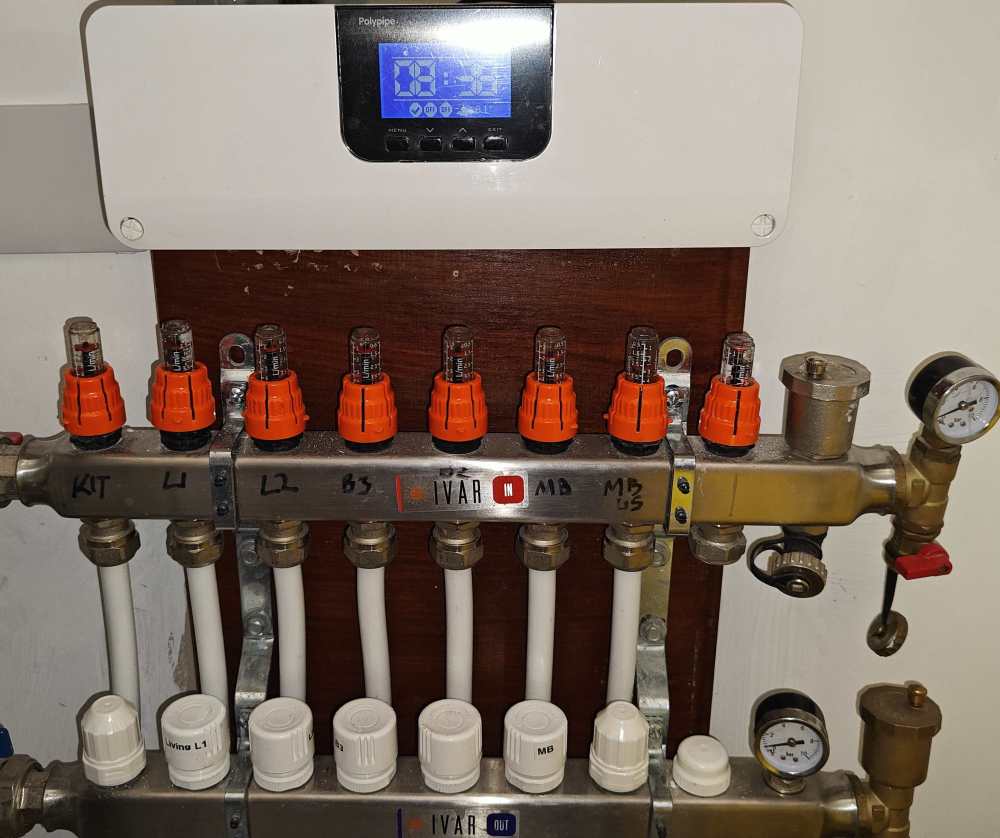
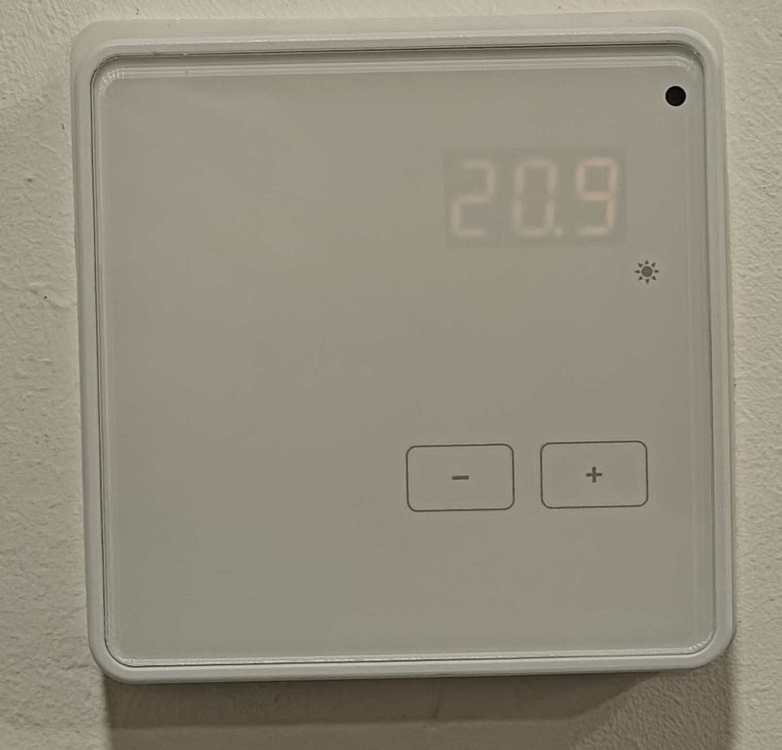
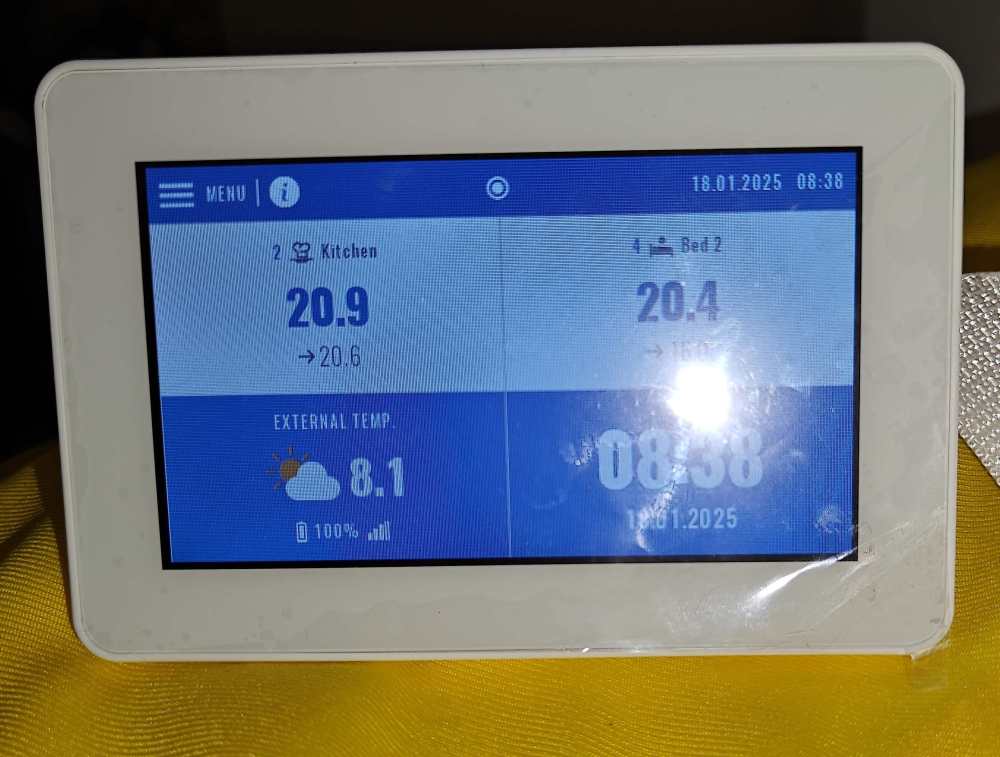
So based on a topic by @Beelbeebub I have been playing with my system and in the most part trying to get a system not connected in any part to the internet. This is now in place. No internet connectivity to anything that controls, but do some internet monitoring. Have used a wiring centre, with lots of good features. It has a wireless outdoor sensor, can do Opentherm WC for boiler control, also has volt free NO and NC contacts, maybe able to use these to allow heat pump to run or stop it running - needs some thought. You can set an outside temperature threshold for the boiler to come on, so if average temp above X degs boiler is not started. It has wired/wireless room sensors (not thermostats), the wiring centre can then be set with schedules and individual room hysterisis and target temperature. It can do cooling control based on humidity thresholds etc. The controller I purchased is branded Polypipe, but also marketed by several others including Roth, but think made by Tech Controllers. The one I am using is being sold on eBay and was never formally released on sale. Bit to complex for the UK market, I suspect. I have no actuators in the system, so it's all a single zone. Each room will have a sensor, but only two will be utilised for boiler control kone in hall and other in kitchen). So either can call for heat, both off to stop heat. Running WC mode via Opentherm, and have an outside temperature threshold for the boiler to heating based on 5 degs averaged over 24 hours (this setting will need fine tuning). Heat pump settings or controls are not changed. Have found the heat pump runs only as needed. Room sensors were £11, plus a Roth sensor with humidity £49 Wiring centre £149 Purchased a remote display/controller also (not needed) £49 Wireless outside sensor (no holes in the walls) £29. Room sensor Remote monitor - only two room connected at the moment.
-
Or as alternative - could they be moved down? Then fill with insulation and board over?
-
I am in the camp, you change stuff at the planning stage, never ever after you start construction. One small change leads to 10 unforseen changes, each adding cost and delay. So my answer is follow the plan. Not sure that is correct, your plans when approved form what is legally agreed scope of work. Any deviation needs some approval, your planning agreement will say that. So minor or major change requires, a document trail, possibly revised approvals.
-
Think if you mix with Agar Agar, the solidification process becomes more repeatable and repeatable over time
-
Not a good material, as when in a saline environment 316 or 316L suffers pitting corrosion especially at or close to 60 degs. So you really need super duplex or even titanium. So not cheap.
-
As you say you can't help some people, they are on a path of knowing all, while knowing nothing. He possibly will get a prorated bill (for his time in the flat) based on his future usage, back dated to the time took over. That will teach him!
-
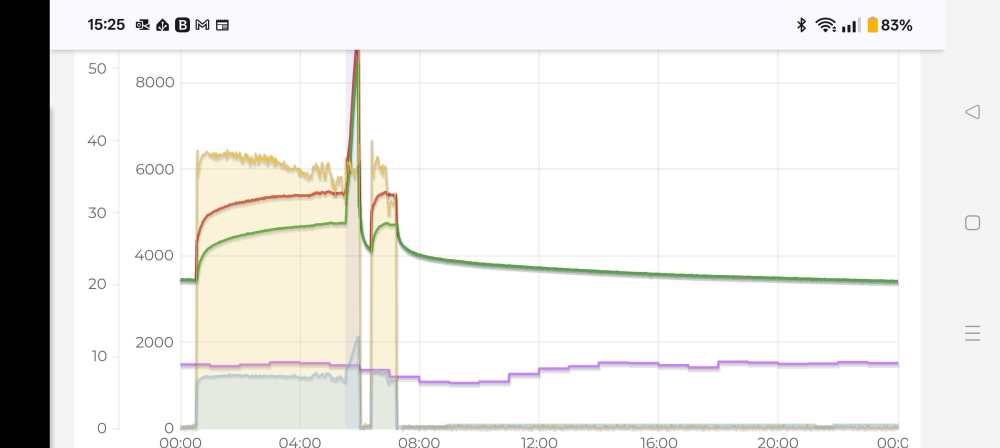
No not correct. You can get long cycle times, but you have to run it differently. Long runs will decrease gas consumption considerably. You need to think of using your floor more as storage heater. You fill it with energy then switch off the heat source, allow energy to deplete then recharge. That is what a simple thermostat does. Your smart stat may do that for you, but suspect it won't as it will want to run in TPI mode, not in hysterisis mode. This is what my heat pump did last night (boiler does the same but cannot give a pretty image). It was supplying around 6kW against about 1.2kW heat demand. It ran for a long period, because I had allowed the floor to deplete it's energy. All controlled by a simple thermostat. The yellow bit is kW, the red line is flow, green line return. Purple is outside temp. The long green line after the yellow is the combined flow and return (pump stays on). The spike is DHW at about 6.30am. The gap in data was the modem rebooting. Previous night for reference
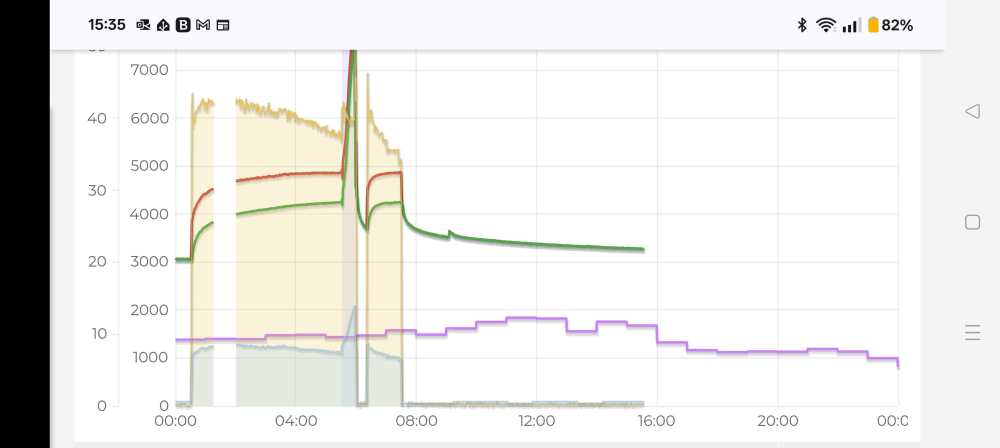
-
Which way does the fan on your ASHP face?
JohnMo replied to low_and_there's topic in Air Source Heat Pumps (ASHP)
You need UFH or fan coils -
Heat output is related to overall floor surface temp and room temp. The close they get the lower the floor output. Further apart they are, the more the output. I run the circulation pump all the time 24/7. But control the heat input so the boiler or heat pump can cope. I have both and both, and both are oversized for heat demand - just like @Super_Paulie boiler is. That fine, but if the boiler output minimum is more than that, the boiler cycles. @Super_Paulie changes flow temp, boiler runs until floor is heat soaked. Boiler has little or no space to add more heat. Runs a short period stops a short period repeat, as boiler tries to stuff more heat in, but cannot. Imagine the floor is a battery, stick on charge, charger runs for a long period to get battery in a charged state. Then blips on off all the time it's connected. If your floor isn't giving off the heat equal to heat supply it's just the same. Messing with flow rates isn't going to make it better, you need to allow the floor to dump some energy then recharge it..repeat. At the moment the boiler is trying to do that, but not doing very good job. It needs assistance and a simple thermostat is needed or use what you have, bring thermostat down to 21 and see what it does.





