
JohnMo
-
Posts
12468 -
Joined
-
Last visited
-
Days Won
179
Everything posted by JohnMo
-

Can the flow temperature be too low?
JohnMo replied to JohnnyB's topic in Air Source Heat Pumps (ASHP)
So thinking about this logically. Buffer is a nul point in a system - giving hydraulic separation to either side - HP and heating circuit. As such a pump is required to move water either side of the nul point. HP only running, hot water enters top of buffer and water at the bottom goes back to heat pump. Pump continues to run the only path is now for water to flows direct from top port to bottom port. Buffer ends up a uniform temperature. If secondary only run, same mechanism occurs, but buffer ends same uniform temp as heating circuit. So pumps run at same flow rate. Water enters top from HP, goes out of top port, goes around heating circuit back to bottom port and out to HP. No distortion occurs in buffer. Top stays hot, bottom stays cold. A layer called a thermocline forms, where it is hot above and cold below. Same as a DHW cylinder. So now run HP pump faster than heating pump. Water enters top port from HP, some water is taken by heating circuit, the rest travels to bottom port and back to heat pump. This moves the thermocline downwards. So a buffer smaller than several hundred litres, the thermocline will be at the bottom port quite quickly. Time taken is a mix of buffer volume and difference in flow rates and cycle time of heat pump. So now have warmer than ideal water returning to HP, killing CoP and rising flow temperature. Similar is true when heating circuit pump is running faster. This time the heating circuit starts running cooler than the heat pump flow temp, as return water from the heating circuit is pushed up to the top port, so to compensate you have to increase HP flow temp. Again a hit on CoP. Volumiser Two places to install flow or return. It doesn't want to be in the flow pipe that is always engaged (upstream of diverter valve), as you don't want the buffer engaged when doing DHW. Ideal is just in the heating part of the circuit, so downstream of the diverter valve and upstream of the tee where where return water from DHW tees back in. If that isn't practical put it on the return piping. -
Can the flow temperature be too low?
JohnMo replied to JohnnyB's topic in Air Source Heat Pumps (ASHP)
I think without actual doing calculations - another 50L would be good. It will make the on and off times longer. Less cycling equals longer equipment life. -
Do you get cycling at low flow temperature? I found when running the boiler at say 36 or below flow temp I would get a 6 to 7 min on 6 mins off cycle. This was quite big gas usage case. Increased the flow temp to 40 and would run without cycling for as long as I wanted. It also dropped gas consumption by a big margin.
-
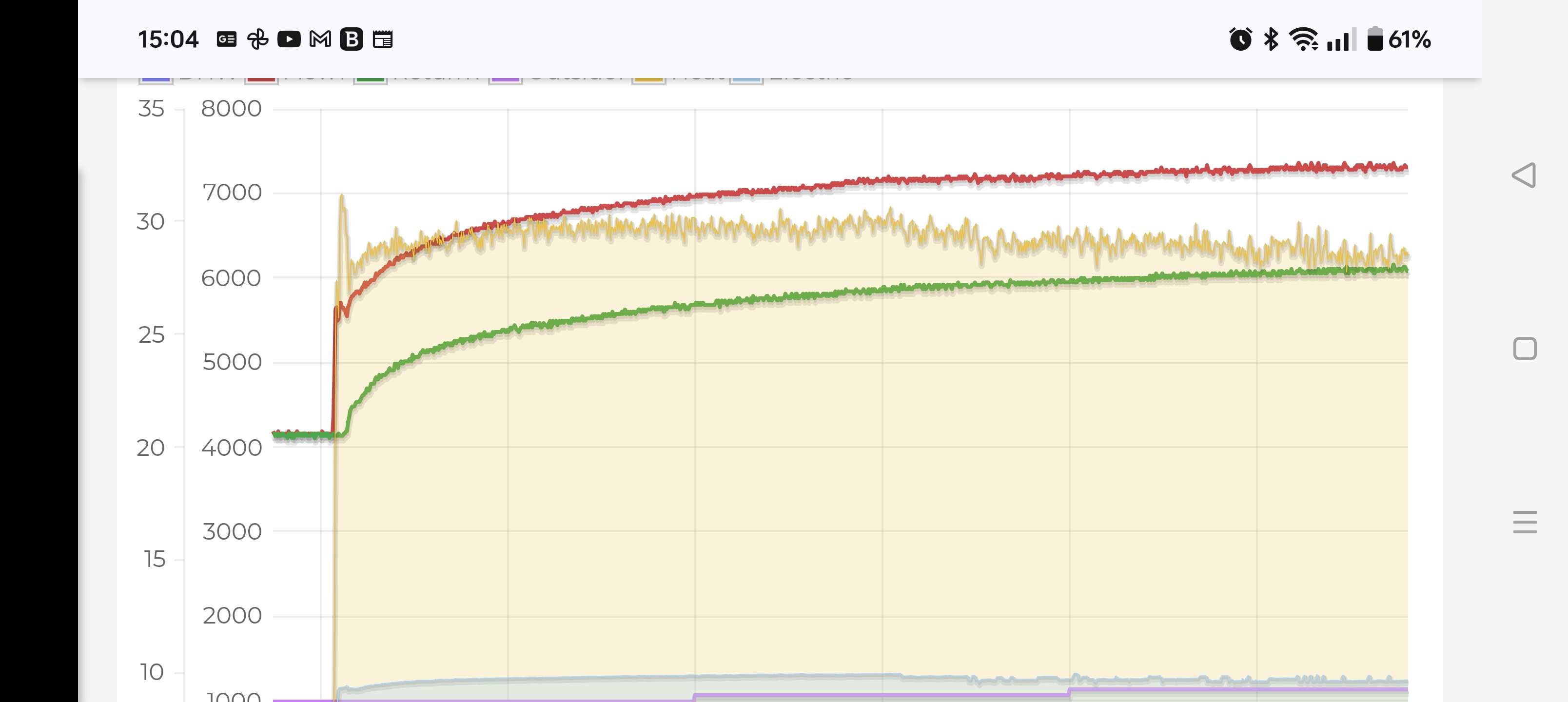
Yes - Normal concrete: Has a thermal conductivity of around 2.25 W m−1 K−1. The thermal conductivity of air is around 0.025 to 0.03 water is around 0.6 W/mK at 20°C Good point Red is flow temp, green is return temp, yellow is power
-
Not always. Lower the flow temp the lower the dT.
-
Can the flow temperature be too low?
JohnMo replied to JohnnyB's topic in Air Source Heat Pumps (ASHP)
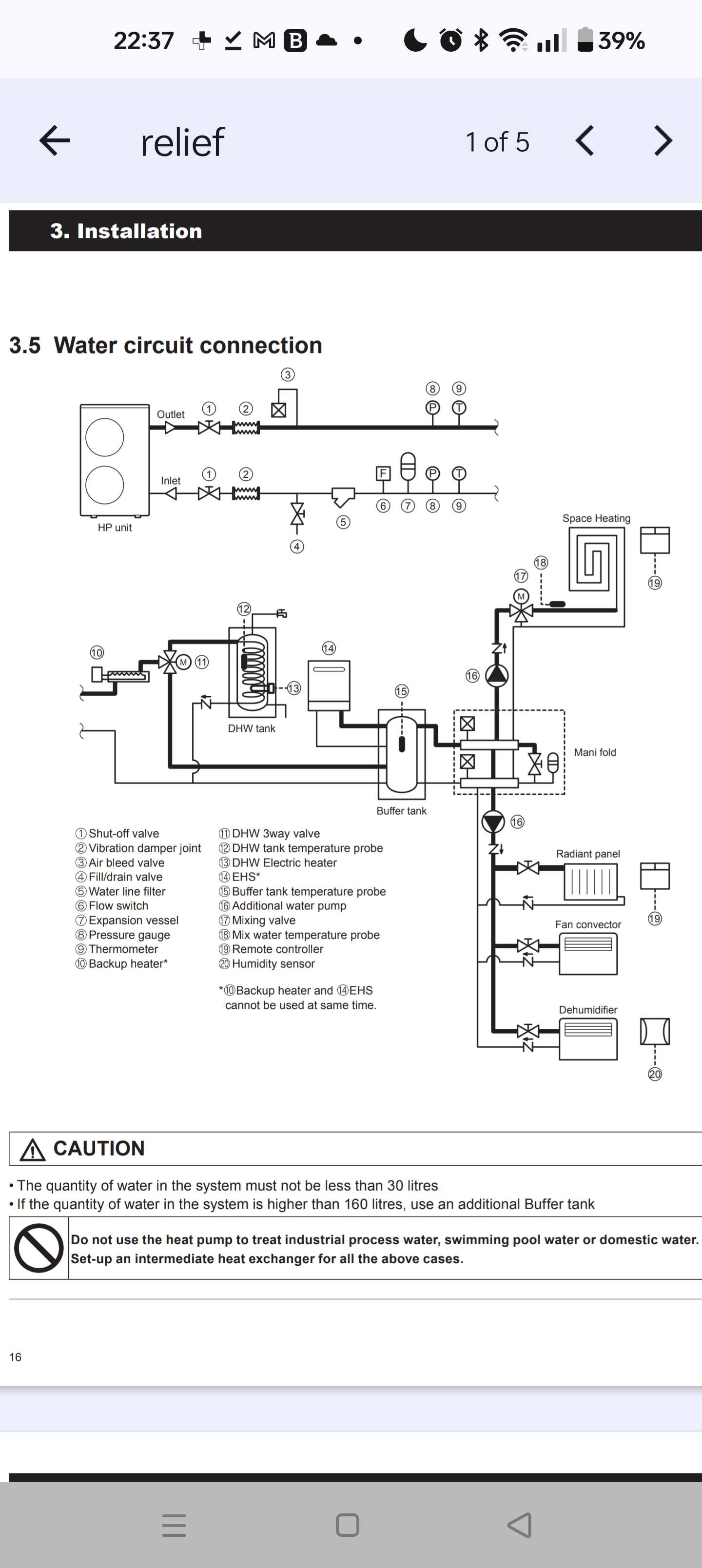
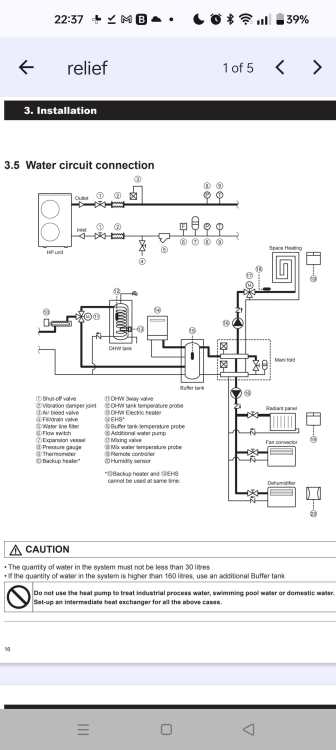
Interesting, reading another post kno idea which) but it had this Samsung drawing. So you have two options buffer or volumiser. See attached. Convert to volumiser? No idea why you need a buffer and min flow bypass valve. quick-start-guide-samsung-gen-6-kits.pdf -
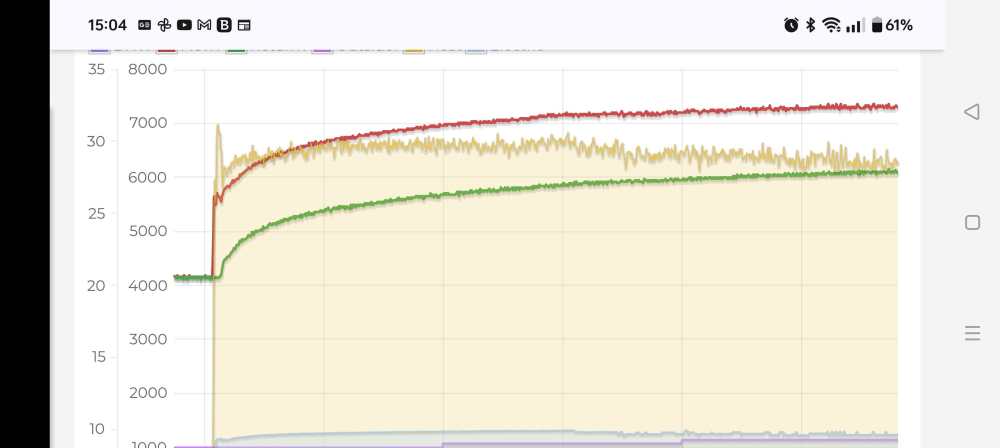
Not really comparing apples with apples. OP is starting system for first time on a new build. If I'm running WC, flow temp goes to target with a couple of mins. But not so when batch heating or doing a cold start of system. Takes a few hours to get there. Cold house first time heating comes on (op case above), or first heating of the season with UFH. Even without cooling prior to heating season, floor is only around 19 to 20. In my case I have 100L plus of water, plus 56T of concrete to heat, so return temp stays low for a long time. Delta T is capped at the max allowed by flow rate and heating kW output. As return creeps up the dT stay constant and flow temp increases with return. Example from a batch charge from the other day, to show what I mean. Run started at 00:30 and was stopped to do DHW at 06:30. Window in image is 4 hrs.
-
You must have one powerful heat pump, that can take a new house water flow temp straight up to target temp with a big deltaT and not risk damage to compressor. My instructions clearly state EVAPORATOR WATER FLOW The nominal water flow rate refers to a 5°C temperature difference between the evaporator inlet and outlet. The maximum permitted flow rate features a 3°C temperature difference while the minimum one has an 8°C temperature difference at the nominal conditions as shown in the technical sheet. Insufficient water flow rates can cause excessively low evaporation temperatures causing the safety devices to trigger and stopping the unit and, in some extreme cases, forming ice in the evaporator and resulting in serious failures to the cooling circuit.
-
Either with a room thermostat Or some of these https://amzn.eu/d/e7oX9LZ, cheap on one day delivery, so you could have them tomorrow.
-
Emitters in your case is radiators. DeltaT is difference between two temperatures. This could be room to radiator difference or difference between flow and return temps from boiler.
-
So this is the first proper start/run. The way the heat works and it makes zero difference what the target temperature is initially. The heat pump starts, it monitors flow and return temperature. It tries to establish a steady return temp, and then sets flow temp to approximately the target dT (difference between flow and return temperature) above the return temp. It will not add more flow temperature until dT reduces. So if have many tonnes of house to get up temperature that has spent its whole life unheated it takes a while. This doesn't mean your settings are correct or even close, but the realities are houses when just built are very damp the water contents require loads of heat to start drying.
-
Go on Heat Geek they have a good write up what you are doing and why. Do you need to do it fully or just a bit of fine tune?
-
The OP hasn't been on since March so unlikely to answer
-
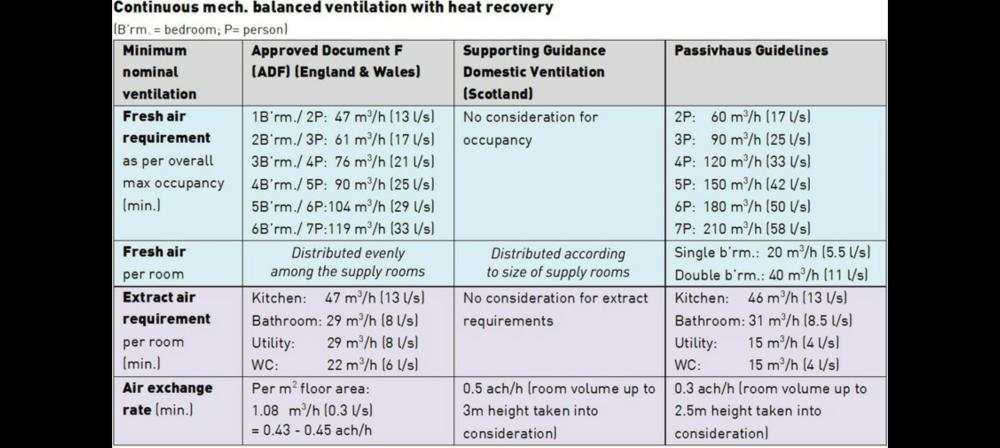
Simple way to think about and you have given the answer - use the most demanding airflow. So if 4P is greater than 0.3ACH, you use the 4P Double single rooms - how many people will sleep in the room - nothing to do with area. Small bedroom with bunk beds is a double room, no matter how big or small. Treat guest rooms as a single or split the difference.
-
Also get a heat pump cylinder with a big coil, not the mini coil Vaillant install. Had zero issues with 6kW heat pump heating a Ideal 210L - 3m² coil. Others on here have 300L and small heat pump without issues.
-
Just had a look at the Chofu manual (original manufacturers) only the expansion vessel shown on the heating circuit, as you say the rest is internal on the ASHP. Sound like a bit of cut and paste engineering from Grant. I would install per Chofu schematics and use the controller that Grant hide away as the controller for everything.
-
Has to be above £7500 to get full grant. If it cost £6k you get £6k, not the full amount.
-
Then why not do MCS certified scheme, then it would cost the best part of nothing.
-
Don't you just hate all this badge engineering? UK skill base seems to have diminished to, use heat gun or similar to remove sticker, stick on new sticker. Now UK made? Where is the innovation, product development - somewhere overseas. We under invest in training, don't have the highly skilled workforce we should have, and they have to install to the best of their ability. Government hide behind private organisations etc. Lived in Malaysia for awhile - if wasn't produced in country (with I think 80% of all material components) it carried a minimum 100% import duty.
-
Can the flow temperature be too low?
JohnMo replied to JohnnyB's topic in Air Source Heat Pumps (ASHP)
He is running radiators - the hysterisis is different. If you need an external one Computherm Q20RF are nice, you can adjust the hysterisis down to 0.1 and do cooling. Hysterisis will affect over shoot and under shoot of room temperature. Cycling is basically based on output compared to how easily the heat generated can be moved away. A low dT between room and water makes this more difficult than a bigger dT. With UFH it's how quickly the floor can absorb the heat and at the same release to the air. -
Just wish I wasn't a tax payer, and then I wouldn't feel conned, every time read one of these posts.
-
You want 40 in a double and 20 in a single bedroom. Dump the hall extract, not needed, unless you need to balance the numbers. Use Passivhaus numbers. Kitchen extract put both ducts to a single extract point - no value having two, keep 9. Lounge area the same one terminal, keep 4. Normal flow area, multiply 2.5, multiply 0.3. so normal flow about 83m³/h, boost multiply by 1.2.
-
That is just bonkers money. A heat pump connected to an existing system that isn't being modified and a cylinder.
-
Just looked and you look to be correct for R290. R32 look very different to midea.
-
20 minutes later you are finished. If your not sure what to buy or mix go to B&Q, to the bit with the sand and cement, and there will be ready mixed stuff you just add water. Mix stiff and trowel in place. Done. Procrastination gets you nowhere.