


JohnMo
-
Posts
13296 -
Joined
-
Last visited
-
Days Won
200
Everything posted by JohnMo
-

Cylinder Choice, Heat Pump, Gas and Oil Boiler
JohnMo replied to JohnMo's topic in Boilers & Hot Water Tanks
She busy peddling away. -
Cylinder Choice, Heat Pump, Gas and Oil Boiler
JohnMo replied to JohnMo's topic in Boilers & Hot Water Tanks
Very true, ours is set a little high. Driven by wife's expectations of very hot water in the kitchen sink -
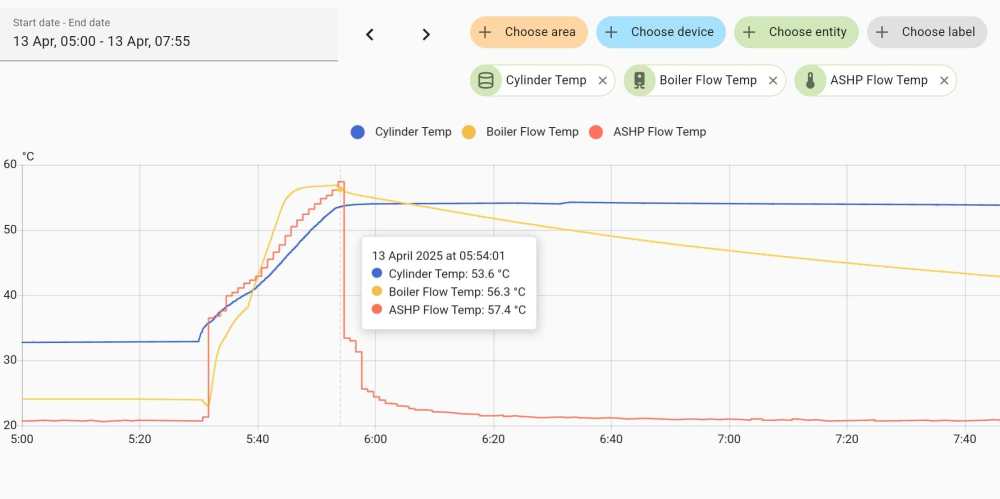
Thought I would drop some information in to a stand-alone topic, about unvented cylinder (UVC) choice, be it for a heat pump or fossil fuel boiler. The normal advice from a plumber is to use gas/oil boiler specific UVC, when installing a fossil fuel boiler and a heat pump specific one for a heat pump. The primary difference is coil surface area, used to heat cylinder. However I would advise anyone to install only a heat pump specific cylinder, with any heat source. You generally get a huge 3m2 heating coil, which allows the cylinder to be hot without excessive boiler flow temperatures. This was mine this morning - running in hybrid mode (gas boiler and ASHP) Cylinder temp at 53 Deg, but more importantly the boiler flow temp was only 56 degs. This ensure good condensation while boiler is running for improved efficiency. Also if you are using S or Y plan heating schemes it allow a good reduction in flow for both central heating and you can have a hot cylinder.
-
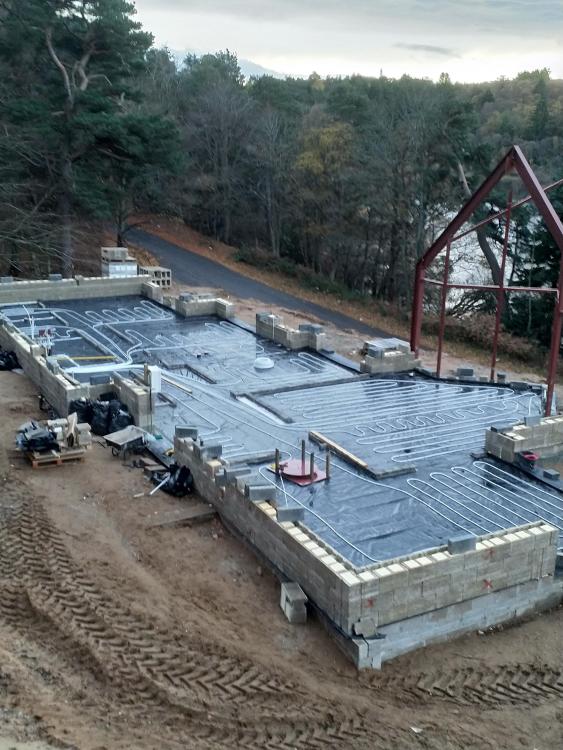
Just looked back at some of your posts @umiq88. Looks like your house is the same size as ours around 200m². Your issue with so many loops could be flow rate from heat pump. You may need more flow than a small heat pump can deliver (around 1m³/h). By way of comparison we have 7 loops in total. One thermostat. Below is what our plan looked like and how it was actually laid out. Even at -9 we only need to flow at about 35 to batch charge the floor. Average room height excluding lounge is 3m, lounge is 6m.

-
Why dedicated loops in halls, they have clumped together pipes at side of halls, then added dedicated loops to halls. Just spread the pipes leading through halls to room at 200mm centres. 100mm centres in kitchen seems excessive? Do you really need all those thermostats? I would do bathrooms at 150mm centres and the rest at 200mm. I did all ours at 300mm centres - zero issues.
-
MVHR ? Who needs it? I don't.
JohnMo replied to ToughButterCup's topic in Mechanical Ventilation with Heat Recovery (MVHR)
We open ours quite often, living room and bedroom windows been open all day, bedroom been open for the last few weeks. But heating is off (or what heating we have on is powered by PV) so not saving or loosing anything. -
Huge MVHR quote
JohnMo replied to Garald's topic in Mechanical Ventilation with Heat Recovery (MVHR)
Really what's the point, you will be several life times saving the money. Is your building even that airtight to warrant going MVHR. It's got PIV now, so would doubt it. If it isn't pretty airtight, it's just additional ventilation, possibly where the 30% efficiency claim comes from. Unlike @Mike I think it's a colossal waste of your money. Just looked at some of your other ventilation topics, you really need to get on with what you have. You have just completed a full renovation, so why do you really want the whole house pulled apart again? -
Do the same in the hallway
-
Makes perfect sense, you are generating heat in that room with the equipment, floor is heated via the pipes that traverse under it etc. Same should be true for hallway etc. divert pipes through utility also, that room doesn't need dedicated heat either. Our plant room is the roof (fully insulated room) never cold in there.
-
Still listening. Interesting the base material is lime for cement. The production of lime produces bucket loads of CO2 just because the chemical reaction causes it. Plus the heat input. So not that sure the environmentalists are correct saying I'm using lime because it's better for the environment.
-
Start by looking at fire engine access and turning space required - or alternative.
-
But why is it a planning issue? But not a listed building consent issue as well? It either both or neither. If it's a boundary to a listed building it needs both. But also needs the listed building owner involved as well.
-
Why? Not a fan of heating or ventilation that requires third party control especially if internet is involved. Background ventilation that already automatically boosts only when needed - zero to do, zero for home assistant to mess up if an IP address changes blah blah. The ones I mentioned are 0 to 100% speed control. CV2 - Cheaper than the one linked, full speed control for setup (set flow rate for normal and boost), auto boost - no additional wires needed, no AVMs needed, no back draft needed, no additional room grille needed. Fit and forget never hear you fan again.
-
As I said the fan linked to is silent, no air noise - nothing. I have to take the cover off to see if it's actually running. Plus costs about 50p a year to run at low speed.
-
I would say you now take that drawing to your structural engineer, he then determines the foundation structure based on your ground makeup and imposed loads.
-
Not sure I would ever use a fan like that again, for any reason. Not knocking the make or model, just the noise of intermittent fans - Dreadful. Just install a Greenwood CV2 or CV3. Background silent ventilation at a very low rate and automatic (rising humidity) boost, again near silent.
-
Ideal brand Heat Pump - any insights?
JohnMo replied to Walshie's topic in Air Source Heat Pumps (ASHP)
That depends on size of heat pump. If you need 4kW max heat and you install a 4kW that storage mode works at more moderate temperatures. However if heat load is 2kW a 4kW ASHP will charge the floor in 12 hrs on worst day and most others in a cheap rate period. Yes, variable flow temp for WC. Heat pumps will modulate based on compressor work input and sometimes variable pump speed, some do it by variable dT also - just to confuse things. -
Obvious first question, are you planning on getting the house pretty much airtight? If yes crack on If no, stop and have a think about it. What benefit will MVHR bring you? Would demand based MEV or dMEV be better alternatives?
-
what outside vent?
JohnMo replied to CalvinHobbes's topic in Mechanical Ventilation with Heat Recovery (MVHR)
Just choose one to suit your needs. My choice will not be yours. -
If it anything to do with the listed building, listed building consent is mandatory and so is planning, without it at the extreme can lead to a custodial sentence. So the statement listed consent not required, means it's nothing to do with the listed building - or very bad advise (been there and been bitten). If the house next door is listed and the OP building is not, and the wall is the OPs it certainly nothing to do with listed. So why planning?
-
Still don't understand what the fig this has to do with planning - it's an existing wall between to two gardens? Where does planning come into it? Can anyone explain?
-
Foam or woodcrete ICF?
-
That really doesn't make sense. If no listed building consent required it not part of the listed building - fine. But why do you need planning to repair a dividing wall in a garden. Maybe you asked the wrong question or phrased it incorrectly? If the wall belongs to next door? Pass the bricks back to them and let them do what ever they want with them. If it belongs to you, go to B&Q get some gabions, go round your garden find nice stones, back fill gabion with bricks and face with nice stones. Do as you can afford it.

-
Ideal brand Heat Pump - any insights?
JohnMo replied to Walshie's topic in Air Source Heat Pumps (ASHP)
Why Just do a thick screed, then who cares about modulation, mine will run for hours at about 5kW, (spent an age thinking it needed to modulate - but the floor is just pulling all the heat you can throw at it) when it's done what it needs to, it shuts down. Generally get a cop of 5+ when running. Why do you need variable speed, most will do it, but very few really use it much. If your doing cooling assume via UFH? They all come with WC, except very basic ones and they don't get MCS certificate. So wouldn't get a grant. Unless you get it for free you are being taken for a ride, then you may as well DIY. As @Nickfromwales says just get a Panasonic. -
Ideal brand Heat Pump - any insights?
JohnMo replied to Walshie's topic in Air Source Heat Pumps (ASHP)
Believe they are rebranded other makes. But with their own spin on the controller. Most heat pump are much of a muchness. Main thing to worry about is the system design it's hooked up to and the way YOU operate.






