


JohnMo
-
Posts
13296 -
Joined
-
Last visited
-
Days Won
200
Everything posted by JohnMo
-

ASHP + Solar PV + Battery - Choices
JohnMo replied to Diarmid's topic in Air Source Heat Pumps (ASHP)
I'm just using a cylinder and again don't expect to say much if anything, without the additional Thermino. Used excess PV today and then immersion took it up to 65 degs. -
How to find tradesmen for the 'inbetween' bits
JohnMo replied to Rachieble's topic in General Self Build & DIY Discussion
No location in your profile, so not easy to answer. Scotland is different from England for some things. Generally there are no bits between. Site cleaning have built in to the contract for each trade to tidy up after themselves (but good luck on that, most wouldn't know which way to hold a broom). In Scotland plasterboard is done by joiners, they also do wall insulation (assuming not a cavity wall) Really wouldn't hire via online. We started with a company we had worked with on many occasions (electrical contractor) and went from there, asked who they liked to work with and for company recommendations. Worked well. -
Drawing may help explain a little better
-
I just used a simple 60 min cycling time (15 min on, 45 mins off) which is perfectly plausible with a 4kW min output and 1 kW required heat input, easy numbers to navigate. Almost exactly what my heat pump did when i ran WC. It's more like 4 to 5 hours on the rest of the day off now.
-
But it unlikely the whole cylinder will be at 10 degs, the bottom yes, but the top of the cylinder is likely to mid 30s or above
-
Cycling is just dependent on how far below min modulation the heat demand is. If you had for example 4kW min modulation and a heat demand of 1kW, the heat pump would be on 15 mins off 45 mins.
-
CoP is a mix of energy use whilst running and while in standby. More standby equals lower CoP. If House temp is not working warm enough you need to adjust the WC curve up.
-
ASHP + Solar PV + Battery - Choices
JohnMo replied to Diarmid's topic in Air Source Heat Pumps (ASHP)
Good design is key, good design is a very simple system. Start adding buffer, LLH and loads of zones, you get rubbish CoP, not in all cases but most. If you have UFH, system should look like this ASHP, flow connected to 3 port diverter valve, one side to cylinder coil other to UFH manifold, return pipes tee together and go back to ASHP. The manufacturers controller. Had the ASHP running yesterday all electric from excess PV for 6hrs at an average CoP of 5. -
ASHP + Solar PV + Battery - Choices
JohnMo replied to Diarmid's topic in Air Source Heat Pumps (ASHP)
Would definitely think of the systems as separate, ASHP and then PV and battery. CoP of 4 is realistic, if running on weather compensation. What are you refering to as tank? The domestic hot water cylinder or something else? Also assume by 5kw battery you mean a 5kWh battery. That is pretty small when coupled to an ASHP especially when cold outside. So during winter months the PV is pretty rubbish, your battery will mostly be charged from the grid. On a cold day with normal house consumption and ASHP, battery will be good for 3 to 4 hours max from fully charged. -
Basically what ever you can do with a heat pump you can do with boiler. Low and slow heating is best for both options. A good boiler and good system design will be cheap to run and give a comfortable house. A boiler running at 70 degs heat rads quickly is a bad design, bit like an on off switch instead of accelerator in a car. A good heating system design is more like cruise control in comparison. Designed right a gas boiler heating system could simply swop over to a heat pump if you wanted at a later date. As mentioned previously if set on a combi do a storage combi. Or do a system boiler and unvented cylinder, on priority demand hot water. Do a room by room heat loss calculation. Design radiator to have max flow temp of say 45 at say -5. Set boiler to run weather compensation and let it run, no need to do set back temperature, do it from the boiler controls. If you went system boiler and unvented cylinder, set up a priority demand hot water, so the boiler runs at low temperature for heating and higher temperatures for cylinder heating. Use a heat pump cylinder, these have a big (3m² plus) heating coil, which gives rapid reheats of cylinder.
-
70m perimeter, approx 8x25m and average of 3m tall except lounge which is 6m tall. Average window Uw 0.6, our glass doors came double glazed (krypton filled) and are 1.2, front door 1.0. We had a blower test prior to plasterboard at 2, fixed all the leak areas (mostly at DPC), but at final test it still came in a 2. But the MVHR wasn't sealed very well during test. So suspect better than 2 by a decent margin, could feel a definite breeze where the MVHR units are located. Couldn't be bothered doing a further test.
-
I would add 200mm PIR insulation, UFH pipes attached to that and then the concrete slab. Someone will come along and say if you cannot do that.
-
Radiators needed for ASHP and UFH?
JohnMo replied to YorkieSelfBuild's topic in Air Source Heat Pumps (ASHP)
Really wouldn't get to hung up on the R32 V R290. R290 is great if you need high flow temperature, not much different otherwise. More important is system design. Your design with UFH and rads is generally fine. You don't have to have the rads on. You could have then on, and run the whole system cooler, plus the additional water volume is good. I would say the rads need to be designed for the same flow temp as UFH, so you have no mixers or additional pumps. Run the whole system as an open loop single zone. Just TRVs on bedroom rads if you need them. Notes on design Installer cannot take credit for airtightness, unless you have a test certificate, they cannot take credit for MVHR if not installed and certified. These all drive the kW required up. The standard heat loss spreadsheet has some big air change numbers in it, which do not truly reflect a house that is airtight with heat recovery ventilation. -
Radiators needed for ASHP and UFH?
JohnMo replied to YorkieSelfBuild's topic in Air Source Heat Pumps (ASHP)
And 120m² So to out that into perspective, we are similar build, but have 192m² living space plus 26m² plant room/store, not quite twice the size. Our heat demand at -9 is 3.5kW. So you should really be installing a 4kW heat pump. Or a 6kW if you want the ability to batch charge the floor in cheap periods (like a storage heater). But you need a decent depth of screed for that also. -
Radiators needed for ASHP and UFH?
JohnMo replied to YorkieSelfBuild's topic in Air Source Heat Pumps (ASHP)
Pretty much, but only between 14 and 19L/min (less what goes via fan coil). This is the loops at min flow, so plenty of flow. Do it for the same reason, living room gets plenty of solar gain so moves that heat to back of house.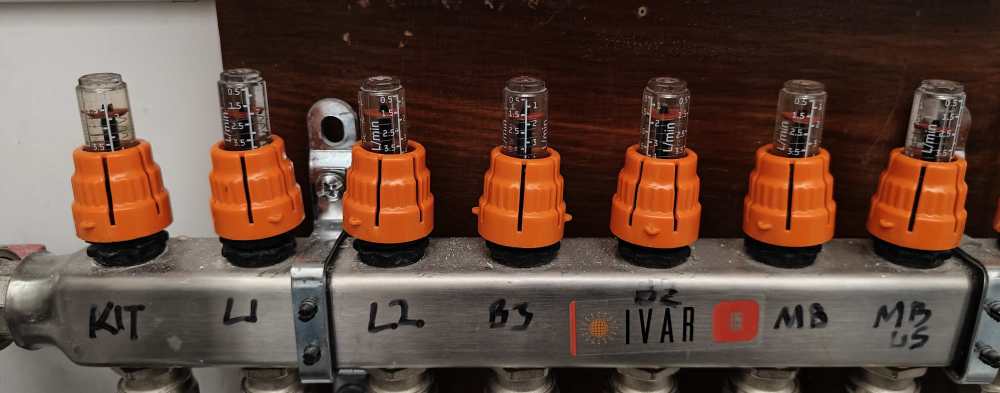
-
Radiators needed for ASHP and UFH?
JohnMo replied to YorkieSelfBuild's topic in Air Source Heat Pumps (ASHP)
Do exactly the same without buffer or LLH. All done via heat pump circulation pump. So no real need for additional stuff. Currently heat pump off and circulation rate is 14L/min, through my 7 loops, and a fan coil, when heat pump starts it ramps up to 19.5L/min. Never needed one of those either, in fact never had one. -
Radiators needed for ASHP and UFH?
JohnMo replied to YorkieSelfBuild's topic in Air Source Heat Pumps (ASHP)
Well that is just nonsense moved to a different installer. Or go umbrella scheme, such as cool energy. DHW 48 is generally a fine compromise. UFH sounds fine. Depending on heat loss, you can just do ground floor UFH, design so it will give off enough energy to heat whole house. Low energy house is a bit vague, ground floor area? Heat loss at designed temps? Have you done an air test? Is installer using that figure to get infiltration rate? MVHR? -
Mine is way simpler than that. Manifold in centre of house, 15mm from UVC to manifold, one 15mm hot to each wet room, then branched. Similar for cold. 22mm just slows delivery of hot water not really needed. Why an electric shower in guest ensuite?
-
Is your £4k (+vat) quote to dig out or dig and buildup with UFH pipes etc. So if you stay in the house 20 years you would need to save £240 a year on downward heat loss only just to break even?
-
Have you done a basic cost benefit analysis, doesn't sound cheap or easy. Just for UFH?
-
But my first point is you could probably knock down the CO2 emissions by a big margin just by getting the boiler to run effectively and well within the condensation range. @marshian I assume the fabric improvements started in 2010, to drop gas consumption, but the biggest change was good boiler running a low temps in an So fabric improvements about 30% gas savings. New boiler low temperature install a further 40% saving after fabric improvements. Total saving overall start to finish 65%
-
Shows how much difference form factor makes as well, we are long thin single storey with all vaulted ceilings. Again MVHR, 3G passive spec windows (but quite a lot of them) Our U values Floor 0.09 Roof 0.12 Walls 0.14 Our heating usage is near double yours.
-
ASHP advice on buffer tank / heat store and more
JohnMo replied to Joyosa's topic in Air Source Heat Pumps (ASHP)
Starting to make a little more sense now Pool on its own could be about 8 to 20kW of the heat pump capacity. House is big and old, how big because you say footprint - so is 700m² or 350m² or is it many storeys high and way bigger than that? -
No they do not stick, they are also well sealed. My bigger windows are around 2.5m high so not small. A well design window will have no issues. Our last house was built in 1820ish and many of the windows were the original ones. Obviously they were wood. So 200 years old, uPVC has a 10 to 30 year life span - depending on maintenance and quality.
-
Goes to show a couple of things First if all boilers were installed and setup well, a big dent would be made to CO2 emissions without the need for a wholesale roll out of heat pumps. Second if a fabric first approach was used for all properties would further mitigate emissions. Plumbers need mandatory low temp heating training.


