


JohnMo
-
Posts
13296 -
Joined
-
Last visited
-
Days Won
200
Everything posted by JohnMo
-
 Blinds or curtains closed first, UFH or fan coils connected to heat pump second. PV to power heat pump 3rd. It's sunny here and has been for a few weeks. Average temperature yesterday was 9.5 degrees and down to 2 degs overnight. However we have the cooling on and it's been on for the last month (except a few days). Well insulated, quite airtight and lots of glazing. Apart from a brief period 5pm to 7pm house stays pretty stable at 20 to 21 degs. PV pays for the heat pump to run. Generally running the house, ASHP etc paying about 80p a day for electric, don't get paid for export otherwise it would be free.
 -
Just a big standard 100A single phase, job done. Shouldn't need any more than a 6kW heat pump, that will pull about 1400W max during start up so just a minute or so. Induction hob and charging is rarely done at the same time.
-
As @IanR says is pretty much what Scottish rules say also, for any Scottish viewers. Next steps are dMEV or MEV, 3m³/m² or worse continuous extract. Almost silent fans run at a low rate, with trickle vents. But you can add a condition based system. So trickle vents that modulate automatically in response to humidity levels. And fans that do the same. Then there is intermittent fan and trickle vents. Generally for 5m³/m² or worse from memory. Trickle vents can be through wall or window frame, can be fixed or automaticy. You also passive stack, and PIV.
-
Be careful with underlay as it's generally an insulation type material, if you have UFH it requires a higher flow temperature. Can you glue down?
-
Thoughts on commissioning a Vaillant Arotherm Plus 12kW
JohnMo replied to sharpener's topic in Air Source Heat Pumps (ASHP)
You could always skip the MCS nonsense and do a self funded install. Something that does 5 to 6kW at -3. Always something on eBay in £1200 to 1500 price range. Bet they want a couple of arms and legs plus the £7500? -
Why vented cylinder, you will get way better performance from an unvented one. Also you really need to get your plumbing in X or W plan. This will give you priority demand got water. And allow the boiler to run at one temperature for heat and another hotter one for DHW cylinder heating. Also while you are getting a new hot water cylinder get one that is specified for a heat pump. This will do two things. Allow a quick reheat of cylinder and allow it to be done at a lower flow temp from the boiler promoting more efficiency. Both leading to reduced gas consumption. So a heat pump cylinder will have a 3m² coil. Boiler also needs to be sized for the heat loss of the property, not based on the number of bedrooms etc. size the bedroom radiators to flow at the same as the UFH, then you are unlikely to need UFH mixer and pump.
-
Get another quote?
-
Sorry missed you last response. Your heat pump will want to run at twice that rate. I just opened all the UFH flow meters fully and let the heat pump do what it wants. To balance the rooms you just trim the hottest room flow down a little. Your 28mm will be fine for this. Make sure your expansion vessel for heating system is after the filter on the return.
-
Why do people bother with heat pumps that do not cool out the box? That is the only reason I bought mine.
-
Ask yourself a similar question and you will have the answer. If next door built on your land would be pissed about it? My answer would be - yes. So why should you be building theirs? Even if it just a little bit. It isn't yours to build on.
-
The control algorithm is the bit that matters as much as anything. Read the instructions well or post details
-
You may need to get a proper look at the performance data table, for heating and cooling. Headline figures are just an average based on prescribed outside temperature and flow temperature. If I was buying again, I would get a Panasonic, everything I have seen, or read say they are good.
-
Interesting ours isn't on the database, all those near us where done for a proposed road scheme, so most are 2.5m to 5m range looking at ground makeup.
-
No test holes. Straight in to proper boring. First water hit, I think at over 20m, as predicted, second water at about 34m as predicted. Approx figures was drilled in 2020.
-
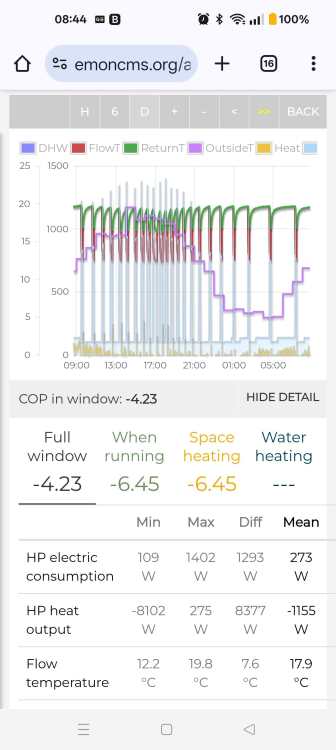
I've just taken a wider view of the ASHP operation so over 24 hrs. The mean flow temperature is 17.9 Deg. So pretty high really.
-
Be careful what you read always check yourself. Yes I have pipes inside and an uninsulated UFH manifold. No voids though. But nothing runs below dew point and that's the important bit, so are always dry. Read this currently running thread also
-
I would say you are missing something. You treat cooling the same as heating - low and slow. Set it on weather compensation. So it's always ticking away. Then you never ever hit 30 degs. Most the time the house is 20 to 22. If you get loads of solar gain you may get short excursions slightly higher. But you shouldn't be in the 30s. So you are looking at a dew point of 12 or below.
-
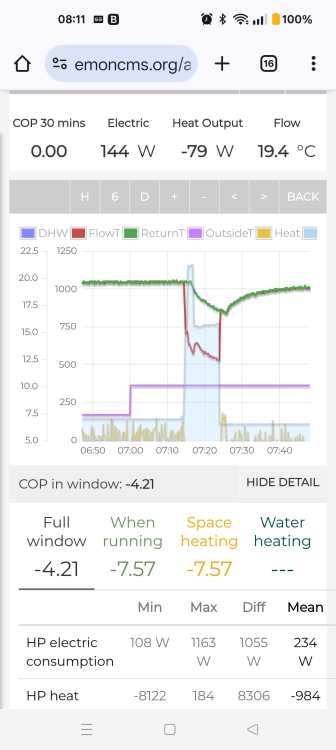
I think set point depends on how the ASHP controller handles hysterisis. Plus what temperature it really brings the floor down to. Mine doesn't really run for long generally in the 10 to 15 mins range and then off from 10 mins to 4 or 5 hours. Really depends on what the sun is doing and ambient temperature. This is the last cycle. As you will see (red line) it's not spending any time at a cold temperature. Set point will depend on how your ASHP responds, if runs for hours on end, 16 degs may be better set point
-
If running pipes through your loft they should be insulated anyway. Pipe insulation is generally closed cell, so pipe isn't affected. We are 50% humidity inside, the area of the UFH manifold is about 20 degs. So the dew point (from you chart) is 9.25 degs. So min flow temp is 3 degs away from there. Floor is a good margin off dew point, no matter what the house temperature. So no issues with UFH. If in doubt insulate pipes (they should be for cooling anyway).
-
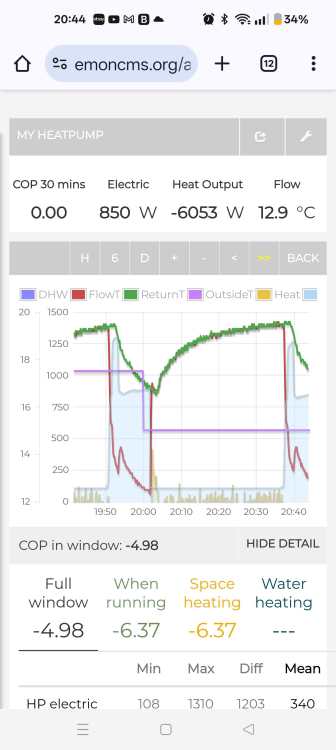
My target flow temperature is 12.5 degs. But pipes are in 100mm concrete. Floor temp is closer to 19.5, so never see any issues. Now on year two doing cooling. Typical heat pump cycling Red line is flow temperature, green is return. Purple line is outside temp.
-
Your beam idea would work and the cool air would fall naturally. But like UFH heating area is king, to allow low running temperature. So reversing to cooling would the whole ceiling be better thann just a beam, allow you stay away from dew point and save being dripped on. Or just do a fan coil? What risk is that, you only need floor a couple of degs lower than ambient to cool. So my floor is about 19.5, well away from dew point. Flow temp goes down to 12.5 Deg (100mm.below the surface) for a few minutes and never see any condensation forming anywhere in the system.
-
Scary really.
-
Polished concrete or tiles are no different. In open space your floor temperature will around 2 to 6 degs above room temperature. Air trapped beneath kitchen units is going to warmer that the room. Make your own call. I didn't have any UFH pipes below beds, wardrobes, any kitchen units. Does house feel cold - no, even at 300mm pipe centres I don't flow high temps. You will get answers that say do and others like mine that say don't. You need to consider your house layout and likelihood of being changed in the future. For example - Our house is not likely to be reconfigured, as it's all geared to views, other/yours houses are different.
-
But get them in black so UV stays out and it doesn't go green.
-
Over your existing pressure switch, add a shelly relay or similar, add a time based automation, it will normally takes 5 mins or less to reset, just set an hour or two automation, that if the switch hasn't reset in a hour raise an alarm.




