


PeterW
-
Posts
18480 -
Joined
-
Days Won
207
Everything posted by PeterW
-

Plumbing Design – Part II
PeterW commented on TerryE's blog entry in The House at the Bottom of the Garden
@TerryE if I was picking one thing up from your drawing I would suggest the Live feed to the contactor and Willis doesn’t go through the manual on switch but I expect that’s just how it’s drawn ..?? -
Grease Trap. Don't read this before meal times.
PeterW replied to ToughButterCup's topic in Waste & Sewerage
I think we should have a BH Design Group session on this... I’ll bring the fag packets ..! I’m sure we can (over) engineer this for @recoveringacademic.... -
I’d noticed that @Nickfromwales but couldn’t see anything on the UVC to allow a return. Concern with the way it is currently, it may cause boiler cycling as it will circulate through the whole tank and not the top
-
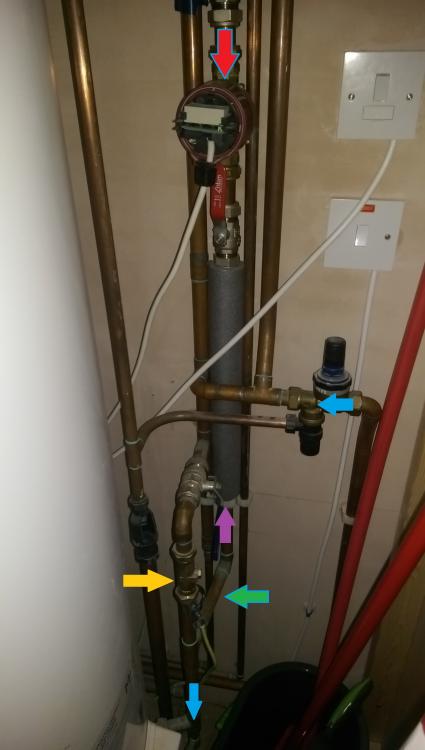
Right... Edited the image you sent as below : What should be happening is the cold water should follow the blue arrows - through the PRV and then into the bottom of the tank. The circulation pump should pull water from the top of the tank and return it to the bottom, following the red arrow. The issue is where the non-return valve is - indicated by the yellow arrow. What is happening is the pressure is pushing cold water past the pump following the purple arrow, mixing at the shower and basically providing lukewarm water everywhere. When the pump is on, it would provide some resistance to the flow but not much, hence why the shower gets a little warmer. The fix is to add an additional non return valve where the green arrow is, with the flow coming from the pump into the main cold tank feed. The current one would stop backflow into the cold supply, the new one would stop the water pushing past the pump. @Nickfromwales will be along shortly to tell me I'm wrong.... Edited to add that yes, you can leave that valve closed but turn the pump off... it looks like its lost its cover too..?? While you've got the cold water isolated I would replace both the pump and add another NRV....
-
Close the isolator above that circulation pump and see if it makes a difference..... There is a non return valve in that lot and it looks like it’s in the wrong place...
-
There’s a difference between drilling brick and block and drilling rebar reinforced concrete ... A cheap TCT will do one or two holes in brick and block, show it concrete and you will be there for days ...
-
Yep I second that ..!! Mine cost me £40 inc VAT including paying £15 for the 52mm core drill that I sheared two teeth off when it bounced off an exceptionally hard brick ..! I wouldn’t buy one, as putting it bluntly I wouldn’t buy a 2nd hand one as they need proper servicing ..! I watched them test the torque on the clutch before they handed it over to me, and if I was buying 2nd hand how do I know what abuse it’s had ..??
-
Just as an aside, we have a couple of pumps that are connected using these as they are IP68 - they also positively lock so are worth using and not expensive. https://www.tlc-direct.co.uk/Products/KBJB0011.html
-
Mine was a Hilti core drill with Ox cores. 110v and massive torque ..!!!
-
Is it a UVC or is it a Thermal Store ..?? There may be no zone valve stopping the flow through the cylinder so when the UFH comes on it may be drawing cold water back through the UVC coil. Got any photos ..??
-
So that’s a 127mm core which I would really be doing very carefully with a big hired in hole drill. Anything up to 50mm you can do with decent cores on an SDS but above that you are into wrist breaking - or being thrown off a ladder by the torque ...
-
Despite views to the contrary, combi boilers aren’t instant as the heat exchangers hold water so the first slug is lukewarm - and 25m is a long way to go ..!! If you have the luxury of replacing all of the runs then look carefully at where your bulk usage will be - that is showers & baths. This should be as close to the main tank as possible - thermal store or UVC is irrelevant at this point. Basins, kitchens and utility rooms can be fed by 10mm radial pipes - they hold much less volume and are quick to pull through to the taps. Flow in a 10mm is adequate for anything except baths and showers. If the kitchen is the furthest point from the tank then dispense with the hot feed and go with either an under counter inline heater or one of the combined boiling water taps that also does a hot water supply then you only need cold to the kitchen.
-
Depends on the day rate really ..? Spon lists around 1.72 hours per door however if these are decent doors and they are having to do work to get them to fit into existing frames then 3 doors/day is probably not unreasonable.
-
I’d use sticky pads and cable ties - you will end up moving the Cat5 and staples can be a little harsh...
-
For all things private borehole related the best source of information is @JSHarris blog .... if you can’t find it there, it’s probably not worth reading ..! Is anyone else on the borehole or is it you alone..?
-
Option 1.... But do a bit of measuring first ..!! Cat5 patch cables come in various lengths so you may find a mix of 5/7.5/10m may be better. Alternate and even easier is to make each bank of desks a group and put a 4 port unmanaged switch on each desk then it’s one main cable back to the router
-
Definition of a self builder.
PeterW replied to Moira Niedzwiecka's topic in General Self Build & DIY Discussion
The ones that haven’t started are the ones talking about “colour wheels” and “mood boards”..... The ones that have started are usually down to seeing permanent red and always in a bad mood ...! -
Enjoy ...!!! Looks like you will be pouring all day but at least it’s under control ...!
-
Grease Trap. Don't read this before meal times.
PeterW replied to ToughButterCup's topic in Waste & Sewerage
We had one - I insisted - on a commercial activity centre build that fed an 18,000 litre Klargester Biodisc unit. Its the Hepworth clay one, and as @JSHarris says, they work pretty simply. http://hepworthclay.wavin.com/web/solutions/foul-water/clean/grease-trap.htm The Hepworth ones seem barking mad prices - no way I paid £1300 (!!!!) but I did find this online for £230. Search for grease interceptor instead... https://www.greasetrapsales.co.uk/buy-online/grease-traps---underground/gt-100-litre-underground-grease-trap -
Grease Trap. Don't read this before meal times.
PeterW replied to ToughButterCup's topic in Waste & Sewerage
Yep.... -
one that doesn't break your wrist.... If you hire one, check the clutch torque has been set properly - how big are the holes you want to drill...??? Some are set to "break" with 150mm cores in them, so with a 50mm core it will try and take your arm with it as the clutch won't give with a smaller core...
-
Thats about the same as we did although it’s 125mm EPS below ground. I would have gone the Touchwood style route but basically we had to use reclaimed external bricks and they were +/- 10mm on every dimension so the inner cavity vairies substantially ...! One of the reasons we also went blown EPS bead for the cavity insulation.
-
Anyone install an electricity meter for free?
PeterW replied to ToughButterCup's topic in General Self Build & DIY Discussion
Eon will do them - I was with them for a whole 11 days before transferring to Ebico to go Zero Standing Charge. You need your meter supply address and they should give you an MPAN -
We built our cavity with a full full below ground of 125mm EPS with 25mm or dry mortar on the outside to hold it in place (150mm cavity) This then has a full stepped DPC across the inner and outer skin to allow the blown bead over the top - BCO had never seen it before and other than having to do a bit of cavity cleaning due to snots it’s worked really well as it means the edge of the slab is insulated well below ground level.
-
@recoveringacademic if it’s a movement joint then you need to use a wall starter that has slip joints on it and render / point as I suggest otherwise it will crack the render .... Or have you finished it already ..??


