PeterW
-
Posts
18480 -
Joined
-
Days Won
207
Everything posted by PeterW
-
Got a link to the actual eurocone lockshield valves ..? May have a use for those on a towel rail... I think you’ve posted a link to this supplier before but when I asked them for any more info on the fittings (certs/guarantees etc) they didn’t respond other than to say the parts came from Europe - with Hep2O you get 50 years and full WRAS certification. There is also no MLCP reference on their site any more - all PEX-Al-PEX and the UFH parts so wonder if they have stopped referring to it as MLCP (for reference, PEX-Al-PEX or PERT are both classed as MLCP or Multi Layer Composite Pipe for those not knowing the acronyms)
-
It is quicker and cheaper to lay a slip membrane and also the foil can be attacked by cement but that is dubious as no-one has ever proven the reaction occurs to the detriment of the insulation.
-
Not sure how it makes it easier to use 16mm both places ..? 99.9% of UK rad fittings are designed for either 8/10/15mm pipe and I have never seen one for 16mm readily available. If you’re running from a UFH manifold then use Hep2O in 15mm straight to the radiator and use a standard 1/2”/compression elbow on the rad and pipe straight to it. UFH manifolds come with various cones and connectors and 15mm is one of them. You would then be using standard fittings throughout and there is no saving between buying PEX/PERT pipe and Hep2O at 50m reels so there is no cost benefit. Also don’t understand your comment about higher temperatures ..? What are you planning on heating the house with ..? Gas / Oil / ASHP..?? All the pipe on the UK market, including the PEX/PERT products are rated to 90°C so you have no issues on heating systems anyway.
-
Yep - 1/3rd cubic metre tubs with a retarder in that lasts 3 days from delivery. Consistent and very good and means they aren’t waiting on mixes.
-
Problem isn’t when they are initially firing, it is when they start to close down and blend off the hot as the cold return increases in temperature. What happens is the flow rate through the mixer valve reduces so the boiler stops firing. As the hot is now cooling and the flow into the mixer continues then the boiler senses the cold flow and fires - short cycling the boiler. This can be for 3-4 minutes in every 15 and destroys boilers and gas valves, and as they never get to condensing temperatures the efficiency is significantly lower. Even a 50 litre buffer can help if there isn’t the space for bigger buffer tanks. These can be had for £200 and with an immersion in them too, they allow for standby heating in the event the boiler fails.
-
Not really as the low heat limit is about 4.2kW, but that is at flow temps of 63°C which is far too high for UFH. I’ve looked at a few options recently but any heat requirement less than 6kW constant and I am struggling with gas boilers without 150 litre buffers.
-
A 30KW combi will not modulate down far enough, and will short cycle to death and not condensate at modern UFH temperatures. It physically isn’t possible as the flow rates are too low to sustain for UFH, and the condensate level is too high. Fact. An older, less insulated and higher UFH flow temp house may support this, but that isn’t what we are talking about, so this is like comparing apples and giraffes.
-
combi won’t run UFH without a buffer tank so you’ll need space for that somewhere. You’ll also need a big combi to get decent water flow - WB CDI30 or similar so won’t be change of £2k installed. Also needs an annual service to keep the warranty, so lifetime costs are not cheap.
-
Ok so it’s bigger than I thought as I was under the impression it was only 2-3ft at most. TBH if you are putting in a hatch, then quit with the tape measure and use a hammer ... you want a hollow sounding gap, then through it with a hammer and widen out until you can get a hand through to shove the insulation out of the way (wear gloves, goggles and a mask) and then get your head up there to see what’s about. Then take some photos and post here so we can advise .... in the interim until you have the hatch fitted you can always just duct tape a bin bag over the hole.
-

Which plastic type for a temporary window glazing?
PeterW replied to epsilonGreedy's topic in Windows & Glazing
I’d use the twin wall polycarbonate as it’s strong and let’s light through and takes screws etc but isn’t easily broken or seen though. -
Wonder if that is cheap brown mastic that has shrunk away as the gap looks fairly equal. If it was moving I would expect it to pivot away from the wall more at the top. Can always rake it out and repoint it. If you want belt and braces then use helical pins from the inside drilled through into the brickwork of the extension.
-
Welcome Probably need a bit more info to give you some help Boiler type..? What controls ..? Make or manufacturer ..? How old is the property / install..?
-
No model number or plate on the internal box ..?? If there are no more pumps then I expect that the issue is the heating system is expecting the rads and the UFH to work at the same time and that is asking for trouble. The rads will suck the heat from the system - I expect it has a circulation pump in the main unit that it is using here - and the UFH is being starved of heat. I would try the following : - set the hot water to come on between 04:00 and 06:00, which means it will be satisfied before the heating is needed - set the UFH flow valves to maximum, don’t turn them too much as they can come off in your hand .... - set the UFH room stats to come on at 06:00 for heating, and the rads at 06:30 A rad flow temperature of 42°C may not feel that warm as your hand will be 38°C anyway. Unfortunately as they haven’t put a blending valve on the UFH, there is no way of turning this up as you will have issues with overheating the floor. Out of interest, what are the floor coverings in each of the rooms heated with UFH..?
-
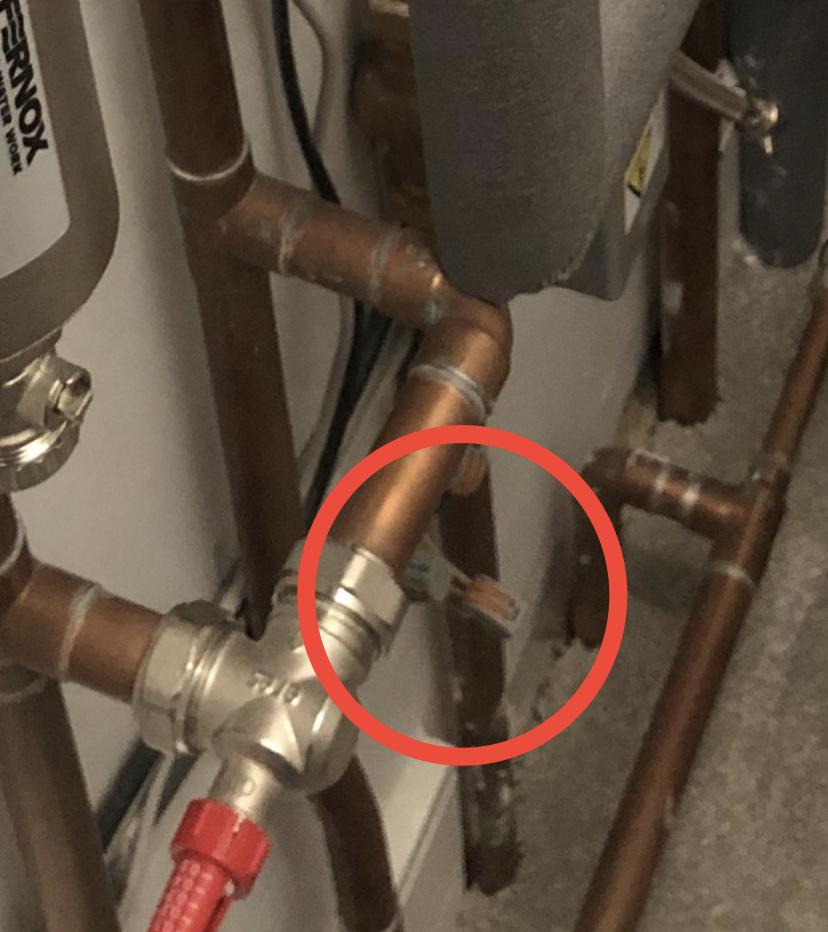
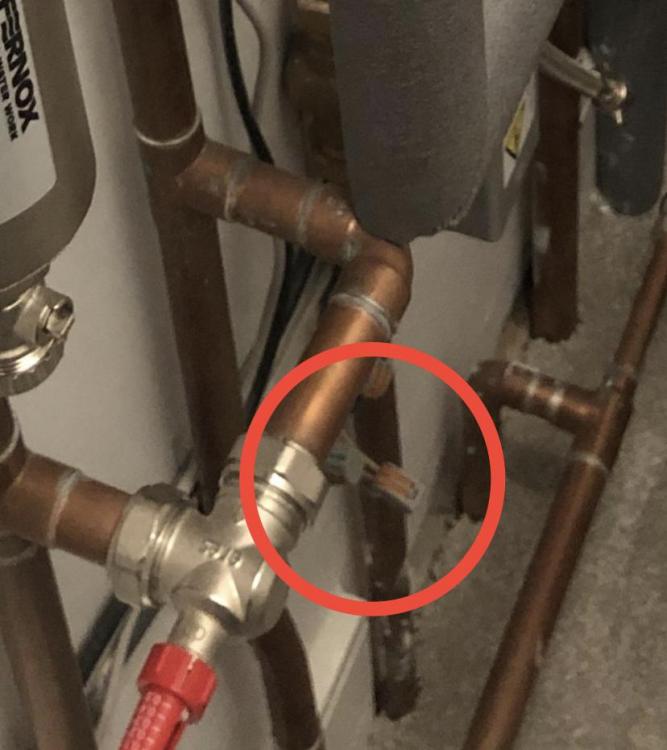
@ProDave... Wago’s hanging in mid air ..!! Isn’t that against regs ..??
-
Is this one of their hybrid heat pumps that works with a gas boiler ..? And all that pipe should be insulated - Building Regs !! Is it brand new ..?? Is there an internal Vaillant unit or just the cylinder..? And finally ... any more pumps ..??
-
That is just shocking install ..!! They appear to be using T&E cable as flex between the isolator and the controls, and 3 loops for the whole of the ground floor ..?? Can you take a photo of the valves near the hot water tank as I expect there is another set and it wouldn’t surprise me if the rads and UFH are fighting for the same heat and only when the rads are satisfied is the UFH getting the flow.
-
That is only partially true - you get a maximum 80-85% transfer which means that when you have a delta of 16°C between inside and outside you will only be getting 13°C uplift. This means you can soon start cooling the air in a house when it Is only 4°C outside.
-
Just get some Tracpipe and use that - you get better bends in it, and it’s dead easy to thread through everything. Your issue will be getting a tank up there at that size, and ironically you may want to go larger (they tend to be shorter ..!) and also look at the support you can get under the tank as ideally you want it spread across 5 trusses as a minimum. Also I’m confused as you say you have a full vented system but what is that expansion vessel connected to in the pictures ..?
-
I don’t think there is enough access up there for him to get there anyway - this will purely be to add insulation.
-
Measure it ..! And then post the measurements on here, with what the top looks like (twin panels, one row of zig zag steel etc) and I will tell you exactly the output.
-
Why have you ..?? Just start by doing the bloody obvious stuff first please and not be negative. Decent fitting door, closed when you go to bed and the heating set to the settings requested ...
-
Not sure why you need to find a joist Zoot as you’re going to hack a 600x600 square into the PB... I would just knock a circle mid centre ceiling and then measure your way to the joists (which should be at 600 centres) and then square it up from there. If you hit a joist immediately then just work 600 away from it.
-
How about doing the settings I said and seeing what happens ..??
-
But the inhibitor neutralises any sodium carbonate and then it is safe for life. The other issue is the OP is talking about radiators which are 1-1.5mm thick, a heat exchanger is substantially thinner and there are more rads than a single heat exchanger.
-
That is way out of date and comes from the early 1990’s and has long been proved a myth From PureChoice This myth stems from an outdated British Standard BS7593:1992. This standard was revised in 2006 which now includes that softened water can be used providing a suitable chemical inhibitor is used. It appears that some boiler manufacturers still base some of there concerns around this confusion, and the 1992 version. The main corrosion inhibitors, such as Fernox and Sentinel, for years have not had a need to change or consider softened water in their formulations. Consequently it has been easier to say nothing. But, now Fernox have released a technical bulletin (number 21) which includes the following extract: As I said, correct use of inhibitor and the use of softened water is absolutely fine. Some boiler manufacturers actually insist on it.