


A_L
-
Posts
652 -
Joined
-
Last visited
-
Days Won
1
Everything posted by A_L
-
You may find the attached PDF helpful There is a 30-day free trial with a CRA (similar to the one you have referenced) available here http://www.builddesk.co.uk/software/builddesk-u/ Vapour_Resistances includes perm conversions.pdf
-
Thermally there is not a lot of difference, 40mm of cellulose has about the same insulating effect as 35mm Rockwool slabs. (Thermal conductivities of 0.04 and 0.035/0.034 respectively)
-
Cheaper panels generally cost less per unit generated. As Ed has said the only real advantage from higher efficiency panels is that they use less roof space. They do not necessarily produce more energy from the same output rating. Possibly of more importance is the 'power coefficient', which can usually be found in the electrical details part of a spec sheet, a number usually between -0.25 and -0.45 which indicates how much output falls with rising temperature. From your quoted panels I would expect the Panasonics to produce perhaps 50kWh/yr/kWp than the LGs, with the Sunpowers somewhere in-between. However once again increased cost of these panels usually means that more cheaper panels are preferable, unless you have to keep under a specific panel output.
-
Based on the claimed performance it is as good as the same thickness as PIR board. It is however on a 'cost for equal insulation performance' three times the price of PIR and six times the price of Rockwool RWA45 batts.
-
Not really, with thermal bridging of the timber fraction a reasonable build-up gives U=0.16. Not so low compared to people here.
-
Only closed cell polyurethane foam comes close to PIR, I do not know of any DIYable kits using this. All the kits seem to be open cell of one sort or another and are only about as effective as Rockwool batts.
-
For the same insulating effect pretty much anything will be thicker, cellulose would have been 0.04/0.023 or 1.74 times as thick (or about 350mm). Rockwool batts, (RWA45/RW3) the basic type not the mineral wool/fibreglass batts sold specifically for TF are economical effective and DIYable. They would be about 300mm on the same basis
-
@Andrew for the specific example in central England the saving is around 0.78kWh/m2/yr
-
Cold external air entering the loft/attic will displace relatively warm air between the two layers of insulation making the rafter layer ineffective. The loft as originally designed must be air tight. No ventilators, particularly in the soffit, no day light visible from inside the loft, particularly at gutter level.
-
Only if no air enters the loft from outside.
-
Actually isn't it the evaporator that freezes? ?
-
Given that polystyrene reacts with PVC insulated cable, on a safety first basis I would avoid having PVC conduit in contact with EPS. There will be the issue of de-rating the cable because of restricted heat-loss but I will leave that to the electricians.
-
No, Bregs are m3/m2.hr and Passsivhaus ACH. Both at 50Pa over/under pressure. At low levels the numbers can be arithmetically similar, e.g. 0.6ACH corresponds to 0.48m3/m2.hr for a simple bungalow of 117m2 I have details for. Also the actual infiltration rate of the unpressurised house is about 1/20th the test number.
-
The reason is that the thickness of one of the layers, the soil, varies across the area of the floor. The heatloss path is floor surface - soil - external air. Therefore at the edge of the slab there is little/no soil and the local R value is approximately the higher one. The area at the middle of the floor has the thermal resistance of a considerable thickness of soil and thus a higher R-value. The 0.14 U value is the weighted average of the whole floor. If you try using floors of the same area but different P/A ratios you will see the effect, since higher P/A ratios imply less 'square' shape which have greater exposed perimeters for a given area, e.g. the common perimeter of two adjoining semi's would not be included.
- 13 replies
-
- 1
-

-
- u-value
- calculation
- (and 3 more)
-
hello and welcome, Do not put celotex on the cold side of the existing mineral wool insulation, it has a relatively high vapour resistance and particularly if it has a foil face is liable to cause the interstitial condensation you refer to later. For any given thickness Celotex will have about 2x the insulating effect of wood fibre board and both will be relatively expensive compared to mineral/fibreglass wool rolls. 200mm of loft roll wood give the desired effect without the expense of sheep's, wool. If you are using a membrane to reduce 'wind washing' it must be vapour permeable to prevent condensation. Putting above two 100mm layers and below one layer puts out of the way while still having the desired effect. It need not be 'airtight; windtight is sufficient, e.g. Tyvek Housewrap or equivalent. Loft boards will reduce heatloss but the extent will be dependent on the insulation backing. Do not use Celotex or Steico across the joists unprotected, the compressive forces from standing on it are to high. Reasonable storage with board on top would be O.K. Your first insulating task is to fit bonded bead CWI, try the Energy Saving Trust for local subsidised offers.
-
Hello and welcome, Boreholes are costly, I assume you are thinking of them because of rocky/thin soil? Also the contractors probably will be reluctant to quote for your location, further increasing price. Here is the blog of someone who has built a low energy house with renewables on a 'remote island' (Raasay). https://lifeattheendoftheroad.wordpress.com/
-
@AliG , air tightness moisture/vapour resistance are two separate phenomena. It is perfectly possible to have an airthight membrane which has a very low vapour resistance and does not significantly inhibit water vapour movement through it. The process is called diffusion and is different from bulk air movement.
-
Just to double-check. The extra insulation is on the cold (out)side of the vapour membrane?
-
Only if the insulation has relatively high vapour resistance and performs as a vapour check, i.e. PIR/PUR/XPS. Possibly EPS. i.e. not rockwool or any fibrous insulation.
-
Heating oil prices for the next 20 years
A_L replied to Nickfromwales's topic in Boilers & Hot Water Tanks
O.K., my tuppence worth. Over any five year period oil will only rise at a little more than inflation. Why? Renewables/CO2 Emissions restrictions/EVs will reduce demand and limit price rises. This will leave oil for what it should always have been reserved for, a chemical feedstock (utterly invaluable source of molecules)/lubrication/fertiliser? -
Knauf Omnifit comes in 90mm, claimed to be suitable for acoustic insulation but lower density than the Rockwools you have posted, so have to double check performance. https://www.knaufinsulation.co.uk/products/earthwool-omnifit-slab
-
Not necessarily, 0.15 is better than 0.2, but any serious calculation of U-value must include the timber present in layer three. With at least a 15% timber fraction it will make a significant difference.
-
Historic retrofilled foam cavity insulation - U value?
A_L replied to PeteTheSwede's topic in Building Materials
@PeteTheSwede If it is t least 30yrears old then it is most likely Urea Formaldehyde foam. It will probably be white and if you squeeze it will crumble as it has become brittle with age. How much this would affect its insulation qualities I do not know. Assuming a lambda value of 0.029W/m.K it gives a U value of 0.44W/m2.K in the build up below.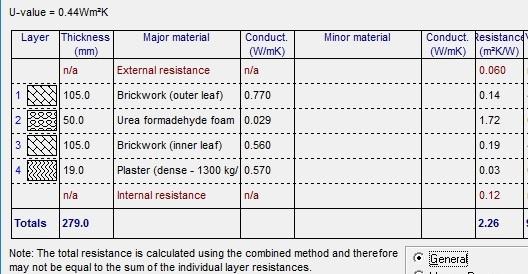
-
Based on attached pdf the UniQ dPV models appear to do this (fig 1.9 page 7) but it appears to be all the PV output is sent to the Sunamp. Which would be a waste in summer and not enough in winter. Edit - note Sunamp have mislabelled Fig 1.9 as a UniQ ePV. Sunamp pdf2040.pdf
-
How about extruded polystyrene (XPS). You are going to need about 30% more by thickness. https://www.jackon-insulation.co.uk/products/detail/jackodur-plus-300-gefiniert-gl/ There is always mineral wool batts (e.g. prorox SL920) or expanded polystyrene. Both with a lambda of 0.035 so about 70% more by thickness

