JFDIY
-
Posts
498 -
Joined
-
Last visited
-
Days Won
1
Everything posted by JFDIY
-
Lintel (or lack of) above a large picture window
JFDIY replied to Oxbow16's topic in RSJs, Lintels & Steelwork
I'd go with Joe's idea. If you want to take it further cut the top edge of the board with a chamfer to encourage the water towards the face of it, you could do the same at the bottom. You can cut (with a circular saw) or router a groove for a drip edge like you see on window sills to stop water tracking backwards. I'd definitely chase a groove for lead to go into the masonry and over the top edge of the board to prevent water running behind. -
standing heat loss across cylinders/thermal stores
JFDIY replied to Jeremy's topic in Boilers & Hot Water Tanks
It needs to be considered in context surely, for example my sister has an unvented cylinder in an outbuilding, which the losses are heat that has gone forever. If the cylinder or boiler etc are within the heated envelope of the building then you can argue that they aren't losses at all, (unless the windows are open) because the heat is retained inside the property. As mentioned above it needs to be in context, the more efficient the house, the more you may consider matters I guess. -
But you'll forget all about it one done. The only time you'll consider the grout line is when sat on the toilet, and you won't be looking under your arm pit to see what's behind you, the one straight ahead will bug you the most. That said where does the lines fall around the shower tray. You may choose to be deliberately half a tile out if it fall better for the tray/bath and door into the room etc.
-
Think I'd match the long side, won't the karzi and bath obscure a good chunk of the opposite side?
-
I went with cemfloor, it's a bit more money, but doesn't need the latance removal that gypsum does. It also will tolerate thinner thicknesses and can be force dried if you need to. Mine has been down six months, no floorings on top yet. We have one crack in a room that will be carpeted but I think this is the area that was poured first, on the day the lads had trouble with the screed pump and overlooked discarding the priming water, which then made that room a bit wetter than it should have been. The main area (5x10m) that will be tiled is pretty much perfect, which was my main concern.
-
£300 for a pump (often with with operator) is the norm round here.
-
Have a look at the uubink foam ducting, about £10 a meter all ready insulated, easy to install as well.
-
Just had another look and also the main supply and return appear to be swapped compared to @ProDave's set-up. His hot supply in is to the elbow on the blending valve, yours is not if the colour code of the handles is to be believed. So when the blending unit tries to add heat it will cool and vice-versa. Hence the weird things you've seen going on.
-
The flow meters could actually be showing more flow at the lower pump speed because they are being blown shut with higher pump speed. I agree with the suggestion already made, swap top and bottom manifolds, so actuators are at top and flow meters at the bottom and try it again. If the manifolds are the same, it might be less work to swap the flowmeters individually and valves that actuators couple up to. That way you could try one and then see if there is s difference in flow being registered.
-
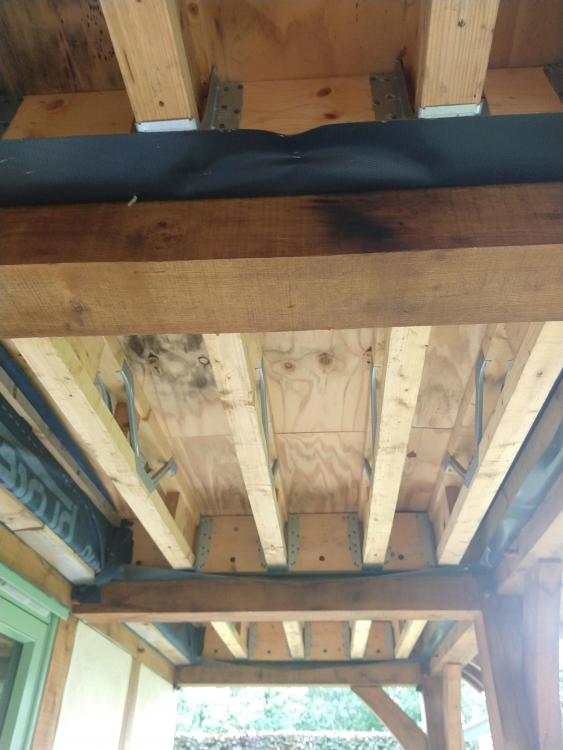
I've got three bays above my veranda to panel in, they are 1.6m in both directions, above is a built in cupboard/wardrobe into the master bedroom. I want to fit UFH to minimise heat loss in the room, I've already got spreader plates so that is my plan. What would the standard detail be regarding air tightness layer, breathable membrane etc. Joists are 220mm deep. My plan is some thin battens under the top chord of joist giving 45mm on the top side, this having 25mm PIR to support the spreader plates and pipes. This leaves 175mm for mineral wool insulation underneath, I'm feeling there should be I a breathable membrane, should it have air space or can it be in contact with anything? Finally the boarding to the underside presumably needs to be moisture proof? Not sure fire proof is needed, building inspector wasn't over fussed, but I would like the finished surface to be rendered I think. Anyone got any standard details of an overhanging floor like thid by any chance? I'm guessing a built over carport would be a similar situation. This was missed off the plans and i'm no longer on talking terms with those who drew up the building regs. Many thanks
-
You're underground what did you expect ?
JFDIY replied to Pocster's topic in General Self Build & DIY Discussion
If the top 'cap' of the wall is going to remain exposed you could have a pole that drops in the corner with a couple of saddles that sit on the wall, one in each direction. Drop the whole shebang in place when needed and remove when not, no fixings or redundant crap to look at long term.; thinking of a time when it's not a building site. -
What constitutes a significant start?
JFDIY replied to Dave and Helen's topic in Planning Permission
Have you got your building regulations drawings approved or are you working under a building notice? Without those you may struggle to get them to accept you've made a start. For us, we piped in some sewers 10m and poured two 1m long footings that needed inspecting prior to pouring the concrete. That said the church next to us have a raft foundation for an extension so just dug 0.75m of the ground away in that area to constitute a start. You could dig out some decent footings, get them inspected and cast in some concrete with re-bar loops conveniently poking out the top, and polystyrene breaks sub-surface so you can break them and lift them out with a big digger when you need to later on. -
Advice required please new tiles with old
JFDIY replied to Vaders brother's topic in Roofing, Tiling & Slating
Only way to salvage that is a joining strip to provide a proper drainage route, gate to say it but only places you'll see them is where they re-roof a semi-detached and leave the neighbours original, see it a lot on local authority housing where the privately owned one next to it isn't done at the same time. -
How to Fix MDF (Instead of Plasterboard) to Stud Walls
JFDIY replied to timsk's topic in General Self Build & DIY Discussion
They panel areas at my work like this and it looks quite good for the amount of effort involved, just keep your fixings away from the edge so you can fill and paint without loosing the edge detail -
You're underground what did you expect ?
JFDIY replied to Pocster's topic in General Self Build & DIY Discussion
Either a double scaffold clip, or buy another lifting sling and just wrap it around the cross-over and it will share the load through the two poles. -
You're underground what did you expect ?
JFDIY replied to Pocster's topic in General Self Build & DIY Discussion
Have a look for a steel stillage, you can get them with solid or mesh floors.https://metalcagesandpallets.co.uk/collections/all/products/metal-steel-mesh-stillage-with-removable-front-shallow-refurbished?variant=31757722026081 I guess the scaffolders call them single clamps. https://www.scaffoldingsupplies.co.uk/products/details/25.html You could also use half clamps to secure to the masonry with Rawl bolts, but you'd need to be cock-on with positioning https://www.scaffoldingsupplies.co.uk/products/details/1318.html Personally I'd leave the other two vertical poles long instead and run the lifting member to them. More stable due to being anchored to blockwork and leaves loading access from two sides The diagonals you show in later drawing will obviously help, but I doubt needed for 150kg -
You're underground what did you expect ?
JFDIY replied to Pocster's topic in General Self Build & DIY Discussion
Correct, but lap type clamps will be do-able if you build them as you go. But there not as strong, usually used for handrails, and under the planks -
You're underground what did you expect ?
JFDIY replied to Pocster's topic in General Self Build & DIY Discussion
Is the jib going to swing? If not, take two opposite poles higher and have a scaffold pole across the two to share the load, I'd choose the ones bolted to wall. In fact you could take three vertical poles higher then use a ratchet strap as a 'handrail/'edge protection for when you're loading -
I had mine set to 4bar for a few days checking for leaks, I dropped it to about 1.5 bar the night before screening, there was only about 30ml of water that made the difference. As those above say, a few degrees temp change can cause a modest change in volume and it has nowhere to go without the expansion vessel. The annoying thing is when you mark the gauge with a big of tape to check for leaks, then over 24hrs are seeing such big changes you can't really decide if it's good or not. In the end I decided that if there was any pressure left in after a few days then the pipes were good and a minor leak at the manifold would either seal itself or could be felt with later.
-
Think they're having your pants down.? Wickes are best for cement round here, £4.20 a bag all in, don't forget you can get a trade card for 10% off. And £60 Inc VAT for a bulk bag of sand from Travis Perkins delivered Or £42 at wickes even with the £30 delivery fee on top makes.me think they've not given you anything like a decent price.
-
Having UFH can only help, and our experience is if you put your feet on the warm floor you actually don't mind the room temp being a bit cooler. Insulation below the screed and in the ceiling will also help. Make sure the pipe spacing of the UFH is quite tight (150mm or less) to help with the vaulted ceiling loss Worst case is that if it doesn't work then you re-instate the rads, or leave them in for this winter and see how you go before removing them?
-
If it's down already then measure from whatever was declared as the datum for the floor if it's your project. Or is it somewhere you've bought already done, that is now showing a more serious issue? If not containing underfloor pipes, you could drill it and see where you break through, assuming it's over insulation it will go soft and you can gauge the point of breakthrough as the depth. Need a bit more info on the make up and what you're trying to determine I think.
-
Cemfloor quote that you can go as thin as 25mm over heating pipes if that helps. See also webber 4310 as a member on here said you could do 30mm including pipes https://forum.buildhub.org.uk/topic/13427-col57-introduction/
-
Are here any special requirements? I had quotes from the local council dept and other people they regularly worked with, then decided to look outside the county and found a self employed guy who was very good for less than half the price. He even gave me a hand for a day on the tools demolishing the old building, which helped me but also gave him the chance to do a better job reporting on the site history because he could see the methods of construction and date things better. He was on site for foundation digging and again happy to assist on the end of a shovel rather than watch everyone else. Drop me a message if you'd like to contact him and I'll dig out his details. I think Bedfordshire should be within his area - he's Leicestershire based.
-
You're underground what did you expect ?
JFDIY replied to Pocster's topic in General Self Build & DIY Discussion
Buy an old forklift mast and bolt it to the wall, small hydraulic pack and away you go.