


Ian
-
Posts
751 -
Joined
-
Last visited
-
Days Won
3
Everything posted by Ian
-
@CADjockey what we had which worked really well was an “offset mortgage”: An offset mortgage is where you have savings and a mortgage with the same lender and your cash savings are used to reduce or offset the amount you owe in the mortgage. The big advantages are that you still have instant access to the savings with no penalties but the cash in the offset savings account is effectively ‘earning’ interest at the same rate as your mortgage.
-
Timber Frame "to Passive or not to Passive" that is the question
Ian replied to Red Kite's topic in Timber Frame
the passive wall option will have lower heat losses overall due to better detailing for thermal bridging and a much better air-tightness. At a guess the difference between the two could mean approx a 30% to 50% saving in your heating bills. Edit - it's worth doing the maths on your potential heating bill savings. I had a similar decision on a small holiday home that I was building a few years ago on whether to go for a passive spec ie 0.1 'U' values and as air tight as I could make it or just go for meeting Building Regs which for my build was 0.15 average 'U' values and no special measures to achieve an air tight build..I achieved 3.7m3/h(h.m2). The final build is completely draught free and easy to heat. The difference in heating bills between the 2 solutions using bulk LPG was less than £100/year. -
site insurance won't extend again - what to do?
Ian replied to divorcingjack's topic in Self Build Insurance
2 years ago I was in a similar situation to the one you've described. The high risk work had been completed on our house inc plumbing & electrics but I needed to finish the kitchen and painting & decorating. Even though I didn't have a Building Regs Completion Certificate I managed to get normal building insurance through a broker which was ideal for my situation but the downside is that the policy excludes damage caused by construction works. Let me know if you want me to give you the broker's details. -
it means air temperature of < 10 centigrade. The issue is that it will take longer to dry at low temperatures. It's water based so the risk with the weather we've been getting this week is the sudden drop in temperature after sunset. Water based products don't perform well as it gets close to freezing.
-
We've had no problems with cracking in the plasterboarded & skimmed walls in our timber frame bungalow. It's now 2 years old. I think part of the reason why we haven't had any issues is that the timber frame was erected and made weather tight in a 2 week period in the summer when it was dry & sunny so the frame didn't get wet.
-
Rates in North Wales are currently just under £200/day for skilled labour eg our very good joiner currently charges £180. Our build cost was £96k for a bungalow with 2 double bedroooms. It was completed 2 years ago and is 71sq.m internal area which works out at £1,350/sq.m. That price doesn't include the costs of getting Planning Permission or Building Regs fees or demolition of a previous abandoned building on the site.
-
Where are all the SIPs suppliers???
Ian replied to hmpmarketing's topic in Structural Insulated Panels (SIPs)
I'm not convinced that there is a real-life benefit in using a MGO SIP panel compared to a normal OSB faced SIP panel. I've no direct experience of MGO SIP but I assume they will still be reliant on timber in their construction for certain structural elements such as the soleplate for example and so they should still have the external render with a ventilated void between the render and the SIP panels. -
@vivienz Just a couple of things for you to check: the sewage treatment plant needs to be located at least 7m from the house but, in my view, the further the better if you have enough land as they can be a little noisy and the large lids are not usually pretty to look at. You need a small inspection chamber on the outflow pipe from the sewage treatment plant (unless your model of plant is one of those with the inspecttion point built in)
-
Sounds like it would probably be okay although GA4000 is not the correct product for a full-fill cavity. Celotex do a different product for that type of installation (CF5000). Also, I wouldn't normally recommend a 50mm full-fill cavity however Essex is one of few exposure zone 1 low risk areas of the UK where it is acceptable in the Approved Documents of the Building Regs. The problem with using a solid insulation board like Celotex in a cavity is that the boards are unyielding and won't adapt to the varying shapes of the cavity. As a result, there is a greater risk that the insulation won't perform as well as it should. Although mineral wool is not as efficient thermally it's easier to get a tight fit with it in the cavity.
-
Assuming the following wall build-up from inside to outside: 15mm wet plaster 100mm medium density blockwork cavity with full-fill insulation 100mm facing brick You'll need a 200mm cavity fully filled with mineral wool or EPS beads in order to achieve a 'U' value of 0.17. That gives a total wall thickness of 415mm
-
If you can find out what 'U' value you need to achieve for the current timber frame walls then I can easily work out what thickness insulation you'd need with a masonry wall solution.
-
@80BSY With the new build ones I imagine that your issue with SAP and all electric panel heaters is that it can be very difficult (impossible?) to get a pass score unless you also have some solar panels or other renewables.
-
We’ve got UFH in a heavily insulated 100mm concrete floor slab and it’s not very quick changing temperature (not a problem for us). It takes approx 1 hour for every 1 degree C increase in room temperature. if you want a more responsive UFH floor build-up you’d be better looking at installing the pipes into the thinnest flow-screed you can get (approx 50mm thick total)
-
Your architect is incorrect. It’s okay to mix insulation types and the way your diagram shows it is the correct method. British Standard 5250 recommends that: Page 92 If different types of insulation are used in successive layers, the layer with the greater vapour resistance should always be placed closer to the heated interior
-
Things going bump in the night!
Ian replied to Redoctober's topic in General Self Build & DIY Discussion
You haven't got a metal roof have you? Those can make noises as the roof surface heats up & cools down. -
Things going bump in the night!
Ian replied to Redoctober's topic in General Self Build & DIY Discussion
@redoctober A couple of years ago I had a client who self-built a green-oak framed house. The loud noises from the oak at night as it dried out meant that his 2 young daughters were too scared to sleep in their own beds at night. What kind of noises are you getting? -
@kingie573 Do you own the land that the pavement would be on?
-
Those are “Plain” tiles and wouldn’t normally need counterbattening to create a ventilation zone. Edit: Also, if you are planning to install a vapour control layer on the warm side of the insulation you are already mitigating most of the risk.
-
@jfb What type of clay tiles are they? "Plain" tiles don't generally need any extra ventilation but the larger format interlocking tiles do need the extra ventilation provided by counterbattening.
-
What is a sewage treatment plant???
Ian replied to Big Neil's topic in General Self Build & DIY Discussion
Agreed...I had the choice on my build and decided to install a sewage treatment plant rather than a septic tank despite it costing extra. The ground worker thought I was mad.. -
What is a sewage treatment plant???
Ian replied to Big Neil's topic in General Self Build & DIY Discussion
New septic tanks are still allowed, at least they are in England & Wales Extract attached below is from the current Welsh building regs which are very similar to the English ones: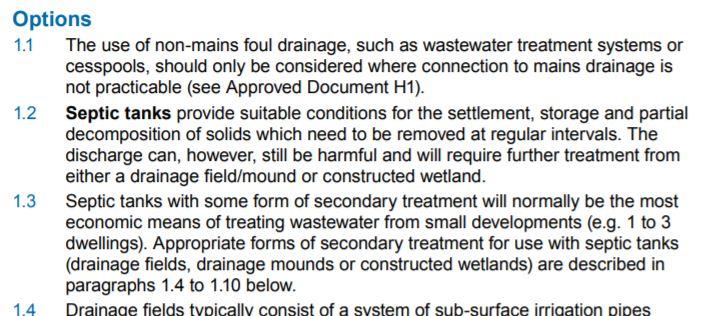
-
Presumably you'd be needing to lower the height of the window cill - how does that work with ICF? Or, do you already have an opening of the correct height so you're simply swopping a full height fixed window for a full height window that will open into the room. Assuming it's the latter then the main gotcha will be the added cost of the glass screen and it's supports. My recommendation for the glass in any balcony would always be two panes of heat soaked toughened glass laminated together. The risk with a single pane of toughened glass is that if it fails you've lost the fall protection.
-
Has anyone incorporated concealed gutters into pitched roofs?
Ian replied to laurenco's topic in Roofing, Tiling & Slating
@laurenco I've done that detail on industrial units but not housing. The main issues are having a gutter lining that is seamless (IE similar construction to a flat roof in solvent welded plastic or rubber) and also it should be designed so that the front lip of the gutter is lower than the back by a decent margin so, if it gets blocked, the water overflow is outwards and it can't come back into the building by backing up under the roof finish. -
Ground that has a very high water table or that is prone to flooding would definitely need the input of an engineer before designing the foundations. Take a look at the power of floating polystyrene on a flooded site in this link of a flooded car park in London: https://www.telegraph.co.uk/news/2016/10/09/cars-crushed-against-the-ceiling-in-underground-car-park-as-floo/
-
@EverHopefull For the last 18 months I've been on Scottish Power's "Powerup" scheme which has a zero standing charge tariff. You have to pay for the electricity in advance and the more you buy the cheaper the unit rate. My usage is 1500 kWh per year and it's definitely cheaper than being on a tariff with a standing charge. It's controlled via an app on my smartphone - the app wasn't brilliant at the beginning but seems much more stable these days and I've been pleased with it so far.


