
Conor
-
Posts
4165 -
Joined
-
Last visited
-
Days Won
12
Everything posted by Conor
-

Show me your inlet/outlet valves
Conor replied to SuperJohnG's topic in Mechanical Ventilation with Heat Recovery (MVHR)
Lindab airy. Fully open position.
-
1. Building regs min flows to rooms is based on an average for the whole floor area, not per room basis. So you don't need 11lps for the living room. Increase the flow rates to other rooms and reduce this rooms rates. 2. Can you straighten the duct runs to the kitchen extract? This will be your highest flow rate run and you need it to be straight and short 3. Bedroom plenums are in the wrong location, esp master. Need to be right in the far corner to generate the right flow paths. With that current design, you won't be refreshing the air at all above the bed. It'll go straight to the ES extract point. 4. I'd always reccomend a bigger unit than needed, but saying that I've had to dial my unit back so much that it wouldn't make any difference if if got the model below, other than saving myself £200. 5. Running the ducts will compromise your overall insulation but probably not enough to worry about. How are you making the boundary between the living space and loft airtight? 6. BC airtightness requirement are a joke. Even the now one here of 5ac/hr is poor. You want a design assumption of 3ac/hr and hope to get 1ac/hr. 7. Don't forget you'll need a condensate trap and drain for the unit. But you're right above a bathroom so 5ha5 should be easy. 8. For runs over 7-10m you'll need to double them up if using 75mm ducting.
-
You can do a concrete slab pour no bother in freezing weather, just need some sort of insulating cover (Hessian, carpet, loose straw etc) while it cures. Curing cement generates heat, if you cover it, it'll stay warm enough to cure properly and not freeze. Sounds like you've insulation underneath which is much better than a pour directly on ground. Oh, you don't want two layers of dpm, or you'll just trap moisture permenantly.
-
Two-block house design - comments please!
Conor replied to beebee's topic in New House & Self Build Design
The two separate (linked) blocks looks great but adds huge amounts of cost and hampers practicality and efficiency What are the constraints of your plot and can you come up with a virtual box of the biggest building foot print you can have? I think the first drawing you posted could be tweaked a bit and be practical and more affordable but still interesting. -
I'd say 6 hours or less if a heated house. Foot traffic 24hrs, working on another 2 days. I'd still put sheets down for ladders, scaffolds etc for a full week after.
-
FYI Virgin and Bank of Ireland (UK) don't require structural warranties. But I think you're right, market should calm down a bit in the new year. Get you BC sign off sorted tho so you can move quickly.
-
You're being BS'd. Don't hand over any money to anybody unless your getting something immediately.
-
Two-block house design - comments please!
Conor replied to beebee's topic in New House & Self Build Design
Agree with all of the above, not a great design in terms of practicality, cost and efficiency. But loads of room on the roof for PV panels!! You could make things substantially better by moving the utility, plant, pantry and play room north of the kitchen / living area and two of the bedrooms to the north of the other ones. This would make each wing more square and the footprint smaller. You'd also need to move the stairs as they are currently jointing two rooms which might be an issues from a BCAR perspective. Or, you could go for a conventional two story and put a lift in. Propably work out cheaper. Get the design over to a sensible headed architect. I recommend Ronan at FMK eco homes. -
You can't. If the builder is going to be using the materials and installing, they should be supplying them zero rated. You can only claim back goods in your name and address. As long as the invoice has the site address on as the delivery, then you're ok. But best using the site address as default with any merchant. You're best setting up cash accounts with the three main local merchants (Haldane, macblair, Murdock) and just emailing them a list of items each time. Best grouping the lists together so you'll get better prices and save on delivery chargers. You'll soon build up a relationship with a sales rep and get the trade prices. You'll soon see you're being quoted 40% less than the list prices.
-
It's much nicer. Our upstairs is a constant 18/19c. If the heating is on it'll rise to 20c before switching off. You just adjust your bedware to suit the temps. Don't miss cool bedrooms in the slightest. Summer douvet all year round 😀
-
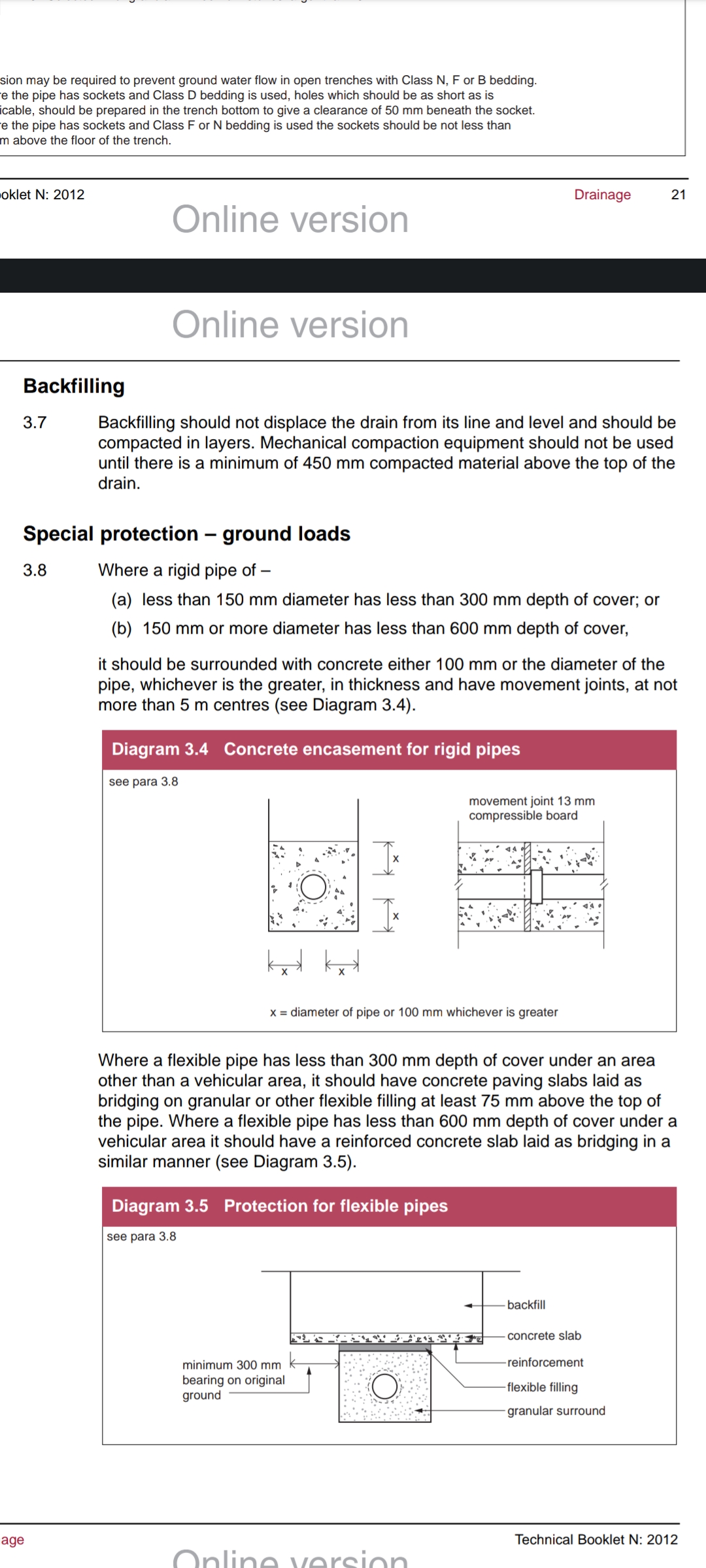
Opposite here. Anything with less than 300mm cover has to be encased. Also standard practice in the water industry for shallow cover pipes of all types. Other than concrete, @pilgrim, make sure the pipe above is well supported and protected from movement.Hence the suggestion of concrete.
-
I'm assuming the garage is unheated? In that case I'd be looking to install an external PVC door... with proper seals. If you can get a fire rated one.
-
You need to dig down, cut off the socket / cement topand fit a rubber coupler like this. Surround in concrete. https://www.drainageonline.co.uk/underground-drainage/drainage-pipe-and-fittings/flexseal-couplings/clay-to-pvc-adaptor-couplings
-
You also need to think about the practicalities of this design. Will you need to access your neighbours side? Erect scaffolding etc? That's important to get all that stuff agreed before you start. Also, do you know the existing wall build up? Will BC allow you to build on top of an existing party wall? How will you insulated it? It would probably be a hell of a lot easier to build a new wall just I side your boundary and suck up the lost 500mm or so. That's what we did, works out much cheaper and faster.
-
Seems like a good way to add £100k+ to your retirement pot.
-
Get yourself an IR thermometer and start pointing it at stuff. Brilliant for figuring out flow temps in different pipes quickly.
-
A few notes, hard to be specific without drawings etc. 1. The MVHR will do nothing to prevent smells entering the house. In fact it'll be worse than currently. You'd need an activated carbon filtration system as well. 2. The 75mm ducts may need to be doubled up for some rooms - say anything over 7m or so. Definitely over 10m. 3. How many stories does your house have? The duct runs take up more space than you think. 4. Each plenum should be at the far corner of each room - have you planned duct runs that take in to account joist direction? Are these routes clear to push a duct through? If not, it will get messy and expensive.
-
What can go wrong with an immersion water heating system?
Conor replied to LeanTwo's topic in Boilers & Hot Water Tanks
Have you checked the thermostat on the actual immersion coil unit? You'll need to isolate it and take off the palstoc cover to access it. -
Second to the painting option above. Is there a drainage system/gravel/membrane behind the new wall? I see gaps in the bottom row of blocks which should do the job. If not, the wall will be permanently damp and whatever you face it with will degrade over time.
-
That'll be reminants of an old warm air heating system.
-
Drying washing with a dehumidifier in a shower room
Conor replied to Ferdinand's topic in General Self Build & DIY Discussion
As our washer drier is too loud to use off peak, I'm currently hanging washing in our unfinished ES. I've a basic dehumidifier running on a plug timer for economy 7. If hung out in evening, everything is dry by the next morning. Think it's using about 1.5kWh, so about half of what the drier would use and it's a double load. I have the dehumidifier set to constant running. -
Bodged as in it was basically a vertical tee that was buried with no chamber. Forced out of circumstances as the manhole the pipe was meant to connect in to was under a 3m tall mound of clay. It's now replaced with another bodge backdrop, but with a proper 90⁰ rest bend and in an accessible chamber.
-
Replacement of Fascias & Soffits - Chrysotile Query
Conor replied to Angelheart's topic in Lofts, Dormers & Loft Conversions
When it comes to asbestos, it's best leaving it in place, as the risk only arises when cut/drilled/ground/smashed etc. Pretty standard practice to fit PVC fascias over existing ones. -
I had this debate with my spark in our build. They were running cables directly against the EPS roof panels and I called him out on it. He was of the view that it was ok, unless they were in a potential over heating situation. I impressed the whole plasticiser migration thing, and he was adamant there was no issue. As it happened, he was going though his NICEIC recertification and his assessor visited the site and was of the same view, not a known issue in their industry. Also, it seems the brittleing of cables is only an issue if they move around and crack... So for hidden cables not an issue anyway.
-
Ok.... The job is done. Really struggled with the rods as the blockage was SOLID and even though it was a 1200mm manhole, was tough getting the rods in. In hindsight a jet would have done a better job. Had to use the rods with no attachment and punch through it. Anyway.. the blockage was at the bodged backdrop as expected... But I pulled out chunks of rock and smashed pipe... I think what happened was a pipe was damaged at some point and not properly cleared out and the debris a cumulated at this one point and caused the blockage. Getting my civils mate back asap to sort out the manhole and do a proper backdrop arrangement. But otherwise a nice day moving 100tonnes of clay 🤣