
joth
-
Posts
2861 -
Joined
-
Last visited
-
Days Won
5
Everything posted by joth
-

Ecodan - adding a zone-specific buffer tank ?
joth replied to joth's topic in Air Source Heat Pumps (ASHP)
Love it. So only 2 ports needed. I'll get figuring out the capacity to get the cycle time up to, what is good, 30mims minimum? I would go massive with it, the only downside is the extra glycol then needed to fill the system. -
Bit more disappointment to throw on the Moralt bombfire this week 1/ The final air-test came back at 0.6ACH. Borderline for Passive house but still bloody excellent for a retrofit like us, but down on the 0.5 we had before 1st fix. The new leaks are the shitty-smelling low profile ground floor shower trap, and the threshold of the damn Moralt door 2/ Final BC sign off is delayed because of... 2 issues with the Moralt door: no auto-closer, and no intumescent strips. Now, the fact it's PH certified airtight _should_ make the intumescent redundant, but UK BC don't know that, our plans called for intumescent strips, and my contractor has misplaced the manufacturer manuals/certs that might have stated otherwise. 3/ A friend pointed out that a lot of house insurance small print require a deadlock from house to garage. The silly lock mech in the Moral door is latch only, absolutely no way to deadlock it. Yeah it's all very liveable/solvable, but having spent so much on this damn door it's sad to be repeatedly so disappointed by it.
-
Ecodan - adding a zone-specific buffer tank ?
joth replied to joth's topic in Air Source Heat Pumps (ASHP)
Yes I think that would be my plan A (as in "My current line of thought is to put a large buffer tank in the loft, next to the FCU." - sorry I see I didn't spell out the exact schematic much) I assume the buffer will give preferential feed-through to the FCU load, thus can get immediate cooling/heating even before the buffer has charged up, but, does mean a 4th pump (and a bunch more control logic - fine, I can do that in Loxone). I'll try and scribble some schematic options -
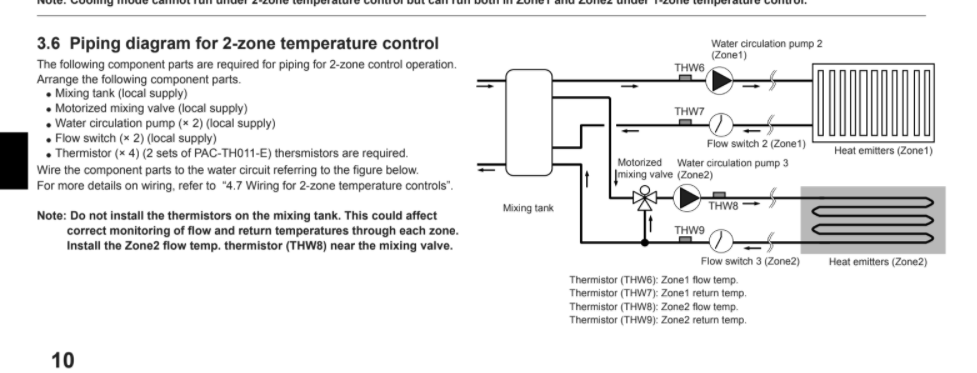
Backstory: I have ecodan 8.5kW with 100m2 UFH on the ground floor, plus a small FCU in the loft "just in case" (thread) The FCU is connected as 'zone 1' per this diagram, with a tiny (10L?) low-loss header: Problem is we're using the FCU far more than anticipated, for cooling upstairs, and it's very inefficient as it causes ASHP short cycling (thread). unfortunately space is tight in the plant room so very difficult to replace the LL header with a bigger (200L) buffer tank. My current line of thought is to put a large buffer tank in the loft, next to the FCU. Downside is this means one more pump (to loop out of the buffer into FCU, as the existing zone 1 pump would just work to fill the buffer). The UFH won't get the benefit of the buffer, but it doesn't need it as it's in 80mm screed slab which acts as its own buffer / heat store. The other option maybe to put the buffer in the loft, and remove (bypass) the low loss header altogether, so in essence the buffer is fed from the primary circulation pump, and the UFH can if needed (e.g. mismatched flow vs primary pump) back-draw from the buffer if needed by pulling water back down the "up" flow path to the loft. This is.... dodgy? but I think plausible?
-
Are stove prices going up or is this a sales trick?
joth replied to Adsibob's topic in Stoves, Fires & Fireplaces
haha my very brief search just led to induction hobs. No idea then! -
It depend on the temperature you're injecting. Heating it maybe "quite hot" but cooling is limited because of water freezing point (and that you need to insulate all the supply ducting to avoid condensation .) I made a thread with the detailed calcs over here but the summary for my use case is about 10Watts of heat/cooling per ºC temp difference at "normal" MVHR flow rates, to realistically if I want say 300W of cooling (enough for 2 humans plus some electronics) and can push in 10ºC air, I need 3x the flow rate.
-
Our Bora had a fault from new, the Bora technician that came out and repaired it said yes they do scratch and recommended the protector matts just like mentioned up thread. https://www.amazon.co.uk/dp/B07C998SP1/ref=cm_sw_r_apan_glt_fabc_NADB3EQYBVVWXVBMH03X
-
Are stove prices going up or is this a sales trick?
joth replied to Adsibob's topic in Stoves, Fires & Fireplaces
(You're talking about glass topped induction hobs right? When I think of "Stoves" I think of https://www.stovesareus.co.uk/stoves.html) Most kitchen appliances have an annual catalogue refresh and price update, in January. Last Oct our supplier said Bora told them prices were increasing in Jan 2021 (so we put down the deposit before then). End of July would be 6 months on so perhaps they do twice-annual pricing. You could ask about deposit now, balance when you're ready for it? -
Fan Coil Units for use with a (cooling) ASHP
joth replied to ProDave's topic in Air Source Heat Pumps (ASHP)
This place has a public price list https://ampair.co.uk/wp-content/uploads/2020/06/AMP-AQUAREA-PRICE-LIST-20-FINAL.pdf (page 31). Good luck actually sourcing one. Learn from my mistakes: 1/ size the FCU(s) appropriately to use the full capacity of your chosen ASHP without causing it to short cycle. I went for a PAW-FC-D15-1 which is way too small for a 8.5kW ecodan. 2/ pay attention to the "water pressure drop" figure. I really have little idea what this is for, but if you intend to have >1 FCU (or add more in future of different sizes) I believe matching them all with same/similar water pressure drop figures will make balancing the system much easier. (Else, perhaps one could use a manifold with salus autobalancing actuators or similar to manage water flow through them, but that's yet more complexity. - again the PAW-FC-D15-1 I have is very low water pressure drop compared to any other, so I would have to bear this in mind if adding more (or, throw out my current one and start over) - aside: why would water pressure drop vary depending on fan speed? Something odd going on in the thermodynamics I don't understand there. 3/ installing a large buffer tank would also help match smaller FCU(s) to a larger ASHP -
It can, if sized appropriately and with a manifold to distribute to them all. ( I got a bespoke manifold from here at a reasonable price: https://www.ductstore.co.uk/acatalog/3_Spigot_Plenum_Box.html) The challenge with this approach is balancing the airflow in the rooms. If they have different degrees of air restriction back to the return plenum of the FCU, the less restricted rooms will "hog" all the air flow and the more sealed off room not get any. An 8mm door undercut is not necessarily enough, and if some rooms like to sleep with door open and others don't, or you want to turn on/off flow to rooms depending on usage or temperature preference, you'll need some way to actively manage the air flow using duct values , air flow monitors, and actuators that quickly add up in cost not to mention time spent tuning it all. (It is of course an problem - countries where "central air [con]" is standard know well how to have a single furnace/heat exchanger and blower drive each room. Tends to be left to the user to adjust the manual outlet vent diffuser per room) For this reason if starting over I'd definitely plan on one FCU per room. They of course could be co-located in a loft void (e.g to simplify the flow and condensate plumbing), which is how I'll go if I do retrofit to this level. They can even share one water circulation pump, just turn on/off or adjust speed of each FCU individually to control flow and hence temp of the associated room.
-
Fan Coil Units for use with a (cooling) ASHP
joth replied to ProDave's topic in Air Source Heat Pumps (ASHP)
Yeah for aliexpress orders I've always added up the price, lifetime I'd "like" to get out of the thing, the hassle of completely replacing it or repairing if it dies, availability of UK based parts or replacement, and how much loss of function it will cause if it does fail. Most my AliExpress orders were for solid state relays, low voltage lighting drivers (feature lighting: easy to live without if it fails, and central cabinet installed makes it easy to replace), motion sensors (I thought easy to live without, but I admit would be very annoying if the did all go, but each one is easy enough to replace on its own anyway). Probably the most critical item is the DMX amplifier / splitter. For a wall-integrated tap / mixing valve, or for a FCU (esp one that is "burried" in a ceiling void) it's not very promising. Mostly the hassle of trying to get to it to repair/replace is going to be high Also note that cheap mixer taps like that (we got a similar deck-mounted one) don't have integrated TMV so the hot temp varies a bit unpredictably depending if the sun has been out (PV redirect was on). You can add central TMV to limit highest temp, but that is annoying for running a bath and can limit overall flow/pressure. I guess having a central manifold would restricted temperature DHW to some taps, but unlimited to others where it makes sense (bath, shower, etc) -
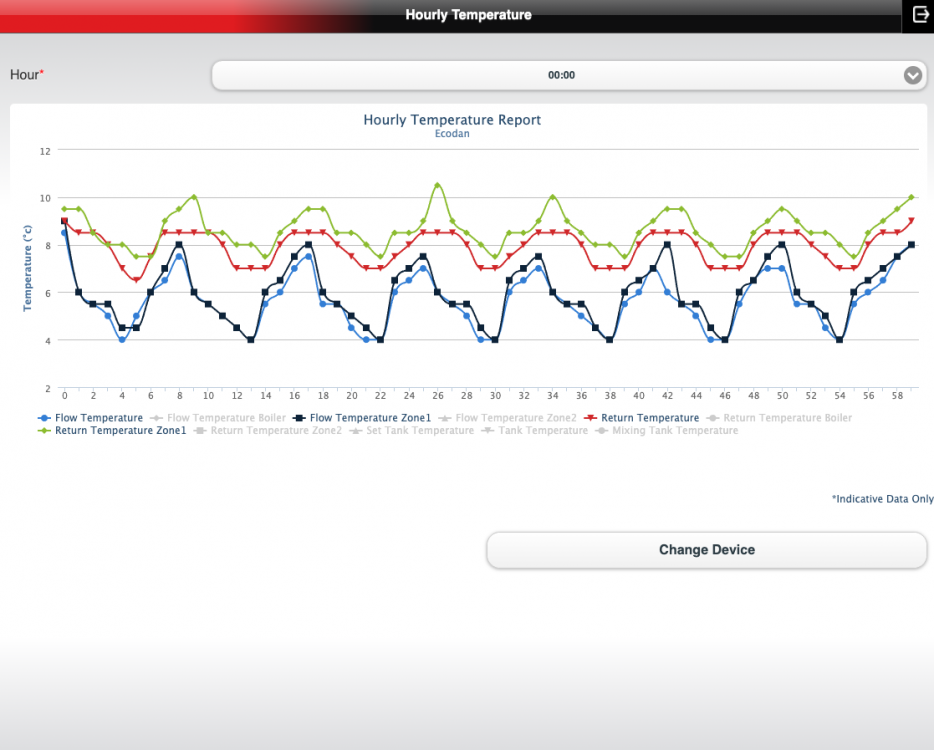
FWIW I have a similar issue with zone 1 (fancoil) in cooling mode not transferring enough cooling energy and hence the ecodan (8.5kW R32 model) is short cycling. I have to say, I hadn't realized the Melcloud UI allowed useful hourly charts (I'd been scrapping it via Home assistant into Grafana) but similar to you I see 8-10min temperature cycling. This is what people would call short cycling, right?
-
OK so it doesn't work for N=1 sample size, but that could just as easily be they didn't design it to have sufficient airflow. I would not use this as a replacement for MVHR, providing heating / cooling vs providing fresh air, seem to me best done by two different systems. MVHR is not a solution for overheating. ASHP+Fancoil is not a solution for supplying fresh air.
-
Benefits of a basement for plumbing/heating simplicity
joth replied to puntloos's topic in General Plumbing
This is immaterial to the decision to build a basement, surely? If they will put it there, great, but if won't put the meter there, fine, they'll put it somewhere else, and then you run a thick length of SWA from the meter into the consumer unit etc which can still be wherever you want it to be. -
Can you confirm it has 3 pumps (primary, and one per zone)? Or 2, sharing a single secondary pump between the zones using a 3 position valve? My installer tried to do it this way initially, but I insisted on a pump per zone as this just seemed a better idea. I can see various failure modes where a single pump would fail to balance between the 2 zones it was expected to drive.
-
Rainwater harvesting tank
joth replied to Happy Valley's topic in General Self Build & DIY Discussion
Don't forget to factor in the cost of carting away the displaced earth, that was the largest component in our quote Plumbing is more complex, especially to keep within WRAS rules, but ongoing maintenance is what adds up more as you have various filters to clean/ change and invariably some matter gets into toilet cisterns that needs cleaning out from time to time. (our plumber only had bad things to say about the overhead this adds) Obviously if just using it outdoors, for garden & car/bike cleaning it's much simpler on both fronts. -
Simultaneous heating and cooling is very common in commercial buildings. My office is only a couple years old and has no ceiling tiles so very easy to see the M&E and get an idea how it all works. 4 pipe system circulates hot and cold to all rooms simultaneously and each fancoil can choice which to use. A central heat pump can move energy between the loops so literally pumping heat from the overheating areas to the places that need it more. Topping up from district heating in winter, or dumping excess to the roof air exchangers in summer. 4 pipe systems generally circulate refrigerant rather than water, I have no idea how the buffering works. In a domestic home I can see it being useful in a tall house with numerous floors, to pump excess heat accumulating in the roof back down into the UFH. More of an issue the more you keep internal doors closed. Getting cats has greatly changed our own patterns of use and impacts the idea M&E system design more than I imagined!
-
Fan Coil Units for use with a (cooling) ASHP
joth replied to ProDave's topic in Air Source Heat Pumps (ASHP)
This is what the Esbe ARA662 actuator mixing valve I mentioned is for. If Z2 (UFH) only is on, the ASHP pushes out 15C water, but if Z1 and Z2 are on it pushes out 5C to send to the fancoil, and the mixing valve closes back enough such that 15C remains circulating in the UFH (The controller is really graceful - it completely closes the mixing valve off first then changes the primary flow temperature, then slowly opens the mixing valve until correct temp is reached, so as not to shock the system with under/over temp flow ) -
Fan Coil Units for use with a (cooling) ASHP
joth replied to ProDave's topic in Air Source Heat Pumps (ASHP)
The mixing valve it the one the Welshman recommended on here a while back: Esbe ARA662 actuator 230v 50hz 120 sec https://www.wolseley.co.uk/product/esbe-ara662-actuator--230v-50hz-120-sec-(1)/ The Mitsubishi FTC6 controls it all, with thermistors on all the flow and return pipes plus in the uvc and buffer tank. You just set a desired flow temp per zone and it does the right thing when the zone calls for heat. -
Fan Coil Units for use with a (cooling) ASHP
joth replied to ProDave's topic in Air Source Heat Pumps (ASHP)
I would assume so, how as would you do it? That's what our setup will look like; approx 17C for UFH and 7C for Comfopost is what we had panned. @joth Are these temperatures fixed in your setup or can you adjust them, based on for example the relative humidy? I Yes this is ecodan with a small low loss header tank and electronic mixing valve, so I can freely run any temp on each zone down to 5°C In retrospect I larger (100L+) buffer tank would have been worth it, as I'm using the fan coil cooling more than expected (see other thread on bedroom overheating) but it's only rated about 1kW cooling so the ashp short cycles a bit driving it alone without the UFH cooling load. Also the buffer could have been cooled during solar generation time and then discharged overnight. Maybe I'll do that another time. The ecodan cloud API does allow for setting the flow temps so could do this automatically if I wanted I guess. I'm currently looking to use the API to configure heat vs cooling mode as needed. -
Fan Coil Units for use with a (cooling) ASHP
joth replied to ProDave's topic in Air Source Heat Pumps (ASHP)
I'm using 15°C in the UFH and 8°C in the fancoil -
A simpler option is to have a new small unvented cylinder heated from the ASHP and take the UVC input from the TS. So if the TS is hot (stove or solar active) the ASHP won't have to work, but if they're not it does. (i.e. same idea as the on demand electric heater but ASHP friendly). It's still a lot of systems to maintain, but you _may_ be able to get the MCS installer to do this (basically tell the to take the UVC "cold in" feed from the TS and otherwise it looks like a bog standard install) is the gargantuan TS specified to enable multi-day storage e.g. to cover less sunny days, or because the daily demand is very high (running a guest house)? And what is the peak demand (5 showers running at once?). This sort of thing is probably influences the choices a lot.
-
Just a thought - you might get some more responses if you make a straw-man proposal or ask a more specific design question. You mention the goal of adapting the heating system to use an ASHP. Is that space-heating only, or DHW too? My initial thought would be to split the UFH from the legacy system and drive that exclusively from the ASHP. If the heating demand is low, that (plus the heat loss from the TS, assuming it's in the thermal envelope) maybe sufficient space heating for day to day. MVHR post heaters and towel rads could get the same treatment, depending how much they're actually doing / needed. Heating a one tonne TS from an ASHP sounds a miserable task. If the solar thermal doesn't heat it enough in winter and the stove rarely used, adding an on-demand electric boiler to the output of it would allow it to ride through the darkest months and still have the use of those parts for DHW when the stove or sun is available.
-
My understanding this is far more about flood prevention at large, than solving a specific hot spot at the end of your driveway in particular. See https://www.building.co.uk/comment/suds-law-sustainable-drainage-systems/5038190.article - As more land is paved over, more water ends up in the city drains and running out via large rivers creating flood risks along them, rather than getting into the ground locally and thus into the aquifer that feed smaller streams and sustaining the wildlife there. The SuDs laws are intended to have more water go into local soak away, and less down the LPA drains. No individual building application will make or break it, but at large they need to be enforcing the spirit of it in order to achieve a net reduction (or at least, no increase) in water heading out to LPA drains. If you richer in time than cash, one idea would be to submit a schedule with the acco at the top of the drive only, see if they approve that, if not resubmit it half way down, and then a couple feet from the bottom. They may get the idea and open a conversation about what they would consider acceptable . The major cost of doing it lower down is you'll need to dig your own soakaway much much lower under your plot in order to allow the run off to flow back under the drive into it.
-
Worst shortages and how to plan around them (Jul 2021)
joth replied to puntloos's topic in Costing & Estimating
I honestly think if you can get through the entire rest of the build and have to hold out a couple months using a temporary £50 oven before the perfect one gets back in stock, you'll be delighted (Also, in a multi year project, storing an oven or american fridge and not having it get bashed up is a challenge, and you may even find it's obsolete or been superseded by the time installed) What I did when about 4 months out from kitchen fitting was phone applianceworldonline.com and negotiated a package deal for the whole lot. They gathered them in stock over a few months, then kept them in their warehouse until the nominated day I needed them. They're going to charge a fee to hold them for 24 months though.