joth
-
Posts
2861 -
Joined
-
Last visited
-
Days Won
5
Everything posted by joth
-
No, gigabit ethernet definitely requires all 4 pairs to be correctly wired through. See the T4 section of the page you linked, or various other pages discuss it too. E.g https://www.practicalnetworking.net/stand-alone/ethernet-wiring/#:~:text=The first major difference is,when building a Crossover cable. https://en.m.wikipedia.org/wiki/Ethernet_over_twisted_pair Or from 20 years ago: https://arstechnica.com/civis/viewtopic.php?t=690470
-
Can you say which pairs were bad, and what sort of badness they had? Remember with T568B the pairs are not in order of the pins in the RJ45, which is what the tester will be reporting. So for example if green pair are reversed, you'll see the tester sing out an order of "1 2 6 4 5 3 7 8" because green are on pins 3 and 6. It would be easy to see this as 2 bad pairs, but it's only one. All that said.... doesn't explain your original issue with orange swapped. To confirm, the photo from the back of the patch panel is actually from the port with the issue? It's possibly not all ports were done the same if an error slipped in.
-
 Doesn't address the OP issue that after a (regular, planned) power cut you somehow need to lock out the ASHP from operating for 12 hours or risk excessive wear on the compression.
 -
Obv you'll be getting some heat from electrical devices, solar gains, cooking, humans trotting around the building etc which as a fixed source becomes more and more significant the more you reduce the overall demand. It'll be interesting to see if the % error vs spreadsheet reduces in the very coldest part of winter. Excellent work on the projects! The DHW reductions are startling
-
How old is the house? Is it possible there used to be some kinda boiler or other combustion heating in their at one time?
-
So how did you get into the RS485 connector on the battery? It seems to be placed in the most inconvenient place with no way to access the screw terminals, and afaict no labeling as to which terminal is G B or A. Context is, everything was going swimmingly until 5:30am yesterday morning when the battery just inexplicably stopped doing anything. It sits there claiming to be charging with 1-3W of input rate (LOL) but in actual fact seems to be very slowly discharging itself. All excess solar is going to the grid, it's not meeting internal demand, and changing ride the MSC profile to be prioritize charge or discharge does nothing. I did a couple battery diagnostic checks in SetApp and it failed both. One time Comms worked but charge/discharge didn't, second time Comms failed too. Removing and re-adding the battery the inverter was no help. Solar Edge have opened a support ticket but claim they can't debug anymore due to my slow internet connection (complete BS). I noticed the installer did not exactly follow the MIs for modbus, B and A terminals are supposed to be in a single twisted pair (SE suggest using Blue, Blue/white) but instead the installer doubled up 3 pairs for it. (Exactly same error as my MVHR installer made, again modbus) I don't *think* this could be the cause of the comms error as it worked fine for a month and nothing has changed, but does seem the obvious place to start diagnostics. I'm going to attempt to drag them back in on Monday anyway. Very frustrating to suddenly be paying full price for all my juice again!
-
anyone had good results fitting a "learning" thermostat like Nest to reduce costs? With opentherm + UFH it is supposed to be quite good (says the marketing) https://support.google.com/googlenest/answer/9250165#zippy=%2Clearn-about-radiators-and-radiant-heating%2Chow-true-radiant-works%2Ctrue-radiant-settings-and-opentherm-enabled-boilers
-
But this is gas which is a bit more tricky than using electrical energy where energy delivered through the meter "must" be being used to do some sort of work somewhere. For example, but you could be just venting un-burnt gas straight out the building via a leak somewhere, without it ever becoming heat energy. Or more likely (per @markocosic analysis), short cycling and poor condensing meaning a bunch of unused heat energy is going out the flue.
-
Yes. One thing to keep in mind is any mixer taps / shower TMVs should have their cold feed come off the same pressure reducing valve ("cold water control group" or multibloc valve) that feeds into the UVC. But aside from the kitchen main they probably already all feed off the old large cold water tank in the loft anyway, so should be easy to reroute these from your UVC if that's going to be in the loft.
-
Got a feeling it was this one? https://www.granddesignsmagazine.com/grand-designs-houses/thatched-cottage-new-forest/ At least, that house was rebuilt after a chimney fire so they made a big deal about the robustness of the new chimney. But I thing there may have been another episode with similar idea.
-
LOL, yes I guess I do. 12V is dedicated to the alarm system. That's class 2 and professionally managed so completely out of bounds to my own tinkering. 24V is for home automation and LV lighting, all speced and installed by myself. 48V is active PoE is on an as-needed basis, but of them all can most easily be added to any room where it isn't already by just swapping a patch cable or perhaps terminating a spare (hidden) CAT6 drop into an RJ45. I wouldn't distribute 5V to rooms as (a) those loads tend to be quite high (e.g. phone/laptop charging) so the power line losses far too high, (b) increasingly (especially from 2024) any respectable USB charging is USB-C so multi-voltage, and (c) it's now fairly easy to put a USB outlet on the end of a PoE cable. I would expect multivoltage PoE to USB-C adapters to become available soon. TBH the main use I've had for this so far is putting LV outlets into the bathroom where mains is not permitted (i.e. my equal parts loved yet maligned PoE powered toothbrush charger) I've found active PoE to be reliable and compatible, no issues at all. I mostly keep to Unifi gear, except for IP cameras which are mostly dahua. If I was doing it again, I'd probably do exactly the same TBH. So for me personally, yes this is my best solution. I bit more systematic about where I put CAT6 (and spare CAT6) drops wouldn't hurt. Questionable whether I'd do the professional installed alarm, but that's OT for this conversation. I'd put more effort into selecting and matching centrally located drivers for the constant current fixtures; I ended up with more than I would like hung from 240V AC driven drivers located next to the fixture, which don't perform anywhere near as well as the direct DMX to 24V dimmers do. But again this is borderline OT for this conversation. I'd not make any more infrastructure for adhoc LV consumer electrics. It'd be nice if someone made aesthetically pleasing PoE to RJ45 + USB-C face-plates. Tplink do ones with integrated Wifi AP which is nice, but just needs the USB outlet to be perfect. (I'd seriously consider TP-link for everything if doing it again).
-
LED strips are CV, the other things are all CC. EItherway, the luminaires all connect directly to the (unswitched) +24V supply but the negative terminal returns back via a dimmer (in the central-cabinet next to the PS). The dimmers all apply the PWM on the negative supply (so "common anode" right?). Mostly DMX driven LED drivers e.g. CV: https://www.aliexpress.us/item/32824271209.html CC: https://www.aliexpress.us/item/4000473275297.html
-
Lights switches and motion sensors are hooked up via CAT6A. This runs loxone Tree protocol on one pair, 24V on another, and misc uses on the remaining 4 cores (mostly used as binary trigger contacts). Radial to each room then point-to-point within the room. This is from the very efficient stable 24V supply that powers the Loxone server (with fuse protection per run). I mostly use 5-core 1.5mm2 for the LED strips, +24V on one core and RGBW for the other 4. The core thickness is overkill but I had a lot of it on hand and ensures I don't get any voltage drop. This also driven centrally, but from a meaty (and very noisy) 600W PSU that just gets fired up after dark, when any of the LED fixtures has a need for power. It also drives some other constant-current dimmable fixtures. The idea is either the above could be replaced by 2x AGM batteries, perhaps directly charged via PV too, but I've never prioritized making that kind of change. I didn't do either the above because I was trying to future proof by pre-installing LV infrastrucutre for unknown future use cases, this was just installed out of necessity to serve the need of things I had already designed into the build. (Much the same as the 12V distro to each room for burglar alarm sensors, I should add). PoE where needed comes via a central patch panel and off a single Unifi 48 port switch. This is the only element of "future proofing" - every room has a few RJ45 outlets (and some spare cables hidden behind faceplates too) and I can quite easily power new things from that where needed.
-
I have 24V delivered in a few places in every room for the light switches and motion sensors, plus a few other things hang off that bus (inc the catflap!). Home automation gear is pretty much standardised on 24V. Also I'm using 24V LED strips, but these are almost all radially routed rather than off any sort of bus. For everything else I rely on PoE (or a wall wart, as the obvious backstop)
-
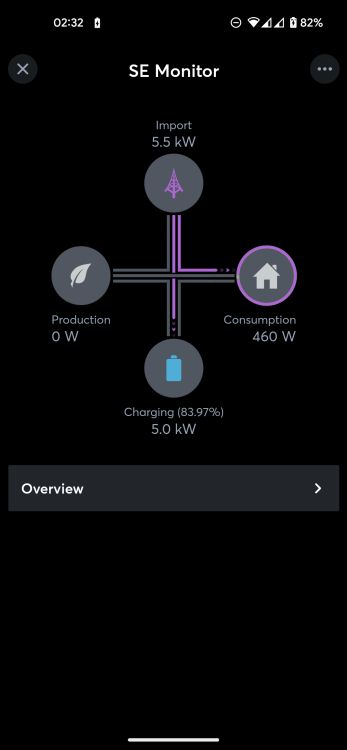
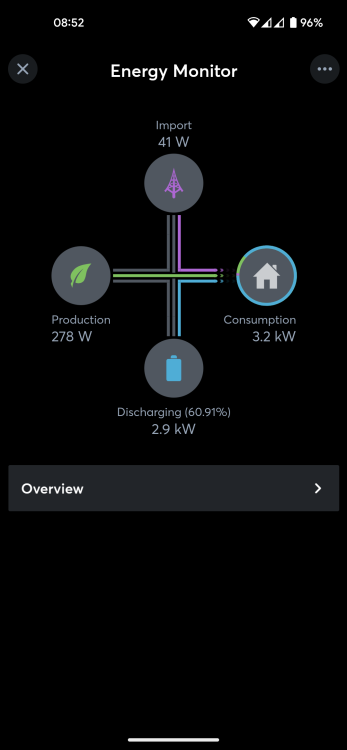
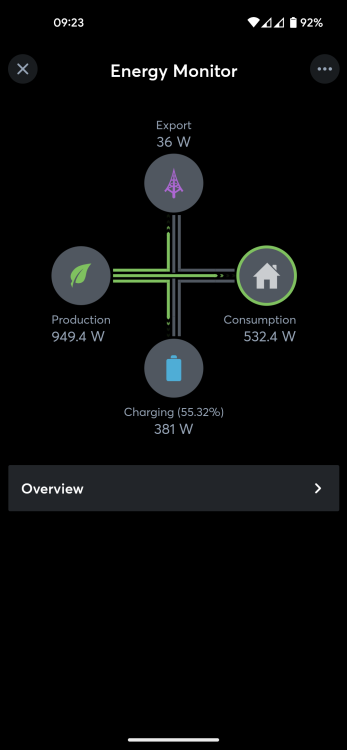
This was super helpful. I also found the solaredge example on Loxone knowledge base which was slightly helpful (the author unfortunately did not understand basic additive mathematics), and some pointers on the Loxone discussion group, and I got the full monitoring/reporting integration working! Direct Loxone to inverter over TCP, not external servers or cloud involved. It'd be fun to do charge control from Loxone too, but first I need to try and address the glitchiness of the scale factors changing (polling them races against the value being scaled), and also figure out what units the accumulated energy meter is in, it claims watt hours, but looks more like joules to me! Images show overnight cheap rate charging from grid, discharging this morning, then charging from PV.
-
Do you want the run from the kitchen to kink at the main stack? It looks like you could make that a straight run with a little movement of the left inspection chamber . Shouldn't the upstairs run from the ensuite connect to the toilet? It feels challenging to run that diagonally even through pozi.joists, it maybe simpler to have it go due left and put the main stack in the top left corner of the bathroom, behind the bath Just misc thoughts, I'm no kinda expert.
-
I'm afraid it's unlikely even CEO intervention will fix this, as you have the right to shop around for export contracts, there's no way for them to know retrospectively whether you spent the last year being paid by some other provider. Plus there's a bundle of paperwork to provide before they would start payments. It's pretty atrocious they didn't provide an initial bill for a year despite your chasing though
-
The ones I had free choice on are. The schluter ones with the electric UFH mats are analogue thermistors that I reverse engineered a resistance curve for. The heatpump and light switches are some digital interface that I have a higher level API to.
-
Yeah I have a few in floor screed, the ones that came with electric UFH mats, one on each shower head / bath mixer, one in each room for air temperature (actually built into the light switch), outside temperature, UVC tank temperature, some on the heatpump flow/return. Probably a few more I don't recall right now haha
-
Oral-B toothbrush with USB charger, plugged into the Unifi PoE USB adaptor https://store.ui.com/products/instant-802-3af-to-usb-adaptor Anything below 12V is not covered by building regs , but PoE can be 48V so technically might be covered but I'd be surprised if anyone cared in practice I used CAT6A everywhere. Slightly thicker cores means less line power loss. But as Peter says even CAT5E would have worked fine.
-
"Between 1 and 3 ACH". What does that even mean? So they guarantee it's no worse than 3? Why bother mentioning ab upper limit of 1? What happens if they exceed that, they come around and poke a few holes in the walls to bring it back within tolerances?
-
Ironically right now I'm selling my PV to the grid for twice what I buy it for overnight (15p Vs 7.5p) so it's better value for me to export as much as I can during the day and buy it back overnight to run the ASHP. This calculus will obviously vary as the tariffs change in future. I technically could make profit by discharging and refilling the battery each night too. 75p for an entire fill of the 10kWh battery probably not worth it for the degradation on the battery. (And definitely not from a needless configuration hassle point of view)
-
If you run the ASHP from octopus Go overnight, it's 7.5p/kWh primary energy so 2.5p/kWh of delivered heat. Giving: Winner: ASHP 75% lower cost than oil. (This only works on a highly efficient well insulated build where you can fully satisfy heating demand in 4hours of overnight usage, or with a very large house battery)
-
Exactly how long a blackout are you expecting? Our house is fine with the heating turned off for 20hours each day, and that was a retrofit. On a new build you should be able to last even longer. If that worries purchase a 3kW backup generator to power the heatpump, this will be cheaper to operate (thanks to the 300% cop of a heatpump) and also allow to run other home comforts like fridge/freezer during the event of an apocalypse
-
The Loxone server (in our house, not in the cloud) knows the time of year, the indoor and outdoor temperature, the forecast max temperature for the next 24 and 48 hours, and how much active heating and cooling has been used in the last day. I wrap these up in some logic to create a estimate of the risk of house overheating and if that's too high I don't turn on the towel rads (or ensuite UFH) The trigger to turn on is from a temperature sensor on the shower (or bath) detecting it's in use. That triggers the shower niche lighting to turn up a bit too