


joth
-
Posts
2919 -
Joined
-
Last visited
-
Days Won
5
Everything posted by joth
-
I didn't know / think of requesting "as much export as allowed". Our G99 was completed by the solar supplier and they've just approved the exact system designed (8kW) and not 1W more. The real pain is the approval is only valid for 90days, the lead time on manufacturing and supplying the exact dimension panels is longer than that! And we're months away from being able to measure up to place the order. Hence my now looking into 3phase as a less bureaucratic plan B. @JSHarris do you now have a battery storage or still in the planning stages? Is it AC or DC coupled? (To the existing invertor?) It's interesting it needs to be figured into the total export allowance. That's another good future proofing reason to go with 3ph. I'm actually wondering if a future 3ph battery storage could be used to optimize phases. Charge from or feed into each phase independently to minimize thr export on each one, via a shared DC battery store, dynamically rebalancing them. In lieu of that, ASHP, plant room (immersion element(s), washing machine), and perhaps the ovens and induction hob, would be candidates to shift to different phases. Ideally the ASHP could be 3ph but we only need 7kW so totally overkill.
-
So if fitting 3-phase inverter (and possibly batteries in future), presumably then the goal is to always split demand as evenly as possible across phases? For summer cooling, this could almost become a reason to use a 3ph ASHP on its own. I was hoping the balance of phases would be summed prior to metering, as stated here https://www.solarquotes.com.au/blog/3-phase-solar-what-you-need-to-know-about-connecting-solar-to-your-3-phase-supply/ (that's in Australia, but it was the only reference I could find) Hmmm.
-

Cost of installing 3 phase vs moving existing mains head?
joth replied to joth's topic in Electrics - Other
Answering my own question! First. it turns out the cost estimate (with on site survey) was much faster than a G99 request. MUCH faster. Like, 3 days vs 12 weeks. Costs for moving existing vs new : a) moving existing single phase supply by 4 meters: aprx £1100 b) installing a new 3ph supply from the street (17m) and disconnecting the the old: £3900 Most of the costs in (b) is the fact they're digging up public carriageway (pavement only) so need permits, H&S, road signing, 3 crews, etc. Other interestingly tidbits: - we actually have a substation immediately on the boundary behind our house. The surveyor's plans didn't show how it was connected to the main supply out front so he ignored that for costing - the existing mains head could be moved to an "indoor" location because it's already indoors, and it's a renovation. For a rebuild, or for a brand new supply, the "new rules" kick in and the head+meter need to be outside the house. I now have to decide if the future proofing benefits of a 3ph supply justify that hefty upfront cost. (It also de-risks some other parts of the build, namely moving supplies around inside and solar connection, but the cost is too high for derisking alone). The fact we're going all-electric house does push us in favour of doing this. And enabling a 22kW car charger could be useful option in the future too. -
Try this thread There's a few others on specific makes in the ASHP topic too https://forum.buildhub.org.uk/forum/119-air-source-heat-pumps-ashp/
-
It'll always be possible to charge from a single phase, it'll just never be as fast. If you only make one car trip per day or want to charge from self generated solar the option of a faster charge is probably not much interest anyway. The cost of upgrading a new install to it could be negligible, or could be considerable depending whether the nearest supply cable is 3 phase or not.
-
Out of interest, how long did it take for them to make that quote? And did you consider requesting a 3-phase quotation too? I've just requested a quote for one, it'd be interesting to know how pricing for it compares. with domestic 3-phase car chargers available, having a 3-ph supply could become increasingly useful.
-
Regarding power-switching, I'm keen to get all the mains level control onto DIN rails and into closed cabinets. I think this is why, after searching all the more modern open source alternatives, I'm defaulting to using Loxone for most of my core systems controls (lighting + heating, and probably shading too purely because Internorm+Loxone have a tie in) as it's all packaged in convenient DIN form. I first came across SSR in their (5 year old) article on making a DIY solar diverter, and showed a DIN rail mountable SSR so that all seemed logical: put it in the same CU box as the miniserver (or extension) and it can all be neatly locked away together. More I read and look at this though, the more I realize the logic for immersion heater as redirect is to always use it as the final / lowest priority device in the chain, as it can be modulated to "use up the gaps" that can't be allocated to the fixed quantum demanded by other appliances. Thus... any "off the shelf" Solar PV that just always left on auto mode will probably offer no less functionally than having direct control of it from HA - so long as I can factor its live usage into any calcs about other devices to turn on/off based on current generation. Regardless which way I go, this also made me realize while we'll have a dual immersion tank, only one of them needs the PWM modulation. The other I can just power through a mechanical relay (contactor) when we have >3kW of excess generation (and/or fire up the ASHP if the controls for that are compliant enough for it), and the automatic modulated solar redirect (whatever solution chosen) will use up any slack still available on top of that.
-
@TerryE when you say HA do you mean home automation in the generic sense, or Home Assistant specifically? (It makes sense either way, just curious what stacks folks have settled on)
-
@Nickfromwales true enough, the improvement is a diffuser that helps retain the stratification even after drawing some water off, and some sensors to measure what the hot water "fill" level is. I too will be keen to get the price, vs comparably insulated and speced Newark UVC.
-
Still getting quotes - should know in a couple weeks
-
Great I didn't know about the 1Wh meter slack, but figured there must be something like that. We're on a smart meter so I'll have to experiment to see if I can see where it switches over. At 3kW that's a about 1s grace, so half second sampling sounds minimum. I was looking at this project that suggests the proportional SSR, which presumably just offloads the need to keep up with driving PWM while in a steady state. Still need to sample at about the same frequency to detect household load or generation changes. I like that it is din rail mounted so could all be installed by my electrician and all I have to deal with is sending the low voltage signal into it to set the target heating level. Anyway, I'm going way off topic here! Thanks both for the excellent pointers, as ever.
-
This is nice analysis, and got me thinking about the equivalent issues on the mixergy tank we're planning to use. (Posted over on the Mixergy topic) I'm curious though that with your focus on avoiding serialised failure modes, you have an HA + mqtt setup you are confident enough for this. That means IP network needs to be operational to get heating on? I've seen too many cascading failures with IP networks to trust myself to run a mission critical one in my own home. My own policy is lighting and heating must work without any IP. Do you have a write up of your HA setup somewhere? Always interested to see how others have partitioned things. One other question: is this SSR relay controlling the immersion? With your proposed ESP32 controller would you modulate it at all, to maximize free excess from PV, or just binary switch it on/off? I'm contemplating making my own PV redirect using solid state contactor with 0-10v input, but again interested in what others have done. Thanks!
-
We're going with a mixergy tank, in part because plan A was sunamp but it's just looking to finicky (and, not convenient to use with a heat pump) The current discussion on failure mode analysis and designing for line-replacement of parts has me wondering about the overcomplications of Mixergy, I don't think it's too bad because - we're not planning to use it to predict usage day by day, just to allow us to have effectively 200L of hot water tank but expands to 300L when there's free energy coming off the PV - the fanciest bits of the internet connection are for the predicting the future parts. Without that I think we'll get fair use from it primarily through local schedule control. - if the fancy controller or cloud service eventually breaks, it just becomes a normal tank, not a dead lump of salt. The only thing that does concern me is the heat plate exchanger and circulation pump assembly they use for getting most effeciency from a low temp heat pump. I have not idea how tightly the speed control for that is coupled into the rest of the controller circuit. Obviously it already had double immersion as the primary backup, but maybe it would be prudent to order with an internal coil too so we have that as a backup (I have half a mind we could warm the ufh from that, if it became necessary to use it as an E7 time-shift store).
-
Exterior CCTV camera advice needed
joth replied to H F's topic in Networks, AV, Security & Automation
Do you expect to do other work at height in future? Investing in a small portable scaffold tower would have long term use and is far more pleasant to work from than hanging off a ladder you can't quite get to the place where you want it. -
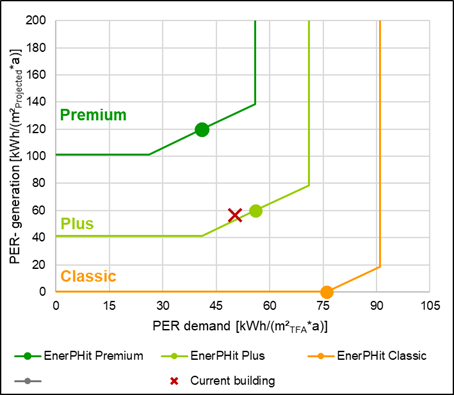
Just got the first draft of our completed pre-construction PHPP and I did a little happy dance on opening the PER tab: What this says is our 8kW of self-generation (vertical axis normalized to ground floor footprint) is enough to offset our energy demand (horizontal axis, normalized to total inhabitable floor area) and achieve their new-ish "PH Plus" category. So far there's only one in the UK that has achieved this (that I know of) so exciting times ahead! (if all rather arbitrary I'll admit, sure). Anyone else gone through PHPP and got PER charts for comparison?
-
There is a small market in reselling devices with Tasmota pre-installed. e.g. https://amazon.co.uk/s?k=Tasmota (similar to modems with Tomato firmware) not sure what the markup is on those, and AFAICT AliExpress isn't doing it yet. Other possible downsides with this approach - assuming you can fettle it to reliable state, I guess one thing is you need to have a means revert the house to "normal" switches if planning to resell the house anytime soon. Also.... if you're building the house yourself it's probably fine, but if working with architect or full services contractor to build you'll be forever trying to explain and re-explain the requirements for these systems (vs saying "just put some lights in please") ?
-
Ah this is good to have confirmed. I have heard reports it works very well, and good price, but was hesitant to recommend without having used it myself as I used to recommend the BT home hub and look where that got us! And wasn't sure about the possibility they'd use it to encourage lock in later... (Fwiw my brother had the Sky equivalent to this and rated it highly for years, but the whole lot went TU over Christmas and now he's a ubiquity convert too) (Oh to add the sky one has benefit each set top box doubles up as a WiFi repeater, but again that just means more lock in)
-
No problem, feel free to shout if you have questions. I could make a diagram but I'm sure there's already some good ones out there.
-
This does make me wonder: do any units have filter access from below? Positioning it with its own loft access hatch directly underneath it would be pretty convenient in our install: just stand on steps, open a ceiling hatch and reach up to access the filters.
-
Oh that reminds me: did you recently add any new devices to the network? My mum has a BT WiFi hub and it generally crashes and won't allow new connections whenever I have used my MacBook on it a while.
-
My own advice is to organise your WiFi completely separately from the broadband router provided by your ISP. This way there's much less friction to shopping around when your contract does come up for renewal. Ubiquity are considered the king of WiFi APs for home use, but Google WiFi is also pretty good and much easier to setup. (I've used both) Nice thing with both these is if you do get coverage black spots you can just add more APs to fill them in. The mesh roaming is pretty good. Just make sure to use your CAT cabling to with all the APs back to a central ethernet switch (they can use wireless for the back haul, but it's never as good)
-
oh yes, thank you for this. Yes that's the distinction - this one does say the installation needs to comply with the MCS planning standards, not that it needs to have been done by an MCS certified installer. The standard mostly seem to be measuring and documenting the compliance with noise limits.
-
Be aware that an MCS installation is (now?) a requirement of installing heat pumps under permitted development rights https://www.planningportal.co.uk/info/200130/common_projects/27/heat_pumps/2 If you already have an ASHP on your PP then nothing to see here.
-
Never was a member's username more appropriate
-
Uninhabitable Earth was the first book in the recently formed Climate Change reading group at work, others since then are Drawdown and Sustainable Energy - Without the Hot Air. (I'm behind on them all, but trying to follow the group notes)

