


TerryE
-
Posts
3826 -
Joined
-
Last visited
-
Days Won
30
Everything posted by TerryE
-
John, if you aren't having a UVC then you'd probably want a TS. If you are driving your buffer tank to 40°C then as far as I can see there are too possible scenarios for using it: Passing the cold feed into the UVC though a heat exchanger driver by the buffer tank. In this scenario if the buffer tank is charged then the cold fill will be at 35+°C rather than 10°C say, and so if you are running your hot tank normally at 50°C, say, then you will only need to heat the water 15° rather than 40°. Using the buffer tank to preheat the UVC with a bottom coil if fitted, but this will only be useful if the tank around the coil is already below 35°C, say. But this would heat the entire tank in this scenario. I am planning to use a SunStack, so only the first option is available for me. The issue that have with this is that I am only looking at 90 or so heating days a year and the bookend 30 days or so are pretty marginal. So for ¾ of the year, I won't be using the buffer tank unless I keep it charged just for priming the H/W and if I do then I've got all of the heat waste associated with keeping the buffer tank hot all of the time just in case I want to run some hot water. When I do the sums I doubt whether I will get the payback to justify the complexity. The problem that I have is that I haven't got the data to optimise our system, and I don't want to over-engineer it unnecessarily. After having talked the pros and cons through with Jan, what we hare planning to do is to have as simple an electric only system for the first year with a double SunAmp and no buffer tank. I'll use a simple electric heater for the slab and an inline boost for the SunAmp -- and instrument it properly to work our true usage patterns, demands temperatures, etc. I estimate something like 90% of my draw will be on the E7 reduced tariff. Once I have a full years data, I will then be able to design an optimised system and work out the expected payback periods based on hard data.
-
We had all sort of crap about providing details of how our window treatment, doors, etc. had to look. Our TA gave a load of detailed drawings but this level of detail came back to bite us later. Both our builder and a friend locally who is also building a house gave the same advice: give as little as possible; any more is just a rope to hang you.
-
John, I assume that you get a NoD following the successful appeal. Have they imposed any extra conditions. IIRC, with ours there were split into four categories (i) before you start work; (ii) before you start building above FFL; (iii) before completion; and (iv) general conditions which always apply. Have they added or varied any in your notice?
-
Mike, it hasn't been. Still a stand-off. The EO has been round twice since. The first time he didn't even notice the door, the second time he spent some time looking at it -- as the workmen told me, I wasn't there. It's f***ng stupid in my view. I doubt that they'd bother with an enforcement order. If they did we'd just appeal and with the correspondence exposed to 3rd parties, it would be just far too embarrassing for them -- however, they can also refuse to sign off the build so we'd be left in a hinterland. Given that our Internorm door sits about 140mm back inside the stone skin, our current plan is to buy the cheapest Wickes external door that we can and mount it in (temporarily) front of the Internorm door opening outwards, so that from a planning perspective it looks just like the drawings. Who says that the front door must open inwards? Once it's signed off we'll remove the temporary door. Bloody ridiculous if you ask me.
-
Peter, I think many of us have similar tales. In my case the enforcement officer noted our front door didn't match our submitted detail. I explained the background, and she told us to put in a NMA to regularise this. "A formality" was the phrase she used. We suggested that we discuss this with our planner first, but she then said the the LPA procedure published online was out of date and planner would only be allocated on a per case basis. So we submitted the application and monitored the portal for 3 weeks looking for the planner to be allocated, so we could discuss the application. The first that we heard of his identity was when the allocated planner sent us the NoD rejecting the application. I had an email exchange which I tried to keep friendly underlying that we had chosen the door reluctantly because of supplier constraints discovered during their site survey, and that the front door couldn't be seen from the road. His response was that any change to the house frontage was non-material in his view and it didn't matter that the door couldn't be seen from the public highway, because callers to the house would see that it wasn't in the style that they wanted! A waste of time and £195.
-
When can I remove my security fence?
TerryE replied to readiescards's topic in Project & Site Management
BTW, the issue isn't one of legality, its one of satisfying your insurers (or the LPA in the case of TPAs) that you have adequately secured the site whilst the build is in progress. My suggestion would bew to keep the site secured until the build is complete -- but there is nothing to stop you putting up your permanent perimeter fence. and removing panels covered by it. -
Brilliant news.
-
Joe, as Jack said we don't pressure test the UFH loops when the concrete is wet. In my case it will have cured for about a year before I pressure test. Any test will simply be a case of go / no-go to use any given loop, since by then it won't be practical to attempt to dig out to expose the pipe and effect a repair. Given then the concrete totally cures with the pipe unpressurised, there isn't any material scope of pipe swelling to create expansion voids in concrete. I still don't understand the mechanism by which the pipe could shrink back and end up marginally smaller than enclosing run in the concrete. If there is some mechanism that I haven't considered then surely the same mechanism would apply for pipe embedded in render. However both the plastic formers and underlying insulation have a considerably higher plasticity (orders of magnitude higher) so the only possible scenario that I can think of and in which pipe flexing could occur as you describe is one where the Pex pipe is in direct contact with the plastic former or insulation and here the concrete will effectively be inelastic and the Pex can deform by compressing the former and insulation underneath. As to the steel rising during the pour, it is over 3 times the density of concrete so this isn't going to happen, is it? The MBC ties down the Pex pipe the day before the pour, so there isn't any scope for extended rubbing. If I understand the trust of your argument correctly, it is that there are possible weaknesses with Scenario A, therefore I will not use Scenario B which is nothing to do with Scenario A. Sorry, but I can't share this conclusion. I am not saying my approach is risk-free, just that it was simple and cheap, and in my view has less risks than the alternative that you propose to substitute. I am not challenging your decision for your slab. That's your call, but this advice is addressed to @Novice, so we should give both arguments for him or her to assess.
-
MBC have done 100s of installations this way. I am not aware of any problems. If you get a decent pump, it will be properly balanced and have a power consumption of 10s of watts. The pipe is in an entirely set matrix, so any differential effects per steel crossing are going to be in the µW. It will actually be worst across a hetrogenous interface from a stiffness PoV e.g. concrete and PUR or EPS. It sounds to me as if your builder is coming up with pseudo-science to support an approach which is easier for him and which is going to involve the transfer of a lot more money from you to him. Our pipe ends above the slab were open to the weather for about 2 weeks. As Jack says, we simply taped over the ends of our UFH circuits and left them dry.
-
That's better It's a pity that you can find an extra half metre on pipe 4 and metre or so on pipe 5, then you could have run them vertically up the wall and only had to box in the corner of the room rather than lose 250mm for the whole length of that wall. If I were you I wouldn't have bother with that strapping but just banged a couple of noggins up between the joists and laid the pipes on those. Also note that your BInsp might has a issue with a boarded out wall which doesn't have fire stops along the top. Another advantage of boxing in and packing the box section with acoustic insulation.
-
Buying part of a neighbour's garden - the process
TerryE replied to jack's topic in Party Wall & Property Legal Issues
+1. There hasn't been a formal boundary dispute and the precise boundary is therefore by agreement, so it isn't a determined boundary and therefore a survey by an appropriate qualified surveyor isn't needed. The neighbour's Building Society shouldn't have any issue so long as the transfer doesn't impact the value of the secured property to an extent that puts the loan into a risk category. Incidentally we didn't submit a plan for the transferred land, only the new plan, because we only realised that we needed to correct our original registration when the LRO informed us of the overlap in registrations and the area impacted, so in our case the TP1 was implementing their recommended method of resolving the issue. IMO, the most important thing is that both you and your neighbour agree precisely where the boundary is. Having had a neighbour piss around relocating fence post behind a hedge that I planted on my side, I am now a firm supporter of using concrete spurs to support any boundary fences. The wooden uprights can be replaced without any doubt where the fence line should run. -
@readiescards, you've created some knots! Uragghh You have to plan your routes a bit like a electronic engineer lays out a circuit board. Pipes should go horizontal or vertical and you should allow for the curves. All cross overs should stick to a simple rule and be consistent otherwise you will get into the hopeless tangle that you seem to have. If you letter the top pipes left to right A-G and the bottom ones 1-5 then you've got 1-F, 2-C, 3-B, 4-G, 5-A when it would have been a lot more sensible to route 1-A, 2-B, 3-C, 4-F, 5-G. You could have cut out the 45° wedge above your diamond-cut holes in the blockwork to allow the 2 and 3 pipes to start their radii turns tighter into the wall and minimise the depth of the boxing and also packed the entire batch of five pipes into a denser 200×300 tight in the corner with some wood framing that the plasterers could have easily boxed in. Also remember that you've got to allow the pipe lengths to allow the horizontal + vertical runs which is not the same as a wiggly diagonal -- you know: old Pythagoras theorem. Still, each to his own.
-
What on earth is going on here? This looks more like something out of a 1960s SciFi TV series. IMO, you should bring them up through the floor as close to the wall as possible and keep them vertical or horizontal. Horizontals should run in the floor voids. You can get the radials down to around 300mm or less. OK, I have a timber frame, but I just boxed mine in deep studding in my en-suites and in the corners of bedrooms where we were planning to have built-in wardrobes anyway to minimise the need to sacrifice living space. I think we lost the equivalent of 120 × 350.mm in total where we could lose the verticals. Where needed, I just used long ziplocks to hold them securely and packed up any loose space in the boxing with acoustic bats. The strapping that BPC supply is really to hold the runs of large pipework to and from the MVHR unit.
-
Yes, Megabad -- except that we haven't actually claimed yet since you can only put in the claim once after the building is signed off as complete. The reclaimable element is the actual VAT claimed at the exchange rate which pertained at the transaction so you will need a record of your CC bill or Fx deal so that the HMRC can verify the actual £/€ rate used.
-
Members' experiences of Timber frame and slab suppliers
TerryE replied to TerryE's topic in Timber Frame
FYI, I am an MBC customer, so I have a PoV. However, let me look at the wider Q. I think that it's difficult to make a true comparison because the various suppliers include different components in their price bundle, and you need to factor this scope of supply into price comparisons. For example, MBC offer a total package including: a passive slab including the UFH loops, the frame, insulation, roof and roof cladding, all necessary air-tightness works in order to achieve a contracted and independently tested 0.6 ACH equivalent. If you are wanting a passive house then all of these components are pretty much essential; you need to design them in and implement them either with your frame contractor or with another subcontractor. There's little point in choosing a frame that is £15K less, say if you have an extra £15K of other subcontract work to do -- plus addressing any design issues across subcontractors and the integration risk. We chose MBC because we felt that their bundle meant that we had a single supplier who were addressing a whole bunch of issues that we would otherwise have to address ourselves. However, if you have an experienced site builder who understands and can manage these risks, then this might not be such an issue for you. So long as the construction quality is good, I think that the framing technology is actually secondary. Most suppliers do a twinwall Larson-strut style frame and a single timber frame. We've got roughly 8% of our wall space as windows at a 0.12 : 1.0 U value ratio. We decided to go for a .12 U spec rather than a 0.16 single wall, but I have a friend who has roughly 33% of his wall space as windows. In his case the decision of whether to use a 0.16 or 0.12 U value for the walls is dwarfed by the design decision to have all of that glass. It's almost impossible to achieve anything like 0.6ACH with that amount of large openings so air tightness is also secondary. By going with that % glass, you are taking the path of having large vistas and a modestly energy efficient house -- that is compared to a passive house, though almost certainly far more energy efficient than a stock build minimally complying to 2013 BRegs. In terms of airtightness, you just have to ensure that you've effectively filled all of the cracks, holes and permeable surfaces and in a way that isn't going to rapidly degrade over time. There isn't a single best solution. but there are standard weakness that your design and implementation must address: around the windows, doors and cassettes, around the joists and joist ends, and ensuring that services don't breech or compromise the airtightness. Miss any of these and you won't have an airtight house. -
Read the building regs. The section is quite short, and the rules are quite clear. There are constraints on the pitch, rise, goings, clearances on the landing, headroom, rails etc, but as long as your stairs comply with these and look solid, I really don't see the issue. There is no requirement for a "competent person" (e.g. professional certificates) when is comes to timber work.
-
BT/Openreach New Connection
TerryE replied to worldwidewebs's topic in General Self Build & DIY Discussion
As far as I read the Openreach instructions, the first step was to contact BT for a new connection. The guy came an did it in a couple of hours -- overhead from a pole across the street to the gable of our new build. The external scaffolding was still up because my builder's guys were just finishing the skin, so it we pretty easy for him. The gable clips across the adjacent plot, but there no issues of approvals since that's our current house. Just over 5.1 mBaud maybe 50-100 kBaud slower than our house but the new house is an extra 30m from the cabinet, so I am not complaining. All part of the standard connection fee. Not sure if overhead is standard, but all BT connections on our street are overhead anyway. -
IIRC Smoking, in-room CalorGas or equiv heaters and open fires account for something like 2/3rds of home fire fatalities. Factor in decent smoke alarms and we are in the 1:20 ballpark. OK maybe 1:10, but the thing to note is that you need to register a house fire and get a case number to make an insurance claim, so the stats include and fire which resulted in an insurance claim. Maybe someone might want to compare car write-offs to house write-offs.
-
If you read the regs, then you will see that there are different rules if it is attached or shared occupancy, but for a single occupancy dwelling -- that is a conventional detached house, then the regulations make no difference. If you think about it, there isn't a material difference if the fire is contained within the room where it originates (for example the cost common fire is a pan fire on the cooker). On the other hand once the fire has got into the fabric of the building (e.g. into the joist space -- especially with modern eco-joists) then modern house once materially gutted will normally be condemned whatever the construction is. We discussed this on another thread and the risks of dying in a road accident are roughly 20 times greater than in a house fire if you are non-smokers. House fires are usually newsworthy, but they are in reality very infrequent. Our passive house has no smokers inside, no open fires, no mobile space heaters, electrics to current BRegs, a decent fire alarm system and the correct immediate action measures (fire blank plus powder extinguishers) so the chances of it going up in flames are a lot less than a 1970s house with an open fire.
-
What to sign away when seeking restitution for negligence
TerryE replied to jack's topic in Flat Roofs
Jack, the key issue is that this isn't about right or wrong from their PoV, it's more about limiting liability. It looks like they've screwed up and you are the damage party. In essence you've got two options: (i) to come to a settlement, or (ii) to go the whole 9 yards and seek a judicial determination. In terms of (i) as far as I can see the company are putting up their hand and saying that they've cocked up and want reasonably to remedy this, but the sting in the tail is that at the same time they want to draw a line under the whole issue so that from their underwriters' viewpoint the whole issue is closed. The alternative (ii) is to go into righteous battle, and the problem here is that the courts can be fickle especially if one party has in its view made a reasonable attempt at reconciliation / settlement. The danger is that you lose or achieve a Pyrrhic victory in that you win in principle but that you don't recover full costs and the residual legal costs leave you worse off. I am not an expert here but in my view the best option for both of you would be either to accept their offer or alternatively to go back with reasonable counter offer suggesting a few well argued and (by independent assessment) reasonable tweaks; I would suspect that you've got at most one bite at this cherry. My suggestion is that you get what you can quickly and move on with your life and your project. -
As @ProDave says it's a combination of relationship / verification plus ownership of risk. If you are paying a day-rate then the unit of delivery is a reasonable full day's work at an agreed quality, so IMO you should agree what the standard working day / total breaks in the day are. The workers should still be responsible for delivery to a reasonable standard and rework up that standard isn't on your bill. As I said on another post we agreed some fixed price packages with our builder and some were based on day rates + costs. In terms of putting up our stone skin (main over-budget task), the biggest uncertainty was that the cut quality of the local quarried stone was an unknown as this can vary with the seams. We took this risk. If we asked our builder to take it then he would have priced it with a 75% chance of covering his costs, and so we would pay a risk premium. He would also have been very uncomfortable quoting for the work. It wasn't his fault that the LPA pretty much insisted that we use the locally quarried stone. The end result is that we have a beautiful looking house with no cut-corners, which is primarily what we were wanting. But as Ian says, our site is adjacent to our existing house and we are on site doing inside works most days. We make a point of establishing a friendly relationship with all guys working on site, from the little things like a constant refresh of tea/coffee through the day, to being willing to discuss issues and make the best compromises / work-arounds when needed. My experience of everyone that has worked on our site, is that if they like and respect you and feel that you do likewise, then they will do their damnedest to do a good job that they and we can be proud of.
-
I don't have a problem with claims that it can help reduce dissolved oxygen, as can lots of other separators, but what has that to do with the price of sliced bread or claims of improving boiler efficiency and heating bills by tens of percent?
-
@IanR It is a print screen of a 400% zoom of the PDF. However, I disagree with your point. The supplier also provided the DRW for precision review and measurement take-off. PDFs are Print Definition Format, that is for printing at the defined scale. Taking measurements off them is a bonus and assumptions about the precision not always obvious. As @Declan52 says, for very valid reasons, the as-built reality might differ from the detail of the plan anyway. PS EDIT: Oops and mindfart. PDF = Portable Document Format. So much for that point!
-
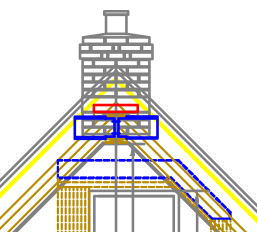
Here is clip of a sections PDF from my frame supplier. It's zoomed to 300% and already looking chunky. The PDF is a rasterised version. No sudh problems wth Draftsight or VariCAD viewing of the DRW file.
-
Yup, we missed an A by one point because we use Electricity to heat our house and don't have PV. The fact that you only need ~15kWhr of base heating / day for an average December and we will be using a green tariff is irrelevant to the failing on the A rating.

