

.jpg.c21f3ac78c9b7efd90cbdcb312744dc5.jpg)
jack
-
Posts
7462 -
Joined
-
Last visited
-
Days Won
41
Everything posted by jack
-
It's quicker and therefore cheaper if you don't have to cut boards. You can get 2700mm plasterboard though - easy enough to cut off 100mm, although why not go for 2700mm high ceilings if your rooms are big enough to handle it? As for whether it's worth doing the extra height, I personally think a bit of extra height helps, especially in larger rooms. We have 2850 ceilings downstairs and I think it makes things feel very spacious.
-
.jpg.c21f3ac78c9b7efd90cbdcb312744dc5.thumb.jpg.7adcad4c0e384f5ecd7d56b0618df6e5.jpg)
Magpies pulling silicone out from around PVC window frames!
jack replied to Prof Tim Noakes's topic in Windows & Glazing
Welcome. With a name like that, I hope you're following the gut microbiome/low carb thread -
Heat recovery efficiency
jack replied to lizzie's topic in Mechanical Ventilation with Heat Recovery (MVHR)
Your body temperature starts falling in the evenings - that probably has an effect: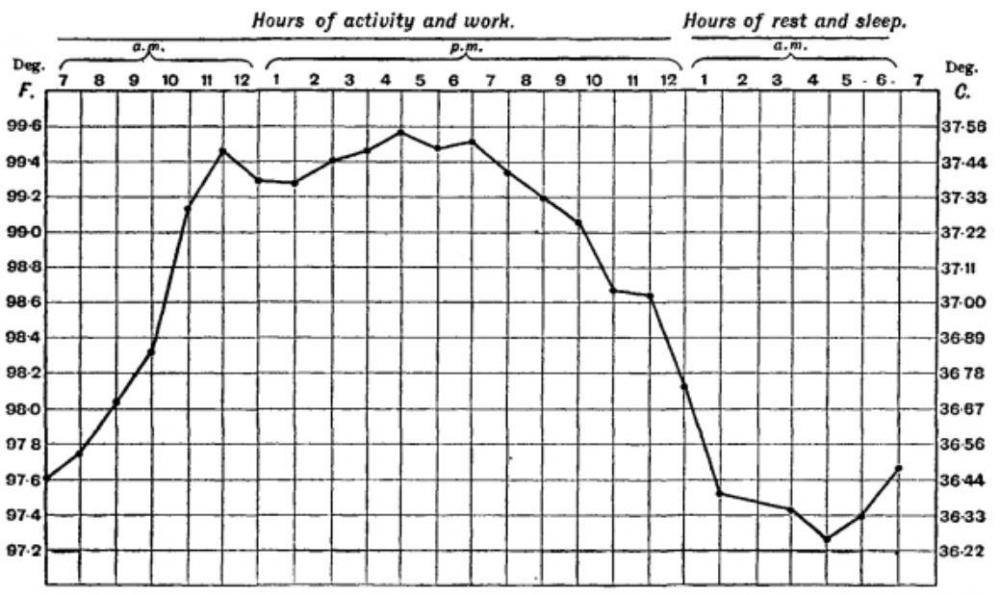
-
Heat recovery efficiency
jack replied to lizzie's topic in Mechanical Ventilation with Heat Recovery (MVHR)
While weather forecasting is still not perfect, gross estimates about upcoming air temperature are usually reasonably reliable. You don't need to know whether it's going to be exactly 10 or 12 degrees - just knowing that it's going to be (for example) a lot cooler for a few days starting tomorrow is probably sufficient to get you 80% of the way there for predictive heating. It may be more complicated if you have a lot of solar gain I suppose - it might be cool air temps but lots of sun, for example. Not an issue I have to contend with in our house, with its relatively low solar gain! That said, our house temp has dropped below 20 degrees in the last couple of days. It's still comfortable enough that I can't be bothered turning the heating back on. -
Had a quick look and it seems Pazen went bust due to the bankruptcy of two suppliers. A real shame - it was a family business run by some really nice people (we visited them before ordering). I see Enersign bought the business, but are you sure that Enersign only supplies these windows and not others as well? That said, the brochure looks like the Pazen brochures, although it's been a while since I've seen ours. Certainly the ENERstore blinds on page 6 of the brochure above look like what we have. This was one of the major selling points for us, but I'm not sure I'd make this choice if I were doing it again. While this detail looks nice from the outside, when looking out from the inside the view is curtailed by the external reveal being in line with the frame. Naturally this is worse with the deep external reveals you get with the thick walls used in highly insulated houses. You also need cladding contractors who are meticulous about lining up the the reveal with the frame. We didn't notice until it was too late, but our contractor (the second - we fired the first) was pretty relaxed, and different amounts of the frame is visible from window to window. Bear in mind also that you still see the frame even if it's completely behind the cladding, because the depth of the frame is still visible. It's much more noticeable in light cladding (we have white painted brickwork in some areas). One reason was the concealed frame detail mentioned above. Another was that I was hearing very mixed reports about Internorm installations even back then, plus the quotes we got from Internorm were no cheaper than Pazen. We had trouble getting quotes from another supplier I was interested in using (can't remember who that was now). It came down to Pazen and Gaulhofer in the end. Interestingly, we were put off Gaulhofer when I showed their local agent Tomas (who sadly passed away a few months ago - see thread elsewhere) our drawings when I met him at Ecobuild. I had a really interesting chat with Tomas, who made some useful points about detailing and installation. He also took one look at the elevations and said that they couldn't supply some of the windows as single tilt-and-turn, because they were too heavy even for the heaviest duty hinges. I therefore foolishly didn't end up getting Gaulhofer to quote. When we visited Pazen right before signing off the deal, the owner/MD spent quite a lot of time going through all of the technical drawings with our architect (he's a mate of ours, so we splurged on a £50 return ticket to bring him along!) As soon as he got the big windows at the front he pointed out they couldn't do them, just like Tomas had! By this stage it was far too late to start considering Gaulhofer, so we just bit the bullet. I suspect this cost us many thousands of quid. The Pazen windows are very good quality. In fact, a passivhaus specialist I met described them as "the Rolls Royce" of alu-clad windows. Unfortunately, we were let down badly by the installers, as catalogued repeatedly on BuildHub. If I were doing this all again, the main thing I'd be looking at other than window quality and price is making a billion percent certain that installation would be done by the supplier in accordance with installation details agreed up front.
-
Same here. Bigger windows, in general, stay open better, but really tall ones can struggle because the inward tilt (which is fixed irrespective of window size) doesn't put the centre of mass of the window far over the pivot point.
-
Combined MVHR, heating and cooling.
jack replied to dnb's topic in Mechanical Ventilation with Heat Recovery (MVHR)
There are all sorts of subtle ways of implementing summer bypass modes, but in general, the heat exchanger should be in the loop at all times, except when the interior temp is too high and the exterior temp is lower than the interior temp. -
Combined MVHR, heating and cooling.
jack replied to dnb's topic in Mechanical Ventilation with Heat Recovery (MVHR)
But the genvex still operates the heat exchanger unless it's in summer bypass mode. The OP seems to be talking about bypassing the heat exchanger when the air con is operating. Generally that's exactly when you'd want the heat exchanger to be in the loop. -
Combined MVHR, heating and cooling.
jack replied to dnb's topic in Mechanical Ventilation with Heat Recovery (MVHR)
I don't quite follow this. Air conditioning is a closed system, so it doesn't cause "draw in" fresh air from the outside. You therefore still need to run the MVHR when you have the aircon running, otherwise you'll have no fresh air coming into the house. If you bypass the MVHR heat exchanger and draw in the air from outside for supply via the MVHR ducts, it still needs to leave somehow. Perhaps you're planning to use positive pressure provided by aircon, and to have that pressure cause air to leave via the extracts? Seems a potentially very wasteful arrangement if the MVHR heat exchanger is bypassed. I also think you'd need to carefully consider how you'd provide the cooled air at enough pressure to force it through the ducts - a standard ducted aircon system relies on much larger ducts than used in a typical MVHR system. Am I missing something? Perhaps a diagram would be useful. -
You can still hear people/cars on the angular stuff (we have it), but you don't have to keep raking it around like the round stuff!
-
I think we figured out that the shutters were the z profile from Hunter Douglas. Control is by Loxone, which also takes care of lighting.
-
We're just outside the Thames Basin SPA - close enough that it had me a bit worried about the potential impact on planning until I looked into it a bit more closely!
-
That's exactly us! Thanks for the link.
-
Your guess is wrong. The last point we got to was them agreeing to take off the charge, but we had to prove the water was now going to a soakaway rather than the sewer. It wasn't at the top of our list at the time and it's fallen off my radar due to everything else in the meantime, but I'll get back onto it shortly.
-
I'm interested in this, as I believe we pay a specific component for surface drainage despite now having a soakaway (house we knocked down had downpipes connected to the sewer). We did start a conversation with our water supplier a while ago but I completely forgot to take it back up again!
-
German windows with roller shutters built-in — who makes them?
jack replied to Dreadnaught's topic in Windows & Glazing
The prevailing wind in our area is straight onto the front of the house. When it's really windy (and particularly when it's gusty), you get some noises from the slats moving around, but on the odd occasion it's gotten really bad I've just put the blinds up until the wind dies off. Never any damage that I've noticed, although it's certainly possible. We also live Hampshire/Surrey borders, so not the windiest place in the country. In Loxone, you can connect a wind sensor and have the blinds automatically retract at whatever windspeed makes you concerned. -
Yes, from memory that's right. They were supplied with our windows, so we didn't see the brand. When we were considering retrofitting the same blinds (ie, before we decided on security shutters instead), we did figure out from the fairly unique profile of the slats that Hunter Douglas was the most likely OEM behind them.
-
That's a really good question, and one I've definitely thought about. There will only be one room (our bedroom) with security blinds, and there's a large window onto a terrace from the adjoining ensuite. I'm not too concerned.
-
I think I've mentioned it in another thread, but we were totally caught out by this. I assumed they'd be more or less completely light blocking, but they aren't. There's a 5+mm gap on both sides, plus lots of small holes where the tapes and control wires go through the slats. Especially when the sun is shining directly on them, they definitely don't keep all the light out. We're about to retrofit proper blackout blinds in the bedrooms to overcome this. Unfortunately, because we never considered this issue, we haven't made provision for recessing the blinds into the ceiling or wall so they're out of sight. If I were doing this again, I'd still go for the same blinds on most windows, but would make provision for concealed internal roller blinds.
-
Ours are controlled via our home automation system. While they can be controlled to change angle during the day to allow for different sun angles, we tend to just have them open, closed, or at around 50% tilt. We program them so that: - Most automatically close completely at dusk - Those that aren't in people's bedrooms open to 50% at 7 in the morning on weekdays. They're left for manual opening on the weekends. - The one's in people's bedrooms are manually opened when the occupant gets up. The controls are an up/down spring-loaded rocker switch. Starting from closed, a double click up will cause them to tilt open and then retract completely. A quick jab from closed will cause them to rotate around 25%, so two quick jabs (but not a double click) will open them to around 50%, which is the most usual position during the day. Holding the rocker up from closed will initially cause them to rotate open and then continue upwards until they reach the fully retracted position. From retracted, a double click down will cause them to close completely. Clicking again at any point will stop the current motion. We have an "all open" and an "all closed" button programmed into the home automation app. If it were a function we used often enough I could program one of the switches somewhere in the house to trigger these actions. I have a holiday mode I can trigger, which emulates us being home. Interestingly, our home automation system is Loxone. When I went on the training course, they mentioned the blinds control was the most common way that customers found them. Oh, and it's worth considering whether you want security as well as shading. The blinds we have are very much for shading and aesthetics rather than security. They can be lifted up much like standard interior venetian blinds (albeit constrained within side rails). That said, I'm sure the average burglar taking a quick glance would assume they're security shutters. However, when we retrofit external shutters to our bedroom windows and glass door to the flat roof above our garage, we're going for security shutters rather than venetians.
-
Actually, I suppose it depends on your house design, but we really like the look of the external venetian blinds on our house. When we specced them we assumed we'd open them all the way every day, but at the front, we just tilt them about halfway open in the mornings. I think they look better down than out of sight! They also prevent people seeing in during the day, but allow you to see out between the slats.
-
The "windows open" graph represents even more onerous behaviour than that: it shows the theoretical case where the windows (presumably all of them!) are cracked open at all times when the temperature outside is lower than that inside, and closed at all other times. I don't think there are many who would be able to consistently implement this in real life, so this is clearly an unrealistic - or at least extreme best-case - scenario.
-
I think it depends what you start with. Even if you start with the correct MVHR, you still need to ensure space to retrofit the ComfoCool unit - probably not a deal-breaker with a bit of planning. The ComfoCool looks pretty expensive - around £4000 from a quick look. You could install a big split system air conditioner for that sort of money. With planning, the duct cooler needn't be difficult to retrofit. You need to plan where it will go, and ensure there's space for you to install it, but other than that it's just a flow and return line from the ASHP circuit, plus a route to a drain for the condensate. Actually, planning the hydraulic circuit and control is probably the tricky bit, especially if you're combining it with underfloor cooling. Ours came with the windows. I think Luxaflex might make some, as does Hunter Douglas. They do need to be carefully detailed to work with your windows, apertures and exterior cladding/finishes.
-
I'm in the south east. Even during very warm periods, the temperature outside is generally lower than inside by mid-evening (roughly 9pm, from memory). By midnight it's generally in the teens, dropping to mid teens or even lower during the early hours of the morning. It's then mid-morning before the heat builds up again. If your home circumstances allow you to open windows as soon as the temperature drops enough, and keep them open until the temperature rises the next day, you nearly always have a full 12 hours of purging going on, and often quite a bit more. So yes, I think what they propose seems likely to work, but in their graph, the bedrooms do spend many weeks in the 22-24°C range. While obviously this is a lot better than the high 20s alternative, it's still pretty warm. I don't know what temperature our east-facing bedroom gets to in the mornings, but the radiant heat off the internal blockout blinds first thing in the morning is really unpleasant. It may be that the room doesn't actually get very hot, but my perception is that it's very uncomfortable. Subjectively, I also absolutely hate being too hot, especially when I'm trying to sleep. I place a higher value than most on my bedroom not being too hot.
-
Yes, that's right. I believe the sole difference is the condensate drain. If you're only heating, you don't need one, but if you're cooling or doing both, you do.
.jpg.c21f3ac78c9b7efd90cbdcb312744dc5.thumb.jpg.7adcad4c0e384f5ecd7d56b0618df6e5.jpg)


