

.jpg.c21f3ac78c9b7efd90cbdcb312744dc5.jpg)
jack
-
Posts
7462 -
Joined
-
Last visited
-
Days Won
41
Everything posted by jack
-
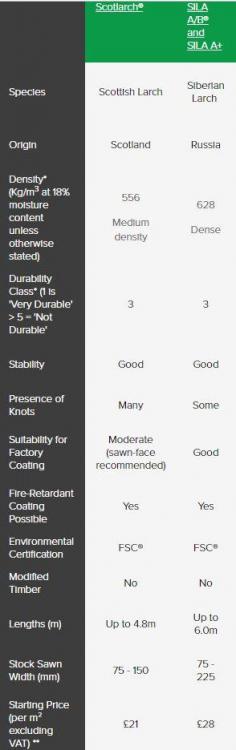
It was nearly 5 years ago, but I'm certain we paid more for Siberian than was on offer for UK-sourced. That said, I also recall that we went for the higher grade stuff with limited knots (and maybe longer average length boards). Maybe that's where the premium was. Just looked at Russwood's site (that's where we got ours). Siberian is notably more expensive than Scottish: That said, I can't understand why would anyone pay a premium for less dense and less durable English larch when the Siberian stuff is of notably better quality (assuming similar grade)?
-
We got samples of British and Siberian larch months before we need them and left them outside to see what happened. The British (Scottish, maybe?) one curled up like a leaf. The Siberian one hardly moved. We paid the extra for the Siberian and were glad we did.
-
Interesting. He rang me a while back (6 months, maybe more) and mentioned a lot of this. I didn't realise it was serious enough to have him wind things up.
-
I would have gone for this but my wife didn't like it.
-
Yes, I think that's a major disadvantage with the sleek, pristine modern look. Next house(!) I'll be incorporating a lot of reused materials and going for more of a lived-in vibe.
-
Just NO, NO, NOOOOOOOOO! Against our better judgement and initial dislike for white surfaces, we were talked into a white Corian worktop for where our sink is. Our main request was easy maintenance for this area, but it's a bloody nightmare. EVERYTHING stains it. You can't leave anything steel (eg, baking tins and trays) on it or it gets rust stains that take a long time scouring with baking soda to remove. Tea will mark it quickly if not wiped off. It isn't heat resistant. We have a couple of scratches beside the sink that have turned brown and can't be scrubbed clean (probably needs a harsher abrasive than we've used to date). In short, white Corian is bloody horrible and one of the worst choices we made in the entire house. It didn't even look very good when it was first installed, in my opinion. In contrast, we were required to sign a waiver for the marble we have on the other surface in the kitchen, acknowledging that marble is a soft, porous material and that we won't hold the kitchen company responsible for it not looking perfect with use. Yes, it's etched and has acquired a bit of a patina over the last four years, but it doesn't seem to stain, and it still looks amazing.
-
.jpg.c21f3ac78c9b7efd90cbdcb312744dc5.thumb.jpg.7adcad4c0e384f5ecd7d56b0618df6e5.jpg)
Room air temperature/quality sensors
jack replied to dnb's topic in Networks, AV, Security & Automation
I have a Loxone system running lighting, exterior blinds, heating, alarm, and some temperature sensing and display. I've wired for (but don't yet use) garage door and electric gate control. There might be a couple of things I'm forgetting. I don't have the music system set up. The Loxone branded amp is just a rebadged Dayton (I think it is) and seems a wildly expensive way of doing things. By all accounts there are cheaper ways of integrating sound into the system, although even then I'd only integrate if you wanted to actually do things using the sound system through Loxone. Their proprietary touch switches are good, by all accounts, but a very expensive way of implementing physical controls. We just have retractive switches for lighting and blinds, and that's fine. Like @joth, I'd consider them for areas where you want multiple inputs in a neat format (eg, in the kitchen, where you might want to control lights and music without using the app). If you stick to radial wiring of lighting (in particular), you shouldn't have any problems with moving to another system in the future. You do need to think carefully about dimming - there are many ways of doing this, each with their own advantages and disadvantages. Their software is probably the best thing about what they do. It's insanely powerful. Basically, you can take just about anything as an input, do just about anything with it (eg, apply logic and/or maths functions), and then control just about anything with the resultant output. What sort of "last 10 to 20%" were you thinking about @dnb? If you can explain the sorts of things you have in mind I'll let you know whether I think they can be done (bearing in mind I'm not an expert, but I did do all the programming for my system). As @joth says, Loxone is increasingly moving to closed systems. They used to be very self-installer friendly, but I understand that's less and less the case. That said, there are mailing lists and forums with some very helpful people on them. if you have any sort of technical bent at all, you shouldn't have any problems. -
Features that are hard to add after the build is finished
jack replied to puntloos's topic in New House & Self Build Design
Great list. There are a couple of ideas in there that we considered but didn't get around to (eg, warm water outside for car/dog). We wanted a secret room but it didn't really work with our plans. This is one huge benefit of having a home automation system run your lights. I've programmed the lights in the bathrooms, toilet, kids' bedrooms and the garage to turn off automatically after 2 hours (I haven't bothered with presence sensors, but if I had, I could significantly reduce this time). I also have a dedicated switch at the bottom of the stairs that turns off all upstairs lights, and the opposite downstairs. I can't tell you how satisfying it is not have to run around turning off lights. I don't know how much energy we actually save this way, but lights being left on is a pet peeve of mine. -
We have a drying cupboard (or will do when I get around to finishing it) in our utility room. It has an MVHR extract above it, and the door will be ventilated at the bottom to allow airflow. It's also beside the plant room. I've left provision for a fan to blow warm air from the plant room into the bottom of the airing cupboard, but to be honest, I doubt I'll bother using it given how effective unheated air is at drying things.
-
Where does the quote say the money goes? Here's the current version of the 5kW Panasonic ASHP we installed a few years back: https://www.easyheatpumps.com/product/panasonic-h-generation-high-performance-55c-monobloc/?attribute_models=WH-MDC05H3E5 Just over £2000 (and you'd reclaim the VAT back on a new build).
-
I looked into these when we were planning the house and concluded that they really weren't "fire-like" enough to be of interest. The ones I saw had fairly stable (i.e., boring!) flames.
-
Without doing any research, I'd assume an open fire might be 10-100 times worse than a woodburner. The combustion process is less controlled/efficient, so you're likely to get more unpleasant combustion products, and a greater proportion of those products will escape into the room compared to a woodburner. Really, just don't do it. If you must have something "flamey", then Opti-myst electric fires are one option (there may be other brands).
-
Yes, ring shank for us too.
-
You need to use stainless, whichever you choose. We attached our horizontal larch using stainless nails. I discussed power-nailing with the guys who did it and they thought it wouldn't work due to the hardness of the larch. They pre-drilled every hole and then hand-nailed - a lot of work! For our soffits, I've been using good quality (Spax) stainless screws and they work a treat. I was worried they'd need pre-drilling, but they go straight in with little effort and no splitting. Torx heads help. One nice thing about screws is that if you need access at a later date, it's easy to do. I had to remove a bit of nailed cladding and it was a nightmare. The battens for the horizontal cladding were power-nailed with galvanised nails. For the battens for the soffits, I just used Spax screws (longer than for the cladding) and they've been fine, although not much is being asked of them in terms of loads.
-
Great post Andy.
-
Not SIPs, sorry. Ours is onto battens attached to a wooden frame that hangs off the house to form a 400-1000mm overhang (different depths in different parts of the house).
-
Final warning: the topic is the impact of Brexit on self-builders. Further off-topic opinions will be deleted without further explanation.
-
Why are you asking people on the internet to answer an unanswerable question, over and over again? You're getting the same result expressed several different ways from different people - that's a strong hint that you're the one not understanding the situation, not them. Why not just ask your builder exactly the same questions? If he's as experienced and competent as you say, he'll give you the answer you need with a 30 second phone call.
-
I suspect that if you're using towel rails with an ASHP, the best you'll get is faster drying of towels and small amount of heat output. The cylinder won't form part of the fluid circuit to which the ASHP is connected, so the cylinder size isn't really relevant to whether you need a buffer tank.
-
The latter two aren't that far from what we have, and I find that very comfortable. >200mm rise would give me pause, I suspect.
-
There'll be a minimum volume that your ASHP will need. A buffer tank is only required if your UFH system doesn't have at least that minimum volume of fluid. Radiators will need to be UFH compatible (ie, designed to work with the relatively low temperature water provided by an ASHP). You'll likely be disappointed with ordinary radiators. Same with the towel rails - they won't output much heat if they're being supplied with water from the ASHP.
-
Get back on the low-carb diet.
-
True for the vast majority of LED downlights, although some LED light sources (LED strip, in particular) need 12V or 24V.
-
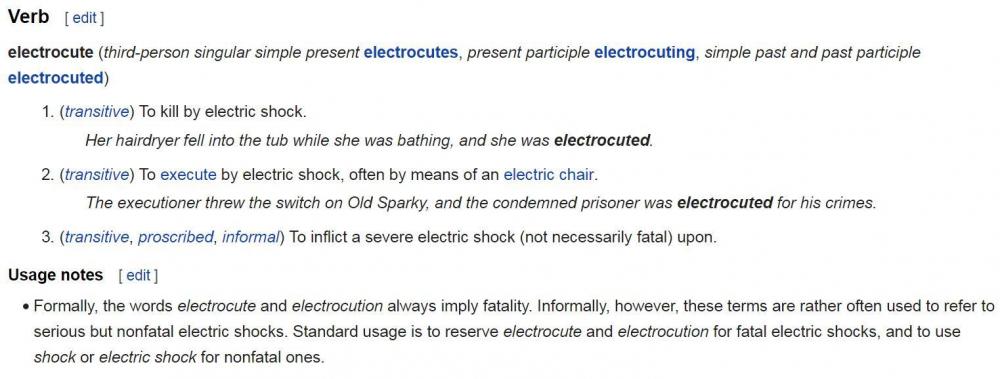
I think it's been a while since the word "electrocuted" definitively meant death by electric shock. Its use in that article is more informal than I'd hope for from a newspaper, but no worse than that imo.
-
Did I mention that I contributed nothing to the spreadsheet and that it was generated entirely by my electrician? He saw early-on how complex things were going to get, with home automation (sometimes multiple light circuits per room), MVHR, ASHP, blinds, etc, and decided that the only way he'd be able to cope was to meticulously plan it all up front. He also knew that he'd be the one being called back in future years to amend things, so it was in his interest to do a good job documenting things!
.jpg.c21f3ac78c9b7efd90cbdcb312744dc5.thumb.jpg.7adcad4c0e384f5ecd7d56b0618df6e5.jpg)




