

.jpg.c21f3ac78c9b7efd90cbdcb312744dc5.jpg)
jack
-
Posts
7462 -
Joined
-
Last visited
-
Days Won
41
Everything posted by jack
-
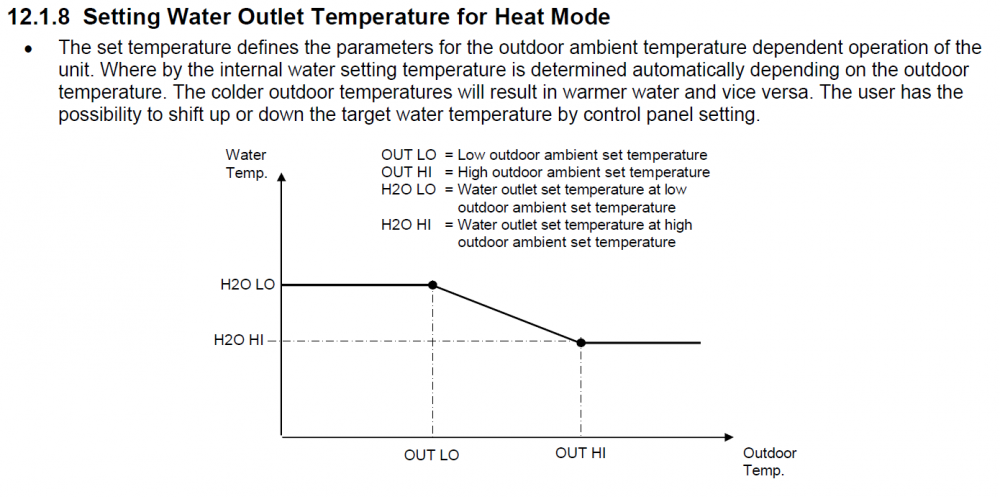
Not sure what else I can say. I use weather compensation that sets a flow temp of: 25°C when the outside temp is above 7°C 31°C when the outside temp is below 0°C It ramps in a linear way from 25°C to 30°C as the outside temperature falls from 7°C to 0°C. Our pipes are on 200mm centres like yours. I find this keeps the house perfectly warm. If anything, it's been a little too warm after these last few very cold days, and I'm thinking of tweaking things slightly so that we get slightly lower flow temps at lower outside temps. What are your floor coverings? We have polished concrete over nearly all of our downstairs floorplan, which does make heat transfer quite efficient. The carpeted TV room can be slightly cooler than the rest of the downstairs area if no-one's in it. Also, it's true that a single storey house will tend to use more energy for the same floor area. Another thing to keep in mind is that there's nothing wrong with the unit running for longer periods of time. Yes, there's wear, but I don't know that there's any less wear running it for a shorter period of time if you're running it harder to run a higher flow temperature.
-
The £14k quote was before I'd decided to include home automation, and didn't include any AV other than antenna/satellite cabling. It sounds like there's very little difference in terms of what's being quoted for. I'm not saying it isn't a rip-off quote, just that it's not that dissimilar to one we had for a very similar job over 5 years ago. That said, we're in the southeast, where I'd expect trades to be more expensive than where you're building.
-
Our house is 289m2 and I seem to recall we had a quote of over £14k for pretty much the same supply and fit as you've been quoted (even including ASHP, solar etc). This was at the end of 2014 in the southeast. In the end, we went with a local guy on a day rate. No idea how many days we ended up with him onsite, although he was quite slow (very methodical) plus we had home automation stuff that took extra time.
-
.jpg.c21f3ac78c9b7efd90cbdcb312744dc5.thumb.jpg.7adcad4c0e384f5ecd7d56b0618df6e5.jpg)
Critique my home automation cabinet wiring
jack replied to joth's topic in Networks, AV, Security & Automation
Exactly this. Whenever I tell people I have a home automation system installed, they immediately assume I get my phone out every time I want to do anything. Absolutely not - that would be a massive pain. The only time the app comes out at the moment is when the family sits down to watch the TV and I want to turn the living room lights to "TV watching mode" and turn off all the other lights in the house. That's done via a single button on the app. And the only reason that's still app-only is that I haven't bothered wiring up one of the switches in the living room so that something like a long press achieves the same result. I haven't done much in the way of actual automation. It's more things like: - an "all upstairs lights off" switch at the bottom of the stairs - an "all downstairs lights off" switch in the middle of the landing upstairs - an "all lights off" function: when you double-click either of our bedside light switches, it turns off all lights in the house. Single-clicking the same switch just toggles the adjacent bedside light. The latter is my favourite function by far. I expect it to eventually also do things like closing the front gates (once we've installed them), checking the garage door is closed, changing the function of the external movement detectors, etc. I don't have any pics of my Loxone install and it's a bit of a faff getting the cover off to take them. However, we had the same issue - three spare pairs for almost every CAT6 run, and LOTS of CAT6 cables, all coming into the same place. In the end, we stripped off the outer insulation (we didn't use screened) and ran only those cores that would be used into the cabinet. To allow us to run the data pairs without the outer insulation, we were ultra-cautious to completely physically separate mains power from the data pairs. In cases where this wasn't possible, we sleeved the data pairs. We carefully rolled up all the spare cores and housed them (carefully labelled!) in a plastic box that abuts the cabinet. It can take a while to find a particular core if you want to add it to the system, but once you do so, it's a relatively easy matter to thread it through to the relevant Loxone input. It looks like you're using the Tree system. It certainly makes for a neater install - we have several times the number of CAT6 cables arriving at the cabinet compared to your setup. -
Re weather compensation, perhaps look for a drawing that looks something like this (from my Panasonic ASHP manual): Given the level of insulation you have, I'd say that 40 is too high. Hard to say for sure given how deep your pipes are buried, but I suspect if anything that would encourage the use of lower temperatures over a longer period of time.
-
What do you mean by max 40 and min 25? Are they weather compensation values? What's your under-slab insulation like? 40 seems a high temperature if you have a lot of insulation. I have 300mm EPS under our slab and never have the temperature exceed 30 for heating. Generally I run it at 25, the lowest temp the unit will do, with weather compensation ramping up between 7 and 0. Bear in mind that the worst situation for defrosting is high humidity, cold outside temperatures, and high heat demand. Often, this peaks when the outside temperature is in the low single figures. As the temperature drops further towards and beyond zero, the humidity tends to fall quite fast too, which reduces icing. I don't know whether the delta value can be set in your ASHP. Unlikely, I'd have thought. Certainly there's no such setting I'm aware of in my Panasonic ASHP. How are you using Loxone to trigger the heating? Hopefully not with one of the intelligent heating controllers. I don't think they cope well very long time-constant situations, like UFH in a deep slab.
-
Water condensing inside the unit is perfectly normal. You can get a lot of condensation on cold days as the warm moist internal air is rapidly cooled inside the heat exchanger. That's what the drain is for. You should not, however, have water dripping from the casing. That suggests that water is finding its way out of the designed drainage path. We had this with our Brink unit on the odd very cold day. In our case, it was because there was a region along the bottom of the heat exchanger where capillary action could cause water to be pulled into an area outside where it could be drained. The result was that in certain conditions, water would accumulate where it wasn't meant to, then work its way through cracks in the internal insulation until it ended up on the inner surface of the bottom casing. It would then find its way out of a join in one corner. To Brink's credit, they sent out an engineer for free, over four years after we bought the unit. He applied a fix in the form of a strip of aluminium that redirected water around the danger area. Unfortunately, it wasn't a very robust solution, but I re-did it myself with some plastic, and it's worked fine since. First thing to do is to make sure your drain is working properly. The next thing is to see whether there's any water pooling inside the unit where it shouldn't (you'll probably need to remove the front casing to see this - at least, that's how it works on our Brink unit). If there's water where it shouldn't be, work your way back from where it's pooled to see where it's coming from. You need to make sure there isn't condensation coming from either of the external ducts. Both the inlet and outlet get very cold in cold weather, so either could be the source of unwanted condensation. That said, depending on where it enters the unit, such condensation should still find its way to the drain.
-
MVHR Calculations
jack replied to john0wingnut's topic in Mechanical Ventilation with Heat Recovery (MVHR)
Why do you want to control it with your phone? I had grand plans for connecting our Brink Excellent 400 into our home automation system, which would have allowed app-based control. However, after living with the system for a while before implementing this, there just didn't seem to be any point in doing so. The humidity sensor was broken by clod-hopping painter (didn't realise until much later) before I had a chance to install it, so we don't even have that connected. We run ours at 100m3/h in our 289m2 (with very high ceilings downstairs) house, and that seems more than good enough. It doesn't get boosted when people shower. I manually boost it if I'm cooking something smoky or we have a lot of people over, but I wouldn't pay hundreds of quid to do this via an app when it's so easy (easier than opening an app, in fact) to just turn a dial the odd time I need to do it. -
Can't you figure out how much the volume of your system is? I assume you have an UFH heating design somewhere, telling you how many metres of UFH loops you have. You can also estimate the volume of pipework between the manifold and the ASHP. Assuming all that amounts to at least 50L, the installer situation becomes irrelevant, because you have it in writing in Panasonic's own manual that a buffer tank is only needed if the volume is less than that. What they say verbally is irrelevant given that it appears to contradict their own written instructions.
-
Combining AC and MVHR
jack replied to moldy's topic in Mechanical Ventilation with Heat Recovery (MVHR)
I think this is how US central heating often works - large bore ducts distributing lots of hot air. One issue is that if you're using your MVHR at high rates, the efficiency drops dramatically (not to mention the increased energy consumed by fans to move that much air - not sure how much the reduced resistance of large ducts helps). [edited to add:] I can't find it, but I'm sure we've dicussed a system where you have large-bore ducting internally, with a central connection to a smaller-bore MVHR system. The large-bore system distributes heated/cooled air, and small proportion of it is constantly exchanged by the MVHR component. Sounds like a recipe for complexity and extreme air drying, but it could work. You also need to think about duct insulation and condensation if you're cooling using internal ducts. I cool our downstairs (polished concrete) floors like this and it's remarkably effective. It also doesn't dry the air like AC can. Upstairs isn't cooled though, and I do wish we'd planned for a way to keep the bedrooms, in particular, a bit cooler. I think if I were doing this again, I have tiled bedroom floors that are cooled in summer and covered with rugs in winter - not sure I'd bother with much or maybe any warmth in winter. Best of both worlds. -
Combining AC and MVHR
jack replied to moldy's topic in Mechanical Ventilation with Heat Recovery (MVHR)
MVHR isn't very good at moving around bulk heat. Cooling one room will have some impact, but isn't as effective as cooling a central air where the "coolth" will be distributed more widely as a result of air currents. You don't want summer bypass on when you're trying to cool the house on a hot day. The effect of summer bypass is to take the heat exchanger out of the MVHR circuit. If you have an air conditioner running inside the house, you'll just be ejecting any cool air you generate. Summer bypass is only useful when the air temperature outside is closer to your desired internal temperature than the current internal temperature. Think cool night following a hot day, when the inside of the house is 24 deg and it's 16 deg outside - in that situation, you want to encourage the (cool) outside air to replace the (warm) inside air. This is achieved by turning on summer bypass, which stops the incoming (cool) air being heated by the outgoing (warm) air via the heat exchanger. During the day, however, if it's 28 deg outside and 21 deg inside (where due to aircon or insulation), you definitely don't want summer bypass on. -
Objections: the best invalid objection you've heard
jack replied to ToughButterCup's topic in Planning Permission
Meh, it's alright when it's a fun one like this. From memory, the only objection we got to our proposal to knock down a tiny bungalow and build a large house was from our local parish council. It was a generic "doesn't fit the streetscape" objection without reasoning, and was (rightly) ignored by the planners. -
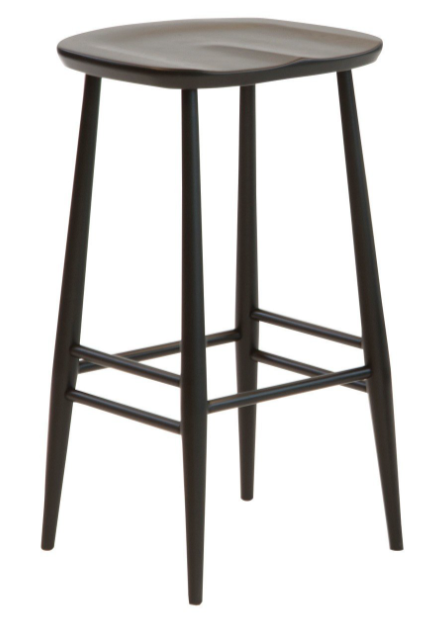
Agreed, although be careful about knock-offs. We ordered a sample from one place, which was fine, then ordered three more, which arrived as slightly different (and unpleasant) colours, complete with overspray and crooked welding. After years of looking, thinking and procrastinating, we ended up going for Ercol bar stools in black: Not cheap, but we got them locally in a sale. I've been amazed at their durability. The paint still looks brand new, and they remain rock solid despite the best efforts of our teenagers.
-
When I proposed doing this, the supplier I got my Brink 400 from said that there was something special about the switch. I was convinced there wasn't, so refused to pay extra for one. As it happened, it came in the box anyway. I fitted it 5 years ago with grand plans to do something more clever, but in the end it just hasn't be necessary. Didn't fit the humidistat I paid so much for, either (although that was because some clod-hopping painter somehow managed to stand on it and break it, despite it being on top of a box out of the way). It's been fine without. We get a little condensation after showers at this time of the year due to not having heating in the bathrooms, but that clears within an hour or two without boost.
-
Building Control: hot water pipes and storage of material
jack replied to ToughButterCup's topic in Building Regulations
I know about that building regulation, although it was completely ignored by our BCO, incidentally. My (obliquely made) point was that if the BCO believes a regulation is not being met, he/she should point at the regulation rather than making inane comments like "there might well be a problem if he intended to store suitcases next to a hot water pipe". -
Location of MVHR System (Zehnder Q350)
jack replied to revelation's topic in Mechanical Ventilation with Heat Recovery (MVHR)
It depends on how loud the unit is. Our Brink Excellent 400 is in our pantry, which is off the kitchen and doesn't have a door. It's boxed in with simple kitchen-type doors without any attempt at sealing or otherwise soundproofing them against noise. You can't hear the unit at all when it's on low (about 25% power). You can hear it on boost, but since I only manually use that now and again, it's actually helpful being able to hear that it's still on so I remember to turn it off! It isn't an offensive or intrusive noise - just a low level background roar. -
Building Control: hot water pipes and storage of material
jack replied to ToughButterCup's topic in Building Regulations
What pipe and where? And to which building regulation is he referring? -
From the installation instruction manual for my 5kW Aquarea model (WH-MDC05F3E5): I interpret this as suggesting a buffer tank is not required. I believe there's a small internal buffer in the unit, hence the use of "additional" here. And the troubleshooting section says this: I assume "is used" is a typo for "if used", which again suggests that a buffer tank is not compulsory. As an aside, the (Panasonic-authorised) engineer who fixed mine suggested that a buffer tank was desirable irrespective of what the manual said.


-
Does the installation manual say that a buffer tank must be installed? Or just that it should be? If you can find something in the same manual saying that it's only needed if less than 50L system capacity, I don't see how they have a leg to stand on. Even if it's an installation fault, isn't that the whole point of them requiring that you use an approved installer? What does the warranty say about the installation, if anything?
-
That's exactly the situation.
-
I just checked and the cheapest we were able to find it was £380. No idea why it's so expensive. I spent some time trying to find a generic substitute at the time, but from memory, it's a proprietary part.
-
Interesting. We had a water pump problem with our 2015 Panasonic Aquarea ASHP about 3 years after installation, and it needed replacing. No extended warranty as it wasn't installed by an approved installer. The part cost was a ridiculously high proportion of the unit. I want to say it was something like £400 for the pump, when you could buy the entire ASHP unit new for around £2k. Who was supposed to back the warranty? Generally I'd have said that was the manufacturer. Also, if it's anything like ours, the requirement for a buffer tank is set out in the installation manual. For ours (5kW), I believe it was needed if the system volume was less than 50L. If you meet the system volume requirement, I'd have thought Panasonic doesn't have a leg to stand on. Even if you didn't, I don't think they can hide behind the installer. What does the paperwork say - was the warranty in writing?
-
I have the same build system as @Bitpipe. When the contractor who we engaged to put up backing boards (and install brick slips onto them) turned up for their first morning onsite, they realised that the studs behind the panelvent weren't spaced at convenient 400 centres. No idea how they'd missed that when pricing the job, since it was pretty clear. One possibility was to cut the boards so that they fit the spacing that was there, but that was going to be a mammoth task. Probably more than 80% of the boards would have needed some form of cutting. In the end, we decided to go with counterbattens. Vertical battens were installed along the stud lines, then horizontal battens were installed on top of those. Fixings for the horizontal battens go through both battens and into the stud behind the panelvent. I do have some concerns about the potential longevity of this approach. There's the odd bit of fine cracking along the mortar lines of the brick slips, but other than that it's mostly held up for over five years. I think with some care it could potentially be an approach that would work with renderboard.
-
I couldn't disagree more.
-
The post you quoted referred to the UK/England, which are political bodies, not people. It also didn't use derogatory language.
.jpg.c21f3ac78c9b7efd90cbdcb312744dc5.thumb.jpg.7adcad4c0e384f5ecd7d56b0618df6e5.jpg)




