

.jpg.c21f3ac78c9b7efd90cbdcb312744dc5.jpg)
jack
-
Posts
7460 -
Joined
-
Last visited
-
Days Won
41
Everything posted by jack
-
.jpg.c21f3ac78c9b7efd90cbdcb312744dc5.thumb.jpg.7adcad4c0e384f5ecd7d56b0618df6e5.jpg)
UVC Retrofit: Tundish D2 Discharge Pipe in a Passive House
jack replied to TerryE's topic in Boilers & Hot Water Tanks
For anyone using Loxone, there's a module that integrates with ToU tariffs, particularly Octopus Agile: https://www.loxone.com/enen/kb/spot-price-optimizer-uk/ For example, if you predict that you need four hours of heating a day when it's cold, you can tell it to turn the heating on during the four cheapest hours. Given the flexibility of Loxone programming, I'm sure you can probably do a hell of lot more with it as well (e.g., automically turn things on when the energy price is negative). It sounds like it's a bit complicated to set up initially, and not quite perfect in terms of knowing actual prices, but hopefully they'll be able to get full integration working @Dan F: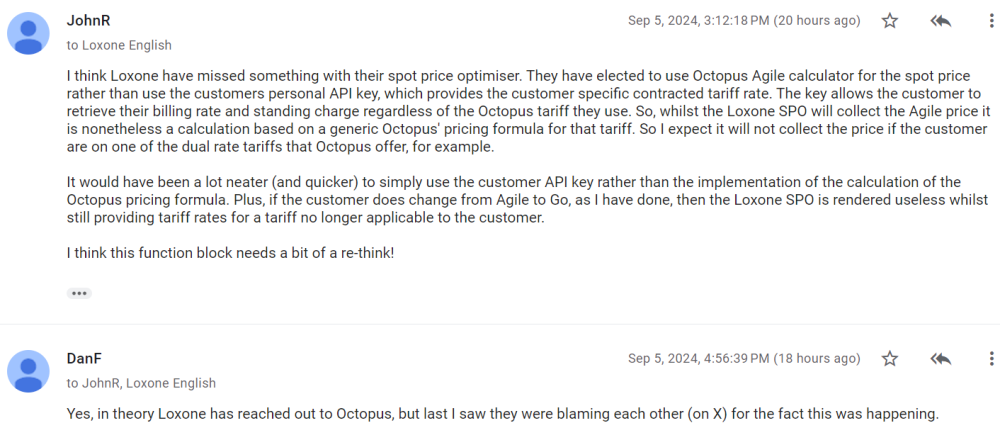
-
Are you talking about costs at different times of day or at different times of year? It doesn't really matter. There are cheap and expensive times across the day all year. Most days there is the opportunity to buy cheap (usually overnight, and sometimes at other times) and sell back when power is expensive. He doesn't net an income during winter, but his annual bills overall are way down on what they were. Of course energy on a ToU tariff can be extremely expensive at times. But that's exactly the point - he's generally exporting at those times, so that's to his benefit. Some of the cheaper electric car tariffs are a little trickier to value, because for most of the day you pay a little more than you'd pay on a standard (same rate all day) tariff. It probably depends how much you charge your car on the cheap tariff, and how much of your other usage you can push into the cheap period. I'm on one of these at the moment (albeit with no battery) and it definitely makes financial sense for our usage patterns. The fact we have solar at least partly offsets the higher rate during the day, at least when the sun's out. You don't need to size a battery system to completely cover worst case daily consumption.
-
No he doesn't. What makes you think that? He still ends up ahead long term taking costs into account. If course, but ToU tariffs are hardly going away. There will always be some benefit to being able to store energy when it's cheap and use (or sell) it when it's expensive. Tariffs will continue to change, certainly, but every change over the last few years has been to the benefit of those with PV and batteries.
-
I understand that the best use of batteries is to charge them during the cheap period (and run everything else you can at the same time), then sell back to the grid when the payback is highest (typically around teatime). I have a mate with a small solar array and decent battery who consistently nets a couple to a few quid a day most days during summer doing this.
-
I don't recall there being a particularly big difference between brands that offered cooling, but I last properly looked when I bought mine ~9 years ago! You might want to see how the ones you're looking at allow cooling mode to be enabled. In my case (Panasonic from 9 years ago), it was just a case of entering a sequence via the control pad. At least one manufacturer requires you to buy a module that plugs into the unit. After some investigation, it was found that the module (over £100, from memory) contained a resistor worth a few pence. Worse (or maybe better, depending upon your perspective!), the exact same module is used by the same manufacturer for another purpose and is sold for a few percent of the price for that purpose.
-
@Bones1, I've made your post a new topic in the planning subforum.
-
Peter Millard on YouTube is the go-to guy for plunge/tracksaw info:
-
They were a great company to work with when we built in 2014 - one of the best we used on the whole build. It sounds like they've tightened up and become more professional and organised, which is great.
-
CCTV not working after internet provider change
jack replied to Dan1983's topic in Networks, AV, Security & Automation
Definitely not my area of expertise, but did you have a static IP address with your previous supplier, and do any of the apps/software you use require that? If so, you need to get a static address with the new provider, and replace the old static address with the new one in anything that expects it. -
Are brick slips dearer? Let's see!
jack replied to John Keith's topic in Insulated Concrete Formwork (ICF)
I don't know about the cost comparison, but for me the main advantage would be the ability to truly self-build in a reasonably quick manner, without needing joinery or block-laying skills. The costs might be more comparable for someone in that situation given they'd be unable to easily self-build with the other methods. -
You've come to the right place. Lots of practical advice from people who've installed ASHPs (air source heat pumps) in many different situations. Post your question(s) in the sub-forum that deals with ASHPs: https://forum.buildhub.org.uk/forum/140-other-heating-systems/
-
ASHP Issues Leak & Buffer Tank with Loxone Thermostat
jack replied to Carpe Diem's topic in Underfloor Heating
Individual control - in the sense of tightly controlling individual room temperatures - doesn't really work in a passivhaus with underfloor heating. Most of us (me included) on here with a similar setup treat the whole floor as a single zone and run with all loops open at all times. You can adjust flow rates to individual rooms at the manifold so that they get relatively more or less heat than the others. Do you know how the call for heat has been set up with Loxone? The worst way to do it would be to have a simple OR gate, such that any zone can call for heat. Much better would be something like at least two or even three zones calling for heat before triggering a call. Alternatively, or in addition, you could work in some averaging. You can also do more complex stuff like weather compensation (if you have an input for the external temperature). Loxone is insanely powerful for this sort of thing (edited to add:), although I wouldn't suggest that anyone design a system in this way. I'm suggesting it only because you've already paid for and installed all the necessary hardware. -
Cat6a cable everywhere, um, now what?
jack replied to Tom's topic in Networks, AV, Security & Automation
This is good advice. I terminated everything at a patch panel, but several locations just have a coiled up network cable in a backbox, covered with a blank plate. -
If the recent spike in energy prices didn't wake people up, I just don't see it happening at all.
-
I thought I might be able to chip in given we have a pretty big mat well formed at our front door, but it appears we don't!
-
Welcome Hannah!
-
Larger "Spark Gap" means fewer heat pumps
jack replied to LnP's topic in Environmental Building Politics
Talk from Octopus and a couple of other places this week about reducing the cost of electricity to those nearer renewables. Now that'd be an interesting approach... -
Larger "Spark Gap" means fewer heat pumps
jack replied to LnP's topic in Environmental Building Politics
We installed a lot of solar, so an ASHP lets me use some of that. Batteries will eventually help further. There's mains gas on the road, but the bungalow we knocked down wasn't connected to it. I didn't want to have to install a gas line down quite a long driveway. Didn't want a flue exiting the house. Didn't want to pay standing charges for gas. With a very low energy house, you can run the ASHP very low flow temps, which helps improve COP and make the ASHP more competitive with gas. I wanted to do underfloor cooling. -
Welcome! True enough, but heat capacity is not the only factor. The environmental heat source (assuming heating mode) for a GSHP is not the water in the ground loops, but the ground the loops are in. While the water in the ground loops is great at transferring heat from the internal heat exchanger, the transfer between the loops and the ground they're in is by far the limiting factor. I was all for a GSHP until learned it would have been ~5 times the cost for a moderate improvement in COP and a lot more hassle onsite during the build. The energy bill for our all-electric house was £1000 the first year we moved in (8 years ago). Even if a GSHP had halved our energy usage, the payback period on the difference between ASHP and GSHP would have been something like 30 years. Admittedly that would have been significantly reduced with the increases in energy costs over the last couple of years!
-
For the last couple of years, every time I've finish a box of pozis, I've replaced them with the torx equivalent. They're just so much more pleasant to use.
-
Just Finished - Thanks for all the Help and Advice !
jack replied to bob the builder 2's topic in Introduce Yourself
Lovely looking home, well done! Enjoy the rest. -
I haven't watched the video, but aggregated data can still be of use even if you don't know the details of individual homes. I wonder whether they do per-house analysis. You can probably learn things by looking at (for example) the variance in temperature across the image of a house. If you have large deviations, for example, there could be cold-bridging.
-
When you say honed, do you mean a matt finish? We asked for a honed finish on our marble worktops and the supplier talked us out of it. I don't recall their reasoning. When we decided on polished marble worktops, my wife and agreed with each other that we'd be completely relaxed about stains, marks, and etching etc. The worktops are over 8 years old now and still look pretty good despite the extensive visible signs of use. Turning to your question, is it condensation dripping down that's leaving a mark, or water that's made it to the outside of the glass after filling it from the tap? If the latter, could it be limescale? And are you 100% sure it's water and not, e.g., juice or wine? For comparison, we've had zero issues with water marks on ours, and we haven't sealed it since it was first sealed when installed.
-
ASHP water leaving temperature control
jack replied to JohnMo's topic in Air Source Heat Pumps (ASHP)
We went through a period a few years ago where spammers would join, post a few inoccuous posts, then go back and edit spam into them once they'd disappeared off the front page. It was just about impossible to police. We still get people posting the inoccuous initial posts, but they generally lose interest and stop posting when they realise the editing block is in place. Facebook has its own tools for reducing the impact of spam (on top of actions of the page admins). We don't have anything like that. We have over 40 times as many members as Camelot, but probably a similar number of mods. If anyone wants anything edited, just let a mod know and they'll happily do it for you.
.jpg.c21f3ac78c9b7efd90cbdcb312744dc5.thumb.jpg.7adcad4c0e384f5ecd7d56b0618df6e5.jpg)



