Bitpipe
-
Posts
4118 -
Joined
-
Last visited
-
Days Won
53
Everything posted by Bitpipe
-
Just get a few of these... https://www.rapidonline.com/Piggyaxe-555-Flasher-Kit-70-1051?IncVat=1&pdg=pla-294357559827:kwd-294357559827:cmp-757438067:adg-44804851896:crv-207912323492:pid-70-1051:dev-c&gclid=EAIaIQobChMI-ZL699yq5QIVyrTtCh1DngMLEAQYASABEgI5nvD_BwE
-
You are now entering the 'Why does a dog lick it ****s' territory. Because it can.
-
Have you ever coded? If not, have a play with https://scratch.mit.edu/ it is designed for kids but the programming basics are solid. If you find it all impenetrable then you may struggle to configure more complex systems but if you find it easy enough to get your head round then you may be ok to DIY.
-

Week 4 - out of the ground, or is that in?
Bitpipe commented on Red Kite's blog entry in Self Building two in North Wiltshire
Brings back memories of our basement - we dug it over 3 days with 72 truck visits to do the muck away - that was for a hole about 12m2 and 3.5m deep - clay, gravel and some chalk. What's your basement build method / insulation strategy? We laid a 'foundation' of 300mm thick EPS 200 (which sat on 150mm of crush blinded with 50mm of sand), covered it with a membrane and the slab was cast on that. 200 mm EPS 70 applied to the external walls. We put a land drain to soakaway at the base of the slab and backfilled with fist sized stones - essentially a giant french drain all around the basement. At ground level it still needs finished with a strip of geotex fabric and some decorative shingle. Good luck! -
Vent position relative to radiators
Bitpipe replied to Barnacles's topic in Mechanical Ventilation with Heat Recovery (MVHR)
Got it - suggest you sketch out your floor plan and then put an extract in each loo / bathroom and one in the kitchen (near the hob). Then choose a supply point in each room that's as far away from each extract as possible, preferably diagonal to the door as that's where the extracts will pull air from. Again, you're just trying to maximise cross airflow in each room - it's far from an exact science and usually you need to compromise around where you can actually fit the vents (joists etc). Best practice is to have the MVHR unit roughly in the middle so supply runs are roughly the same length - this makes it easier to balance.However in my case, the unit is in the basement on one side of the house and there are vents everywhere so again, not critical. You also need to think on where to put the external in/out as these are larger bore ducts (sometimes steel if moving between floors) and need insulated so you don't want them too long. -
Vent position relative to radiators
Bitpipe replied to Barnacles's topic in Mechanical Ventilation with Heat Recovery (MVHR)
Not sure as I've only ever seen them in relatively airtight houses that have minimal heating requirements or just UFH. MVHR flow rates are fairly low - they are there to provide fresh air while minimising heat loss (i.e. compared to a window trickle vent). Normally you position them in a room to maximise airflow from their location to where the nearest extract is (usually bathroom or kitchen) so in the corner of the room diagonally opposite the door (which needs to have 7600mm2 gap at the bottom to facilitate air movement. Is this a new build or a retro fit? If the latter, how airtight is your house? It's not that MVHR won't help but below 2 ACH the heat recovery part won't be that effective as you'll be getting a lot of heat draining inherent ventilation anyway. -
14th International Dark Sky Reserve
Bitpipe replied to Jeremy Harris's topic in Environmental Building Politics
Shame there's no way of resolving that (cough?) -
VAT for dummies
Bitpipe replied to Davidkw's topic in Self Build VAT, Community Infrastructure Levy (CIL), S106 & Tax
Ah sure where’s the fun in that I quite enjoyed reacquainting myself with vendors from 3 years previously .... I had nothing much planned for those three solid weekends anyway... -
Things to find lost TV remotes
Bitpipe replied to Ferdinand's topic in General Self Build & DIY Discussion
Remember those 80's key finder thingy's that you had to whistle and then they'd beep? Well don't get one as they were crap. This however.... https://www.amazon.co.uk/Universal-Remote-Massive-Buttons-Satillite/dp/B0011OVNHI -
Got broken in to last night ....
Bitpipe replied to ToughButterCup's topic in General Self Build & DIY Discussion
I think I told this story back when it happened... A few years ago I was doing a few bits inside the house early one evening, must have been just before first fix was complete as it was getting dark out. Anyway, someone knocked on one of the windows and I assumed it was a friend who had called to the caravan at the rear, so I went up to the front door to see who it was. No sign so I went as far as the gate and a car tore off up the road. Outside the house (we're at the end of a cul de sac) was lots of emptied jewellery boxes, costume jewellery etc. Obviously these guys had just burgled someone and grabbed what they could and were sorting it out in what they thought was a quiet spot. No idea why they thought of knocking on our house but maybe they were chancing their arm that there may be a few tools to take while they were passing. Anyway, I called local police and was amazed when a car of CDs and offices appeared literally minutes later - turns out the guys had also nicked an Audi from the burglary and it had a tracker so the police were already on their tail. They were nabbed about 10 mins after the police arrived at ours and all the stuff was collected up off the street. Bizarrely I was recorded as a 'victim' so was kept in the loop - usual story, they both had records as long as your arm and were not long out of prison. Both pleaded guilty and got banged up again for another few years. No doubt rinse & repeat on their release. -
Out of the mud at last.
Bitpipe replied to Moira Niedzwiecka's topic in Landscaping, Decking & Patios
Looks great - It's a fantastic feeling when you can go in and out without the trail of mud & grit ! -
While the concrete is green post shuttering strike you have the option to take it down if the pour was really bad - we never had to do this but there was peace of mind seeing the surface both sides. We did cut into one green section of the stair enclosure outside the basement box and it was surprisingly easy to do but within a few days it was rock hard.
-
Just to add, I was wary of ICF for the basement walls as you can’t see the quality of the pour, compared to traditional shuttering. While we’re well above the water table, the waterproof concrete is our only barrier so I wanted to ensure the pour was flawless. We used the warranties Sika system with water bars, mastic, plugs and waterproof concrete. It was all inspected and signed off by Sika to get the warranty.
-
I built a passive basement - 300mm reinforced steel / waterproof concrete (Sika). External dims are 11500mm x 10500mm and internal wall height is 2700mm. Slab sits on 300mm eps 200 and we dressed the exterior with 200mm eps 70. We decided against any ufh in the basement slab and it works fine - always a comfortable 20 ish degrees down there summer or winter. Standard dot & dab pb on interior, Jae dean on floor. the basement is an ‘open box’ with a steel web over the top to support a suspended timber floor. This has wet ufh in Alu spreader plates under a 18mm osb deck. On top of that is 12&9mm ply and then a resin floor system. MBC passive house on top which ties into the insulated layer of the basement. So, I wouldn’t bother putting ufh in your basement, you will never need it.
-
MVHR upgrade from MEV
Bitpipe replied to James_H's topic in Mechanical Ventilation with Heat Recovery (MVHR)
Crossing joists will be your challenge, hopefully you can avoid that. Are you using new plenums (or whatever the name is for the unit that terminates the duct in the room and that the ceiling vent attaches to? They are quite deep but can be trimmed as required - you'll probably need to cut the hole in the ceiling from above once you know where you want it and then cut it flush on the room side. The ceiling cowls have a generous overlap so hide a good 1/2" or so around the plenum. Get a big can of silicone spray as it makes sliding in the duct & rubber washer much easier - you will probably have to experiment a bit on how much slack to leave in the duct to allow for this. -
Just about to start the first fix electrics
Bitpipe replied to Triassic's topic in Electrics - Other
Before first fix started for sure , he'd priced up a estimate based on a marked up version of the planning drawings showing light & socket locations. When the frame was up, he marked up all the socket / data / switch locations on site with tape and pen and we did a final walk around to see what worked wrt likely furniture & door positions. That's when we added things like duct for wall hanging TV etc.. -
MVHR upgrade from MEV
Bitpipe replied to James_H's topic in Mechanical Ventilation with Heat Recovery (MVHR)
You seem to have made a thorough consideration of the pros and cons but how are you planning to get the new ducting in situ - pulling the ceilings or from floors above? The 75mm ribbed duct that many of us has used is flexible but a bit unwieldy, especially in long lengths. It was fussy to get it in place in a bare frame (and before other services went in) so you may have more challenges. In my experience, the external vents are somewhat dictated by the position of the unit and how much rigid wider bore (in my case 180mm) duct you can practically run. In an unheated space, it all needs insulated too (I insulated mine even though it is in the plant room as there was a lot of condensation on the cold intake). Commissioning is entirely self do-able and you'll probably do a better job than an 'expert' who's only there for a few hours. It's just trial and error adjustment of ceiling vents & fan control with a little bit of maths to balance in/out flows and meet the min extraction rates for regs. -
Show me your dirty MVHR photos
Bitpipe replied to readiescards's topic in Mechanical Ventilation with Heat Recovery (MVHR)
I have same unit and it looked similarly grimey, especially the summer bypass unit. I just went at everything internal with the soft brush on a hoover, then a damp cloth and then a dry cloth. -
Just about to start the first fix electrics
Bitpipe replied to Triassic's topic in Electrics - Other
100% agree with this - our electrician came up with a simple but flexible design that has worked well. Basically a mix of dimmable LED ceiling spots, some up lighters & pendants in specific areas (breakfast bar, dining table) & lots of wall switchable 5a lamp sockets. In other parts of the house we used LED strip behind a diffuser for attic room lighting, under banister lighting and other tricky spots. Same electrician also designed our basement wall layout as it had been an open box in construction and he needed to get on with speccing the electrics. We liked his sketch so much we just handed it to the joiner to frame out -
A tactic I used with some trades was to say 'Help me to understand' vs 'I'm not happy'. At the end of that conversation you then have the right to say 'I'm not happy with that' or 'That's not what we agreed'. If they can't explain why the floor level is off without loosing their temper or walking off site then you can't deal with them. Maybe they're used to rougher treatment and that gets their respect, who knows.It's not how I operate and does not sound like your comfort zone either. Ultimately you control them by virtue of ££. If you pay for work that you're not happy with (or accept overage cost that's not your fault) because you don't want them to go away or be abusive, then that is extortion in my opinion.
-
We didn't bother with silencers and took a wait and see position - if I did fit one it would be horizontal. I have a supply vent more or less above my head in bed - didn't quite think it through. On normal flow it's pretty silent but when boost kicks in there is a slight drone which, if i'm awake in middle of night is noticeable. Now normally that only happens when someone goes to loo in the night (bathrooms have PIR to trigger boost) and was also how I discovered that one of the kids PIRs had failed 'on' a few weeks ago. Anyway, surely only the supply path to rooms needs silenced? Why would you silence the extract path? This may be a long winded way of saying I may buy one of your silencers from you !
-
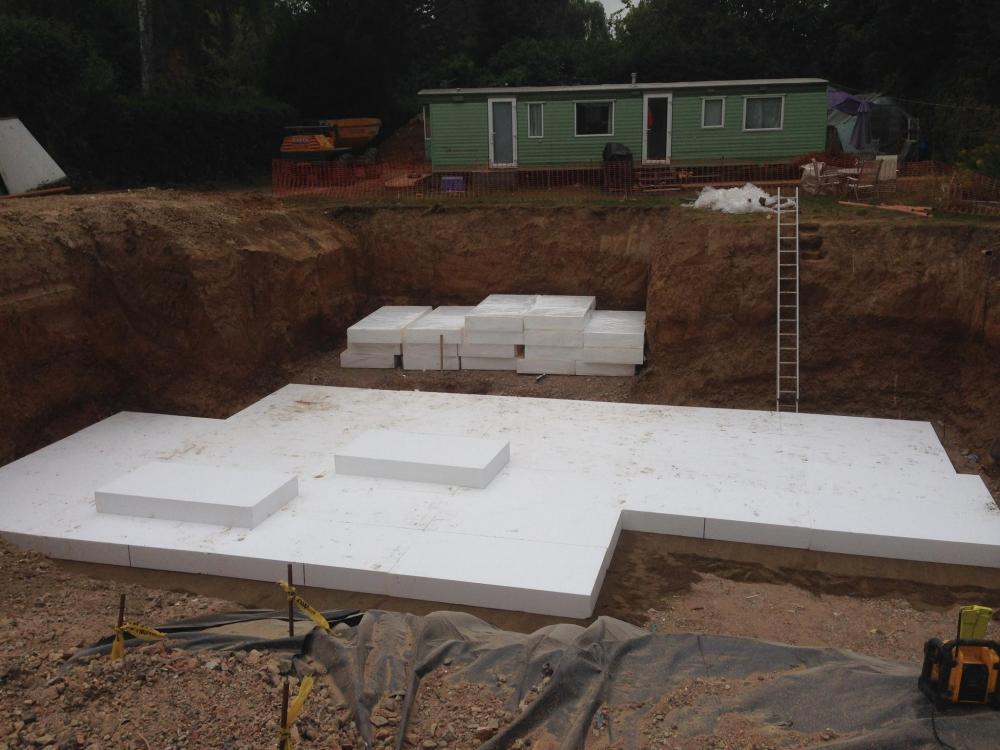
Sure was - 12 m x 11m x 3.5m before we started filling it back in with house
-
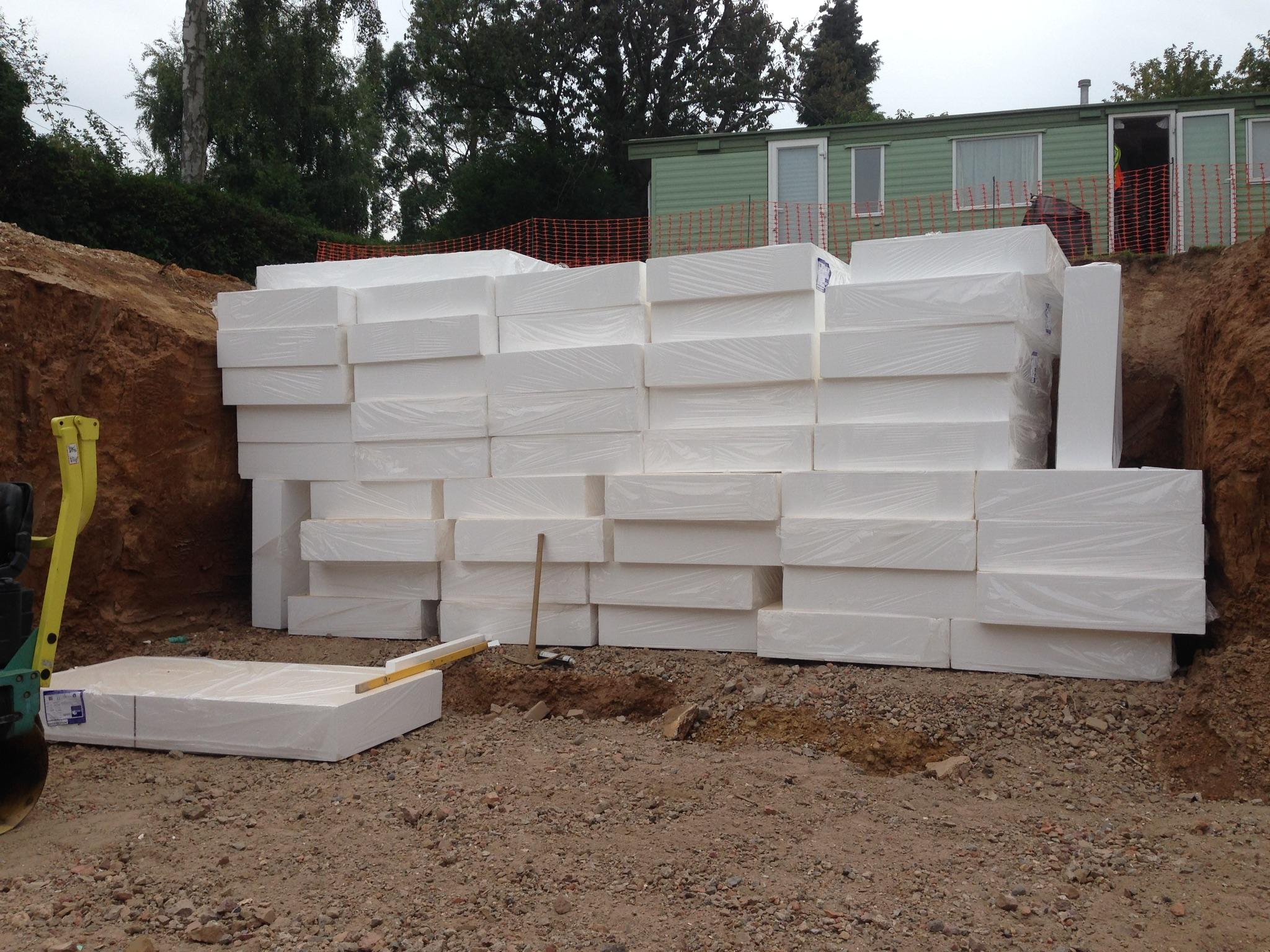
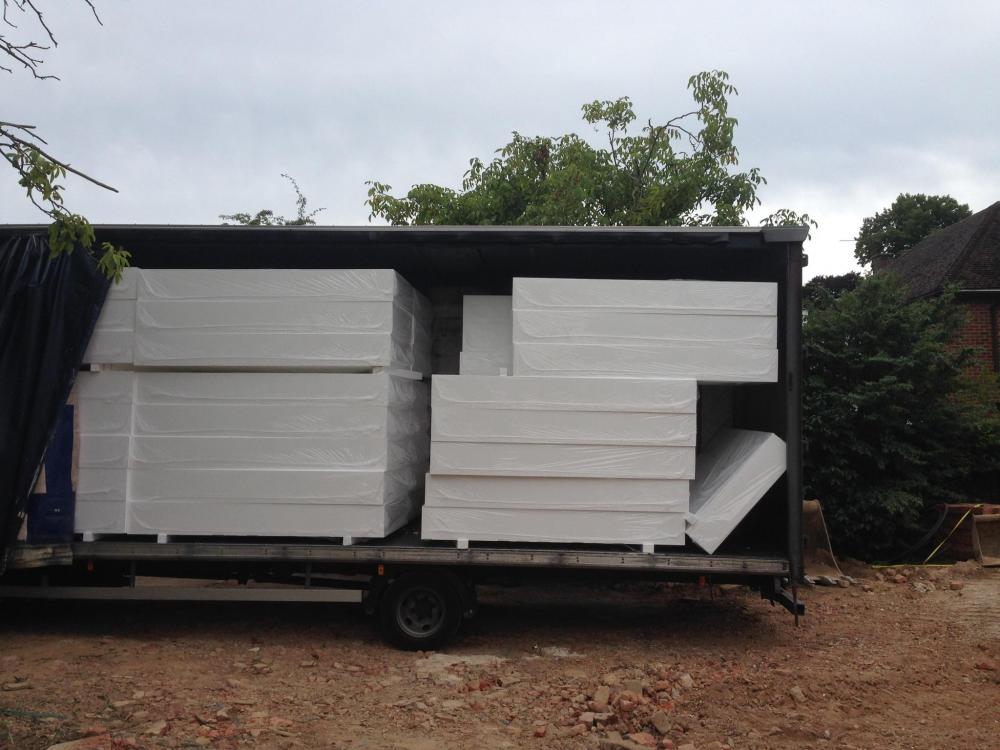
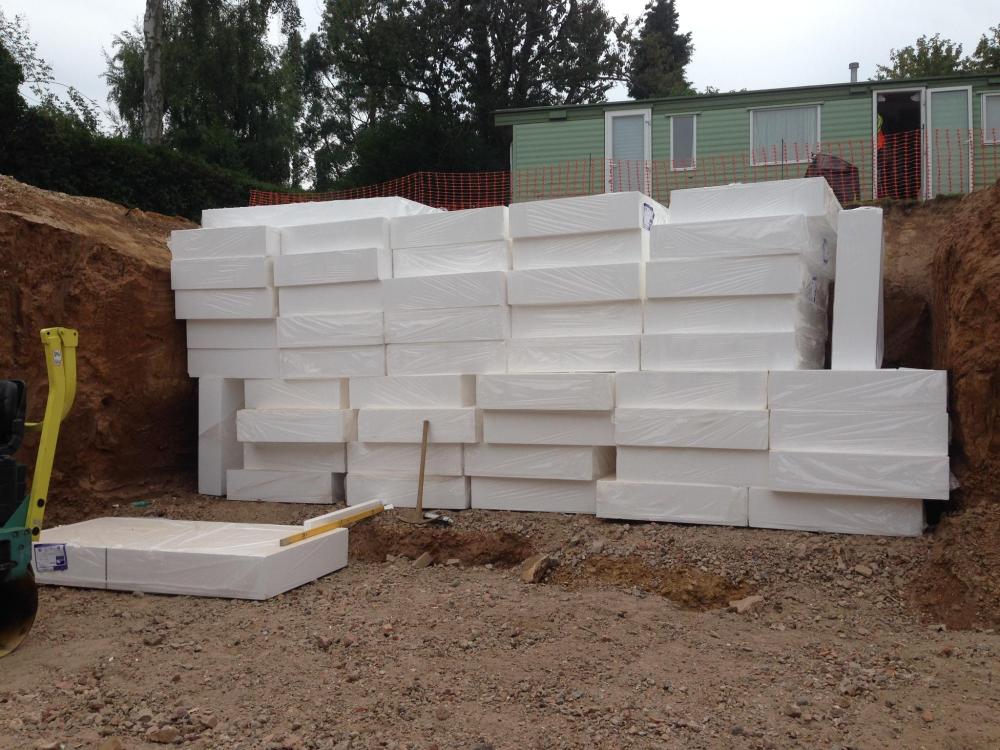
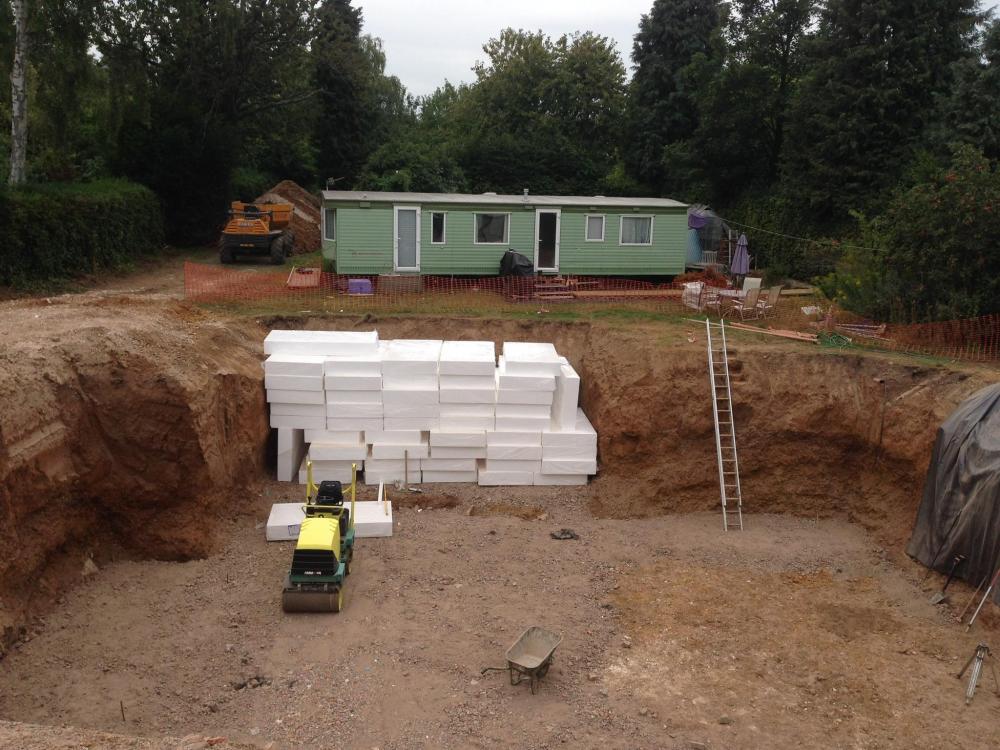
This was my under slab delivery - EPS 200 in 1200 x 2400 x 300 blocks which were relatively heavy - about 30kg each due to their density. The EPS 70 which was 200mm thick was easy by comparison.
-
Our electrician told us of a job he was on where the 'developers' are a couple of guys who made some money with their IT business and bought a plot with permission to build some high end barn style 'eco' houses - having worked on quite a few MBC builds, he knows just how 'un-eco' the barns actually are. Anyway, the builder has been slogging away with a small team and the build schedule has more than doubled from the optimistic one year original plan. The internal finish & spec is quite basic vs the price being asked but 3 have shifted and they're now left with the last unit which will deliver all the profit to the project. However, in the delay to complete the build - planning has since been granted to a small housing estate right on the door step and in full view of the extensive glazing of this last unit, which is making it very hard to sell. Meanwhile, builder has a fleet of shiny new trucks & vans
-
Some simple questions that will help us help you.. 1) Do you have an approved set of drawings that they are building to? These will show floor levels etc and probably can't be changed on the fly without planning or building control sign off. 2) Do you have a written contract / estimate / quote with this builder for the works? If not, you are both in a risky position as he can inflate the cost at will and you can refuse to pay. 3) How are you paying? Staged payments are best when work is complete and to standard. Avoid paying upfront for materials etc as there is always a risk that you may not get them if you fall out. Building merchants offer established builders decent payment terms so he should not have cash flow issues for materials. Labour can often need paid at the end of the week, but if the work's been done then there should be no issue.