


Bitpipe
-
Posts
4118 -
Joined
-
Last visited
-
Days Won
53
Everything posted by Bitpipe
-
I relied hugely on DraftSight (on a Mac) during the whole planning & design process, using it to compare drawings from MBC and the basement SE, checking dims & taking measurements, prototyping ideas etc. Would not have been able to build the house without it. It's a bit tricky to lean but you don't need to do much to interpret existing drawings. Sadly the free licence expired after about 12 months and I could not get it to renew, needed to install on another PC.
-
Terry is my booking agent, gets a 10% fee Happy to help - I posted a lot on ebuild on our basement and I think some of the content made it over here. We also started down the Glatthar path and while they are a fine company with a high quality product (friends have used them), they are pricey. Here's our story: 1) we got a SE to design the basement - design was simple, an open box that followed the upper wall footprint with some lateral steels to support a suspended floor and point loads. We already had the MBC frame design in hand at this point so that was their point of reference. After construction, we framed out the interior in timber to give us some future flexibility in layout. 2) SE needed a ground investigation report and drew up the spec for that, we both shopped around for a few quotes before choosing a reputable firm. Unfortunately they had poor supervision on site and the subsequent report was a bit of a mess, needed to be re-done to collect more data (which I had to pay for, albeit at a discounted rate). But we finally got what we needed and the engineer did the necessary calcs and drawings which I took to building control and shopped round local groundworks contractors - NOT basement specialists. EPS under the slab is chosen based on the loading per m2 in N - EPS 200 grade met our requirements. The side insulation does not have any vertical load on it so we used EPS 70. Thickness is up to you, makes no structural difference purely thermal. We chose 300mm for the slab and 200mm for the walls. 3) waterproofing strategy depends on the conditions. We did not hit water until 4m so well below the slab. Our ground is clay, gravel and chalk so free draining under the basement. Engineer specced a land drain around the slab to soakaway and 1m of stone backfill. We were happy to just use warrantied waterproof concrete (Sika) - the internal membranes are expensive, especially when pumps etc are required and I was wary of the external membranes (how do you every prove they are the cause of a leak?). 4) Engineer was very conservative on the size of the excavation required but we spoke to a few ground workers and they said that 1m working room with a small 45degree batter at the top was standard - this is important as party wall law for basement is concerned with where the excavation starts not where the wall starts. Was pretty easy to conclude that we would be ok based on the 45 degree rule so I took it no further and the neighbours never raised it. Up to this point, it's hard to be definite on costs as you may have some scary ground conditions that need piling or other specialist work - so you take the risk that you may get this far and need to walk away if you can't afford the cost. 5) we shortlisted two contractors, both are essentially muck movers and sub to specialist concrete teams. Neither had a clue on the EPS but were happy to prep and let me lay it or do it themselves at a day rate. Excavation and muck away was about 1/3 of cost - if you can loose spoil on site then you'll make a big saving. Concrete prices were broadly similar, complex structures will cost more as there is a lot of skilled joinery in making the formwork. We bought GRP lightwells from MEA in Germany - effectively the contractor leaves a window hole in the wall and the light well is fixed during back fill. Window goes in later with rest of building. Would have been quite expensive to get concrete lightwells cast in-situ. 6) We picked a contractor and got to work. I purchased the EPS via a buyer who got me the best deal, but you can get prices from SIG and other places. Laying it was not complicated - ground worker compacted 150mm of type 1 and then laid 50mm sand, blocks were just laid on top, allowing for 200mm min extra all round. We didn't need to cut blocks at this stage. EPS was covered with a membrane, tucked down and taped and the gaps between the EPS and excavation were filled with type 1 to give the concrete team a level working space. 7) Slab was laid out in steel and poured and then the walls were cast. Regular inspections from Sika and a final sign off at the end. You need to give some thought on service penetrations for fouls and water, electricity etc - normally an oversized duct is cast in place and the eventual service will run inside with the gap sealed up. 8) I then applied the EPS 70 to the sides using LE foam to adhere and fill gaps. This was clad in corex to minimise damage during backfill. Used a small chainsaw to cut it - messy but quick. Land drain installed and then backfilled with stone as per spec. Half way through this I put the light wells on. Top was 200mm graded flat with muck ready for the scaffolders and frame erection. Was probably one of the most straight forward parts of the build, once all the SE work and GI frustration was resolved. Needless to say, we love our basement, great decision that gives us 50% extra floor space for about £1000/m2.
-
Sure, happy to help. We purchased Gaulhofer windows from a UK reseller. The external shutters were specified to five east facing windows (our street view) as an add on for specific windows and the window drawings and dims included them. I got the technical guy at the reseller to work with with MBC to ensure that a pocket was built above each relevant window to accommodate the blind box - obv. sacrificed a little insulation here. The blind box front sat flush with the MBC frame and this made the exterior of the frame 100mm back from the frame which was perfect for us. Windows arrived with the blinds fitted so felt like they were an integral part of the unit. The units themselves are Roma blinds (roma.de). The electrical connection (a 220v 4 core cord) ran into the house within the frame. No issues in making everything airtight from the inside and as the blinds were flush, the render batten & board was able to run flush over the top. Looks very neat, when the blinds are recessed, they are invisible, however we keep them down most of the time and just tilt them as required. Very effective in keeping sun out and can almost act as a blackout. Electrician wired them into the room light panel and we have a mix of rockers and latching switches - they do take about a minute to fully extend or retract so holding down a switch for that long is a bit of a pain. Only downside is I omitted to spec a blind for the south kitchen window (east has one) as I felt it was shaded enough and looks out onto a hedge and neighbours gable. However the lower sun angle allows it to shine in, not a massive solar gain issue, more of a nuisance. Practically impossible to retro fit a matching external bind now so will have to fit something to the interior.
-
That's the stuff - used about 12 cans to stick about 80 sheets of EPS to the exterior basement wall. Goes off pretty quickly and as it is low expansion, does not push the EPS away from the wall, although a bit of propping is never a bad idea. Quick spritz of water on wall and EPS before the foam is good for adhesion. Wear gloves though, if you get it on your hands it will leave a hard to remove black stain. I recall Jeremy saying that isopropl alcohol can remove it. If you get a decent gun from screwfix, you don't need to flush it out after use - i've picked up a can after 6 months, chipped off the hardened foam and it's worked a treat.
-
Low expansion foam is pretty good - remember to dampen the eps before applying the foam.
-
 We used Sika but same principle. You should be fine then. Make sure you calculate the volume you need to fill (i.e. diameter of duct less diameter of pipes times 150mm) and then figure how many tubes you'll need. They're about £25 each and the mortar is about £7 a tub. Tube is roughly 500g - I remember calculating the volume based on the density in the data sheet. I posted a thread on ebuild about the applicator gun, ended up with this one from amazon - - Everbuild Silicone Sausage Foil Pack Applicator Gun 15in - 600ml.
 -
Thanks. Manufacturer is getting back to me with installation instructions, but I think you're right. Not sure we can return as it's been opened but will see.
-
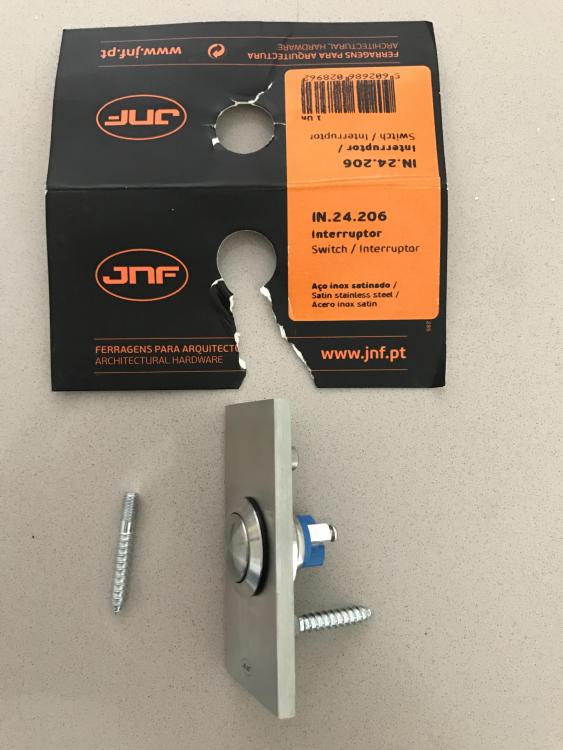
Ok, I avoided the pitfall of many an airtight builder by planning to have a doorbell. Now we're trying to fit the push and are struggling (hasten to add it was chosen by the mrs). It'a a flush stainless steel plate with two fixings that have a machined thread on one side (to mate with the push) and a screw on the other (to fix to wall). Problem is that once the fixing is attached to the push, there is no way to rotate the screw, unless you rotate the whole push which obviously doesn't work. Have spoken to the Portuguese manufacturer but they just sent me the technical drawing, not any instructions. Wondering if there is a special plug that can hold the screw without it rotating (I.e.) just pushing it in. Not keen to just bond it, would like to solve the puzzle!
-
Maybe we were just lucky but as inexperienced self builders, we managed to get decent trades across the board. Some were better than others but even the weaker ones were still pretty decent. None came without some kind of personal recommendation. We found that having strong start with the groundworker (basement) and MBC (frame) kept the up the quality with the follow on trades. Only dodgy ones were the scaffolders but I'm told that's par for the course
-
This is what we did and it ran pretty smoothly - you definitely save the main contractor overhead at the cost of some pencil chewing and phone calls. That said, by opting for a fairly comprehensive timber frame package leaving us with a well insulated, airtight structure with all internal stud walls and temp stairs. This made it pretty easy to commence first fix plumbing and electrics on the inside and to get windows in and roofing & render on the outside. From there, first fix joinery, plastering and second fix work follows on. Trickiest bit is finding good trades, we were lucky to get to know a few other (roughly nearby) self builders such as Jack and HerbJ and rotated some trades between us.
-
That made me laugh - I know what we've borrowed and roughly what savings we've used up but also have the 'one eye closed' approach to budgeting at the moment. Also prepared for the VAT return to be underwhelming - I started a spreadsheet but it fell by the wayside early on and I just have a big box of paper to wade through!
-
No idea - I assume that the ducts enter your basement horizontally? The Stopaq is fairly viscous stuff (you have to pre-warm before using otherwise it refuses to come out of the tube) with the consistency of plasticine. If you follow their recommendation of stuffing the pipe with foam and then the remaining 150mm with the Stopaq and finally the mortar then you should have a pretty decent seal. Looking at the ribbed duct, how is that waterproofed into the basement wall? I'd be more concerned about getting water between the outer duct wall and the basement wall rather than down the duct itself.
-
We're not far off that ourselves (excluding land). We're in a largish Berkshire town just off the M4. About 380m2 and total build cost is around £550k inc the basement & single garage, may be a bit more when external groundworks and landscaping are finished. That's to a near passive standard with very decent windows and doors, German kitchen & bathrooms. Like Mikey, we went pretty low tech (aside from cat cable everywhere) and I did the MVHR install (saving a few grand) and a bit of general labouring but not a whole lot else.
-
You may need to remove the first 150mm of the basement side foam to use this.
-
This is what you need. http://newtonwaterproofing.co.uk/solutions/seal-service-pipes/ They will sell it to you direct. I used it in the basement to seal foul, water & electric services running through ducts that had been cast into the wall. It basically never goes off and remains flexible. I got a generic sausage gun from amazon, the Newton one was over £70.
-
My architect wanted £15k for discharging planning conditions and detailed drawings for building regs submission. When I pointed out that our TF supplier was doing the calcs etc for the frame and would provide their own drawings, they stuck to their guns, saying that it was a lot of work importing others drawings etc. In the end, I did my own planning condition discharge (14 or so) and just sent the TF details to the BC along with the SE's design and calcs for the basement. Didn't use the architect any further in the process. I appreciate that it's not that easy if you need detailed drawings for others to work from, but still sounds steep.
-
We have a Hacker kitchen - very pleased with it, super solid and well made. We bought ours from a firm that specialise in stone worktops and this is the only kitchen they do - they were a good £3/4k cheaper than the local independent show room who also stock them
-
Health risks associated with passive houses
Bitpipe replied to K78's topic in Energy Efficient & Sustainable Design Concepts
Looks like I spent £4k on a 4.5m wide, 2.2m high passive cat flap without even realising. Cat has chosen the living room slider as her chosen means of entry and exit. Agree with Jack - when its very cold or hot out then the windows and doors can stay closed and the house is nice and comfortable, rest of the year I don't really care. Our trades noticed this during the summer - they slowly realised that if they shut the front door & windows early on on a warm day the house stayed cool, if they left them all open, it got too hot. They admitted that it was counter intuitive but obviously worked! We never bothered to get passive certification, seemed like a lot of money for no real benefit. -
Health risks associated with passive houses
Bitpipe replied to K78's topic in Energy Efficient & Sustainable Design Concepts
We've been living in our (non certified) passive house for a month now and I've only got round to completing the MVHR installation today due to other works in the plant room. So for the last few weeks we've been randomly leaving the windows, velux and big sliding doors open for ventilation and it's been fine - no need to have the heating on either even on the recent cold nights. Will be interesting to see what difference the MVHR makes. Can't agree with Stones more, we have a highly insulted, airtight house that's been designed to minimise solar gain (blinds and orientation). No one dictates how we live in it though. Solar gain is an issue whatever the standard of your house - our caravan suffered from excessive gain (was unbearable in the summer) and that was not passive by any standard -
When is site insurance no longer required?
Bitpipe replied to Bitpipe's topic in Self Build Insurance
It's very expensive to renew - £300 for the last 3 month extension, thats why I'm keen to get onto a more standard policy. -
We took out a 12 month policy with SelfBuild (underwritten by Zurich) and needed to extend by 3 months as we had not moved in yet and still had quite a few trades on site. We've been in a month now and still have a few bits to complete but nothing really major internally (some electrics & joinery to finish, installation of final stairs and balustrades) and a few big jobs externally (rendering of garage, external balustrades & balconies, landscaping & paving etc..). We don't have BC sign off yet, won't get that until final stairs and balconies & balustrades are in. So, feels like we can transition to normal buildings & contents insurance but any gotchas I should be aware of? I believe that the SB site insurance can morph into such a policy, not checked the small print yet.
-
Members' experiences of Timber frame and slab suppliers
Bitpipe replied to TerryE's topic in Timber Frame
We used MBC. As first timers, we felt that their TF quote was the most comprehensive (if not cheapest) and removed a lot of uncertainty. Very pleased with their service, great quality and easy to work with. As we built a basement with another contractor, we DIY designed the passive wall interface (mimicking MBC's passive slab design) which has seemed to work well so we didn't get the slab / frame synergy that most people look to them for. Target timber frames were very keenly priced and I've seen them do quite a few commercial builds locally (I'd say that about 30-50% of local developments are TF). Perhaps if we had a bit more experience or were using a main contractor then they could well have been a contender. -
I bought a £35 laser measure early on (when the basement was being built) and had great fun running round checking every measurement on the build as it was going up - everything was spot on but it gave me peace of mind. Eats batteries though
-
We have a traditional pitched slate roof house (Berkshire, M4 corridor) with an east west aspect, built this/last year by MBC. We have ample glazing on the east and west with minimal north and south. All out east glazing and south roof windows have electric external blinds / shutters and these have been extremely effective at minimising solar gain during the day. The only times the upstairs and room in roof were uncomfortably hot were on very warm days this summer when trades left all doors and windows open, letting in warm air. When we suggested they kept them closed the following day the house remained comfortably cool. Only regret on my behalf was not speccing a blind for the south corner kitchen window (it's east counterpart has one) - does not get a lot of direct sun as the neighbours gable shades it and privacy is not an issue but it would have looked nice to have both looking the same! +1 on GRP roofs, we have a few flat sections and our roofer would not use anything else, it is pretty bullet proof.
-
vat on fitted blinds
Bitpipe replied to DH202020's topic in Self Build VAT, Community Infrastructure Levy (CIL), S106 & Tax
They're part of the fabric of the house, can't be removed easily. This is the one of the basic principals as I understand it, which is why carpets are not exempt but wooden floors are, built in kitchen appliances are not exempt but built in extractors are etc... It's not always logical but there's a fairly comprehensive list in the self build VAT notes. In my case, the blinds were part of the window package (they were fixed to the windows in the factory) so were zero rated at source.

