Bitpipe
-
Posts
4118 -
Joined
-
Last visited
-
Days Won
53
Everything posted by Bitpipe
-

What site signs are you displaying?
Bitpipe replied to readiescards's topic in Project & Site Management
Don't forget this one. -
17% is pretty much the fall in value of the pound from this time last year from €1.4 to €1.16. Just did some rough calcs and we sourced about £170k of materials for our build directly from EU (MBC frame, Gaulhofer windows, RK Door, Velux, MEA lightwells, Megabad bathrooms) so that would have been an additional £29k of cost which we could not have afforded. I'm sure lots of other elements purchased through merchants & trades (timber, plasterboard, slates, tiles, resin floor etc) came from outside UK also. Come to think of it, the only bits I'm 100% sure are UK made are the MK sockets and switches. Perhaps some of these items can and should be sourced and manufactured in the UK but they would likely still be dependent on raw material imports, never mind the available design, engineering and quality expertise (thinking on doors and windows especially) given the very small domestic market for such high spec items. So challenging for those building right now and in the coming years, exchange rate could get even worse when Article 50 is invoked (perhaps not if an interim EEA solution is seen as likely) and worse again if tariffs are imposed depending on what the post Brexit trading arrangements are.
-
I used the CDM Wizard app (free on iphone) to create worklists etc for each trade. Have to say, no-one ever came near us from a H&S perspective during the entire build.
-
When can I remove my security fence?
Bitpipe replied to readiescards's topic in Project & Site Management
We removed the majority of our site fencing once the scaff came down and we had a front door on the house - i,e. it was secure but mostly because it kept banging in the wind and blowing over last winter. We still have a few scabby heras panels blocking a gap in the hedge, to be honest the neighbours have been asking us when they're going as its a bit of an eyesore. Back to your builder, was there any agreement on this in the original contract (guessing not)? -
We struggled to find a solution to a shower screen, we needed to fix from side vs the rear of the trim - could not find a system that did this so ended up buying the 8mm glass separately from the trim. The trim was cut to size + 2mm and was bonded onto the glass with Sikaflex leaving the 2mm overhang where it meets the floor. The glass was then put in position and the trim bonded to the tiled wall using more Sikaflex and we rested it on 2mm spacers onto the tray. We then filled the gap between glass and tray with clear Sikaflex, leaving gaps around the spacers, and next day pulled them out and filled those gaps. We did add a bar just for peace of mind, as it's my sons bathroom, and to minimise any wobble but to be honest it's rock solid without it.
-
BT/Openreach New Connection
Bitpipe replied to worldwidewebs's topic in General Self Build & DIY Discussion
Have you looked at the satellite options? You get d/l from the dish and use the phone network for u/l. As most domestic internet traffic is d/l biased, it can work quite well - an old boss of mine who lived in the sticks used this. A quick google suggested this, sure there are others. http://avonlinebroadband.com/choose-your-package?infinity=ict2~net~gaw~ar~157527628784~kw~satellite broadband~mt~e~cmp~UK_Generic~ag~satellite broadband&gclid=CO7717q9ntACFUcQ0wodeQsLag -
BT/Openreach New Connection
Bitpipe replied to worldwidewebs's topic in General Self Build & DIY Discussion
I had the local OR surveyor come round today, nice chap. He got out his wheel and did some sums. These are the key facts - Per Webby's previous feedback from OR, the £3400 allocation is for pole/overhead only if that's what everyone else is using. As we're requesting duct when overhead would suffice from a network perspective, the allowance does not apply so we pay for all the extra work. Road crossings are £100/m Soft digging is £50/m 5 pair duct cable is £5/m (including pulling through). Survey fee, should we proceed is £250 All meterage are rounded up and VAT added to the above. So, from where the ground-worker terminated the BT duct on our site, its about 7M to the kerb (bit of a dog leg as the duct end is not in line with the pole) and another meter in the verge to the pole. If I were to get the GW to straighten the dog leg on our side it would be 5m of road crossing. 45m of cable needed plus an extra 5 for the pole = 50m. So that makes it £700 + £50 + £250 + VAT = £1200, plus the cable (£300 inc.VAT). My man wanted £900 for the same job - would need to source my own cable but TLC do it at £0.45 / m (CW 1128 standard) so that's a princely £27! OR man warned that the contractors are great at finding extra chargeable work to do so to make sure that all of my duct is well exposed in advance - his recommendation was to get my man to do it all (inc. pulling the cable) and just get the OR engineer to hook up either side - I just need to wait for his formal quote, reject it and cancel the order. Then wait 30 days for it to go off the system and order a new connection again. I also got the surveyor to pop across road and talk to neighbour on the status of the verge that the pole sits on. Said neighbour has never really spoken to us since we moved in 5 years ago so I was never that keen doing it myself. Anyway, it's LA owned so while they maintain the hedge on it, they can't block what we want to do. So, aside from the vanity paying £900 odd quid to avoid an overhead cable, we appear to have a clear way forward. Will continue to update as we proceed. -
Builders strapping - cutting tool do they exist?
Bitpipe replied to readiescards's topic in General Construction Issues
+3 -
We got two Hormann doors (and a side door) for our garage, one electric and one manual. Was pleased with the quality of the doors and the installation. Was not much between that and Ryterna. Can share the firm on PM, midlands based but came to Berkshire. Also did my passive front door.
-
BT/Openreach New Connection
Bitpipe replied to worldwidewebs's topic in General Self Build & DIY Discussion
I've already got the site duct in (draw rope only) but may do this for the road crossing. -
BT/Openreach New Connection
Bitpipe replied to worldwidewebs's topic in General Self Build & DIY Discussion
Openreach engineer came today to install the new circuit and I quickly explained that overhead was not an option and that ducting between basement and boundary had been installed - terminating roughly opposite the existing pole across the lane. He was fine with this, did not try and push the overhead drop wire option but now needs to get a surveyor to site early next week to progress any further. He agrees that it's best to quantify that option before getting my own guy to run duct to the pole - as said before, he'd be more than happy to work with duct already in place but he did tell of a few local builds where he ducting had got blocked or was to spec and it was a nightmare pulling the cable through. Duct also needs to be touching the pole itself. He did warn that they'll likely suggest the option of a pole on my side of the road to the duct but I've already ruled that out as we have further works to do to the boundary and a pole would impede those. Last nugget of info - apparently OR are defaulting to single pair drop wires to minimise the amount of redundant copper in the network - with the widespread adoption of broadband, very few homes need more than one pair. We plan to have at least two lines so he will need to request 5 or 10 pair cable for our job - may well just drop it off and have us pull it to the pole if we go down the DIY option. -
Squeaked in with an EPC A Rating
Bitpipe replied to Bitpipe's topic in Energy Efficient & Sustainable Design Concepts
That's a good point, but really how few people care when buying a new home? For me, the main driver was 1) to get the FIT before it collapsed and b) to get the Ecology mge discount for the next year. Nothing in the SAP scheme influenced me to do anything different than I was already planning - it was just a question of getting credit for decisions already taken. That said, if I ever come to sell, I'll get a 4m high sticker made up of my SAP rating and apply it to the side of the house like a new fridge... -
Squeaked in with an EPC A Rating
Bitpipe replied to Bitpipe's topic in Energy Efficient & Sustainable Design Concepts
Now you're just showing off Jack Agree that the modelling could be improved, we were in a similar position trying to get any kind of EPC ahead of the FIT cliff last Jan. Still, no-one's beat Jeremy's 106 rating yet! -
Squeaked in with an EPC A Rating
Bitpipe replied to Bitpipe's topic in Energy Efficient & Sustainable Design Concepts
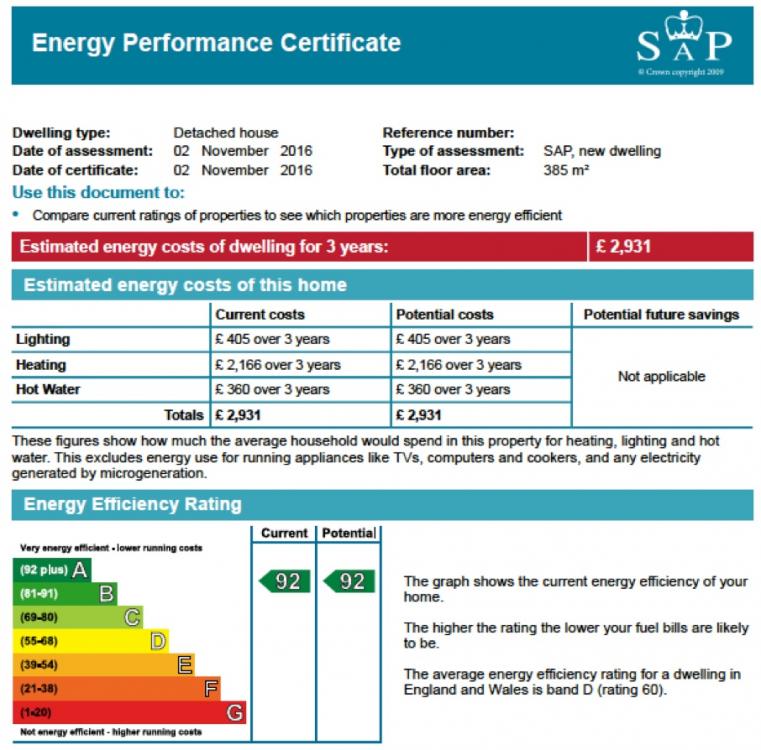
Found this interesting stat - bit old (end June 2014) but still relevant. http://www.lcea.co.uk/epc-ratings-explained/ EPC percentage splits for Domestic EPCs asset / band Ratings Domestic Energy Performance Certificates (EPCs) lodged on the UK Government’s Register by Energy Efficiency Rating which fall into each A to G asset / band ratings: – A 0.09% B 8.39% C 27.68% D 38.70% E 18.43% F 5.20% G 1.51% N/A 0.004%2 -
Just made it - we don't have a huge amount of solar PV and it's quite a large house, personally I think we'll have much lower space heating costs but the assessor assumed a 40 degree water temp for the UFH circuit. Anyway, I'll take it - means we get our Ecology discount for the next year of the mortgage!
-
I did all of our EPS cutting (for the external basement wall insulation) inside the basement box with a small electric chainsaw - it generated loads of waste, was like a mini snow globe when the wind got in there. Was a messy job to clean up also, especially as it became a mix of EPS beads, rain water, mud and other building cr@p. So, if you want to create some DIY EPS beads, go take a chainsaw to your insulation in a confined space Leads me to wonder what to do with the 6 200mm thick sheets of EPS 70 I have left - will probably stick them on Gumtree or free cycle..
-
Warmstar - they do a whole kit, primer etc. Tiler really liked their mats as they were properly sticky. I chose the default stat and just binned it, got a decent one from UFH SS. Also got the 6mm insulation boards, latex and tanking from ebay. Would advise getting the digital multimeter and installation alarm as well - it clips on and detects earth and L/N shorts during the install. Take lots of pics when laying, before laytexing etc just in case you need to cut the tiled floor after - my plumbers had to do this to get the waste in for the free standing bath. Was never so happy when they all warmed up for the first time.
-
We found dipping very tricky and gave up after the first loop. Instead we left out a long slot of deck where the loops crossed over the tops of the joists and then put ply over the top of this. Will see if I can dig out a pic. If Brendan is on your job, he should remember what he did at mine - just remind him about the basement house.
-
100% - we threw down the UFH in a day and a half over our 100m2 suspended timber ground floor. As Nick says, I looked into various options but using alu spreaders was the cheapest and the MBC lads were happy to help laying them down ahead of the floor deck - in fact they took over and put the pipe down also - I'm sure you can negotiate the cost of the pipe from MBC (same as you'd use in screed) and the plates are £3-4 each from UFH Superstore or Boulder. A few bacon sandwiches will grease the wheels here 100% on the de-coiler too. MBC will have one in the van usually if you don't want to hire or buy (and return if you 'forget' to use it ). Once the pipes were down, the 22mm deck board followed - in our case, rather than use battens we left out sections of deck where the returns came up over the pozi joist tops (held with a pipe clip) - its impossible to thread the pipe through the joist at each return. This was OK for us as we knew we'd be laying ply on top in prep for the resin floor - if you go the same way, allow an extra 12mm floor thickness. Also did the stapling from underneath and everything was snug. Just watch when internal walls are fixed to the floor and plumbers & sparks drill though the floor - they need to be constantly reminded abut the pipe underneath! We have nearly 50mm floor build up in timber (22mm OSB deck and 21mm in ply) then 2mm rubber crumb and 2mm resin. Takes a while to warm up but has rarely come on so far with the air temp set to 21. We don't have heating upstairs apart from towel rads and electric UFH in the bathrooms (very last min addition) - spent pennies on the UFH - cheapest 100W/m2 mats from E-bay and they work a treat. Tiler was happy to throw them down as he went but make sure your electrician has made the necessary provision with ducting etc for the probe and tail of the mat. Top tip - label the circuit pairs (and their location) before you commission the heating. We have 6 circuits downstairs, 5 on one stat and one on the other. Took some trial and error to isolate the one circuit - had to crank the heating up and send the cat off to find the warm spot.
-
BT/Openreach New Connection
Bitpipe replied to worldwidewebs's topic in General Self Build & DIY Discussion
They do have different addresses as the current connection is 'site office' and is classed as a temporary connection. The fact that it was previously a residential connection is hopefully immaterial Main reason I did it is to avoid a break in service. When we moved the wire from old house to the container, they treated it as a house move so did a cease on the line and the re-connection followed a week or two later. -
BT/Openreach New Connection
Bitpipe replied to worldwidewebs's topic in General Self Build & DIY Discussion
https://www.openreach.co.uk/orpg/home/products/pricing/loadProductPriceDetails.do?data=pAWshrQ7XRSLb9S%2BW8IAk0G8vUtdrlJTUevDC2QqJZ8lMnGHsqdC0vzO163bJmh34D91D7M0q8u%2FIlSgtIFAKw%3D%3D Product - Wholesale Access First Line. - The first £3400.00 of charges will not be raised against the first narrowband voice service provided at a site. 30/08/2007 3,400.00 -
I had a quote for a sprinkler system in our core and basement (100m2) that was about £6k plus potential extras of £1500. Main reason we considered it was to remove the need for external basement stairs. One of the upsides of a sprinkler is that it causes less water damage when suppressing a fire compared to the fire brigade, especially the (more expensive) atomising mist variety. In the end, we went for the exit option and it's made the space more usable.
-
BT/Openreach New Connection
Bitpipe replied to worldwidewebs's topic in General Self Build & DIY Discussion
Now we've moved in, I really need to sort the BT situation. Currently I have a drop wire to the site hut/container and have the master socket & BT Hub there. Using a pair of power-line plugs to squirt ethernet into the house and into a wifi access point. Connection is flakey and bandwidth is massively reduced across the hops. Groundworker laid BT duct from outside the basement plant room site perimeter, roughly opposite the BT pole where the current drop wire originates. I have a quote from him (£900) to take this across the road (it's a dead end and we're the last but one house, so no real through traffic) to the foot of the pole. Like others here, I've been told by local OR engineers that they'll happily pull cable through a duct as its way easier than rigging a new drop wire. Second bit of intel I got from a OR engineer was that there are two types of field worker, OR employees and contractors. The latter do more straightforward jobs and have more basic supplies. For duct work a OR engineer is needed with underground training & the gel filled cable. So, after going round in circles on the OR site, which looks geared to greenfield sites and developers, I've just bitten the bullet and ordered a brand new connection, figure when they come here next week and I show them the ducting and explain why a drop wire is a non starter, we'll see what's what. I did look at their price sheet to see the price per / m for road crossing etc. The £3800 new connection allowance is also there. If and when the new connection is active, I'll just cease the old one and get them to remove the DW so I can remove the container. Once more into the Openreach Breach my friends... -
The only day rate trade we had was our joiner - his work was a good standard but output varied day to day, which can be frustrating to a lay person. Obviously some jobs take more prep than others and communication is key - i.e. what's the plan for today, where do you think you'll be by the end of the week? If your time is free, then it's worth offering to go pick materials up (if practical) and ensure that bigger deliveries are on site on time, otherwise you're paying them to nip to Screwfix or the local yard on your behalf.
-
We have electric, water and phone coming into basement plant room and fouls from kitchens and bathrooms exiting. Gas is the only service that needs to come in above ground, ours then runs down into the plant room where the boiler and UVC are, plus elect distribution and MVHR. There are two basement approaches - an open box, where the floor is suspended timber (joists and deck) or a full box where the floor is cast in situ concrete or bison floor (or similar) that is screeded. If done properly, either should give you the tolerances you need. We did the former and had 2-3mm tolerance across an 11m run at the wall top. Pockets formed for steels (we had a steel lattice over the walls that the joists connected into, designed by our SE and supplied by MBC) had 25mm tolerance all round. MBC did come out prior to frame manufacture after the basement was cast to see if we needed to tweak anything, a few pockets needed small adjustment to get everything where it needed to be. Cant' see why the rc lid / screed option wouldn't be every bit as good as a normal raft. I'd say its a toss up cost wise. You will probably need to commit to structural walls or column in the basement to support a cast roof but the walls can perhaps be thinner (250 or 200mm vs 300) as the lit provides additional rigidity. We put UFH in alu spreader plates once the floor was joisted out and before it was decked. Did not put any UFH in the basement itself - its a pretty constant temp there year round, very slightly cooler than the ground floor. I was happy to use MBC but there are plenty of others so do your research and choose who works best for you. Ironically, the reason many choose MBC is because they offer a frame and slab package and remove uncertainty and risk around the interface - this didn't apply to me !