

Ed Davies
-
Posts
1674 -
Joined
-
Last visited
-
Days Won
1
Everything posted by Ed Davies
-
If you have a three phase meter do exports on one phase (e.g., from PV) cancel imports on another? If not, as I suspect, then it's probably best that any loads likely to be running when any PV is generating be on the same phase as the PV.
-
Something I've fancied for a while is bedroom blackout blinds that open a short while before the alarm goes off. Managing storage of energy, thermal for DHW or heating in tanks or the slab and/or battery storage in the home or car, seems like the “killer app” for home automation to me if you have any sort of variable rate energy supplies which you almost certainly will have with an ASHP when the temperature varies outdoors, never mind PV, E7/10 or smart meters.
-

Self-Build - window regulations - Danish windows
Ed Davies replied to Klim's topic in Windows & Glazing
https://www.gov.scot/publications/building-standards-2017-domestic/4-safety/48-danger-from-accidents/ 4.8.3 But you're in a different country. -
Does the preheat energy from your heat pump for your DHW come out of the heating or the hot water figure here? I'm thinking it must be from the heating part as 680 kWh/a is about 0.9 kWh/peep·day (assuming two people) which is way less than the usually assumed 3 kWh/peep·day so that 450 kWh is basically the electrical input to the heat pump? Still, quite impressive. Say your heat pump output is 1575 kWh/a (450 kWh times COP of 3.5) and you're actually using 2 kWh/peep·day of DHW that'd be 1460 kWh/a for DHW of which 680 comes from direct electric heat so 780 kWh off the heating leaving 795 kWh going into the slab. At 130 m² that's 6.1 kWh/m²/a which is not terrible. Or am I missing something?
-
That is interesting, as it's traditionally been considered not worthwhile because the cost of the wear and tear on the batteries exceeded the price difference. That was a calculation that needed re-doing, though, given how battery prices have changed. Be useful to say what your assumptions are here. Remind me, how much PV do you have? For the moment are you going to send the first lot of excess PV to DHW? Are you planning to also send it to your car, later? I.e., actually have the car charge rate roughly follow PV generation in some way?
-
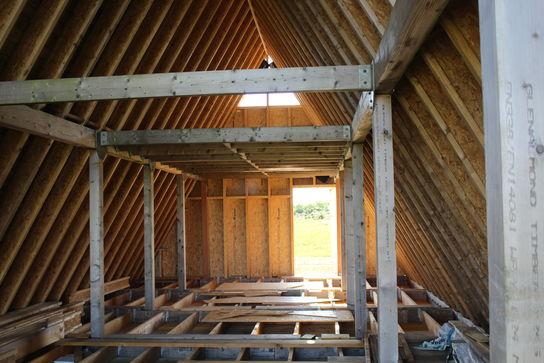
Since I've got about half the amount done I hoped to at the beginning of 2018 I'm not nominating a pocket at all.
-
Pity. In some countries it's normal to live on the lower floors building the upper ones as money comes available. Forget which countries I read it about, perhaps Egypt.
-
Living in it as is until they can afford to add the next storey?
-
Heating system for an ICF house with UFH
Ed Davies replied to Nelliekins's topic in Other Heating Systems
Part of why I was so confused by earlier bits of this conversation is that the “DHW Cylinder” doesn't actually contain DHW; it just happens to be used to heat DHW (via the PHE) amongst other things. Much better to call it a (small) thermal store, I think. -
I was watching the video when I thought of it but have just looked again. First time I didn't appreciate that the bolts are short enough that they don't go right though so you only have to avoid the places where the strut is bolted to its supports.
-
What centres are the Unistrut slots on? Sub-multiple of the panel width + 6mm?
-
Ah, OK. I was reading your Willis heater thoughts as a substitute for knowing the SoC well, rather than an addition to it. A slightly scary aside, but airliner fuel tank gauges also work this way. They, of course, have sensors in the tank to measure the quantity of fuel present but they're not very accurate so the quantities displayed to the crew come from counting the fuel put in (off those sheets of paper on the clipboard the dispatcher brings on board after you've just finished boarding) and fuel out via flow meters in the fuel lines to the engines. The tank gauging is just used to adjust the running total so it doesn't get totally out of wack due to cumulative errors.
-
Yes. I guess we're looking into how you'd use a hypothetical SoC indication to motivate asking for one. But sometimes you don't want to charge the PCM cell fully. E.g., you're charging from peak rate electricity in the early evening and only want to put in what will be needed until cheap rate electricity arrives at midnight. Or you're charging in the early morning and want to put in enough for a couple of start-of-day showers but leave as much room for charging from PV as possible. Households differ.
-
I don't think there's much controversy with respect to PV diversion: if there is spare PV power available and the store is not full then you should divert to the store. The only complication is if there are multiple stores, e.g., Sunamp + some sort of battery either in an EV or hanging on the house wall, when there might be a decision to be made as to which gets priority at any time. The question then is if there is another heat source, an oil or gas boiler or mains electricity: when should it be used and to what SoC should it aim to bring the store? E.g., it would be sad to charge the store fully on overnight electricity then only a few litres of DHW be drawn for washing in the morning followed by a bright sunny day with PV going to “waste” into the grid. This depends so much on the other system components (e.g., whether the other heat source's cost is time dependent, whether as @Nickfromwales says there's a combi downstream of the Sunamp in which case you'd be more willing to “risk” a low SoC to leave room for PV) and lifestyle (do you shower in the evening or morning, does the household use more or less the full capacity in a day or just a fraction). I think the most general solution is to have a target SoC for different times of the day (e.g., 70% at 06:00, 30% at 18:00 or whatever), leave the PV to do the best it can then boost as required to meet those targets.
-
Indeed, this is always a problem with PCM energy storage: it's easy to get a fix on the SoC at the ends of the scale but much harder in the flat-temperature phase-change part in the middle. Similar with many battery chemistries. The only way, really, is counting the joules in and counting them out again and, as you say, counting them in is easier though I don't think the Sunamp controller has a measure of the amount of variable current coming from the PV. With direct mains charging they can assume 2.7 kW, or whatever, but that doesn't really work for PV.
-
Wonder why the previous owner returned it.
-
Bearing in mind that doesn't happen in Scotland until about a week after New Year.
- 186 replies
-
- 2
-

-
- sunamp
- energy efficiency
- (and 1 more)
-
Beginning to wonder if that 90% setting was originally intended to be when it's discharged to 90% state of charge (i.e., 10% discharged) but it got misinterpreted by the programmer/technical writer and the management at Sunamp haven't yet realised what's happened.
- 186 replies
-
- 4
-
-

-
- sunamp
- energy efficiency
- (and 1 more)
-
https://en.wikipedia.org/wiki/Comma-separated_values ¯\_(ツ)_/¯
-
They're tab characters. Most spreadsheets should be able to import them easily enough though you might need to select the tab-separator option on the import/open page. CSV is a terribly badly defined format even when it's interpreted as “comma separated values” if any of the fields can contain commas. E.g., some software thinks all strings need to be quoted, others that only ones containing commas need to be then there's the question of how you escape quotes in quoted strings and whether new lines are allowed in quote strings, etc. Interpreting it as “character separated values“ and picking a sensible character like tab at least avoids that pain.
-
Hidden Door: anyone made one, installed one?
Ed Davies replied to ToughButterCup's topic in Doors & Door Frames
My niece has a hidden door from her bedroom into her en-suite. It's in a wall of shelves where just one section swings out like a normal door. If you didn't know it was there you just wouldn't notice it, no tracks on the floor or ceiling or anything like that. Sorry, quite a few years since I looked at it (she was five or six then, now at university) so no idea of the hinges or whatever. -
Help with kitchen renovation/ 1st house.
Ed Davies replied to zoothorn's topic in Bathrooms, Ensuites & Wetrooms
A lesson I've gradually learned: lay things out to be cut oriented towards where they'll eventually fit so you can visualize the move into the right place, a simple slide along or rotation upwards or whatever. That way errors like mirror images or measuring the wrong way will be more immediately obvious, ideally as you mark up rather than as you cut. -
Cement is 3 times more polluting than aviation fuel
Ed Davies replied to NSS's topic in Environmental Building Politics
The CO₂ emissions embodied in cement was one of the things which put me off a passive slab-type build. By contrast my house has used one mixer load (7.<something> m³) for the founds. There may be a few paving slabs later for the drawbridge, etc, and maybe a few pre-cast bits to sit the container on if I decide to keep it. For a passive slab, though, could you use CLT [¹] as a substitute? I'm thinking maybe two layers, with joins offset, with UFH groves and maybe internal wall, etc, slots CNCed out. Layers glued and screwed. Obviously the thermal characteristics would be a bit different (heat less immediately accessible) but it seems generally plausible to me. [¹] Cross-laminated timber: big kids' plywood. -
It's looking like the first run of decent weather here for months. I'll not be wasting it.
-
Cement is 3 times more polluting than aviation fuel
Ed Davies replied to NSS's topic in Environmental Building Politics
Re energy payback of PV, a good place to start though it's clear some people have been very confused by the first paper linked: https://www.carboncommentary.com/blog/2016/12/8/musqo7036dslptm1b8efduj6i3e7ms Linked, indirectly, from there though only the abstract is public: https://onlinelibrary.wiley.com/doi/abs/10.1002/pip.2548