Crofter
-
Posts
3451 -
Joined
-
Last visited
-
Days Won
10
Everything posted by Crofter
-
That's the strongest argument yet in favour of vinyl flooring
-
I could certainly put props underneath, at key points. Nothing fancy, just a length of wood and a wedge. I might do that under the stove actually, because I've ended up building the hearth up using three stacked paving slabs, and it's a lot of weight concentrated close to mid-span. If the joists deflect permanently it could open up an air gap somewhere. I'm a little surprised how much bounce there is in the floor- I used the online calculator on the JJI website to spec it. It's possible to get a miniature Millenium-bridge style resonance going if you walk around at the right speed.
-
Building Regs applied to a "lean to"? How?
Crofter replied to Ferdinand's topic in Building Regulations
Portable building works well for a standalone garden room, provided it is under 30m2 and has no sleeping accommodation, but it works less well for a lean-to because the structure has to be self supporting. -
My bathroom floor is built up using 300mm JJI joists at 600 centres, over a 16ft span. 22mm T&G P5 chipboard on top. There is definitely a degree of deflection going on with this buildup. The bathroom itself is at one side of the span, taking up 1.6m, so coming to about a third of the span. Can I just stick tiles directly down onto this using an appropriate flexible adhesive? If not, would a layer of ply provide sufficient additional stiffness? I know that is the default procedure, but tbh I'd be surprised if e.g. an extra 12mm of ply would be able to change the degree of deflection by any measurable amount. Perhaps my intuition is way off on this. The other option is to give up on tiling, and just stick vinyl down, which would be OK, I guess. It would have the advantage of the bathroom floor being lower than the rest of the house, so less chance of water running out.
-
Building Regs applied to a "lean to"? How?
Crofter replied to Ferdinand's topic in Building Regulations
How many of these structures are you allowed to build? I really like the idea of a big covered space at the back door- somewhere to stick the bikes, stack firewood, hang a washing line, tie up a wet dog, etc. I could presumably count it as either a car port or a covered yard, or both. So could I put two of these on two different walls of the house? -
Just about to click 'buy' on this and having a last minute hesitation about how much extra to order... If I buy eleven packs, I calculate that gives me just 2% left over (0.7m2). Not ideal! OTOH another pack sets me back £80. I'm trying to rein in the budget and it will be pretty frustrating to spend that money on a pack that might never be opened. And these things are almost impossible to sell on at a decent price in such small quantities. I'm a pretty careful worker, but 2% is a *very* slim margin... in the real world, how much wastage do people find they need to account for?
-
MiL had a 'tambor' unit with a roller door installed in her new kitchen. Another idea I've seen is a 'breakfast cabinet' which is like a dresser, and opens up to reveal toaster, bowls, boxes of cereal, coffee machine, etc. Or you could just use the grill...
-
I thnk I've got some boiled linseed kicking about somewhere, so I'll give it a try on an offcut.
-
They are indeed out of reach. But I think bare wood looks rather dull. I suppose it's personal opinion really! I'm not sure what species the wood is- it's not as red as Scots pine, nor is it pink like Douglas. Wouldn't surprise me if it was just the same stuff as used for framing, but it cost more because it's relatively clear grained and a planed all round finish.
-
I've been reading various old threads about the oil vs varnish question, and seeing a lot of praise for Osmo products. Thing is, most people praise its hardwearing qualities and moan about the price! So maybe I can get by with something cheaper, given these beams will see nowhere near the abuse(or even direct sunlight) that floors and skirtings do. The beams are 'dressed all round redwood' from the BM, and in no sense are they red in colour- what's that about then?
-
If your roof is designed/warranted/specced to use a tenting membrane and not rely on the racking strength provided by sarking, then you can go ahead without it. So long as you're happy that you're going to be able to work quickly and safely on the roof without it. If the tiling ends up taking much longer you might reconsider the cost of sarking
-
Yup. By the way, traditionally (for slated roofs), sarking was done with broad planks (11" wide sometimes); these days you would use 22x150mm treated sawn boards. But for new builds, it's common to use OSB instead because it is cheaper, faster, and gives better racking strength.
-
That photo should be quite helpful. TRADA recommends a minimum of 12mm counterbatten, but in practise everybody uses 25mm, probably less chance of it splitting or breaking. The battens are fixed right through the counterbatten and sarking, and into the rafters themselves, so the counterbattens are really just acting as a spacer.
-
I guess if you had no sarking the membrane would sag and you wouldn't need counterbattens.
-
My roof sarking is only 11mm, way easier to work with and considerably cheaper than 18mm. The membrane just goes straight on top of the osb- any water is just going to run down the slope.
-
Roofshield is very high quality stuff, twice the price of what I used, and my membrane lasted most of the winter exposed- although it was tightly battened down onto the sarking. I feel your pain about doing a whole roof on your own... and mine was probably much smaller than yours
-
I swapped out the flimsy twine that came with my ducting for a length of fence wire- no chance of breaking that!
-
Low profile concealed shower valve
Crofter replied to Crofter's topic in Bathrooms, Ensuites & Wetrooms
Lots of good ideas and info, thank you all! Been pretty busy today so will have a think and reply when I have a bit more time... -
Low profile concealed shower valve
Crofter replied to Crofter's topic in Bathrooms, Ensuites & Wetrooms
That's a belter. Go on @Nickfromwales Skye is lovely this time of year... But seriously, I'm way too late to be considering that sort of butchery to my floor. So a tray it is. -
Low profile concealed shower valve
Crofter replied to Crofter's topic in Bathrooms, Ensuites & Wetrooms
Go on, enlighten me... genuinely puzzled about how I would go about having a wet room. Would I have to raise the whole floor? Because I can't lower it to create a drain point without cutting into the tops of my JJI joists... -
Low profile concealed shower valve
Crofter replied to Crofter's topic in Bathrooms, Ensuites & Wetrooms
But don't deliver to me. -
Low profile concealed shower valve
Crofter replied to Crofter's topic in Bathrooms, Ensuites & Wetrooms
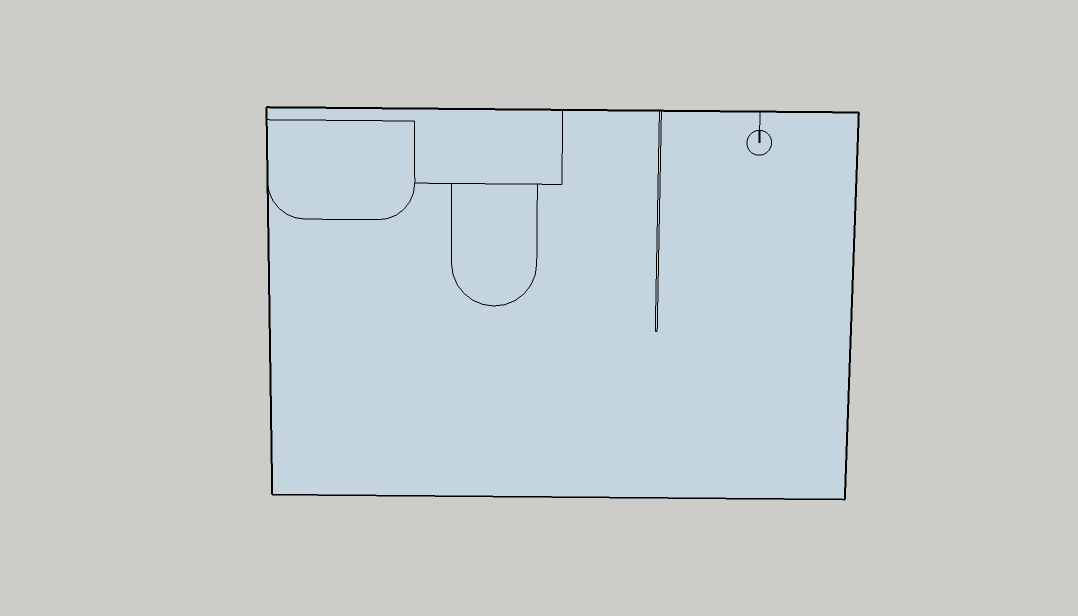
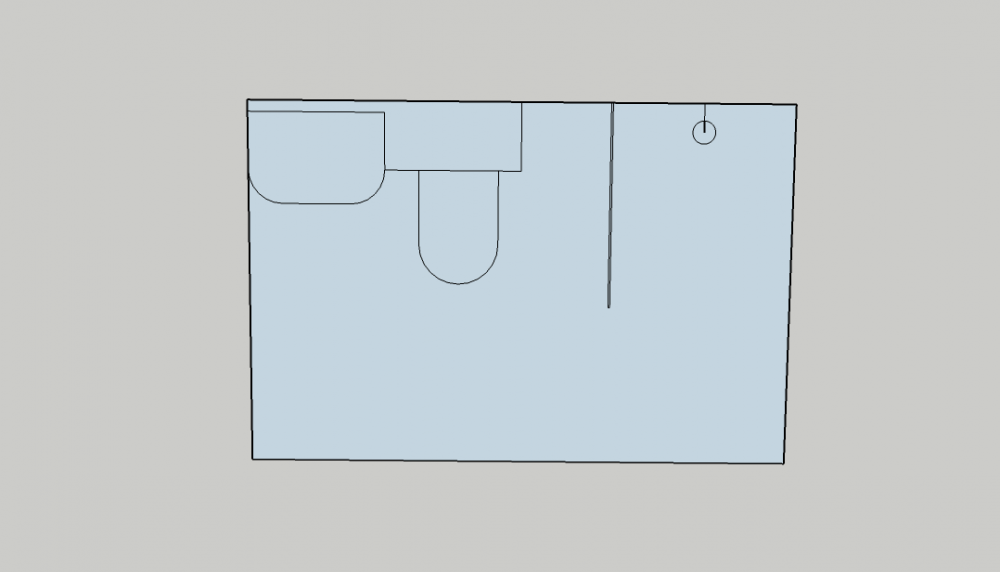
Thanks, but I don't think I can go for a wet room- it's on a suspended timber floor. My sketch was probably a bit misleading. -
Low profile concealed shower valve
Crofter replied to Crofter's topic in Bathrooms, Ensuites & Wetrooms
Not clear from my sketch, but the idea is for the tray to extend the full width of the room. And it probably looks like it's going to be a wet room, but it's not. Nothing set in stone yet... and I'm bracing myself for the delivery costs on a 1600x800 tray... -
SWMBO has decreed that it is not acceptable to have the shower mixer valve situated beside/under the riser rail. This is because the shower will be a large walk in enclosure with a fixed screen, and the riser will be down the far end. So she reckons we should have the valve 4ft away on the wall opposite the entrance, so that you can turn the shower on and off from outside. I reluctantly admit she may have a point. The problem with this is that the wall there only has a 25mm void behind the plasterboard, which is nowhere near enough to conceal a shower valve. I think I will have to resort to some combination of spacing the wall out a bit, and/or locally digging back into the insulation to create a bigger space. This means breaching the vapour/airtightness membrane and cutting back into the 50mm PIR, then making it all good again afterwards. It's not a particularly appealing prospect tbh. I could go a bit Heath-Robinson and fit an exposed mixer, with a third elbow fixed onto the outlet where the hose ought to go- this would feed the outlet back into the wall where a concealed pipe run would take it to the riser. Not convinced I could make that look right, and it would be a bit harder to clean. So my questions are... - does anybody know of an exposed mixer valve that is actually designed to be sited remotely, with its outlet feeding back to a concealed run? - failing that, what is the lowest profile concealed mixer valve that I can get? Quick and dirty sketch attached... remote mixer valve would be located on the RHS wall, opposite the entrance to the shower.
-
Ooft. Now that I am doing the top coat in some rooms (Leyland Hardwearing Matt, in pure brilliant white) I've got the task of painting white on white and it is doing my head in. I expected a bigger difference between the contract white and the PBW, but it's almost impossible to see where you've been, unless you can get the angle of the light just right to see the slight sheen. Any tips for this? I could try rigging up more lighting, but I already feel like I'm going snow-blind...