


Crofter
-
Posts
3484 -
Joined
-
Last visited
-
Days Won
11
Everything posted by Crofter
-
Indoor meter boxes - any regs applicable?
Crofter replied to readiescards's topic in Regulations, Training & Qualifications
Ok I'm drawing a blank here on finding a list of meter suppliers/installers. There's supposed to be a list on Ofgem's website but they've hidden it extremely well. Being the stingey git that I am, I don't like just picking up the phone to the most obvious supplier, if there's money to be saved by going elsewhere. But maybe SSE are the only game in town anyway? And does this mythical list exist, or is it a case of wasting half a day phoning individual electricity companies? -
Indoor meter boxes - any regs applicable?
Crofter replied to readiescards's topic in Regulations, Training & Qualifications
A what now? -
Indoor meter boxes - any regs applicable?
Crofter replied to readiescards's topic in Regulations, Training & Qualifications
I guess so! Hopefully I can get a shorter section than the full 2m. -
:blush: well I did wait until the light was crap before taking any photos The guys from SSE were saying what a smart finish I'd got- can't take credit for the plasterer's work though. Said they see every new house on Skye and this was the best finish they'd seen. The flooring is on the dark side but I think it will look pretty classy against the white walls and ceilings.
-
Just a quick update seeing as I had the camera on me. As always, not as much progress as I would have liked- I was away from the build for a lot of August, but it's good to come back to it refreshed. The painting is finally finished (that seemed to take an age), the WC is temporarily installed, and the woodburner is up and running- I'll do a separate entry for that, at some point. The overhead beams are now sanded back and sealed with Osmo Polyx oil- I'll use the same stuff on the windowsills. The trickiest part of doing the beams has been installing the spotlights, with some very careful drilling to feed the wiring through from above. These beams are tied into the rafters so any mistakes would just have to be filled as best I could, and serve as a reminder forever more. Today's task was to start on the flooring, which is carbonised strand woven bamboo. I am bonding this down so, again, little room for error. I decided that rather than start at one wall, I would mark a straight line up the middle of the floor, through the big connecting door, and then screw down a batten. This becomes my starting line and ensures that the flooring will tie up as it moves from bedroom to living room. I wa worried that if I'd started at the wall, then when the two sections of floor met up at the doorway I could find myself a few mm out. I have no idea if what I'm doing is common practise but it seems to make sense to me! I didn't get as far as bonding down anything yet today, as the floor turned out to be a lot dirtier than I realised, and I've spent all day on my knees with a sander removing blobs of paint and plaster. A few quid spent on some dust sheets would have been a good investment... oh well, I'll know for next time
-
Indoor meter boxes - any regs applicable?
Crofter replied to readiescards's topic in Regulations, Training & Qualifications
Just to update, SSE came round and were quite happy with what they found. They did stick their own bit of board over my double layer of OSB. Sorry for poor photo- it's on a cupboard with no lighting. They did say I ought to shield the cable with something, but it's just PB behind it so I can't just stick on any old thing. They mentioned there was some sort of self adhesive guarding available. Now I have my MPAN, so any tips on choosing a supplier? I want to have E7 if that makes any difference.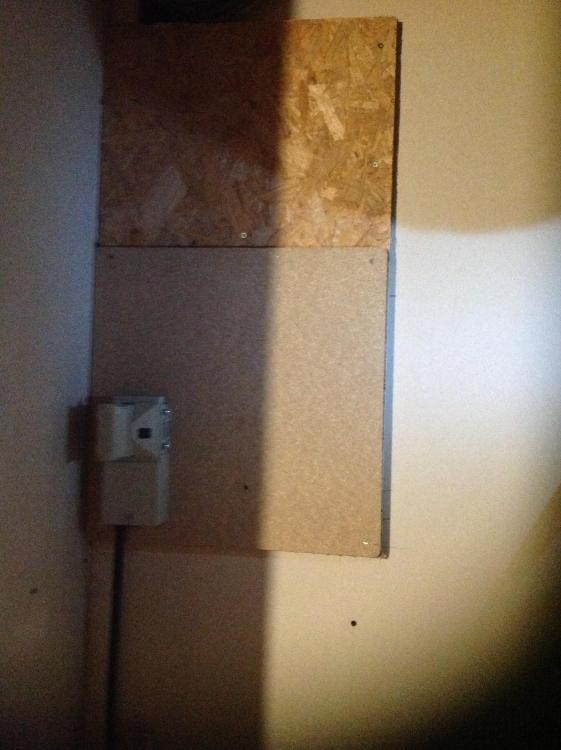
-
It's early days yet- lots of decisions ahead. Agree that electric could be good. It would be a fairly small setup (maybe 2 showers max) and for summer use only, so incoming temp ought to be reasonable. And any sort of shower must feel like luxury if you've just woken up in a yurt, surely?
-
Hi Kerry, I seem to have missed this thread. I'm on Skye too- whereabouts are you building? Happy to share advice and have a general rant at the unreasonableness of delivery costs
-
Obviously planning would be required for all of these things, and a BW for the wastewater treatment. What I'm hoping to clarify is the standard that the facilities block needs to be built to. As many of us know, it can be pretty hard to upgrade an old building to meet modern regs if you are converting it into a house. But does a toilet/shower block need to meet the same standards as a house?
-
Asking for a friend, who is considering getting into the glamping business. This would involve a number of pods and/or yurts, which would obviously be building regs exempt (as portable buildings), as well as a facilities block for toilets, showers, and perhaps laundry and basic cooking area. if the facilities block was likewise a portable building, then it's happy days. However my friend is keen to convert an existing stone byre for this. I know that as soon as you put sleeping accommodation into a building, or it exceeds 30m2, then you are into regs territory- but what about toilet, shower, laundry, kitchen?
-
Yes, why would you use copper pipe and plastic fittings? I've actually gone for the opposite- brass compression fittings onto Hep20 pipe. Seemed like the best mix of avoiding joins and having small enough fittings to fit into my 25mm service void. Although I think I'm going to manage to arrange it so that all of the fittings are accessible anyway, with nothing boxed away behind the PB.
-
Boots, shoes, trainers: steel, composite, which?
Crofter replied to ToughButterCup's topic in Tools & Equipment
Dunlop Purafort steel toed wellies, in yellow, as endorsed by every fisherman in the world. Wouldn't be seen in anything else! -
Single Room MVHR
Crofter replied to Crofter's topic in Mechanical Ventilation with Heat Recovery (MVHR)
There are 24v and 12v units out there, so it would be either directly wired in, or powered using a DC-DC converter. -
Hi and welcome to the forum! Hard to answer your query without understanding what your priorities/requirements are... cost, longevity, ease of cleaning, aesthetics, sound transmission, comfort underfoot? If the look you are after is wood, then there's not much better than good quality oak, as I'm sure you already know. But it's not necessarily that durable- it can scratch easily enough if you move a piece of furniture, or get a bit of grit caught under a door. It may not be compatible with your heating system, if underfloor. It may be too noisy for the rooms downstairs. And if it's good quality, then it won't be cheap- probably £40/m2 or more. You can find oak at half that price but it will have a 2mm wear layer which won't stand up to sanding out damage. Another option would be bamboo- similar appearance, can be much cheaper (starts at about £22/m2) and far better durability. I've opted for this, although have yet to lay it, and @JSHarris has done his whole house in it. Compared side by side, oak does look better IMHO- but you can't have your cake and eat it. If noise transmission is an issue, you'll need to consider a good quality underlay, or abandon hard flooring altogether and go for carpet.
-
Single Room MVHR
Crofter replied to Crofter's topic in Mechanical Ventilation with Heat Recovery (MVHR)
The primary purpose would be to address condensation whilst not losing too much heat. My thinking is that a small MVHR unit acting as the primary means of ventilation would shift a decent amount of air, but without lowering the cabin temperature right down to the same as outside. Am I right in thinking that by maintaining a higher cabin temperature, an MVHR system would shift more water vapour than a normal extractor fan? I do have a rudimentary heating system, which is diesel fuelled with its own flue. This makes a modest difference to the cabin humidity by raising the temperature, but is not enough to overcome the condensation produced by cooking or breathing, unless the ambient temperature is already quite mild. Overheating is, as you say, not likely to be an issue where I am! I am toying with wiring the MVHR up in two ways- manual boost for when the boat is occupied, and on/off via a VSR otherwise, so that is acts as a dump load for the solar panel. That might be more hassle that it's worth actually because in winter I will have barely any excess power, and that is when I would need it the most. And it might be that for an unoccupied boat, where cabin temperature is irrelevant, it's best just to rely on the dorades and the forehatch which can be left slightly ajar. Shore power would be a massive game changer, but a marina berth would involve moving the boat either hundreds of miles or a ferry ride away, and would put up my annual costs by about five-fold -
Wet room without mosaic tiles?
Crofter replied to divorcingjack's topic in Bathrooms, Ensuites & Wetrooms
And you can just tile straight onto that liquid membrane? (once it's dried... I'm not a complete idiot you know...) -
Single Room MVHR
Crofter replied to Crofter's topic in Mechanical Ventilation with Heat Recovery (MVHR)
So some more thoughts on this- the daft boat-mounted MVHR idea, that is. How much free space might the outside part of a unit require? I'm struggling to think of somewhere to mount it that is well enough protected, and wondering about putting it in a cockpit locker. This would place the inside component right at the galley which is good. I obviously can't have it venting in and out of a cockpit locker- but I could build an enclosure around it, and have a grille. Not sure if these units need to see a nice free flow of air though, and that this might be too restrictive? -
You could extend the LV section of cable and mount the transformer remotely if that helps?
-
Or what about the systems used to fix wet-wall panels? Metal ones obviously, not the icky plastic stuff.
-
When my Dad (a civil engineer) was building a house, the BCO told him to stop phoning up asking for inspections because everything he had done was perfect. Which is a great story until you learn that all this perfection slowed the build down so much that it was never actually completed On my last house, I was really surprised that the joiner working with me insisted that we box away everything structural without any inspections first- we were doing a loft conversion and making some alterations to the joists. But sure enough on my one and only inspection, the BCO just wandered about with a tape measure and checked things like the handrail height and the MOE window. His biggest concern was whether we'd deviated from the plans, and when I told him that we hadn't, he was happy as Larry.
-
Is this the chance to buy some new tools?
Crofter replied to MikeSharp01's topic in Plastering & Rendering
My heart bleeds I've just had to pay £50 P&P for a £200 shower tray, and that only got it as far as Inverness; add another £65 van hire on top to get it to me. I swear I spend more time sorting out postage/haulage than actually building stuff! -
Is this the chance to buy some new tools?
Crofter replied to MikeSharp01's topic in Plastering & Rendering
My sparky was pretty good at borrowing my multitool, except for one lightswitch where he just grabbed a padsaw. And this was in a wall that was already plastered. Not massive chunks coming off, but certainly enough that I'll need to make to good with filler. Totally avoidable. This is why I'm doing 99% of the build myself... -
Is this the chance to buy some new tools?
Crofter replied to MikeSharp01's topic in Plastering & Rendering
I did all my PB without a collated driver. I had the loan of a 110v Makita one but it was unreliable, kept marking the PB or just jamming, and the cord was too short so I was forever lugging around a huge transformer. Really wasn't too slow to do it all the hard way, using the drill rather than impact driver, so that I could set the torque. For cutting box-outs, the oscillating multi-tool was weapon of choice- although I've used plastic boxes fitted after the PB. -
Wet room without mosaic tiles?
Crofter replied to divorcingjack's topic in Bathrooms, Ensuites & Wetrooms
Sounds like a neighbour worth having! -
Indoor meter boxes - any regs applicable?
Crofter replied to readiescards's topic in Regulations, Training & Qualifications
My duct is 63mm rigicoil or whatever it's called- in black. The spec did say 32mm but I figured that I would hopefully get away with it, since it's what I had on site. I'll find out tomorrow...

