Iceverge
-
Posts
4485 -
Joined
-
Last visited
-
Days Won
32
Everything posted by Iceverge
-
300 mm rafters are hard to find and expensive. 220mm should cover most bases structurally and an insulated service cavity or external layer of insulation should see you OK.
-
Welcome. Do you mean a cavity walled house? EWI external wall insulation doesn't require an external layer or masonry. In any case it might be easy to think the walls of the house are an expensive part but they're not really. Keep the roof simple and the structure simple to make the best use of your cash. Any plans(without your personal details) to share?
-
Scissors trusses may be a choice if you did want the vaulted look. 400mm is quite generous for the floor build up. You could probably slim it down a bit in various rooms with some top hung posi joists. 18mm flooring, 220mm posi joists 12.5mm plasterboard x 2 3mm Skim 266mm Or 18mm flooring, 220mm timber joists 17mm resilient bars 12.5mm plasterboard X 2 3mm Skim 285mm
-
 I hope it works but fundamentally I think government targets are the wrong way to go. Feels like the infamous Soviet tractors factories. Better in my view to eliminate the hurdles in the planning system. Here are some of my ideas. 1. A walk in, walk out service for domestic houses. 2. Default an application to approval if the council doesn't reply in an appropriate period of time. 3. Guaranteed same day approval for knock and rebuild if your house fits inside the same "box" and the style is appropriate. 4. Compulsory purchase and immediate public auction of derelict houses and brownfield sites. 5. Relax the listing criteria for lower grades of houses so that people can properly "restomod" their houses rather than being forced to live in something's from the dark age.
 -
2.7m downstairs here and 2.65 upstairs here. The best ceiling height seems to be a factor of room size. A very large room with a 2.4m ceiling will seem very low whilst a small room will be ok. I wouldn't be plasterboarding the wall like that anyway, terrible for airtightness. Wet plaster for me every time.
-
Timber or Casoline type ceiling void
Iceverge replied to Mr Blobby's topic in General Construction Issues
They just shot nailed the hangers in in our house with a Hilti gun. -
Manifold system versus hot return system
Iceverge replied to Russell griffiths's topic in General Plumbing
Everything is downstream of the PRV for us and I notice no difference when showering no matter the draw on the cold. We have a borehole so the pressure is as good as we want it. Maybe the thermostatic shower takes care of any differential flow. -
Timber or Casoline type ceiling void
Iceverge replied to Mr Blobby's topic in General Construction Issues
Metal is incredibly fast. 2 men did 90m2 for us in about 4hrs and it was perfectly level. We varied the ceiling void from 300mm to just about enough to fit the 75mm MVHR pipes in different rooms to maximise ceiling height. The only place I would consider timber is with 22x70mm strapping where there was no ducting, again to maximise the ceiling height. However you'd need a lots of shimming to get it level as the hollowcore slabs have a curve on the bottom. -
Yeah, no probs.
-
Manifold system versus hot return system
Iceverge replied to Russell griffiths's topic in General Plumbing
That was ours. I would have no issues teeing off inside a bathroom for a basin or w/c provided that the joint was easily accessed and ideally there was a floor drain somewhere to catch any leaks.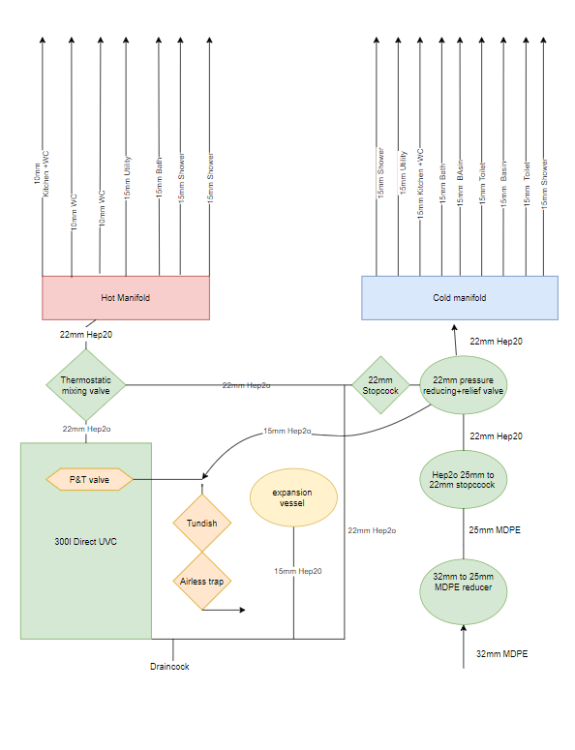
-
Manifold system versus hot return system
Iceverge replied to Russell griffiths's topic in General Plumbing
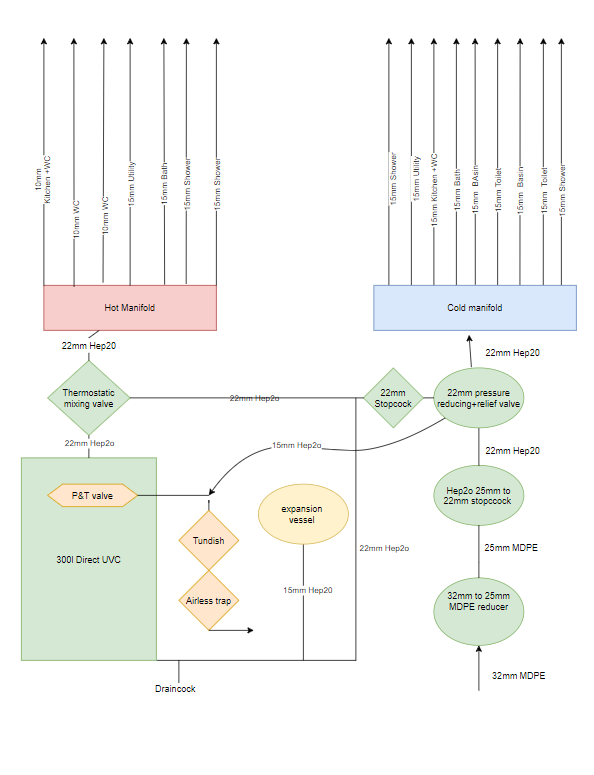
Bigly complicated IMO. What is the length of run to your kitchen tap? Ours in 13m and takes about 10secs to hot at 5/6l/min from a convection heated 10mm pipe. A good chunk of the volume of the dead leg is in the kitchen tap though. In any case, assuming you are using a mixer kitchen tap, my understanding is that you would need to feed the cold through the T&P valve to ensure a balanced flow so not teed off the mdpe individually. 25mm MDPE to the stopcock, 22 mm Hep20 to the cylinder and then manifolds, 15mm for kitchen/utility taps + bath/showers and 10mm for everything else. Our 10mm gives roughly 5.5l/min, 15mm gives about 10l/min. -
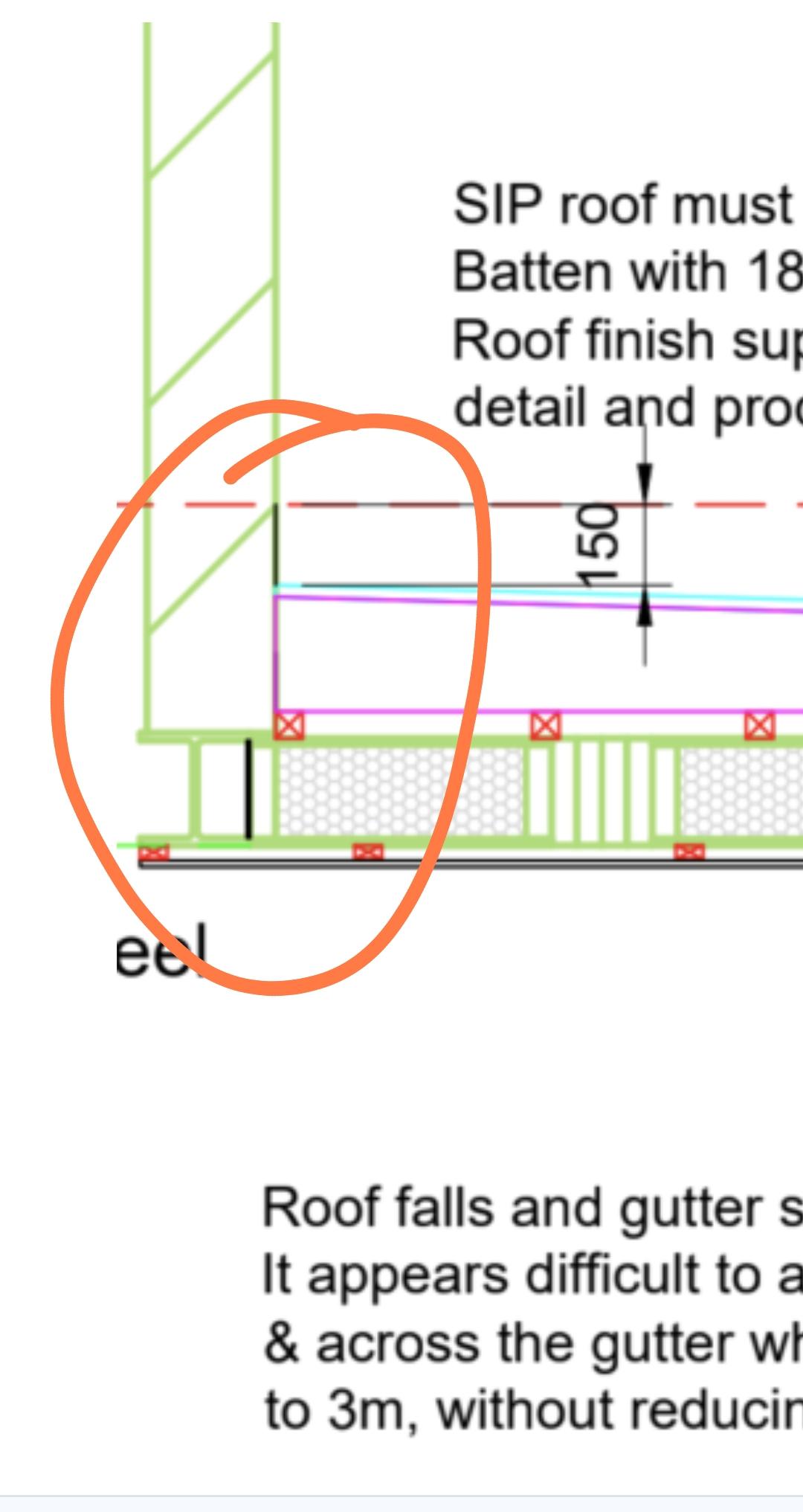
A warm roof is exactly the same as a SIP. Typically Insulation sandwiched between layers of PLY or OSB. I'm unclear as to why you can't just apply EDPM straight on top of the SIP. maybe with one layer of OSB to bridge the joints if it was necessary. Rest the SIPS on a beam or exposed glulam internally to to maximise the ceiling height. Dispense with the parapet if you can. It's a recipes for leaks or troublesome cleaning duties. To ensure a slope just support one side of the SIP higher than the other.
-
What is Ubakus really doing? And what is that 2/3 - 1/3 rule?
Iceverge replied to Garald's topic in Heat Insulation
True that, Pacific NW gets plenty rain i'd have thought though. I must look up the design codes. God , what has my life become. -
I'm guessing that this part of the roof can't get any higher? Is the steel in place? Is it overall thickness of the roof or slope you're mainly concerned about?
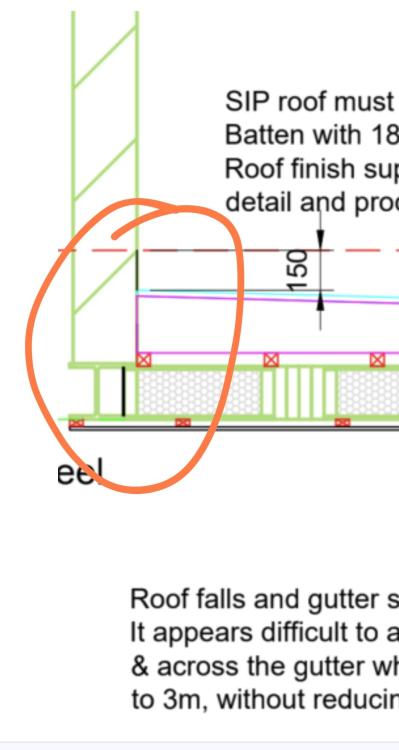
-
What is Ubakus really doing? And what is that 2/3 - 1/3 rule?
Iceverge replied to Garald's topic in Heat Insulation
The dirty secret that is little talked about is the effect airtighess has on moisture related problems. Do a proper sealing job with one layer of low vapour permanently anywhere in your wall or roof,then stick insulation either or both sides of it, and problems just don't occur. Look at the houses in the US in mega cold climates with an external taped layer of OSB that survive just fine. Meanwhile badly constructed dry lined houses here end up as "fungus in your wall nirvana" despite looking fine in a model. The point nobody considered was the crap air sealing that is the norm. -
What is Ubakus really doing? And what is that 2/3 - 1/3 rule?
Iceverge replied to Garald's topic in Heat Insulation
Do this by reducing internal humidity, more heating and ventilation. Less drying of clothes, diligence with extractor fans and cooker hobs. Adding more insulation outboard if possible like EWI. Eliminating multiple layers of highly impermeable materials into the wall to facilitate frying both onwards and outwards. Improving airtighness to prevent air cracks taking moist air into the wall. -
What is Ubakus really doing? And what is that 2/3 - 1/3 rule?
Iceverge replied to Garald's topic in Heat Insulation
It took me 6 years to have my Eureka moment. The only principle that matters is: The average amount of DRYING must exceed the average amount of WETTING. This is the only thing that matters. If you heat and ventilate any space sufficiently then there will be no problem with moisture buildup regardless of insulation and airtighness layers etc. Take an aircraft for example, the impermeable skin is outside the minimal insulation, often at sub zero temperatures but there's no issue with moisture despite hundreds of people breathing it out. That is because they are ventilated and dehumidified to within an inch of their lives by the air-conditioning. A well built thermal bridge free house with a vapour impermeable barrier inboard may still suffer moisture problems with excessive moisture generation and poor ventilation. It is a highly dynamic situation and in reality all you can do is make a best guess with a model then suck it and see. If you find yourself at the wrong side of things then you need to add DRYING and reduce WETTING. -
What is Ubakus really doing? And what is that 2/3 - 1/3 rule?
Iceverge replied to Garald's topic in Heat Insulation
I've been thinking about this for about 8 years now since starting the house process. Any model is naturally limited in its output because there is only a finite amount of inputs. Ubakus for instance will throw up moisture trapped within a wall for some buildups, however that is only when the outside air temp is at the default of -5. Whilst most of us might get that occasionally it's almost never long enough to cause an issue. If you live in Siberia it might be a different story. This issue is easily solved with some analysis of the most lightly worst case weather scenarios based on historic data and future predictions. However what is impossible to predict is the exact amount of showering or stir-frying the occupants do. Now hot they heat their house, how long the kids leave the door open. Their choice of paint for the walls, or even how many coats of it. Any model which will assure you of this is wildly pessimistic. Any guaranteed moisture safe construction is hugely conservative with its vapour management and the as built thermal grading. Take an ewi wall and a cold vented attic as examples. -
Helping family member buy a house
Iceverge replied to Jilly's topic in P2P lending, Crowd Funding and Alternate Sources
A one off gift is often spend with haste and quickly forgotten. A persistent small annuity might buy more comfort in the long term. -
Helping family member buy a house
Iceverge replied to Jilly's topic in P2P lending, Crowd Funding and Alternate Sources
Perfectly reasonable approach but everyone sees things differently. I would be apprensive of presenting a solution to someone unless they really enthusiastically agreed with it. I know of a situation where someone was gifted a brand new house in a nice estate by a family member in the same village in order to divide up and sell their deceased parents house which was smaller and much less habitable. They just didn't move out and the new house is/was idle. Very true. Whilst a new house in the same location may be the ideal situation but we don't live in an ideal world. Shifting kids around the country isn't ideal, especially if they're doing well in their current school. Perhaps just sucking up the current living arrangement for a few years until school is finished might be the best. You could maybe then get somewhere for their mum. Alternatively give some cash to the kids towards their education, school trips , uniforms etc and take some pressure off their mother. Maybe you could pay something towards university or training if they were keen. -
Habito, Fermacell, OSB & Plasterboard, Ply & Plasterboard, or…..
Iceverge replied to G and J's topic in Building Materials
11mm OSB then 12.5mm plasterboard and skim gets my vote. You could increase spacing of your studs to 600 cc then. If you were to move the airtightness layer to the outer sheathing as per my previous post then you could install all wiring in the main stud bays, fit the OSB with whatever depth back boxes suited your electrician, drill a 70mm hole for the cellulose blower in the top of each bay, blow full of insulation and plasterboard over the top. Then just use slightly longer screws to fit the socket face plates as needed to account for the depth of the OSB and plasterboard. -
@The Bear Have you already bought the kit? You've made a fine job of that base, I don't think a stick build would be beyond you.
-
Helping family member buy a house
Iceverge replied to Jilly's topic in P2P lending, Crowd Funding and Alternate Sources
Have they asked for help? -
Normal blocks aren't that hard if you take your time. However by the time I had built our house, our block-layer would have completed the great wall of China.
-
MVHR and log burner
Iceverge replied to Tetrarch's topic in Mechanical Ventilation with Heat Recovery (MVHR)
I have the "stranger on the internet" qualification, does that not count for anything 🤣?! I am of the opinion that it a regulation that is based on the square root of an uneducated guess by someone without even a highschool understanding of physics. Regulations are what the manufacturers and Hetas copy and paste. Can anyone point to me a controlled study where there is any actual data on this? Any real world examples of carbon monoxide poisoning where MVHR was a contributing factor.