Iceverge
-
Posts
4485 -
Joined
-
Last visited
-
Days Won
32
Everything posted by Iceverge
-
 Welcome welcome. Nice to have someone from down under and to learn from your particular situation. A friend of mine built a hemp Crete house recently but from blocks in Ireland. Lime render 75mm hempcrete blocks 170mm hempcrete batts in a stick built timber frame. 75mm hempcrete blocks Lime render. I don't know if the blocks are available on Oz but it was less labour intensive than shuttering on site hempcrete. For the TF have you considered stick built on site? I like the hammer band they use in Sweden rather than a double top plate. Maybe it would solve your lintel issue. See 9mins20secs into the vid. https://youtu.be/4nRz0D0bNmg?si=qOs-IhmdRxzuLNad
 -
Design for mull of Galloway. Thoughts?
Iceverge replied to DannyT's topic in New House & Self Build Design
Good ones that won't be draughty will cost a fortune. Most of them are rubbish at air sealing. I would get french windows.witb fixed sidelights. They'd be fraction of the cost and seal much better. -
Installing a small MHVR system
Iceverge replied to Mark-R's topic in Mechanical Ventilation with Heat Recovery (MVHR)
Those flexible silencers aren't great. I would use a rigid metal one in preference. Another option if there is no solid wall for the MVHR unit is just to sit it on the ground floor on rubber feet or a matt. Mechanic ventilation with or without heat recovery is always worth it regardless of airtightness levels. True it won't do much on a leaky house on a windy day but it will serve a valuable function on days with no wind in keeping the interior healthy. dDCV is cheap and easy to install if you can live with out HR. -
Sounds enormous, too big I would say. I know of a couple of circumstances where people built a "garage". Say 5.5m x 8m externally with a converted attic above. 2 rooms upstairs and 2 downstairs and a w/c shower too. 70m2 total. Specs at a guess are 150mm floor insulation, 150mm EPS beads in the walls, Second hand uPVC Double glazing and 200mm mineral wool between the rafters. All within planning but not built to current building regs. However it was wired and engineered safely. In any case better than almost all rental properties. Given how hard it is to find housing here and the need to get kids started in local schools etc it was perfectly understandable in my mind. When the main house was finished then they moved in there, used the garage as storage and used upstairs as an office.
-
Are you growing weed or developing some commercially sensitive form of geranium? If not I can't see the issue. Can you elaborate please. Have they engaged with you informally and if so how did you respond? Escalating things to the solicitors level seems drastic and in the long term only benefits the solicitor. Have they explicitly said this?
-
Shower tray waste type & stench from toilet flush
Iceverge replied to Greenjefe's topic in Waste & Sewerage
Broken AAV. Air admittance valve. -
Your wife is very very right. It's a house not a branch of currys. nothing more frustrating than being unable to work the controls. It's more expensive, more lightly to break etc. Single zone heating on a timer or single thermostat. All rads no plinth heaters or fan coils or UFH. UVC for DHW only. No messing with banking heat for space heating. It doesn't really work unless you have thousands of litres. dMEV to every wet room. Electric UFH in bathrooms on a switch or timer. Fastidious attention to Airtightness. As much insulation as you can fit. As much PV as you can fit. No home automation or connected nonsense. It's out of date as soon as it's installed and everyone who is not Geek hates it.
-
Fine, beware for DHW you're roughly halving the capacity of the store Vs an UVC. Eg a 500l TS will only deliver roughly half the amount of hot water a UVC will at the same temp. They work well with high temperature water supply though. I put a 250l Maxipod in my parents house. Good idea. Water is a cheap battery. Beware you may not have quite enough solar in shoulder months to achieve the 60ish Degs a TS needs to work. An UVC meanwhile will work right down to 40 DEG. Fine for DHW, however unlightly to do much for space heating. Beyond early morning. Rads everywhere. As large as you can fit. Simple cheap, all on the same zone. Put electric UFH mats in the bathroom on a timer for comfort. In my parents house the solid fuel cooker will often get the store to 70ish Deg + after which the rads will kick in to dissipate the excess heat. They'll be running at maybe 30deg which is far more comfortable than the regular "hot" rads you get. My point being, if you oversize your rads and run them at a low flow temperature then you'll have lots of the benefits of UFH without the complexity of integrating a new and old system. Good plan. If you were just to add 10mm of PIR under the floor though it'd make a world of difference. I did a thermal model here for someone ages ago. There's no mystery with internal insulation. Just make sure it can "DRY" more than it gets "WET". 1. Eliminate bulk water. Gutters, chutes , drains leaks driven rain etc. 2. Regulate internal humidity with mechanical ventilation. MVHR DCV and PIV is the hierarchy. 3. Don't build layers in manner that will trap moisture with materials of very low permeability, PIR, foil, polythene etc. 4. Stop air taking internal moisture where it should go via air leaks. Lime and hemp is good, but over sold IMO. A mild sand cement wall parge and tapes to the windows and floor for Airtightness. A battened layer of mineral wool for insulation and plasterboard would be fine. Airtighess is the key here.
-
Speedfit pipes. What do I need to know?
Iceverge replied to saveasteading's topic in General Plumbing
If you have the time why not. We're in a borehole so I try to avoid copper and brass where I can. -
Speedfit pipes. What do I need to know?
Iceverge replied to saveasteading's topic in General Plumbing
Hep20 all the way home for me too. Less joints is always better than more joints. -
Speedfit pipes. What do I need to know?
Iceverge replied to saveasteading's topic in General Plumbing
Copper to Hep20 worked primo for me. Also I put Hep20 straight into compression fittings. Not recommended by @Nickfromwales but I've had zero issues with it. .........so far...... As documented previously I tried to insulate my way out of a hot water issue with a huge dead leg caused by moron plumbers. It didn't work. My philosophy would be to absolutely minimise the amount of water sitting idle in pipes and not bothering with insulation on them. They cool quickly regardless. Then MAXIMISE insulation around the cylinder including any pipes that are permanently hot. My only exception to insulating pipes is outdoors for freeze protection and inside for hot return loops. ( A good house design will make these redundant anyway) -
Flat roof design 101 from basics for the Suffolkian idiot….
Iceverge replied to G and J's topic in Flat Roofs
That ply between the foil and the PIR will be cold and attract condensation and won't be able to dry out again unless you have superbly low internal humidity. -
Slight cracks at top of wall just below ceiling
Iceverge replied to AidanGee93's topic in General Structural Issues
That looks like a problem that needs to sorted from outside. Can you get any picture of that? -
Lol, wasn't actuallly ment to be a joke! Yes noise transmission would be a potential downside.
-
Speedfit pipes. What do I need to know?
Iceverge replied to saveasteading's topic in General Plumbing
There's not much margin for labour for a plumber in it I guess. Nobody likes doing themselves out of a job. It won't pop out, it'll weep a little at the joint. Usually from a scratched pipe. The joints can be disassembled but it's more fiddly than the videos suggest. One thing I noticed about them was there's less water hammer than multilayer barrier pipe and press fittings. Time spent with a a pen and paper before install will be well worth it as they'll look a mess if you don't plan it all out. -
I don't know why we don't use more insulated metal panels on houses. They're extremely fast and perform very well.
-
Mortar is sloppy work by nature. If you want zero drips use a different method. Like @saveasteading says the most important thing is a workable system . My preference had I to do it again would be to extend the cavity as low as possible so that any fallen mortar would still be far below the floor level. Have a hose on site to give a quick rinse of the ties at the end of every block laying session to clear them of any mortar. Pump the cavity with EPS beads.
-
Speedfit pipes. What do I need to know?
Iceverge replied to saveasteading's topic in General Plumbing
+1 for Hep2O. Plastic pipe tidiness is directly proportional to the amount of clips used. The fact the fittings are double the price would have a lot to do with it. Building industry is slow to move from what they know too.

-
Who ultimately decides and how can I know upfront?
Iceverge replied to flanagaj's topic in Planning Permission
Can you drag out the local planning applications and read the planners comments. Know exactly what everyone else got shot down for and you'll have a very good idea what is best to apply for. -
One key point about warm deck roof construction that I dislike is that plywood gets trapped between multiple layers of impermeable material with no opportunity to dry through ventilation. If there's any excess moisture or construction moisture it can't go anywhere, potentially storing issues for freeze thaw action or organic matter decay. In the above diagram every piece of timber has the chance to dry to air.
-
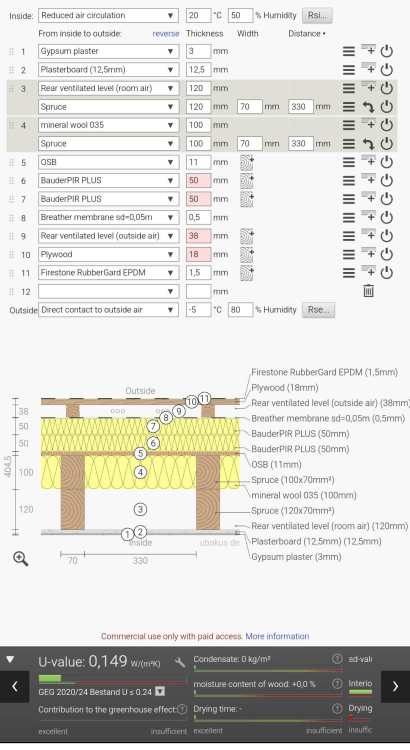
Sorry no sketch. My family dragged me off before I got my drawing finished. As ever durability, cost and buildability are top of my agenda. Couple of points to discuss with your designer. 1. The steel looks like a 305*102 UB of some description. I would try to get it swapped out for 2 x C24 300*75mm timbers or maybe a Gluelam. For a TF building they would be far easier to fix to and present less thermal bridging issues and be about half the steel price. 2. Those pozi joists look to be only about 180-200mm which really isn't the best application of them in my opinion. You are gaining little of the potential strength of them by having such a thin depth . If you were to replace them with 225*75 solid joists you'd save a ton of cash and be able to collect them from any builders merchant. They'd be simpler to trim and adjust on site for chippies too. 3. To get the desired slope I would just rip a 100x75 timber onto a wedge and hammer it on top of the gable walls and use them to slope all the joists. Accept a 2 degree fall in the ceiling inside too. It'll be imperceptible. No need to source tapered insulation or multiple fitting strips. Here's my proposal. 225*75 joists in lieu of posijoists. Cheaper and easier to source. 100mm mineral wool batts between joists. Easily sourced and cheap. 11mm OSB layer returned to internal airtighess layer at perimeter with strips of membrane. Joints all taped externally for ease of construction. 2 X 50 mm layers of PIR staggered taped.and foamed joints, to mitigate gas migration and board shrinkage. Breather membrane. 38 x 50 mm battens at 90 Deg to joists for ventilation/drainage plane to be continuous with wall ventilated cavity 18mm ply deck to support EDPM or GRP. Build the parapet on top of this layer of ply allowing the ventilation to go under it and down the wall cavity.
-
I might try to sketch something later if I have a chance
-
Yes. However a single skin layer for water proofing is more vulnerable to long term damage than a system which deals with 99% of the bulk water with a primary external layer, then a ventilated gap and then a secondary impervious layer that will allow any drips drain away by gravity. A cavity wall, a slated membraned roof would be examples. Relying on a single waterproofing layer such as an EDPM over a warm roof, rendered external insulation, or a bituminous flat roof is less robust long term. The waterproofing layer is assembled on site, generally relying an adhesive of some sort to cure correctly. Moreover the elements will be directly pummeling the only waterproofing layer increasing the lightly hook of leaks.
-
That'll be fine. Personally I would always prefer a ventilated gap above a drainage plane but what you've got will work.
-
Parapet. Flat roof! Can you design them out?! A cross section would be good of what's proposed.