Iceverge
-
Posts
4381 -
Joined
-
Last visited
-
Days Won
31
Everything posted by Iceverge
-
I'll bet my bottom dollar that it's 150mm PIR with a u value of 0.15. Its a very common detail and the 70mm screen just happens to add up to 220mm which is the height of a block. With 70mm screed over 120m you still have 16 tons of "storage heater" if you run UFH pipes through it. Every degree you raise the temperature of the slab by is about 4.4kWh of energy added. Say your heating load at is 2.2kw if you manage to heat up your slab by 5 degrees on cheap night rate electricity your it'll keep your house warm for 10 hours. Thats my grasp of it anyway. Read @TerryE blog for a better explanation. Although you have a lot of heat storage capacity in your walls don't over estimate the effect it'll have on day to day life in your house. If your sitting room is 17deg it will take an age for the 20deg stored in the centre of the concrete wall to release its energy to the room. Practically by the time it does something else will have already heated the room or you'll have given up and gone to bed. In reality its only the first few cm of a wall that absorb and release any heat on a daily basis. The slab is slightly different in that actively heating it you are taking into account this time delay. If done well you can gently (and cheaply) heat your slab well in advance and enjoy the slow release later. However it's not much good if you need heat NOW! We didn't install any heating ( in Cork). Mostly due to be pretending to be brave (read stubborn) and also being tight. There was something like €7k uplift for UFH and a heat pump and at our very small heating needs I couldn't make it break even anytime before 25 years if ever. We'll have to see how this goes this winter with our single electric rad in the hallway but in hindsight I would have copied @TerryE and @Dudda and just done UFH and Willis heater with the option of a ASHP later if a cheap one appeared. With regard DHW we have a direct 300l UVC. This performs well leaving aside the issues we had with the plumbers. I think I would get one with a spare ASHP coil and even larger capacity next time round.
- 20 replies
-
- 2
-

-

-
- sunamp
- dhw ( domestic hot water )
- (and 2 more)
-

New Member from Cork Ireland building ICF House
Iceverge replied to Blynchy's topic in Introduce Yourself
@Blynchy Welcome welcome. We're not too far from you being in the rebel county also. We've been in 6 months now. Passive house with strip foundations, wide cavity walls and trussed roof. Any plans you'd care to share? -
Downlight/spotlight on pitched roof with insulation
Iceverge replied to richie9648's topic in Lighting
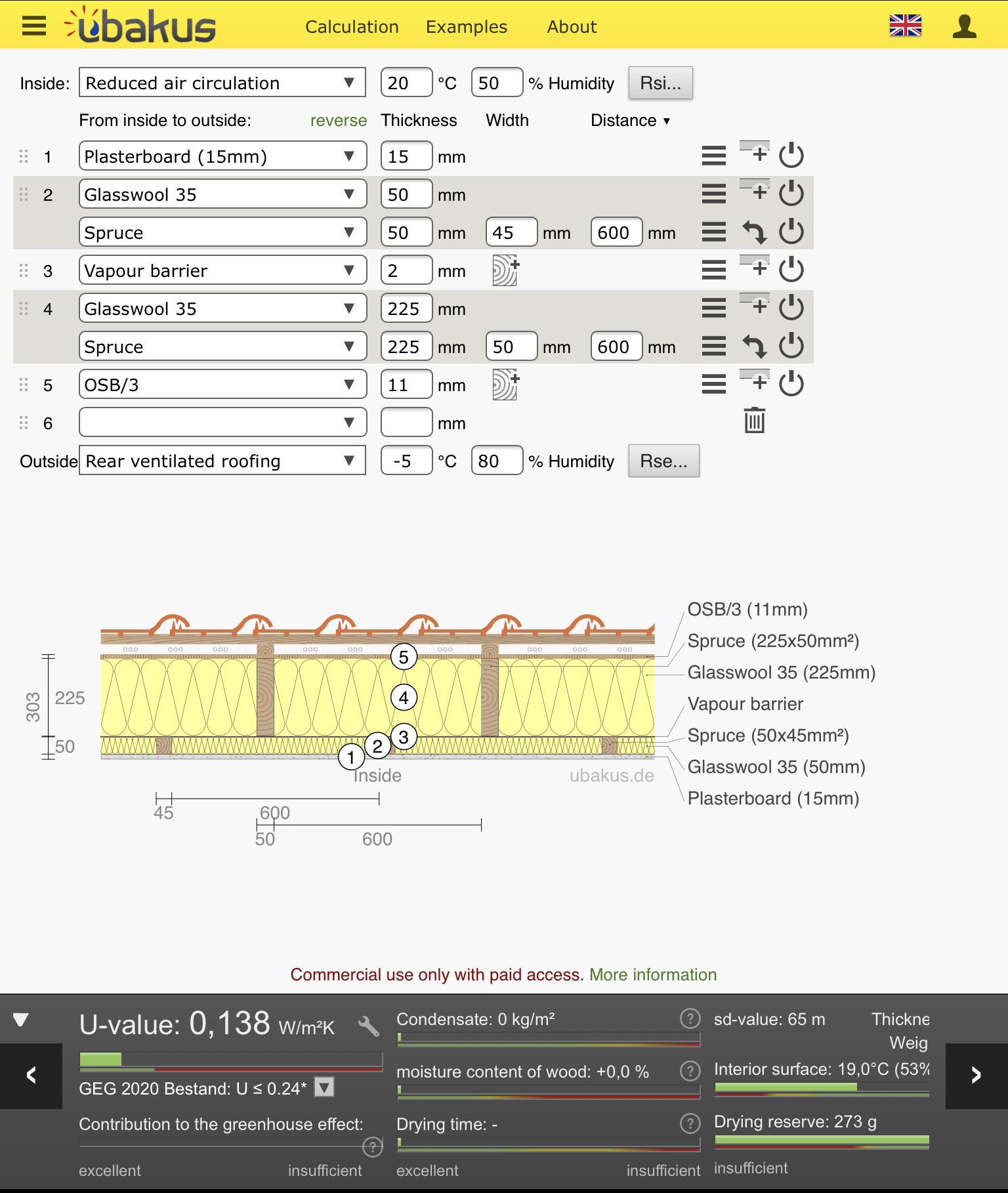
Any construction details for the new roof was what i was looking for. Something like this below. By the way this would be my preferred detail. Swap out the 325mm engineered joists for 220x45mm timbers and include a 45mm insulated service cavity. U value slightly better than 0.15. You'll have a very vapour safe roof if you do a good job sealing the vapour barrier and use a good breather membrane outside. You will need to batten and counterbatten to have 50mm ventilation over the membrane under the tiles. If you can't find cellulose or it's uneconomical for such a small project use mineral wool instead. -
What is your heating going to be powered from? MVHR is very good but needs to be installed correctly to not be annoying. If you're happy with the extra cost of the UFH drive on with it upstairs but its not needed in my opinion in a well insulated house.
-
Your measured energy usage is excellent. Even the most diligently put together computer programmes are full of assumptions so could be looked at as rough estimators. I remember you fitted a stove in your house which are unfortunately poor performers when it comes to airtightness. in this case 0.5ACH all by itself. https://www.greenbuildingstore.co.uk/cumberworth-radical-retrofit-airtightness-test-wood-burning-stove/ Did you have any leaks here during the test? Also your gains from lighting it are hard to measure. Once you reach an ACH of less than 2 the gains are small in any case. IMO is your SAP is good enough I'd just file and forget and enjoy your nice house.
-
Downlight/spotlight on pitched roof with insulation
Iceverge replied to richie9648's topic in Lighting
If you find them stick up a cross section and I'm sure the collective brains here will present the optimum solution! If not maybe you could put together a sketch yourself. -
Retrofit non-combustible insulation sleeve on flue?
Iceverge replied to MarcelHoldinga's topic in Stoves, Fires & Fireplaces
It sounds primarily like an airtightness issue. I assume it is an insulated twin wall flue. If so you can get an airtight grommet to join to your airtightness layer. -
Downlight/spotlight on pitched roof with insulation
Iceverge replied to richie9648's topic in Lighting
100mm of insulation won't meet regulations. Do you have any architects detail drawings of the roof structure you can share? I understand the pic isn't of your own roof. What stage of construction are you at? -
Downlight/spotlight on pitched roof with insulation
Iceverge replied to richie9648's topic in Lighting
Yes, Its seems to be totally forgotten by most builders and designers with everyone hell bent on achieving one u value or another. U-Values are long forgotten when the roof is full of fungus and the timbers are rotten. I was almost going to point it out but i think 3 of my last 4 replies are on similar topics so the tune is wearing thin. -
Downlight/spotlight on pitched roof with insulation
Iceverge replied to richie9648's topic in Lighting
5-6 inches sounds like someone who hasn't updated their understanding of the world in some while. 20mm slimline LED spotlights are readily available. -
How to convince BC that slab not needed on the hardcore?
Iceverge replied to Olf's topic in Floor Structures
I think this worry stems from not compacting the hardcore properly. Pouring a concrete sub slab reduces the risk of the floor sinking over time. Nothing serious happens just cracked tiles by doorways etc. If I could assure that the hardcore was to be laid in thin layers and diligently compacted I would happily skip the subfloor. Your BC and SE don't have the time to check these things so tend to go with the solution that is more tolerant of poor workmanship. As an alternative you could do a hardcore base (properly compacted), insulation, 100mm reinforced screed with mesh tied into perimeter walls. Tie the UFH pipes to the mesh before you pour. powerfloat to finish. By the way you don't really need any concrete in a floor if it's done properly. -
As the lately emigrated @Jeremy Harris found out thermal stores have their drawbacks. UVC is the cheapest to install however inspections do add up. For a given quantity of water you cannot extract the same energy as an UVC or traditional vented cylinder. As I understand this can be overcome by, 1. Using a heatbank type with a pump and an external heat exchanger. ( e.g Gledhill Torrent or Newark Cylinders Aquinox) 2. Having a very large tank with a DHW coil in tank (e.g akvatherm thermal store) 3. Running a normal store very hot (80-90 deg) Not sure if this is advisable however. However if your DHW requirements aren't huge I'd side with @PeterW on this and get the 300l TS.
- 5 replies
-
- 1
-
-
- thermal store
- uvc ( unvented hot water cylinder )
- (and 1 more)
-
Multiple layers of insulation to insulate flat roof?
Iceverge replied to Tim B's topic in Heat Insulation
What is your total roof build up. Primary consideration is not to rot the roof. You don't want to trap moisture in there with the PIR as it is impermeable. As far as i know PIR under the rafters is a common detail but the roof must be able to dry upwards and outwards. -
Full fill between the rafters membrane batten 25mm counter batten 25mm for 50mm ventilation above the rafters. tiles.
-
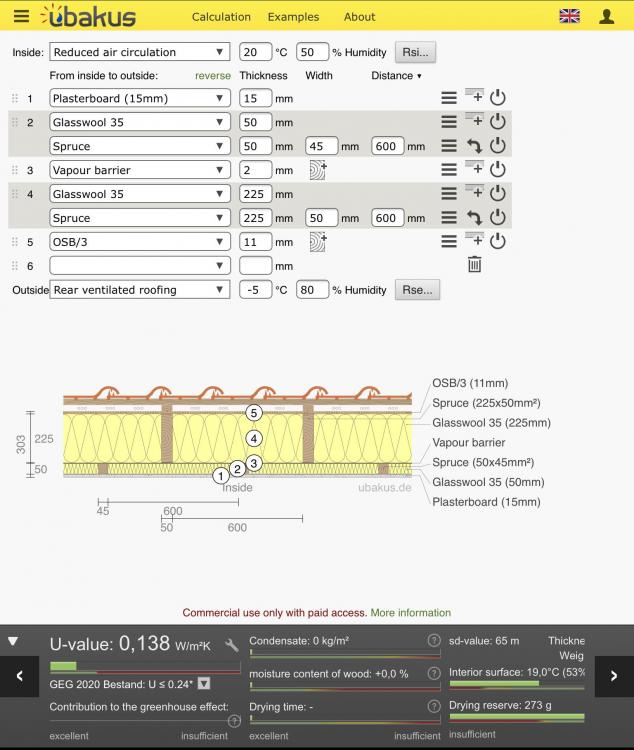
Get rid of the Pir. too expensive, messy and wastful. go back to 225mm rafters. Add a proper vapour barrier and a 50mm service cavity. glasswool is cheapest but i’d prefer blown cellulose. edit: i’ve forgotten the roofing membrane above the osb.
-
Your engineer/architect sounds like they’re still designing houses for the days of minimal insulation, no airtightness, uncontrolled ventilation, and oil boilers. If you’re off gas you’re pretty much tied into an air to water heat pump in Ireland. The argument about response times is a bit mute as they work best at low temperatures and longer run times unlike the old oil boiler in a drafty house which needed hard firing whenever the occupants were home and shutting off afterwards to spare energy. Our hollow core (ducon) had a 75mm 35N concrete screed with concrete mesh. This was a structural requirement. In your case get rid of the UFH pipes and insulation and wait until as late as possible in the build ( after interior plastering) and pour a pumped screed as thin as the supplier will stand over. This will leave you an immaculately level floor that won’t be covered in lumps of plaster etc. Spend your time now filling the ends of the hollow core slab if it’s not wrapped already for airtighness. By the way we’re not a million miles from the west coast and have no central heating, just a single electric rad in the hall.
-
Tile 25mm batten 25mm counterbatten fixed with long screws through to rafters roofing membrane. pir tightly fitted and ideally taped at all joints. osb rafters with mineral wool batts between. plasterboard. You need to avoid allowing interior air coming contacting a cold surface that is also impermeable. in your case you have insulation outboard of your osb keeping it warm so you’re ok provided you don’t put too much insulation inboard of it between the rafters. what is your target u value and what is the thickness of your rafters?
-
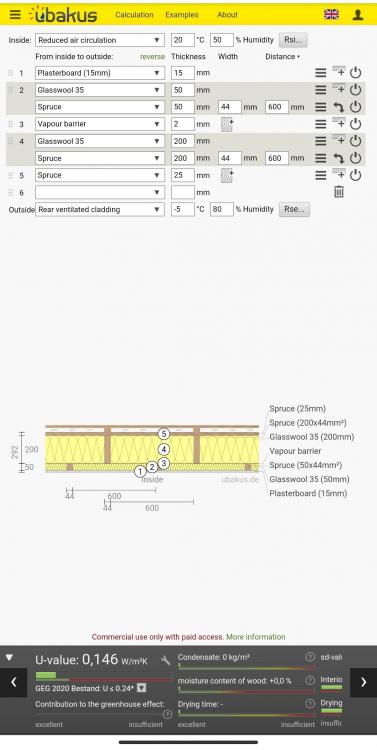
Vapour membrane is vital for airtightness and to prevent condensation on your rafters causing the rafters to rot. PIR in the roof is a bad plan for loads of reasons. Torturous to install. Expensive. Bad decrement delay leading to overheating. Shrinkage of timbers and PIR causes drafts around the insulation making it underperform severely. I have attached probably one of the cheapest options. No PIR. Better still if you can replace the glasswool between reg joists with blown densepack cellulose. Supplier installed. Excellent for decrement delay, airtightness, toxicity, environmental credentials the list goes on.
-
We put our sockets at 750mm to avoid bending over too much in old age. Also they are above the height of bedside lockers which is handy. Quite accidentally, as most are situated by windows, they are out of sight behind curtains too. I found 1200mm light switches strange coming from an old house. I sneaked them up to 1250mm when i chased the walls to satisfy my gut. Complete waste of time. As @ProDave says the nearer they are to the door handle the better.
-
It sounds easier to just pay for the boiler
-
our tony tray was destroyed by the wind too. rectified with sand and cement for the larger gaps followed by airtight expanding foam and then airtight paint, it was slow but achieved a very ACH good result. If you could get someone to spray apply blower proof paint it would be quite quick.
-
I agree with this for OP and @trialuser. AIrtight foam for the gaps and airtight paint over the top around the joists. what U value are you targeting @ash_scotland88. How deep are your rafters?
-
Roof and inlets/outlets
Iceverge replied to eandg's topic in Mechanical Ventilation with Heat Recovery (MVHR)
No to the cavity from me. You're likely to get off gassing from the roofing materials on sunny days not to mention the ventilated space will get very hot in the sun. On a still summers day even with roof terminal unless you allow a significant inlet height you’re lightly to get elevated intake temperatures. Are wall terminals an option? -
MEV or MVHR
Iceverge replied to 70sbrick's topic in Mechanical Ventilation with Heat Recovery (MVHR)
I installed a Domus MEV unit in my parents house from BPC. It has reduced the humidity but we'll have to wait until the winter to see what the true benefit is as the weather has been quiet dry since. I wasn't overly impressed with the unit. The fans were noisier than I expected and the ducting was difficult to fit well. From your situation it is indeed difficult to see huge benefit from MVHR. I would be careful with the spec of ducting supplied with MEV however as often it can be the floppy stuff that may end up being noisy. If retrofitting MVHR supply ducting is too difficult you could always just install a MVHR unit as an extract only and dump all the fresh air into a single hallway or similar. You'd get most of the benefit of the recovered heat with less if the hassle and expense. -
Yup if you get it specced properly. You might need a structural screed. Storage underneath might be damp and difficult to access .