Jeremy Harris
-
Posts
26430 -
Joined
-
Last visited
-
Days Won
360
Everything posted by Jeremy Harris
-
Worth bearing in mind that there are pretty much always faecal bacteria in shower waste water, at least for those in the UK that rely on toilet paper for smearing the stuff around their backside. For those that use a bidet or shattaf this may be less of a problem. Not sure I'd like the idea of having diluted shit sprayed on my face, TBH...
-
Yes, they are giving advice that conflicts with BS7671, so they need to change it. Their argument may be that Icynene foam doesn't react with PVC cable, which I'd guess it doesn't, and they've made the error of then assuming that nothing else needs to be considered as far as wiring is concerned. Not sure I like the idea of embedding wiring directly in foam. If there's no service void then I think I'd look to see if conduit or trunking could be used, if only to avoid the need to rip large areas of foam out if any changes are needed in future.
-

Worst DIY product of the year
Jeremy Harris replied to H F's topic in General Self Build & DIY Discussion
The sealing strip sticks well if the surface is prepared properly. As above, wipe with IPA, dry off thoroughly (IPA cools the surface and may leave condensation behind) ideally warm up the surface, then apply the strip and push hard on it to ensure a good bond. Any trace of dirt, dust, oils from paints etc will stop stuff from sticking, so degreasing and cleaning well is essential when using any adhesive product, and especially so with self-adhesive stuff. A useful check it to try a bit of masking tape on a surface first. If that sticks the surface is clean enough, if it doesn't, then it isn't. -
Ooops! That's a bit of a bugger. Makes me glad I decided to stick ours fairly high up in a fence. Had our very good landscaping chap back around yesterday (who happens to have just started a Class Q self-build), as we want to put in a pond and some more raised beds. When I looked out our bedroom window this morning it looked like we already had a pond pretty much exactly where we are getting one put in...
-
Neighbour has objected to our plans
Jeremy Harris replied to Robert Clark's topic in Planning Permission
Good news. In the grand scheme of things the PC don't usually have much clout, unless there is an agreed Neighbourhood Plan in place (and even then that doesn't carry as much weight as the government intended when they introduced them), but if the PC have the friendly ear of the local County, or Unitary Authority, Councillor then they can request that the application be called in, which then means going to the planning committee, rather than being decided under delegated authority by the planning officer. Planning committees can be a bit of a crap shoot, in my experience, as inevitably personal views held by Councillors come into play (even though they shouldn't, really). The consultees that often seem to have a fair bit of clout are ones like highways, conservation and sometimes the fire officer, or even the Environment Agency. In our case most of the issues we spent a lot of time on were raised by the Environment Agency (flood risk), the Conservation Officer (pretty much anything and everything she could think of), highways (easy, just concerns over visibility really) and the fire officer (made recommendations for sprinklers but they weren't mandatory and so didn't get included as a condition). Worth reading these sort of consultee responses carefully as they are published, because it seems that they often end up as conditions, and some can cause later problems. For example, the EA mandated levels above Ordnance Datum for our finished floor level, parking area element of the drive and garage floor. Highways mandated a maximum gradient for two sections of the drive. It turned out that these two conditions were mutually exclusive - to get the gradients stipulated by highways the levels needed to be lower than those stipulated by the EA. We resolved it fater getting consent (because I didn't spot the problem earlier), but with hindsight it would have been easier to have resolved this conflict with the EA and highways. We may even have got the EA to allow us to make the levels a bit lower than the current 1.5m above the 1 in 100 year flood risk level, which would have made a useful difference to the usable area of the plot. -
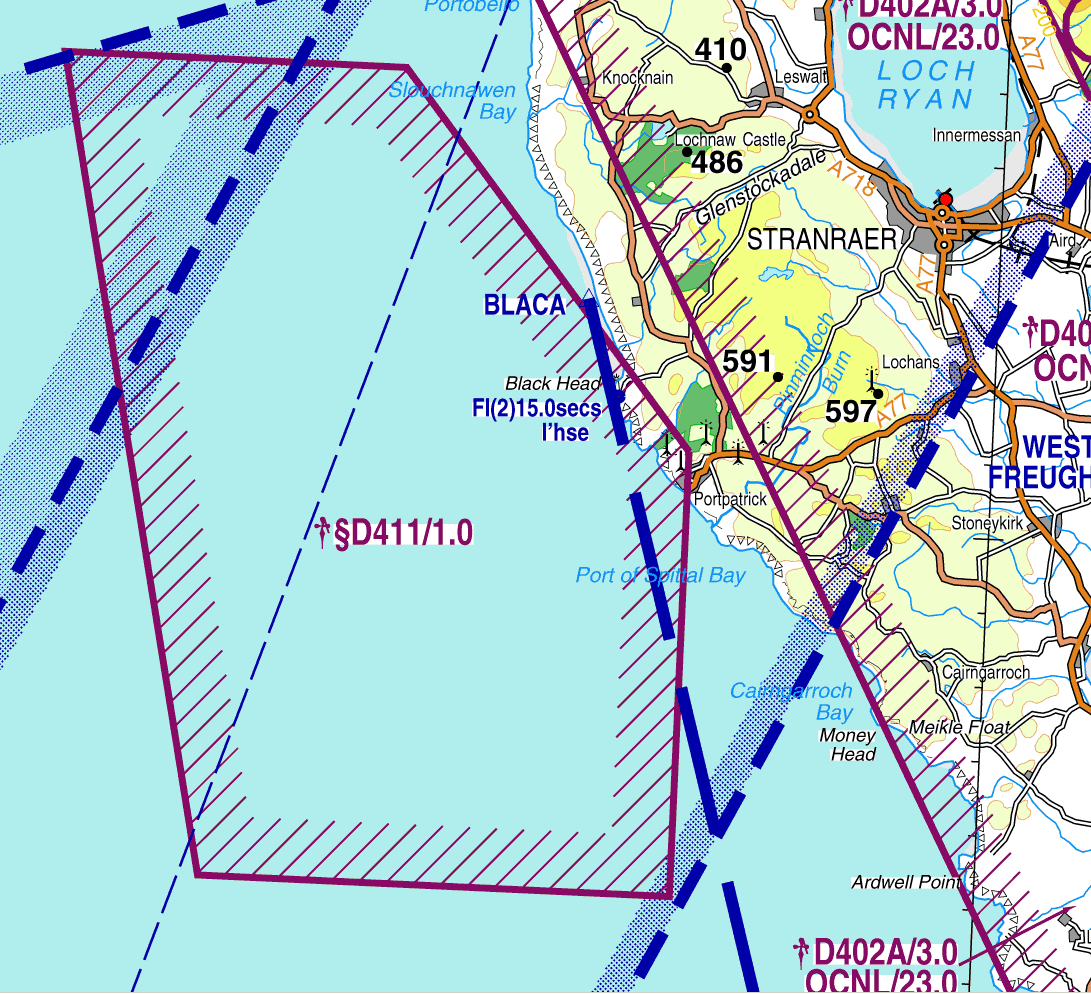
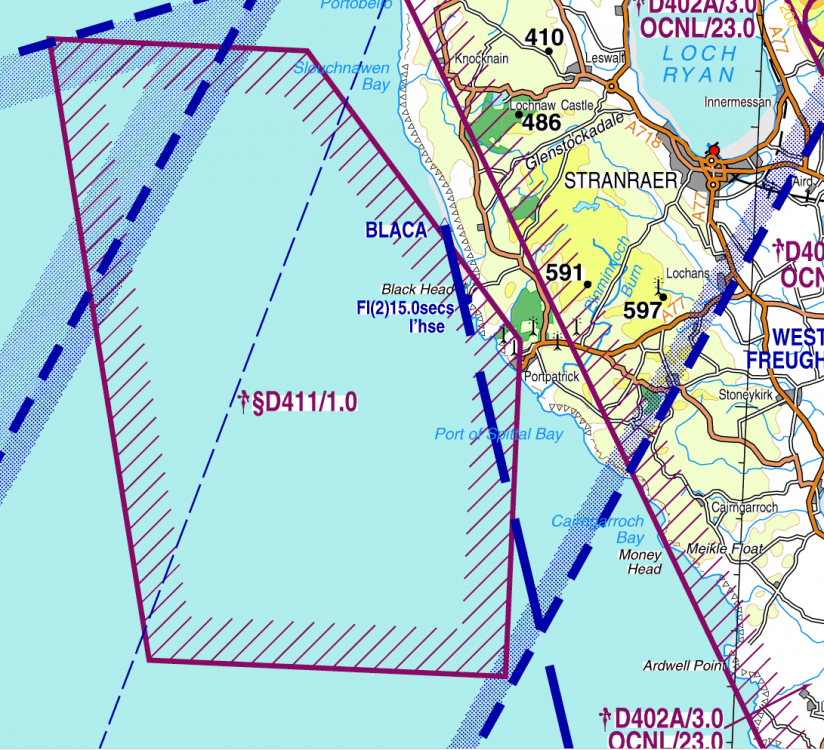
No, not related to maritime surveillance, it was an OP for Portpatrick Range, an air/sea weapons range that extended out over the Beaufort Dyke. Most stuff done there was underwater, as the water a few miles offshore goes down to about 1100ft, making it an ideal place to test stuff that needs to work in deep water. Some old charts may still have the Danger Area marked, D411:
-
Pantry keeping it cool with mains water pipe underfloor
Jeremy Harris replied to passivhybrid's topic in Underfloor Heating
Either a slab of marble or, in the house I grew up in, a concrete shelf in the larder covered with white tiles (the whole inside of the larder was done in white tiles). There was an external vent grill down near floor level and another near the ceiling, to allow air to circulate. The kitchen (and larder) were on the North side of the house (had been part of the servant's quarters at our old house, complete with separate staircase and indicator bell system in the kitchen). The operating principle was to ensure that the larder had a high heat capacity (hence the "cold" shelf) and to prevent it getting any solar gain at all. That way it would end up at around the mean daily temperature, cooling slightly during the night and warming slightly during the day, with the high heat capacity of the shelf and tiles helping to maintain an even temperature. However, a look at the mean daily temperature data shows that a passive larder like this would never have stayed very cool in summer. This is the mean daily temperature for our area (data from the Met Office), for example: This shows that for about 5 months of the year a simple vented larder would be above 10°C, and for a couple of months it would be above 15°C, assuming that it was perfectly insulated from the inside of the house. In practice the inside of the house will always leak some heat into the larder, so it will be slightly warmer than these mean daily temperature data would suggest, plus it would be a source of heat loss from the house. The myth that larders were always cool places really goes back to the days before we had refrigerators, where a ventilated space like this would always be cooler than the house, so better for keeping perishables in. The reality is that they weren't ever very effective, and anyone that really wanted to keep food fresh (and had the money to do so) would have an ice house, usually built underground, or in a basement. A larder built into a basement, and insulated well from the thermal envelope of the house would stay at the typical UK ground temperature, which is about 8°C. Not as cool as a fridge (they are typically around 3°C to 4°C) but fine for storing fruit and veg, cheese and possibly wine.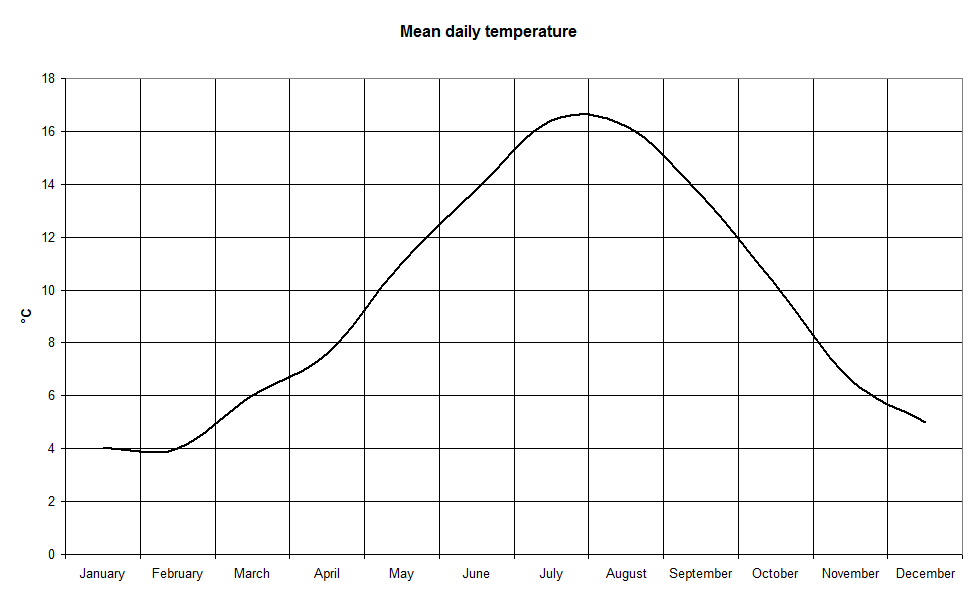
-
Usually the other way around. Grease filters are usually the washable mesh ones, the charcoal ones are downstream of that to adsorb odours. The grease filters can sometimes just be washed in hot water, or put in the dishwasher, to clean them. Charcoal filters have to either be replaced or can sometimes be re-activated by subjecting them to dry heat (which drives out the stuff they've adsorbed, so needs to be done outside). Washing a charcoal filter in very hot water might partially reactivated it, but they really need dry baking at quite a high temperature in order to open up all the pores in the charcoal and drive out everything they have trapped. At our old house, I adapted the charcoal filter in the hood so that I could just refill it with activated charcoal granules. These can be purchased relatively cheaply for use in pond filters, and it wasn't hard to adapt our filter so that a layer of these could be spread on to the mesh and sandwiched in place with the outer mesh. As far as I could tell this modified filter worked at least as well as the original one, and cost a fraction of the price to replace/refill. I didn't bother trying to re-activate the charcoal, as the stuff was so cheap it wasn't really worth the bother. If anyone wants some I still have a few sealed bags of it here, left over. We don't have an extractor in the new house (doesn't seem to be a need for one) so I'm never likely to use the charcoal granules for anything.
-
FWIW, BC here wanted me to provide the certificate from EH that the water had been tested and met the required standard for drinking water. It was one of the few bits of paper they actually took any interest in. We don't have open storage, but pump the water from the borehole. through an oxidisation system (to precipitate "clear" ferrous iron as ferric oxide), to a pair of 300 litre pressure vessels, then a back washable sand filter, to the house potable supply, where we have a UV disinfection unit as a backstop way of being fairly confident there are no bugs in the water.
-
On a private supply, water doesn't become potable until it has been treated, so water held as raw water in a vented tank is still raw water, much the same as that in a reservoir. As such, there aren't any particular requirements that apply, other than common sense ones, like keeping animals and insects out as far as possible.
-
No issue with compliance with anything, as by definition any vented tank on a water system cannot contain potable water, so any possible issue with contamination from a gap not being sufficient, or from a backflow risk, will be dealt with by the downstream filtering and disinfection system that will be required.
-
Pantry keeping it cool with mains water pipe underfloor
Jeremy Harris replied to passivhybrid's topic in Underfloor Heating
I think this has been discussed here before, but I can't find the thread. Any pantry built like this needs a well insulated door, and all walls that face into the thermal envelope, ceiling, floor, etc need to be well-insulated and sealed. If including vents to outside then the pantry door also needs to be airtight, so the easiest solution might be to just use a decent external door as the pantry door, as that will have the required seals and be reasonably good thermally. Another approach might be to just build the house with a "notch" in the external thermal envelope, that runs around where the pantry will go, with an uninsulated external wall over the notch. Whatever approach is used, it's worth remembering that the outside temperature will often be well above the temperature needed for a pantry for a fair part of the year, so the pantry may well end up warmer than the rest of the house at times. If I were going to do this, then I think I'd forget trying to put vents to outside, forget trying to use a thin wall to outside, and just build a well-insulated cupboard wherever I needed it to be, and fit it with a decent door, with an airtight sealing system (probably a suitably redecorated external door). I'd then just fit a small air-to-air heat pump in it, to keep it at a constant temperature. Doesn't need to be anything big, the sort of cooler units fitted to small delivery vans would be about the right size, might even be a bit too powerful. Failing that, a small monoblock ASHP, supplying chilled water to a cold shelf in the cupboard would probably do the job. Still cheaper and easier to just buy a larder fridge though... -
Pantry keeping it cool with mains water pipe underfloor
Jeremy Harris replied to passivhybrid's topic in Underfloor Heating
Easy to work out. Incoming mains water will be at around ground temperature, so ~8 deg C. Just calculate the heat input to the pantry using the pantry surface U values, then work out how much mains water will flow through the pipe for a typical day (roughly 150 litres per person per day) , then use the heat capacity of water to see just how much heat the cold water will extract from the pantry. I don't have time to do the sums now, but if I had to guess, I'd say that the cooling effect would be about the square root of bugger all... -
Funny old thing, but the master time display in the hall, along with stuff like the outside air temperature, humidity, CO2 concentration etc is, in effect, an atomic clock. I have a GPS receiver sat up in the services room that is used solely to provide an accurate time reference for the house data measurement and logging system. The clocks that provide this signal from the GPS satellites are Rubidium or Caesium atomic clocks, so in effect we are working to an atomic time standard for some stuff, but I cant get the clock on the cooker to sync to this...
-
They will still need a fair bit of water to wash tools, boots, hands etc, probably more than would go into the mixes. I was surprised at just how much water was used for washing stuff, but I saved a fair bit by having two old plastic dustbins, with lids. These were used for washing stuff, with one bin being the "dirty" one for initial washing, the other the "clean" bin for rinsing stuff. This worked well, as the worst of the muck tended to settle in the bottom of the bins overnight, which saved having to replace the water in them too often.
-
I gave up on trying to control slab temperature, and just switched to a couple of ordinary room thermostats. They work very well, although I needed to set them to use their smallest hysteresis, easy enough as they have a switch on the back to do this.
-
I don't think zoning really works very well with UFH in a house that's near passive house performance, TBH. It changes temperature so slowly that I doubt that any UFH could effectively maintain one heated room at a different temperature to another. Not sure what you mean by expansion tape. Where would it go? I fitted a temperature probe in a part of our slab that's fairly well clear of UFH pipes. It slightly under-reads the floor temperature, perhaps by about 0.2°C or so. Not sure why. It was useful to satisfy my curiosity as to how things behaved, but I don't think I've looked at the slab temperature more than once or twice in the past couple of years, as it tends to be pretty stable.
-
The programmer I used is just a standard single channel Drayton LP111, the thermostats are Computherm Q7RF wireless units (there are two, one controls heating, one controls cooling). The programmer doesn't select heating or cooling, the thermostats do that. The programmer just sets when the system is on or off. This also gives an easy way to just turn the thing off when on holiday. Our house is a passive house, with a very long thermal time constant, so room zoning would have been pretty pointless, as it takes well over a day to drop by 1°C, and trying to change individual room temperatures on the fly just wouldn't work. We have no heating upstairs, just towel rails in the bathrooms that come on for a couple of hours, morning and evening, and that ensures that the bedrooms stay slightly cooler than the living rooms.
-
If the programmer is off, then the pump turns off, and the thermostats cannot fire up the ASHP either. The programmer is just a standard central heating one, with the heating channel turning the power to the circulating pump on and also providing the power for the thermostats, so with it programmed off the heating/cooling is off, with it programmed on, the circulating pump runs, and if a thermostat calls for heating, or calls for cooling, the ASHP will fire up from the thermostat call.
-
The pump turns on and off from the programmer, so whenever heating/cooling is scheduled to be on, the pump runs. The ASHP fires up in either heating or cooling mode when both the programmer is on and one of the thermostats is calling (there's one thermostat for heating, another for cooling, set with different thresholds).
-
I wonder why they decided not to make the racks fold down on the model we have? Seems a retrograde step, perhaps induced by some penny-pincher who found that they could save a bit on the production cost if they removed the folding bits. I wish we'd noticed this before buying the thing, although as we bought it online, the chances are we'd not have spotted that these racks don't fold down.
-
+1 to the above. We've found that one advantage of being able to pump water around the UFH with the heating/cooling off, just using the manifold pump, is that tends to even out the floor temperature. In summer this can help to redistribute heat around, so that parts of the floor than may get hot from the sun shining in get cooled a bit as that heat is shifted around to the rest of the house. It can make a significant difference at times, because just reducing the temperature of a patch of floor by a few degrees can significantly reduce the heating effect this has on a hot day.
-
Thanks, I'll have a look around and see if there are spares available that are about the right size. Might be easier to adapt a rack that's more or less the right size than start from scratch and make new racks. I could probably get away with just replacing the lower rack, I think, as that's the one that is a rather daft design. SWMBO has just reminded me that the reason we didn't have this problem with the old stand-alone dishwasher was because the sticky-up bits in that, for supporting plates, used to fold down flat in sections. I've no idea why they didn't do the same with the built-n version of what is a very similar dishwasher. Makes me wonder whether the lower rack from the stand-alone model would fit the built-in one. Might have a wander around Curry's or somewhere, armed with a tape measure to find out.
-
When to start the mortgage application process?
Jeremy Harris replied to SuperJohnG's topic in Self Build Mortgages
One word of caution, that may be just bad luck on our part, or may be something that can still happen. I arranged a mortgage with Santander to cover the balance we needed to complete our self build. The mortgage was on our existing house, which was mortgage-free, and was only modest (around 40% of the value of the house at that time). I did this in plenty of time (around February/March, when we thought the build proper would start around September). All went well, I paid the fees, the mortgage was agreed, and all the paperwork signed, mortgage deed drawn up, etc. Because we didn't need the money until the second stage payment for the house frame, I told Santander that I wouldn't be drawing down on the mortgage for a while, and they were fine with that. Skip forward to October, and we needed to draw down on the mortgage to pay the second stage payment . I went into the local branch to request this drawdown and was told that the bank policy had changed, and that the mortgage had been cancelled, leaving us with no way to pay the stage payment... I did battle with Santander for ages to try and sort this out after the event, but so far they've not even apologised, let alone refunded the hundreds of pounds we paid for the valuation, mortgage deed, arrangement fee etc. Needless to say we no longer bank with them, and wouldn't touch them with a bargepole. We ended up getting another mortgage arranged in a hurry, and paid through the nose for it, as we had little choice, but I deeply regret not just drawing down on the mortgage as soon as it was approved and sticking the money in a savings account, even if that did mean paying a few months extra interest on the mortgage when we didn't really need to. Caused a heck of a lot of stress at the time, something we could have done without at that stage in the build. -
Love the look of that one, seems a very practical design. It neatly gets around the nuisance of the hinge down door with the lower rack that slides over it (and which inevitably seems to end up with drips running down the edges).